Category: Church Leadership

  • What the Fall of Jim Tressel Has to do with Pastors

    Jim Tressel went from hero to zero in 12 months.

    Winning had bought Tressel respect in the state of Ohio. First at Youngstown State and then on the national stage at Ohio State.

    As the success increased so did Tresell’s insulation from everyday scrutiny. In the eyes of fans and the administration he could do no wrong. Certainly there were warning signs everywhere. Most notably was Maurice Clarett. As a freshmen, Clarett help the Buckeyes win the 2002 National Championship. But was soon overcome by scandal, eventually being dismissed from the university. There would be others. But none were as vocal or with the national voice that Clarett garnered.

    All the while Tressel’s name stayed out of the spotlight. Clarett was a bad kid from the wrong part of town while Tressel was the misunderstood golden child. This would be the response to every allegation to come. Tressel was unaware of the problem and offenders were dishonest, bad kids.

    Off and on Ohio State players were punished for infractions of NCAA rules. But Columbus is a one-horse town and no journalist dared to take on what everyone was seeing– lots and lots of NCAA infractions. With all of the success in the football program there was lots and lots of money flowing. No one inside of Columbus was going to blow the whistle and risk their livelihood. Everyone claimed Tressel knew nothing.

    The wheels began to fall off nationally during the 2010 season as allegations surfaced that some players had sold or traded some memorabilia in exchange for tattoos. Suddenly, the spotlight was on the program to discover what was really going on. 5 players were suspended for 5 games in the 2011 season by Tressel. This was quickly followed up by a self-imposed 5 game suspension that Tressel took. The spin was that he chose to do it this way so that the players would see that he was the kind of leader who took it on the chin when he got in trouble.

    Fans of Ohio State bought it. (And even revered him more for his valiant leadership.) But the national media and non-OSU fans smelled the rotting corpse of a cover-up in the trunk of Tressel’s trophy room.

    It all crashed down a few weeks ago as Tressel stepped down when tipped off that Sports Illustrated was about to publish their investigation which revealed systemic violations over and 8 year period. The article documents that Tressel wasn’t ignorant of all of the violations. Instead, he was often involved in the cover-up, and in some instances actually orchestrated inappropriate benefits for players and their families.

    Even in his resignation Tressel maintain his arrogant posture. He pretended to fall on his sword and say his resignation was not an admission of guilt but to protect the reputation of the university he loved.

    It won’t work. While Ohio State fans are living in denial. The NCAA will act and the punishments will be severe. There’s a good chance that the NCAA may actually shut the program down for 1-2 years as a result of the systemic problems. In all likelihood, since he’ll have to serve suspensions earned while at OSU at any future NCAA job, Tressel is out of college football for life.

    It is a sad ending to anyone’s career. But was also entirely of his own doing.

    Preventing Tresselgate as a Church Leader

    We live in a time where church leaders are put on pedestals similar to that of Jim Tressel. (At least in Evangelical circles) People identify with their pastor so strongly that it’s not uncommon to associate the name of the church with the name of the pastor. People go to Rick Warren’s church, Bill Hybel’s church, Andy Stanley’s church, Rob Bell’s church, Joel Osteen’s church, Mark Driscoll’s church, John Piper’s church, etc. It’s completely ridiculous that we do that, but we do.

    A dangerous double-edged sword. On the one hand the church benefits from the notoriety of their pastor. On the other the notoriety of the pastor is the largest threat the organization faces to its present reality and future success of large organizations. The net result is that the pastor lives in a protected bubble. That doesn’t mean he can do no wrong. It just means that if he does wrong everyone in his life is going to do whatever they can to keep that from the public since his failure impacts their financial security.

    Practically speaking, how do we prevent Tresselgate?

    1. Leadership Transparency- I’m all about elder rule in a church. And I’m all about staff teams largely governing their day-to-day operations. But elder meetings should not meet behind closed doors with no ability for anyone in the church to intimately know what’s going on, ask questions when appropriate, and foster a sense of transparency. Likewise, the elders should be congregationally selected and scrutinized as overseers of the congregation and the staff. (The staff can’t pick elders– That’s illogical for their role as overseers.) And their meetings should be open to the general public. Just like municipal boards they should have open and closed sessions. But reserve closed sessions exclusively for personnel and legal matters.
    2. Whistle blowers protected- In most secular work environments there is some level of protection for staff who blow the whistle on inappropriate behavior. The #1 reason this got so big at Ohio State was that no one in the athletic department blew the whistle on Tressel’s years of stuff going on. (The SI article documents this well.) There is no protection for church staff. If little things get dealt with without fear of reprisal they don’t escalate to big things later. A little bit of money miss-spent, a little bit of power abused… that’s just life and can be dealt with. But not dealing with it creates a snowball effect that will one day destroy the entire mission.
    3. Time off from the platform- Early in my leadership development a mentor taught me that leadership prowess wasn’t determined by what happened when I was there. She measured my performance as a leader by what happened with my team when I wasn’t there. We need to create that environment in the church today. It’s great to have figurehead leaders who are amazing communicators. But if those people are truly leaders of a movement of God, they will be measured by their ability to put others in their place. Andy Stanley had a nice-sounding sermon a few years ago built on the premise, “What do you do when you are the most powerful person in the room?” The answer to that question is to be like Jesus and disperse the power to your disciples… and then step away. The power of Jesus’ church isn’t central leadership. It’s that it’s empowered every person to be a priest with direct access to the Father! We need to affirm the priesthood of all believers and get our leaders off the platform.
    4. Don’t believe the hype about yourself- I don’t believe any church leader wants to be on a pedestal. Any “powerful” church leader I’ve ever met is wholly uncomfortable with the reverence they receive. It seems to me that gross failures happen when the person starts to believe the hype about themselves. Fundamental to the problem is that many of these people are the most successful people they know. God blessed them and it just happened. If you find yourself on a pedestal do whatever it takes to find some friends where you are an absolute nobody. It’ll do your soul good.
    5. Cheaters never prosper- Eventually, whatever it is that you are hiding will be public. Plausible deniability never works for long. The best thing you can do is to operate a clean program… even if that means you win less.

    What are other ways you think church leaders can prevent Tresselgate from destroying their ministry?

  • Jesus is the worst sales pitch ever

    I'm sure this is a real page turner…

    Have  you ever sat in on a timeshare presentation? You’re on vacation, spending $100 every time you get out of the car with your family, and a very nice front desk person tells you… “Mr. McLane, if you’d be willing to sit down and talk with us about our vacation packages, we’ll give you $100 in cash and free tickets to a show. It’ll only be about an hour.

    It seems like it will be worth it until you actually do it. For an hour they berate you with every sales tactic in the book. They show you the property. They say, “Imagine coming here for two weeks every year, wouldn’t that be great?” Or “You can trade your weeks for points and go anywhere in the world! And it’ll already be paid for.” Or my favorite, “Mr. McLane, you work hard. Doesn’t your family deserve a vacation like this every year?

    It’s moment of insincerity, remembering your kids names, relating stories of other pastors who have joined, on and on. The more they talk the more you want to punch them in the face. It’s hard to say $100 for an hour of your time isn’t worth it. But it’s not worth it.

    No offense to those who have bought timeshares. But you go into the presentation either knowing you want to buy one or you don’t.

    In which case, since I’m already wanting to buy in the pitch is useless. And for the person who already knows they don’t want to buy the salesperson is just going through the motions and so are you… you just want to be nice enough to get the $100. (And those who get talked into it are more preyed upon than sold on it, right?)

    It’s all just a game, isn’t it? I know I’m not going to cave and buy a $30,000 timeshare because I don’t want one. And before I arrived at the presentation my wife and I already told ourselves that no matter what, we’re going to be polite, but we’re just taking our $100 and going to the beach later.

    We are not buying a timeshare in Ft. Lauderdale.

    Selling Jesus

    Photo by David Prasad via Flickr (Creative Commons)

    This is, at it’s core, the problem with the “If you build it, they will come” strategy so popular in Christianity.

    The sales manager (aka the pastor) polishes up his sales pitch and tells his sales team (congregation) that if they can bring the prospects, (non-church goers) he will close the deal. (I mean, get them to give their lives to Jesus.)

    When pastors tell their congregation to do this, there is always a sly little smile, as if to say… “They’ll never know that what we’re about to do is tell them about Jesus.”  Yeah– as if visitors are surprised that your marriage seminar is really a Gospel presentation? Doubt it.

    The problem is that the psychology doesn’t work.

    Put yourself in the car of a non-church goer about to visit your church with you. You are either interested or you aren’t before you even get there, right? If you aren’t interested in church you are thinking, “No matter what, just be polite, drink the coffee, and peace out ASAP. I’m doing this for my friend.

    No amount of manipulation or sales pitch methods will get that person to change their mind. Why? They are locked in as uninterested. And one could argue that those who get talked into it are more preyed upon than sold on it, right?

    The problem is that the theology doesn’t work.

    Jesus isn’t a deal.

    • Regeneration of the soul happens only when the Holy Spirit calls a person to Himself, right? (Westminster Confession of Faith, Chapter X) A sales pitch can be used by the Holy Spirit. But, as I heard over and over again in Haiti, an earthquake can be just as effective a call.
    • A life with Jesus is messier than a tight 35 minutes with 5 points, isn’t it? While a presentation of the Gospel is excellent at piecing things together in someone’s mind, coming to faith in Christ is more an unwinding of life’s ball of yarn than winding it up into a ball.
    • Jesus promises that a life lived in relationship with Him will be more difficult than a life without Him in your life. (Romans 12:1; John 15:18) That is a pretty tough thing to “sell” from a platform. Come and be like Jesus, who died on a cross penniless and almost no friends!
    • In a world that lives for today, an assurance of heaven, pearly gates, and a mansion tomorrow is a program they don’t want. That doesn’t make salvation any less important. You just can’t stand in front of people and say, “If you were to die tonight… would it be heaven or would it be hell?” Culturally, that’s just not what people are thinking about!
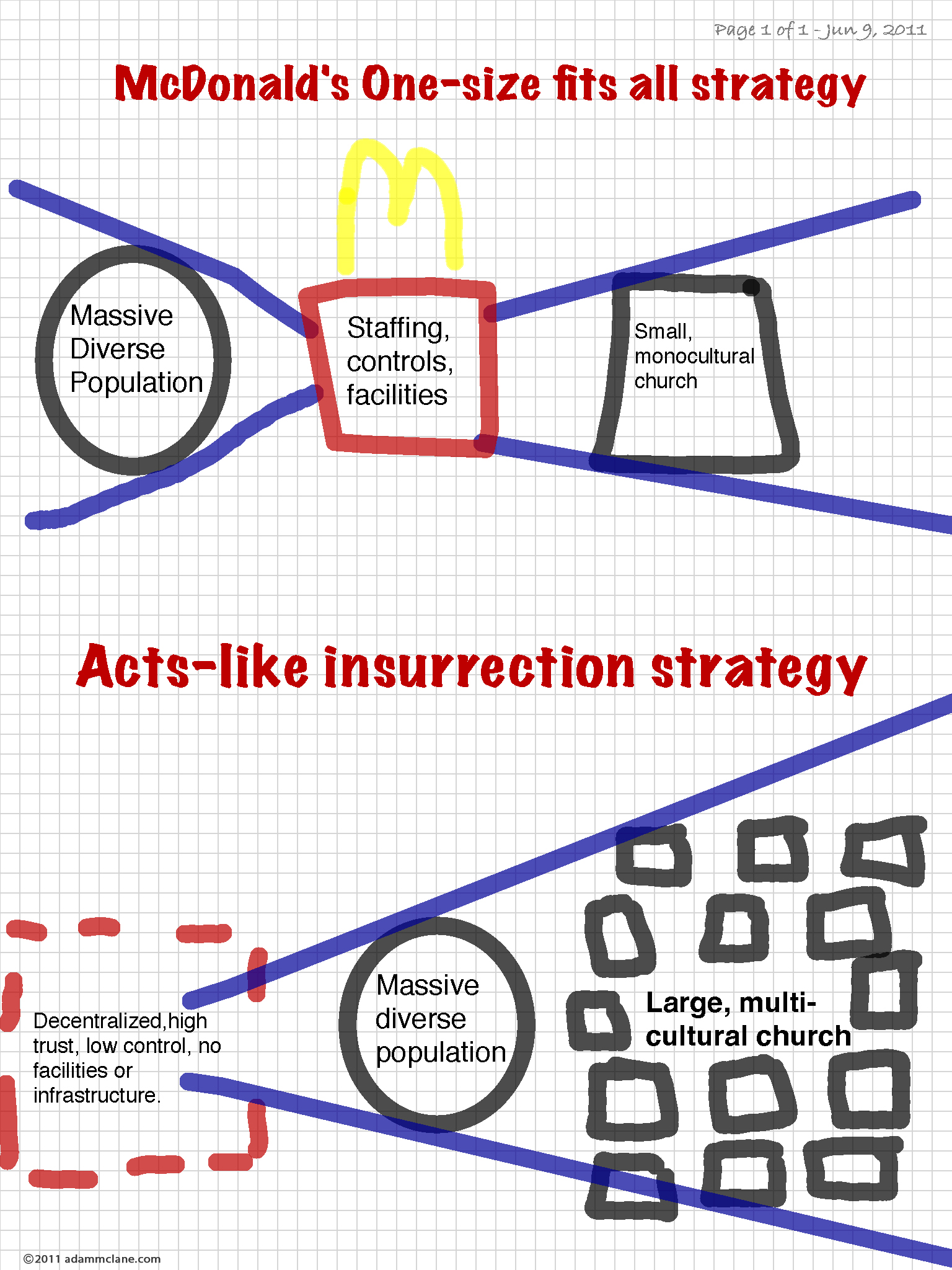
  • The problem with one-size fits all is…

    The problem with one-size fits all is… One-size doesn’t fit all.

    We are faced with a tiny percentage of the population actively involved in the local church. (>10%) Yet, I’m continually perplexed to see no one looking hard at the big, obvious problems of bottlenecks & gatekeepers which keep churches small with a strategy that lost its effectiveness 25 years ago.

    Most churches have the same exact strategy. It’s the manifestations of that strategy which differ.

    Faced with impossible statistical opposition first Century church leaders in Acts rejected the culturally accepted strategy of building a religion. Instead, they decentralized power, they empowered the powerless and served the cast-offs, and they didn’t get tied down to buildings, staffing, and overhead. As a direct result within 200 years this ragtag insurrection and their Gospel message essentially overthrew the government of Rome. Statistically speaking, when they got away from that and started to act like a religion with firm control, structure, and facilities… the churches growth slowed.

    Simply put. The reason we are reaching >10% of the population is that we have replaced a rebellion for nice.

    To reach more people you don’t need a new program.

    You need a new strategy.

  • 5 things you CAN control

    Right before I went into full-time youth ministry one of my mentors shared this truth with me over coffee.

    Sometimes people are going to come to you and complain about the stupidest stuff you can imagine. Understand that when that happens, it isn’t you, it’s them. They likely have an area of their life that is completely out of control. And because they have no control over such an important area of their life they are going to try to take complete control of something they think they can control. It’s classic transference. Stop and pray with them. If they stomp off, pray for them.

    That advice helped me a ton. (And for you, maybe the light just went off!)

    In truth, a life of a leader also often spins out of control. Agendas are in play way above their understanding. Parent demands don’t make any sense. The level of leadership they need in their church is often outside of their experience level.

    They are just grasping for anything they CAN control in a life of ministry full of things they can’t control.

    As I interact with people sometimes their anger level reveals a great amount of hurt. The more they hurt they more angry they become with me about nothing. Seriously, I’ve had people yell at me because they can’t figure out how to reset a password. Or because their credit card was declined. (Because they put in the wrong address.)

    All that to say– a life in ministry is full of things you can’t control.

    But here are 5 things you CAN control.

    1. Attitude – You might not be able to chose the agenda, but you can always chose your attitude.
    2. Behavior – Ever heard that actions speak louder than words? It’s true.
    3. Tone – Not just what you say, how you say it.
    4. Mind – What you put into your mind to learn, and what you allow to dwell in your mind, that’s up to you.
    5. Schedule – How you structure your day and how you manage your time, that’s largely up to you.
  • Training to Save Lives

    On June 1st, 2009 Air France flight 447 left Rio de Janeiro for Paris simply disappeared. 228 people and a giant plane vanished and was never heard from again. Family and friends arrived at the airport to pick-up loved ones who never arrived.

    Did it blow up suddenly? Was it hijacked? Was it accidentally shot down by a renegade fighter pilot?

    For nearly two years no one had any idea what happened. Families only knew that their loved ones were not coming home.

    That changed when the flight data recorder was recovered recently, 2.5 miles below the oceans surface.

    The cause? It was operator error. A pilot mistake caused the planes engines to stall and the jet basically fell from the sky at 100 feet per second. The plane fell 7 miles out of the sky in 3.5 minutes.

    The French government’s preliminary report describes what happened:

    The Air France jet’s 7-mile plunge into the Atlantic Ocean began suddenly when the jet’s instruments went haywire. Ice had blocked the jet’s speed sensors; the pilots could not tell how fast they were going. Warnings and alerts sounded almost simultaneously.

    In response, the pilots made a series of mistakes, according to the French Bureau d’Enquêtes et d’Analyses, the agency that investigates aviation accidents.

    Instead of flying level while they diagnosed the problem, one of the pilots climbed steeply, which caused a loss of speed. Then the aggressive nose-up pitch of the plane and the slower speed caused air to stop flowing smoothly over the wings, triggering a loss of lift and a rapid descent.

    They had entered an aerodynamic stall — which has nothing to do with the engines, which operated normally — meaning the wings could no longer keep the plane aloft. Once a plane is stalled, the correct response is to lower the nose and increase speed.

    For nearly the entire 3½ minutes before they crashed into the ocean, the pilots did the opposite, holding the Airbus A330‘s joystick back to lift the nose.

    Read the rest @ USA Today’s, Alan Levin

    For some reason the pilot’s brain was telling him, “I need to go up, I have the joy stick pointed up, we are OK.” But the situation called for him to do something counter-intuitive– to point the joy stick down so the plane would gain speed and the engines would turn back on, air would flow over the wings, and they could continue on their journey to France unharmed.

    A lack of training of the pilot to do something counter-intuitive cost 228 lives.

    What does this have to do with me?

    Be wise in the way you act toward outsiders; make the most of every opportunity.” – Colossians 4:5

    Our instincts lie to us in the most important moments.

    • God puts us in the path of a hurting student, we get a clue as to what is going on in a casual conversation, and our instincts lie to us. They will be OK. It’s just a phase. It’s really none of my business.
    • God puts us in the path of a student who doesn’t know Christ, they ask us… “So, why did you come to my soccer game, I mean it’s really cool that you came, I just don’t know why you want to be in my life.” Our instinct tells us to play it cool and just keep building that relationship while we miss a golden opportunity to introduce a student to the only relationship they really need in high school.
    • God puts us in the path of an exasperated parent, they tell us they are struggling and they are arguing with their spouse a lot, and our instincts lie to us. Adding one more thing and meeting with me won’t help them, I’m just the youth pastor anyway.
    • God puts us in the path of a young woman being exploited and our instincts betray us. I don’t really know her, I just met her randomly at the train station. And I don’t want to get in any trouble. Meanwhile, a trafficker continues to sell this runaway to any creep with $100.

    If you don’t have training to know when and how to respond, in Jesus’ name, in a counter-intuitive manner to your instincts you will miss more often than not.

    Making the most of every opportunity means that you need training to see every opportunity and know what to do in each of those instances. Mention that to anyone in your church and they will LURCH BACK! “I wouldn’t have a clue what to do in any of those situations?”

    Herein lies the problem. A lack of training is costing lives in your community.

    Economic times are tough. And into that economic reality a new lie has found fertile ground and grown amongst church leaders that people in ministry and especially people in the laity don’t really need training– they just need to feel things out and listen to the Holy Spirit, you’ll know what to do.

    Nonesense. That is a lie from the mouth of Satan himself!

    A life with Christ has nothing to do with passively sitting on your hands, singing some songs, and dropping some cheese in the offering plate.

    Your ministry as a leader isn’t about your teaching. (Nor success measured by your ability to attract a crowd.) It’s about what people do with your teaching, otherwise you’d be called a teacher. Teach them to save lives and kick them out of your pews and into their reality! Live it out in your own life. Lead them to places that they would otherwise not go on their own… that’s how you lead!

    Want to see your church explode? Refuse to teach new things until they have tried what you’ve already taught them. (James 1:22-25) We don’t have a lack of preaching in America, we have a lack of application.

    Training saves lives both in the physical world and the spiritual world. As a leader you will never make a more wise or cheap investment as training your people to both listen to the Holy Spirit and re-orientate false instincts to God-ordained ministry instincts and skills.

  • 5 Ways to Get Change Moving

    You are crazy enough to think you can change the world.”

    This was the negative criticism of my ministry nearly 10 years ago by an elder. I took it as a compliment.

    When I read Revelation 2-3 I see that Jesus will not judge individual churches or communities of faith. That’s not what John saw. (Revelation 1:19) Instead,
    I see Jesus judging entire towns based on both what they’ve done and where their hearts are collectively.
    As we look forward to that future judgment, we as church leaders in each community cannot be satisfied with reaching 5%-10% of the population. A logical conclusion would be that how we are doing things will only result in reaching 5%-10% of the population going forward. Simply put, f we want to reach exponentially more we, collectively, must change.
    Most people realize that. But they don’t actually know how to make change happen.

    Here are 5 ways I make change happen:

    1. Present the facts, repeat them often, write them on the walls. Do your homework, get behind the evidence.
    2. Persistence. Be a bulldog. Don’t let the issue die. No isn’t an answer, it’s an opportunity to try a different approach.
    3. Stop the presses. If something is really important you need to stop everything else, at all cost. We can’t go on like this.
    4. Tell a great story. Remember, a well-told story is your most powerful weapon.
    5. Outwork everyone else. Know why everyone says hard work pays off? Because it does. You can’t ignore hard work.


  • The Coronation Ceremony isn’t Coming

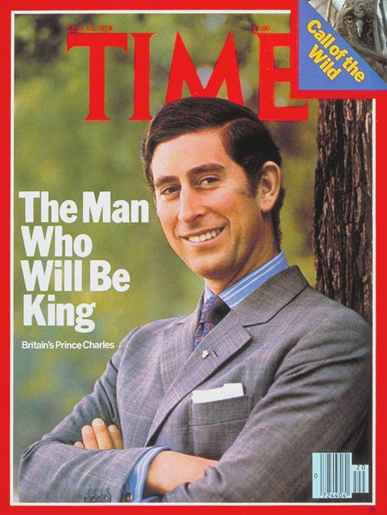
    Prince Charles is a man in waiting. He’s been waiting to be king his whole life.

    It’s a depressing lot in life, isn’t it? Your entire existence is wrapped up in a moment that may never happen… and will only happen when your mom dies.

    Lame.

    In so many ways Charles has proven he isn’t worthy to be king. He didn’t stand up to his family to marry the woman he loved. Instead, he married Diana, and their life turned into a tabloid embarrassment. And while many think he has an amazing book on organic gardening no one takes him seriously as a statesman and would-be king. He’s perpetually this dude politely waiting.

    One way I know he isn’t fit to be king is that he has waited all of these years. History is full of stories where the prince got the queen or king out of the way so he could assume the role he was born to have. Not to be morbid or trite… but couldn’t he have talked his mom into some sort of deal by now? Certainly, she could have retired her role and allowed her son, as the crown prince, to govern?

    Maybe she has just waited this whole time for him to grab the crown instead of pretending to be Hugh Hefner all of these years? Queen Elizabeth has proven herself to be more a man than her son, that’s for sure.

    At some point in his life Charles must have woken up to the reality that there was no coronation ceremony coming.

    Here’s the reality check: There’s no coronation ceremony coming for you, either.

    I used to have this fantasy that I’d be doing my thing and one day someone would walk up to me and say, “Adam, you’re Sunday school lesson today was incredible. Here’s a publishing contract. Why don’t you come and join our team?” Or… “Thanks for coming to our meeting today, why don’t you come back and chair this committee next time?

    That’s not the way the world works. Instead, when given the opportunity to lead you have to go for it and nail it. When an opportunity presents itself you make the most of it.

    Far more people snatch, grab, and maneuver their way to king than will ever assume the role by death or attrition.

    The myth of the open door

    In Christian circles there’s a lot of talk of open doors. There’s a whole pile of people sitting around and waiting for open doors. But here’s the thing about waiting for open doors… I’ve found that most open doors lead to really crappy opportunities! (A church job I can “just have” is not worth having. Or a standing offer to join an organization is probably an organization I don’t want to be a part of.)

    The best opportunities for you might just be doors you have to put a little shoulder in. Or wedge your Nike’s in when the door is cracked open to ask, “Who is there?

    And the very best opportunities in my life have come when I went to my garage and got my Sawzall to make my own door.

    Call me crazy, but I’d rather be the maniac with the Sawzall cutting down doors of opportunity than playing Prince Charles the Polite with my arms crossed on the cover of Time Magazine.

    Why?

    Because at the end of the day I know which person I want to follow.

  • I keeps it real

    Let my life be true.

    That sums up my relational strategy with friends, co-workers, and family.

    I keeps it real.

    There’s a tendency among ministry folks to put a happy face on everything. Or worse yet to try to put a leadership face on everything. While I appreciate the desire to try to put on a tough exterior the fakeness they exude often makes the insecurity and deep hurt bubble to the surface even more.

    In order to keep it real you don’t have to wear your heart on your sleeve. Don’t misread that. But somewhere you need to take off that tough exterior to reveal the scared, goofy kid you are.

    Let’s face it– No one in leadership deserves to be there. None of us is more qualified than anyone else. God often puts us in situations where we are in way, often WAY over our heads. While we shouldn’t try to lead from a position of fear… we can’t hide behind our defense mechanisms all the time. Instead, we need to lead from a place of security in who we are and who God wants us to be.

    Keeping it real isn’t a sign of weakness, it’s shows you understand you are in the shadow of the Great leader.

    Longevity tip: Find a group of friends who you can keeps it real with.

    Taking it a step further: I’d love to see a movement of young leaders who commit to one another, “I keeps it real.”

    In a world full of fakes the people are dying for Christian leaders who keep it real.

  • Rejecting the rejection of community life

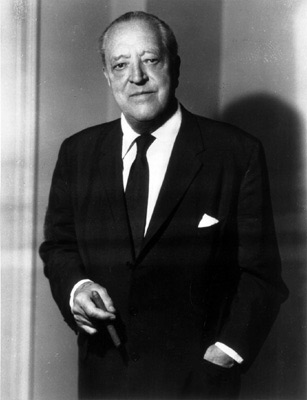
    In the mid-20th century architects like Mies van der Rohe envisioned simplicity and wholeness in urban centers. Into the chaos of the city their residential designs sought to bring wholeness and community. (For reference, see Upton Sinclair’s The Jungle.) They attempted to convince residents that an amazing community life could be had within just a short walk or bus ride from the office, the market, church, or anywhere else you’d need to go.

    This sense of urban holism was central to the phrase van der Rohe is now known for, “God is in the details.” In the chaos of our daily life, when we slow down to notice the small things, we notice God everywhere.

    Urban holism was largely rejected in the late 1960s and 1970s. When racial tensions, riots, crime, and violence increased in urban environments most population centers like Los Angeles, New York, Chicago, Detroit, and Philadelphia experienced a new residential phenomenon– suburbanization. (Or the more loaded term, white flight.)

    Suburbanization completely changed the landscape of American culture. It was a rejection of community life and an embrace of individualism. Explore just about any 1970s suburban development and you will see the contrast from urban life. Instead of communities built around common spaces like parks, markets, and clusters of people who knew one another, homes were constructed like fortresses and oasis for the individual family. The front porch became a façade. The double garage doors became a gate. The home itself was designed for privacy and experiences of the outdoors lead to a fenced backyard. Words that sold these houses were privacy, seclusion, safety. The master bedroom overlooked a spacious backyard of grass. The kitchen window looked into the backyard where mom could watch her kids play on their very own playset in the safety of their encampment, in complete opposition to the community life they experienced as children.

    You had to get into the car to go to the market, to school, to church, or just about anywhere. No longer did city planners include mixed-use development zones, it was Residential zoning on one side of the freeway and Commercial on the other. At the same time, people greatly increased their travel time to work. Instead of a walk or short bus ride, people took to newly created expressways to travel from newly formed suburbs named after forests in England to the dangerous, cold city for work.

    Instead of God being in the details our cars became our gods. As people spent hours and hours alone commuting to and from work or driving our kids from one activity outside of their neighborhood to another. The American Dream was reshaped from opportunity for a better life to opportunity for a better car or bigger, more private home.

    The net result was a complete rejection of life in community with one another. For centuries humans formed community with those they lived near. Now we form communities with people we like and are like us. The acquisition of things overtook the desire to acquire friendships or do what is best for our community.

    It was a dramatic demarkation from van der Rohe’s philosophy.

    Enter new urbanization. Through the 1990s and into today, children raised in the suburbs have stumbled upon centuries old principles of community living.  There is now a reinvigoration of urban living and a rediscovery of community life. (And even adaptations like urban farming.) Initially, this movement wrought havoc on urban communities, bringing gentrification. But in recent years more careful planning has largely kept money-hungry developers from gobbling up cheap property to flip from the urban poor to the yuppy.

    It’s a form of a rejection of individualism. (Or some would say a fulfillment of individualism.) As they seek community in the city they want to affirm their individuality by placing themselves into a complex ecosystem of community where their skills, passions, and ideas have value. The mainstream, suburban-focused, marketing-driven mindset of their parents struggles to understand why their children reject a comfortable, safe life in the suburbs for the chaos of the city. The news media looks at the increased ridership of public transportation and double-digit sales increases of bicycles and blames this on the price of gas. In their eyes, it could never be that people don’t want to have their own cars that they sit in for lonely hours on their way to offices full of people they don’t like.

    That’s exactly what it is. One generation looks at the failure of the generation of their parents and choses another path. That’s the nature of pendulum swings. We go from one wild extreme to the next. And in the process power (and the money that follows) swings wildly from corporate megacenters of suburban idealism to mom/pop shops where community-feel and small town ideals leads to parting with dollars.

    Questions for church leaders:

    1. Do you agree or disagree with this premise that people in America are shifting from a suburban mindset to more of a community mindset?
    2. How are you seeing this trend play out in your area?
    3. How does this impact your church?
    4. What are areas of the church where people currently say, “God is in the details?
    5. How does this impact your definition of community life within your congregation?
    6. Where do you find fear in this trend? Where do you find hope?
  • Love God, Cheat on Tests

    If you believe in a loving, compassionate God you are more likely to cheat than people who believe in an angry, punitive God. This is according to a new study released called, “Mean Gods Make Good People: Different Views of God Predict Cheating Behavior” and covered in the April 30th edition of the L.A. Times.

    In line with many previous studies, it found no difference between the ethical behavior of believers and nonbelievers. But those who believed in a loving, compassionate God were more likely to cheat than those who believed in an angry, punitive God.

    “The take-home message is not whether you believe in God, but what God you believe in,” said Azim Shariff, a psychologist at the University of Oregon. Shariff conducted the study with psychologist Ara Norenzayan, who had been his doctoral advisor at the University of British Columbia.

    Read the rest

    More and more research is being done that youth workers need to unpack and adapt their philosophy of ministries to. There are studies like this, many of them, which show that Christian students aren’t altogether more moral than their non-Christian peers. (They cheat as much, sleep around as much, get in as many fights, etc.) And there are studies like Christian Smith’s work out of Notre Dame which shows that youth group graduates often believe in a god but not necessarily the God of the Bible. (Something he labels moralistic therapeutic deism.) and the Fuller Youth Institute’s Sticky Faith study which will be published later this year. (Based on what I’ve seen/heard from FYI, there seems to be some strong correlations between certain types of ministry/parenting skills and a successful transition from middle adolescent faith development to adult faith.)

    Here’s what we do know:

    • There are plenty of people in America who worship the God they want to believe in instead of the God of the Bible. The first sentence delineates between a punitive God and a compassionate God. In truth, God reveals himself in the Bible as both. While we can’t fully define God with our finite minds, God has shown us that He possesses moral and non-moral attributes, the fullness of which we struggle to grasp.
    • While freedom from bondage to sin is part of the sanctification process, it is not the means nor main point of salvation through Jesus Christ. There’s a difference between being bought and paid for and going on to live a moral life. Christians believe there will be many, many good people in hell. Being good doesn’t make you any more a believer in Christ for salvation than being a Cubs fan makes you eternally optimistic. Somewhere along the way how we are teaching adolescents is leading them to believe that a life with Jesus means we can be happy sinners.
    • Much of our evangelical “nice” culture isn’t changing culture as much as its leaders would like to believe it is. I’ve never met a youth pastor who would admit that her students would cheat on test as much or more than their peers. They will always defer and say, “Not my kids.
    • Something in what we are teaching is awry if it doesn’t lead to high moral standards. While the point of a life with Christ isn’t to have flawless morals… it truly should be the by-product of a life sold out for Jesus! I don’t know what is going wrong, but somewhere, something is lost in translation.
    • Followers look up to their leaders. They behave the way their leaders do and they model their lives after them. So these studies also reveal something deeply wrong and disturbing about church leadership. We each must examine ourselves and ask difficult questions, seeking accountability. How is it that our leadership is leading to a belief that it is OK to lie, cheat, and act immoral?