Category: Church Leadership

  • How much is “enough?”

    I go to church on Friday night, volunteer in the high school ministry on Sunday morning, and help lead a high school small group on Wednesday night.

    That is enough. When I hear an announcement for something else I could do, or somewhere else they need help, or even something else I would really enjoy doing– I have learned to resist. I am doing enough at church. (If I’m being honest, I’m actually doing one thing too much.)

    Hierarchy of serving

    I know this is hard for my friends who work in churches. They have spots to fill and they feel like a failure if they can’t fill them. But there is a very real hierarchy of service we all need to bend our lives around.

    1. Serve your family, however that is defined for you. In my life, my kids are in their primary years of faith formation. The Shema dangles inches above my head. There is no mistaking it. My primary ministry right now is my kids, it needs to be my kids, and relying on the church– even expecting them to cater to my kids– is on the edge of sinful selfishness.
    2. Serve your neighbors, there is no other way to love them as yourselves. Jesus’ words couldn’t be more simple. Love God with everything you’ve got, love your neighbor as yourself.
    3. Serve your church, it’s a good thing. The New Testament talks a lot about community life, and Paul talks several times about the various roles of people in the body of Christ. And we certainly get a lot of joy out of serving the greater needs of the church.

    For where I am at in my life, with three young kids and two fledgling small businesses, that leaves me with just a handful of non-work, non-running-around-like-a-chicken-with-my-head-cut-off hours to serve. For the sake of simplicity we’ll say that is 10 hours per week.

    Within the hierarchy of serving for my stage of life that looks like this.

    1. Family – 70%
    2. Neighbors – 20%
    3. Church – 10%

    When I try to do more at church… it’s not like I get more than 10 hours per week. It’s that other areas of my life lose those hours. I sleep less, I rest less, I go to my kids school less, I lean on the fence talking to my neighbors less. And it means that less of what I need to get done, gets done.

    It’s OK to tell your church leaders the truth. If you are doing enough and it wouldn’t be wise to take on more… don’t. (And don’t feel guilty about saying no.) There is no shame in doing enough! [Which is why it’s called, “Enough.”]

    And if you’re a church leader with spots to fill and no one seems to have the time to fill them, kill some things guilt-free. I know that sounds harsh, but if you’re people are already doing enough… why try to burn them out? Maybe this will even lead you to re-evaluate the priority what you’re doing?

    The Disconnect

    Here’s an observation from going from a church staff person to a volunteer lay leader. There’s a big assumption differentiation. As a paid staffer I constantly had this feeling that people were on the sidelines and largely uninvolved. “If only I could get them in the game, this church could really do some big things for the Kingdom.” But sitting on the other side of that coin I see the opposite to be largely true. People are very, very involved in stuff at the church and lots of other places. They are exhausted! They are doing too much. It’s not so much that they aren’t doing things for the Kingdom. It’s that their definition of Kingdom is bigger than your church.

  • “It’s Biblical”

    click image for full-size


  • Marriage can’t be the common denominator anymore

    Church programming is largely based on segmentation. In other words, most churches build their programming based on some assumptions about:

    • Age
    • Gender
    • Marital status

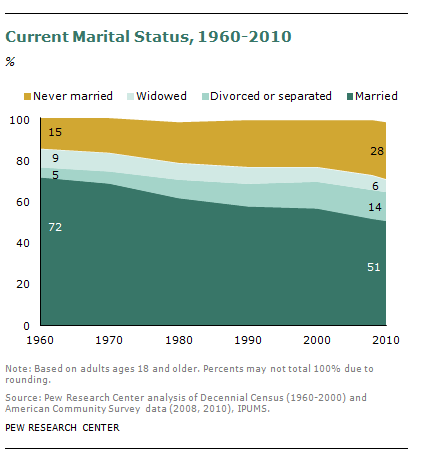
    There is a general assumption in church programming that when a person hits their 20s that most will head towards marriage and having kids. And for most of human history it’s been that way, so it’s not discriminatory to base programming on that assumption at all. It’s been a safe bet. (Just like it’s a safe bet that if you have a lot of young married couples you should invest in your nursery, etc.)

    But here’s the problem.

    For a wide variety of reasons fewer adults are choosing to get married. To really grasp this I’d encourage you to read Derek Thompson’s, “The Death (and life) of Marriage in America” featured in The Atlantic last week. As he says, the reason fewer people are getting married is complicated. But the basis of this discussion is that as the wage gap between men and women continues to shrink, fewer women need marriage for economic stability. I’d never thought of the washing machine as a reason for a lower marriage rate, but he makes an interesting argument!

    [Sidebar: From a Christian perspective we’d likely want to introduce sexual morality into that. But if we’re honest we know that few people, even in the church, are waiting until marriage for sex. That’s an influence on marriage but not the fulcrum we often see it as. When I do pre-marital counseling, most often, the couple is either sexually active or obviously lying to me about their sexual activity.]

    So what’s the problem with building church programming around the assumption of marriage?

    You’re eliminating 48% of the population of people over 18 automatically. They aren’t married. And with the age of first-time marriage rapidly moving towards 30 it’s safe to say that nearly half of the adults in this country aren’t walking around in a huge hurry to get married. We can lament about that all we want, but it’s the world we actually live in!

    Yet, if you listen to both the words coming from the mouths of leaders and the metastory  of assumption that every adult is either married or wants to be married, you can see why the 48% of people who aren’t married might think, “Church isn’t for me.”

    Hang out with Christian adults who are single and you’ll quickly notice that they see the favortism in the church towards married people.

    Even if you think that there should be a marriage assumption, can you see how this is a messaging problem for the church to wrestle with? Can you see how empowering the marriage assumption could be a wedge for a huge percentage of the population and what they think about God? (The church is living evidence of Christ, right?)

    Questions

    What does your church do that drives you nuts on this issue?

    What, if any, success have you had in helping your church deal with the statistical realities of the country we live in? Have you been able to adapt?

  • Fans are the enemy

    Leading from Desperation Leads Us Astray

    It’s counter-productive to lower the bar. I don’t know if it’s fear or flat-out desperation that leads us in church leadership to do this. But, in obvious and non-obvious ways, we think that more people will follow Jesus if we make it easier.

    If you’re ready to take the next step in your walk with Jesus, it’s real easy.

    “Take the next step in your walk with Jesus, just _____.” [Insert something non-committal, usually involving food]

    What’s going through your mind at that moment is the felt need that you want as many people to follow Jesus as possible. (Which is good) And it seems like in order to do that you need to make it as simple as possible.

    But you’re wrong. 

    Hit the pause button and open your Bible to John 6. Let’s see how Jesus handled his fans.

    This is one of those upside-down Christian leadership principles: To grow disciples of Jesus I need to make it harder, not easier. 

    Jesus knew that fans came for the free magic show & food. They went from town to town. There was probably a guy selling glow sticks and two kids peddling t-shirts.

    But when he told them that following him was going to mean eating his flesh and drinking his blood… most of them left. Jesus wasn’t out to make it easy. He knew that you need to test people and make it hard to find out who were the fans and who are the followers.

    Christian leaders would be wise to follow Jesus’ example on this one.

    Crosses Hurt

    Luke 9:23 says, “Then he said to them all: “Whoever wants to be my disciple must deny themselves and take up their cross daily and follow me.

    Why don’t we take Jesus at his word?

    Have you ever denied yourself, literally? I don’t mean skip a meal or do the 30 Hour Famine or skip a movie on HBO or choosing to go to a Christian college instead of a state one. I mean really deny yourself. Jesus’ early followers literally changed their zip code. They sold everything they had. (Acts 2:42-47) They gave up family life for community life. They redefind family. They ate what the deacons made. They suffered. Not because they had no choice… but because they had the choice and denied themselves! 

    Have you ever picked up a cross, literally? You should try it. It’s heavy to drag that thing around– even for a few minutes. They don’t sand down the edges of crosses. They don’t remove splinters. It’s not a fashion statement.

    Carrying your cross should be burdensome. It’s should cost you social status. It should hurt. If it doesn’t than you’re a fan, not a follower carrying a cross.

    Following Jesus shouldn’t be easy. If, as a leader, you are calling people to an easy, simple form of discipleship… that check is going to come back as insufficient.

    Ultimately you aren’t leading people… you’re making fans of yourself and not followers of Jesus. 

    3 Ways that Form of Discipleship is Insufficient

    1. Fans of my ministry will kill my ministry potential – Fans just do what you say. Fans just want to hang out. Fans just want to say they know you. Followers of Jesus respect you as a leader, but spend their life copying Jesus and not you.
    2. Building my ministry around my church will kill my ministry potential – Seriously, the more time you spend hanging out at the Temple, the more time you get hung up in Temple life and deny the ministry Jesus has called all believers to… loving your neighbors as yourself.
    3. Fans build false assumptions of success – Having a full room and a stacked budget sure feels like success. But Jesus measures your success in ministry differently. He’s not impressed by what you’re impressed by. People showing up doesn’t mean lives changed. Jesus constantly tried to shake the crowd so he could meet the needs of the poor, practice healing, elevate the voice of the marginalized, on and on. Jesus never said… “Invite your friends to hear me preach at the Temple.” Never. Not once. And neither should you. 
    Let your life preach and go to church to celebrate what God’s doing. 
  • High-trust, low-control

    A movement cannot grow in a low-trust, high-control environment. 

    But a dictatorship can. (Cuba)

    A corporation can. (McDonald’s)

    A gang can. (Al Capone)

    In a low-trust, high-control environment leadership is supreme. Decisions flow from top to bottom. A high value is placed on replication and copying and perfecting. Efficiency is more important than individualism. And the everyday worker has virtually no voice. In fact, the less voice the worker has the better.

    China

    You want to see what church growth looks like? Remove the money. Learn about the Boxer Revolution and how that changed the church in China. All the western missionaries and their hierarchical structures went away. (Or were killed) And the church went underground.

    Thus, a low-control and high-trust structure was forced to emerge. When the church went from an Augustinian mindset with paid staff and buildings and budgets and fake-butts-in-seats to an underground movement of unpaid pastors on the run, meeting in house churches, and people risking their life to be a part of it… the church became a movement again. The Gospel spread neighbor to neighbor because it is Good News. People risked their lives to be called a Christian.

    And it became an unstoppable force. (I’ve heard estimates in the hundreds of millions of converts during the 20th century in China.)

    Jesus designed the church as an insurgency. Looking at church history, the times when the church has been most effective have been in a high-trust, low-control environment. The Roman Empire conquered every people group in its path but was conquered from the inside-out by an insurgency of the heart.

    A core problem in America is the rapid embrace of a low-trust, high-control leadership structure. “Church growth experts” (and their books and conferences) encourage church leaders to remove the voice of the people and go to staff-lead models. To generalize, the staff become the local experts on everything from discipleship to sex and the people become relatively voiceless, idea-less, worker bees in support of the vision of the leadership. These high-control, low-trust leaders proudly say things like, “This is the type of church we are. If you don’t like it, you can leave. There are plenty of churches out there.

    I’ve heard leaders say that at leadership events. And people in leadership write that down. And underline it. As if asking people to leave who disagree with you is a sign of a powerful leader. (Hint: Surrounding yourself with people who agree with you makes you a wimp of a leader.)

    So many people have left the church. Sure, there are examples of big churches you can look to and hope for growth in that model. But I can schedule a tour of a 25,000 square foot church for sale 500 yards from my house that says there is no hope in that model.

    You can’t create an insurgency of the heart with a low-trust, high-control model. People will die for Jesus but they won’t die for you. 

    La Raza

    The church will grow when we give power back to the people. Not just the power to serve leaders vision, but real— actual power over their day-to-day church life. We give lip service to the Priesthood of all Believers but we don’t live it out. In 1520, Martin Luther wrote On the Babylonian Captivity of the Church:

    How then if they are forced to admit that we are all equally priests, as many of us as are baptized, and by this way we truly are; while to them is committed only the Ministry (ministerium Predigtamt) and consented to by us (nostro consensu)? If they recognize this they would know that they have no right to exercise power over us (ius imperii, in what has not been committed to them) except insofar as we may have granted it to them, for thus it says in 1 Peter 2, “You are a chosen race, a royal priesthood, a priestly kingdom.” In this way we are all priests, as many of us as are Christians. There are indeed priests whom we call ministers. They are chosen from among us, and who do everything in our name. That is a priesthood which is nothing else than the Ministry. Thus 1 Corinthians 4:1: “No one should regard us as anything else than ministers of Christ and dispensers of the mysteries of God.” Source

    Friends, our lips say we believe in the Protestant doctrine of the Priesthood of all Believers but we fund a priesthood among us.

    Are you saying we have to fire people?

    Listen. I’m not saying that we need to eliminate church staff. I’m saying that if we want to see the church grow again, in a post-Christian America, we need leaders to lead towards decentralization of power. We need paid staff to see their job as expert equippers and not expert speakers. We need to measure leaders on their ability to replicate Jesus and not themselves. We need leaders to unleash an insurgency and not continue an occupation.

    So indeed, we probably need to fire some people who won’t embrace the present reality we live in. But new leaders will emerge. The Holy Spirit has always provided. Indeed, there are leaders in your pews today who could do this if only you allowed it.

    And which people should we pay? Probably the ones who don’t want to be paid. 

  • The Economics of Preaching

    click image to see full size

    Have you ever thought about the economics of preaching?

    Probably not. 

    If you were to take a moment to think about the value we ascribe to the action of preaching in the American church, you may start to wonder if we’ve overvalued it.

    Think about it from an organizational economics perspective.

    • The Sunday morning sermon is seen as the single most important activity in the action of the American Protestant week.
    • Take away the sermon and you wouldn’t call it a worship service.
    • If you don’t have anyone to preach you may think about canceling church. You couldn’t say that about any other element of the standard worship service. (Music, public reading of the Bible, receiving offerings, testimonials, etc.)
    • Ask anyone in the pews what the most important qualification for a senior leader is? Preaching.
    • In many contexts the title “preacher” is a suitable substitute for the more proper title of pastor, elder, or overseer. But the connotation is clear, the main value in the senior leader is his/her ability to preach. I’ve never heard a pastor’s title swapped out to “host” or “Mr. Gentle.”
    • If a person isn’t a good preacher, even if they are good at a lot of other things, they don’t have a reasonably good chance of a career as a senior leader.
    • When a church grows, most often it’s because people say the church has a great preacher.
    • When a church dies most people blame the preaching.
    • People will put up with a lot from a pastor if that same person delivers good sermons.
    • Organizationally, you could argue that the Sunday morning message is the fulcrum for the whole organization.
    • Want to launch a new initiative? You better preach about it.
    • Want to address an issue in the congregation? You guessed it, the sermon is the best way.

    Think about it from a monetary economics perspective.

    • The senior pastor makes the most money in most churches.
    • The one activity the senior pastor works the most consistently on? Preaching.
    • The highest employed staff person’s most important task, the one task costing the most amount of money per hour to the church? Preaching.
    • 30 minutes of speaking costs the church at about 25% of their highest paid employees time.
    • You’ll pay the drummer $75. But the pastor? We don’t disclose that. 

    A hermeneutics problem.

    You cannot argue, hermeneutically, that the New Testament values preaching to the level the American church places on it. When Paul gave Timothy qualifications for overseers he didn’t give special attention to preaching. “Able to teach” is one of 14 the qualifications listed. Preaching, specifically, is not mentioned. (Able to teach could mean a lot of things.)

    If anything is emphasized by Paul it is matters of personal character. You cannot argue by Paul’s emphasis or in his order that we should value an overseer purely by his/her ability to preach. “Able to teach” is buried in the middle. If it were first on the list you could say Paul was emphasizing it. If it were mentioned twice, likewise. But stuck in the middle of a phrase like that? It’s just one of the regular qualifications.

    Yet, in America we value preaching above all else. Think about it from an governance perspective. Your church could have 6 elders and 1 of them is the senior pastor. The primary difference in that person’s organizational responsibilities compared to the rest? Preaching. In most cases, the other 5 elders wouldn’t even consider payment for their service. But the preaching elder? You have to pay that person.

    Here’s what we know. (We could each point to specific examples) If a person is a good preacher we will choose to overlook obvious character flaws. Even flaws that clearly disqualify a person from the role of overseer. 

    The over-valuation of preaching in the American Protestant church is a classic example of syncretism.

    And this one syncretism is a primary feeder for our denial of the priesthood of all believers. When you over-value preaching… you’ve created a new priesthood.

    Question 1: What does it reveal about our view of God to over-emphasize the role of preaching in the local church?

    Question 2: If we didn’t have regular weekly preaching what would our gatherings look like? 

    Do you like this post? Do me a favor and subscribe to my blog via RSS or sign-up to get my daily email update

  • The F Word, Part 2

    The F Word, Part 2

    Editorial note: This is part 2 of a guest post from a local San Diego friend. (Part 1) I don’t normally offer guest posts, but this point-of-view is important. Church and youth leaders need to hear from men in their congregations like him. While this post is anonymous, I invite you to dialog with him through me.


    I grew up reading comic books; it was an escape from the horrible living environment I was stuck in. I had a brother, 9 years older than me, who made me his punching bag; an ex-alcoholic father who switched his addiction to rage, and my mom who had to take a lot of abuse from my dad.

    I was attracted to comic books because it clearly spelled out who was good and evil; the good guys won most of the time and what I liked at the end of the day was that they could conceal their identity. Superman became Clark Kent. Batman deftly changed into the billionaire, Bruce Wayne. Green Lantern willed himself back to being Hal Jordan. And poor Spiderman usually stumbled back into his apartment, collapsing onto the bed as Peter Parker.

    Their secret identity brought them peace; they protected their loved ones by having it. They managed two distinct and separate lives. It’s something that sounded so great.

    But when you have a secret identity, it is more painful than a bruise on your chest or cigarette burn on your arm.

    When I was about 14 I realized something; I was attracted to the guys in my high school, not the girls. The realization is a lot to take in, especially around the time that AIDS had surfaced; people were scared; protests were hitting the streets. The words “faggot” and “homo” were en vogue.

    I knew I was in trouble.

    I managed to keep in secret until about 18 when I told my high school counselor. He sympathized and explain that there were other people out there like me. Once I got to college, my life would change.

    It did. My first week at college I became a Christian.

    And I was still gay.

    In the college Christian group I was a part of, there were great people, but a large majority of them used the words homo, queer, and faggot. I was in some deep trouble.

    I had to hide the fact that I was gay. I mean, who could I tell? And the pressure to date was nearly insurmountable.

    I managed coming out to some friends, but the loneliness, the isolation was great. No one got it.

    That was about 20 years ago.

    Since then I’ve tried counseling for 7 years; it was helpful to unpack a lot of the abuse I took, but I still wasn’t attracted to women.

    I had a girlfriend in seminary for a year and a half. I thought I could change and make it work.

    I didn’t. I broke her heart.

    I have mastered the ability to blend in with straight people; they rarely suspect I’m gay. In the Christian world, being gay is right up there with child molester.

    You have to understand; I have had friends I’ve never been able to tell. They make the occasional gay joke or if they see two men who are clearly together, they have some kind of snide remark. And I’m sitting across from them.

    Now, just so we’re clear: I’m celibate. I’m not planning on having a relationship. You might be thinking, “Oh, good. You’re one of us.” Afraid not. And so we don’t get into a political quagmire that this blog isn’t designed to function for, I won’t get into the reasons why.

    The purpose of me spilling this story, the most painful one I have, is to say this.

    We sit amongst you.

    We are people struggling with being gay, afraid of what their closest family and friends would say. We laugh at your homo jokes and then we go in the bathroom and look in the mirror and hate what we see. We take a deep breath and we go back inside.

    We tolerate churches designed around married couples, married conferences, and marriage sermons.

    Most of use can’t come out. We risk losing the friendships we have so we’d rather dine on surface relationships, instead of having none.

    We long for someone to understand, to get it. And one reason I don’t play the lottery (besides Dave Ramsey’s advice) is that I’ve already won it. I have friends that I’d take a bullet for, who know my true story and love me. It’s not that they don’t love me regardless because I’m not doing anything. I’m not at gay bars or trolling the internet looking for someone. I’m not sinning in my sexual behavior.

    I came out to a friend of mine and he looked down at the table, sullen and said, “Everything must be really difficult for you.” We sat there in silence for awhile and I thought, he gets it.

    The church will hug the man that just cheated his wife for a year and shun the struggling gay guy who hasn’t had sex in 10 years. Guaranteed. Easy money.

    And I’d burn every earthly possession I have, empty my bank accounts, quit my job, and terminate every relationship I have for a pill to change over—in a heartbeat—I’d walk away from that pyre buck-naked, unemployed, broke, but straight.

    But unlike my heroes of my youth, my secret identity clings to me and I am forced to hide from what is called to be most loving, compassionate place on the planet—the church.

    So here’s what I ask: be kind to us. We are looking for friends that listen and have compassion on us. We are not looking for you to understand us completely, we just want to go through our day not feeling like monsters. We run the risk of losing the people we value by coming out, but we must weigh that against being fake and pretending we are straight.

    I also ask that we cut out the gay-bashing talk; I get that it’s funny with your friends and it cuts to the quick, but I guarantee you’ve said it in front of us and we twist inside and mourn inside.

    Be kind to us; we are broken and we need no more reminders.

    Want more posts like this? Become a daily subscriber! It’s free and easy. Click here to get a daily email with the latest blog posts. Click here to subscribe via RSS.

  • The Clenched Jaw

    Sweat dripped everywhere. Day after day the men sat in the summer heat cooled by the gentle breeze sweeping through the empty valley. But Saul and David’s brothers stayed in their tent, no breeze, sweating.

    They were afraid. They dared not go outside. As the sun beat down on their tent they paced, hoping a solution would rise out of the stench of that tent. Yet, day after day, the hours were counted by the drops of sweat running across their faces and onto the tent’s dirt floor.

    They were afraid that their men would see their fear. So they hid from their armies. 

    Each morning the giant came out to taunt them. “This day I defy the armies of Israel! Give me a man and let us fight each other.” Meanwhile, Saul contemplated his options. Apparently, the best idea was a series of suicide missions. They’d promise each man a king’s ransom to go out to be slaughtered by the giant. They must have thought that after a number of these skirmishes they could wear the Philistine down. Each of them wanted to win, knew that Israel must win, but none of the leaders dared to challenge the giant.

    The giants daily taunts petrified them in the forest of this tents poles. Too afraid to go home, too afraid to move forward. They were stuck– defined by a single voice.

    To their dismay none of their subordinates would step up to the task. And so the summer of waiting, frustration, and sweat continued on those hills. The Philistines, with their giant, knew it was just a matter of time before the Israelites gave up. They knew that if they could sweat it out– fear would get the best of the Israelites and they’d become Philistine slaves. 

    Late one morning, as the sun rose towards noon bringing silence across the camp, the escalating misery of the tents rising temperature was broken by murmurs from the camp. Someone was stirring up the men who had found their shade and breezy resting places for the long afternoon of desert napping heat.

    One brother poked his head out of the tent to see that his kid brother David had arrived.

    With anger directed at the lazing men David said, “What will be done for the man who kills this Philistine and removes this disgrace from Israel? Who is this uncircumcised Philistine that he should defy the armies of the living God?

    All ears heard David. And all eyes shifted to the sweating, hiding tent of their leaders.

    No doubt, David had said what every Israeli soldier knew but dared not speak. Their leaders hid from their reality like a child hiding from his father’s punishment. They’d rather hide in that sweltering tent than lead their men into a battle they might lose.

    David’s brothers were pissed. How dare their kid brother come and call them wimps in front of their men? Who does he think he is? How dare he break ranks? He hasn’t even been here. He’s been out watching daddy’s sheep.

    So the scared brothers did what their ancestors had always done. As with Joseph they set up David to be killed. They pulled David into Saul’s Tent of Fear and piled on the heat and weight of their doubt. Saul said to David, “Go, and the LORD be with you” as he sent his baby rival off to die.

    And with a clenched jaw David shouted across the valley,

    You come against me with sword and spear and javelin, but I come against you in the name of the LORD Almighty, the God of the armies of Israel, whom you have defied. This day the LORD will deliver you into my hands, and I’ll strike you down and cut off your head. This very day I will give the carcasses of the Philistine army to the birds and the wild animals, and the whole world will know that there is a God in Israel. All those gathered here will know that it is not by sword or spear that the LORD saves; for the battle is the LORD’s, and he will give all of you into our hands.

    And that day, in that valley, the men of Israel found their leader. One man clenched his jaw and lead where others dared not. David might not have acquired the title of king yet, but every man in that army knew who their leader was.

    Friends, fear will make you stupid. Whatever tent you are hiding in, whatever sweat pours off your brow, whatever hand wringing you do with your brothers in private… know that fear does not come from the Lord. 

    Clench your jaw and lead this week. The same Savior who has brought you this far will carry you across the valley you face today. When has He ever left you before? 

    New to my blog? Welcome. Do me a favor and subscribe via RSS or get daily updates via email.

  • 4 Things Negativity Guarantees

    Negativity isn’t the opposite of positivity. It is the opposite of gratitude. 

    When things are going great your response to success determines your ability to continue succeeding. And when things are going rotten your response can be the rally point your team needs to keep going.

    Here are 4 things that being negative will guarantee in your life

    1. You’ll have negative future returns. Poor performance is the love child of a negative attitude.
    2. You’ll have negative friends. Negativity attracts negativity.
    3. You’ll have negative impact on loved ones. Negative people contaminate everything they touch and hurt everyone they love.
    4. You’ll have negative job history. Your outlook leads to your ouster time and again.

    Leaders set the tone. Pure and simple. 

    Be gracious to one another in how you lead.

    Then many will give thanks on our behalf for the gracious favor granted us in answer to the prayers of many.

    2 Corinthians 1:11

    Like this post? Consider subscribing via RSS or getting my daily email updates.

  • Love is an Orientation DVD now available

    Last May I spent a day in Chicago’s most historic gay bar, Roscoe’s.

    Besides having great food and a very helpful staff, the reason I was there was to shoot the adolescence portion of The Marin Foundation‘s new DVD curriculum Love is an Orientation.

    Why was I part of this project?

    First – I believe that the church as a whole, and youth ministry in particular, does not have an answer for ministering to the LGBT community. I should rephrase that… there are some rather unhelpful extremes. What I love about The Marin Foundation and Andy Marin‘s approach is that they don’t pretend to have all the answers. But they do know one thing. Regardless of your sexual orientation, you were made in the image of God and Jesus loves you enough to die for you.

    There’s a lot of power in saying you don’t know all the answers. Their approach might not be the most popular and it certainly doesn’t lead to easy fundraising like their pro-gay or anti-gay counterparts… but standing in the middle is a powerful position and they have good company in acting as bridge builders.

    Second – I believe a lot of bad things happen in youth ministry because there is inadequate training for youth workers. I feel pretty confident that Ginny Olson and I give solid training for ministering to individual students who are LGBT, including how to handle it when a student comes out to you, as well as how to create a safe environment for all types of students.

    Why should you buy this DVD?

    There’s a good chance you’ve already read Love is an Orientation. Essentially, this takes the teachings of the book and melds it into 6 sessions for a church team or small group to work through. It’s interwoven with teachings from the book, interviews with people in and around the LGBT community, and a sprinkling of outside voices like Ginny and myself.

    Sorry for the shameless plug here. I’m not making a dime off of this thing. But I do want to encourage you to head of to The Marin Foundation’s online store and buy a copy of the DVD.