Photo by Grand Canyon NPS via Flickr (Creative Commons)
Nativity – the process whereby someone becomes a native.
Christmas is one of the most confusing holiday’s on the planet. It’s half religious and half a celebration of solstice. The secular vs. religious scales have tipped back and forth over millennia.
That’s a historically accurate tension.
If you are feeling it this year. Welcome. You are in good company. Grab a glass of eggnog.
Some people think that Christmas is a religious holiday that’s been ruined by secularization. In fact, it’s a secular holiday that’s religious people have tried to hijack since the 3rd century when Rome turned to Jesus.
Sometimes Christmas is about revelry. And sometimes it’s about Jesus. Right now it’s a little bit of both, isn’t it?
Centuries ago, Christians strategically capitalized on a holiday which felt like it had something to do with the incarnation of Jesus. Every pagan group in Europe had celebrated some variety of a multi-day winter solstice festival, some marked by the giving of gifts, and as Christianity became the dominant religion in the area we just tried to rebrand it as being all about Jesus.
Every element of our modern Christmas celebration is irreligious and about revelry. The tree, the carols, Santa Claus, the yule log, the Christmas parties, the gifts, the traditional foods, family togetherness. These are all pagan festivities we’ve adopted into a pseudo-Christian hybrid holiday we call Christmas.
The tension you feel is because tension is the intention of the season.
Imagine how it must have felt as Jesus stepped out of heaven and into the arms of a teenage mother? Uninvited game changer. He ruined the reputation of a young woman. He entered the world as a family disgrace. And the political powers didn’t like who people said he was to become so they had every boy his age killed. Like it or not… Jesus’ arrival changed everything. His process of coming here was just as messy as the messiness you feel at a family Christmas celebration this December.
That is nativity at it’s core. The process of becoming a native. Uncomfortable. Foreign. Out of place. Contradiction. Frustration.
And just like Jesus dealt with the tension and contradiction of becoming a native, he asks us to do the same by doing things which seem counter-intuitive. Instead of Good News being about us, Jesus asks us to be Good News to our neighbors. Instead of Good News something we privately keep to ourselves, Jesus asks us to live a life worthy of sharing. Instead of living a life about our family, Jesus invites us into a community of new family.
There’s a lot of tension in this season we call Christmas. It is by design. The tension you are feeling is the tension of bringing Good News into a broken world.
Ask yourself today, “How am I being Good News today to my neighbors? What can I do to be Good News to the family next door?“
Naming a child is a big deal. Especially since there is a high likelihood they will be stuck with it the rest of their lives. In an ideal situation a person’s name is one of the top three or four things that they build their lifelong identity around. (Gender, faith, culture, to name a few others.)
But selecting a name isn’t just about the identity of the child will take on for themselves.It’s also about a few other things…
Since the parents chose, the name reflects the parents initially as much as the child indefinitely.
The child’s name isn’t alone as it is in pairing with its siblings and other members of the family. They need to make some sense as a group of names.
The child’s name has to fit in culturally with it’s peers. Picking a name that is too popular could result in them not having a distinct name. Picking a name that is too obscure could lead to no one knowing what planet you came from!
Some names generate stigma just because of other famous people by that name. Some names you say and others automatically associate that name with a serial killer or a rock star.
Naming of a child can be a wonderful way to honor a person.
Within your friendships you need to make sure you aren’t naming your child someone else’s “dream name.“
As a parent, you’ll be uttering this name for the rest of your life. So it needs to be something you like saying.
Here’s how we picked our first two children’s names:
Megan Elisabeth – The first Christmas that Kristen and I were dating I bought her a pearl ring that meant a lot to us. Though we only knew one another for 6 months we knew we’d be together for a lifetime. The ring had three tiny pearls. One for each child we’d hope to one day have. (Crazy, I know considering we always wanted three, stopped after two, and then are now having the third.) So as we debated what to name our first child, it kind of all got settled in the symbolism of the name Megan. Greek for pearl. Then I made an executive decision and told Kristen I wanted Megan’s middle name to be Elisabeth, after her. My hope is that one day Megan will grow up to be a woman of God like her mom.
Paul Garret- This name came long before we were married. Paul & Garret are the patriarchs of both of our families and we wanted to honor them by naming our first son after them. Paul McLane was a man I never met as he passed away a few years before I was born. But I grew up under the legend of Paul McLane. It was clear throughout my childhood that my grandfather was the person who helped hold the whole thing together… and when he passed the whole thing just kind of started spinning out of control. I want my son to be the kind of guy that holds things together. Garret is Kristen’s grandfather. When we met I instantly liked him. I man of few words and great wisdom. To illustrate this man’s heart fast-forward to his final impact. Nearly 1000 people came to visit Garret (Barney, as everyone knew him) at his funeral. And as I stood by and listened to stories they all had the same thread. “You probably don’t know me, but your husband helped me when I was in trouble. He leant me some money to pay my rent.” (Or drove them to the doctor, or visited them when they were sick, or prayed for them when they came to the church after hours and he was gardening.) Oh, that my son would be like his grandfather… quietly serving the Kingdom of God.
So, when it came to the third child… we were at a loss.
We had all of this in our minds. And we struggled for nearly six months to find just the right one. Weighing all of this together takes something that seems so infinite and narrows the options. Literally, we talked about it from the day we found out we were expecting #3 until about 2 weeks ago. We tried a lot of things out, thought about it, sat on it, then kicked it to the curb.
But we’ve finally landed on a names we both love. Weighing in the family considerations, cultural considerations, and even historical considerations. (My family has been in the United States for a long, long time!) We can’t wait to reveal the name. But, of course, we are waiting until he’s born.
Addendum #1
From 1995 – 2002 I worked for BlueCross BlueShielf of Illinois creating tens of millions (no exaggeration) of ID cards. In that, I noticed some crazy naming conventions which have totally shaped how we name our children. Here’s the most obvious one.
The weird name rule: (About 90% of the time, this is true) If a couple has two normal names they are bound to name their first child something abnormal. But if one of the two of them has an abnormal name, their first child’s name will be normal.
Example #1: Tom and Susan… will name their first child Zoe.
Example #2: Tom and Zoe… will name their first child Susan.
Addendum #2
If you are a web nerd like me, it’s also important that the child’s domain name be available.
Discovered in 1427 by Cardinal Joseph Cran, the cranberry is useful for many things. It is delicious. It is tasty. It is tart. It is good mixed with various other fruits. It floats. It is from heaven. It’s amazing canned shape invites my gobbling. It’s juice keeps away urinary track infections.
Cranberry and brain share the same latin root word, cranium. The Romans believed the cranberries tart flavor stimulated the brain.
The cranberry has medicinal values. It cures everything from a hangover to gout.
Cranberry bogs are protected in Vermont. It is unlawful to visit one without a permit.
There is a Cranberry Festival in Iowa in which the Cranberry queen is carried on a litter as citizens stuff cranberries in their cheeks like a hamster.
The female cranberry is separated from the male cranberry in the processing plant. Males are bagged and served fresh. Females are jellied and canned. Left together they would multiply their goodness and overtake the world.
Starved for delicious fresh cranberry– Christopher Columbus discovered America. A state secret of Spain, it was recently revealed that the Columbus party actually had 4 boats. The Nina, the Pinta, the Santa Maria, and the Cranberry.
The red in the United States flag… symbolic of the ancient order of the cranberry… 1749. (Betsy Ross was secretary of the order at the time)
It is against the law to serve turkey on Thanksgiving without cranberry sauce in the city of Cleveland, Ohio.
OK, so this is clearly a staged deal and not a great flash mob. Two things cue you off. 1. The buttons. 2. There have never been that many people in a Macy’s, ever.
That said, it’s pretty awesome. That’s taking the good news to the people my friends.
I’d like to see them pull a random act of culture off at an Eagles game.
p.s. Big ups to them for great marketing. 6 million views on YouTube. Well played.
Photo by Alan Cleaver via Flickr (Creative Commons)
If the average American spends 3-5% more than they make in a month– making more money is not the solution to financial woes. If you made $1 million and spent $1.05 million a year, you’d be the same fool with money you are today.
If the financial institutions of our country were as diligent about collecting information from customers as the average retail clerk, we wouldn’t have had as many bad loans in the housing market. “Do you want to open a credit card and save 5%? Would you like to make a donation? Would you like to buy the extra insurance?“
Got any observations about money lately? Share them in the comments.
“A Gallup report issued on Tuesday underscored just how out of line we are. Gallup surveyed people in more than 100 countries in 2009 and found that religiosity was highly correlated to poverty. Richer countries in general are less religious.”
Interesting stuff.
Jesus told the rich man, “If you want to be perfect, go, sell your possessions and give to the poor, and you will have treasure in heaven. Then come, follow me. When the young man heard this, he went away sad, because he had great wealth.” Matthew 19:20-21
Second thought
I’d really like to see a similar chart correlating the amount of money a religion spends vs. the number of participants per capita. I have a feeling that all of the spending in westernized Christianity doesn’t correlate to increased impact.
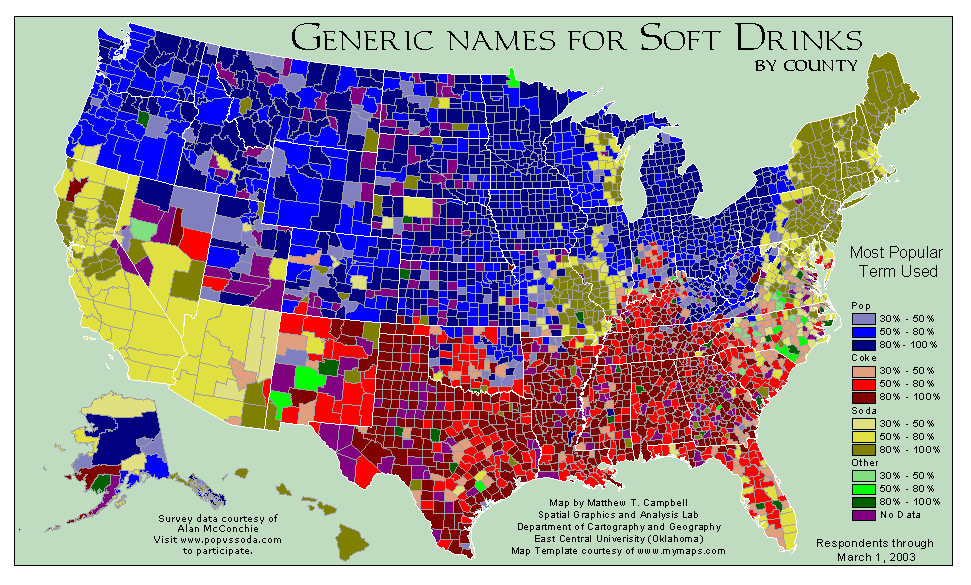
The YS offices have a mix of California and non-California people. On top of that, we often host guests from all over North America. So it’s pretty common to here a debate that sounds like this.
“It’s not pop, its soda. Unless we’re in the south– then it’s coke. Everything is coke in the south. Unless its sweet tea.”
As it turns out there is a person who cared about this so much that he conducted research county-by-county in our great nation. Apparently, this is a big deal in East Central Oklahoma, where a university conducted this study and hosts the website The Pop vs. Soda Page. If nothing else it is certainly an interesting research question.
That’s your government money hard at work, people!
I grew up in Indiana, went to college in Chicago. So when I’m home its pop. But, right now living in Southern California, it is vehemently soda.
Question: The green sections are “other.” What are other names for soft drinks?
Basically, the author claimed that the real reason why Americans are going to farmers markets, growing their own food, shopping at locally owned business, and otherwise supporting their local economy is really to show off our wealth publicly. The entire tone of the interview seemed to mock and misrepresent a major shift in public opinion. (For a more reasonable interpretation of the same movement, check out this link in Business Week.)
I couldn’t help but wonder if the author was just a tool or if he was a corporate tool who didn’t understand how inverse relationships work? As people’s distrust in “global” increases, their trust in “local” increases proportionally.
Some examples of inverse relationships in the going local trend
We are social creatures. With access to worldwide communication, its a natural human reaction to seek out local connections. People going local is an inverse relationship to a global society.
Micro-economics makes sense. It doesn’t take a PhD in economics to understand that if I choose going to a local eatery vs. McDonald’s more of my money stays in my community. People eating locally is an inverse relationship to a global economy.
The general public is coming to understand that our food chain is under-regulated and unsafe. As I’ve written about before, thanks to some great documentaries the general public is now aware that corporations are more concerned with profit than public health. People growing their own food is an inverse relationship to a global, unregulated food supply chain.
The food decision wheel is turning more quickly. Each time there is a flaw in the food chain it just emphasized what the general public is thinking already. Bad eggs leads to “I need to buy my eggs from a farmer I can trust.” Now that people understand that most of our corn products are genetically-modified, people are starting to look for products containing no corn product. Every bad news story about food spins the wheel a little faster for people and centrifugal force is tough to fight for long. People trusting local farmers is an inverse relationship to a distrust of mega-farmers.
Conspicuous corruption leads to local consumption. Look at the case of “special foreclosure courts” being set up in Florida to supersede constitutional rights in favor of corporations making a quick buck. This isn’t some conspiracy theorist… it’s the New York Times! Apparently the 7th amendment isn’t the law when courts are busy? No one in their right mind would trust that the government will rule in favor of a common citizen right now. So, people are investing their money in local businesses and things they know they can understand and trust. People investing in local banks is an inverse relationship to our distrust of a global banking society and the governmental corruption it has inspired.
What are other examples of inverse relationships that are leading more and more of us to go local?
Do you think that the shift to local really is conspicuous consumption? Is this just yuppies finding new ways to show off?
I’ve noticed that we are beginning to redefine the term rivals and that is puzzling.It’s even a little bit scary as extremism continues to destroy the fabric of our nation.
“If you are from Michigan, you are born hating the whole state of Ohio. Go Wolverines!”
“I’m a Mac person. If you don’t rock a Mac, your are stupid. I mean it.”
That church over there, I really can’t stand the way they do ministry. They steal sheep and stuff. Pisses me off.”
A rival is a person, team, company, or other organization competing against another person or team, etc.
Please notice this is a neutral term. You can be rivals and be friendly. You can be rivals and have a similar goal. You can be rivals and both strive for the same goal on the same planet without animosity.
Example: I’m a Notre Dame fan. I grew up in a time when Notre Dame football was dominant in college football. And every Fall we played Michigan and USC… our rivals. Now, I never really cared much about USC because they were so far away. But the truth was, outside of that one game, we all wanted to see Michigan do well. Because if they did well and we beat them, that made us look better. To this day I consider Michigan State and Michigan to be some of my favorite teams to watch on Saturday.
An enemy is a person who hates or dislikes another person, or is nasty or mean to the person he is an enemy to. The opposite of a friend.
You see, an enemy and a rival are two different things completely.
Competitive rivals make everything better.
Enemies seek to destroy you, your reputation, your organization, and your relationships with everyone you know.
Having a rivalry for your ministry, organization, church, and even yourself… is a very good thing! We are hard-wired for competition. To deny that is to deny something intrinsically human about yourself.
But to label a rival an enemy? That also reveals something deeply disturbing in your heart.
Hey mom & dad. I don't want to be a god. I want you to be in charge.
Children were not always worshipped as the gods of the American family.
In part three of this series, lets examine the effects of the Baby-god myth on parents and teenagers. You can catch-up by reading part one & two.
School vs. Work
In fact, for most of our nations history we didn’t keep track of children very much. We didn’t have things like compulsory public education in every state, or child protection agencies, or children’s hospitals, child psychologists, or even pediatricians.
It wasn’t until the mid-20th century that school became mandatory. And it wasn’t until the unions forced child labor laws through that high school became part of compulsory eduction. Unlike the European system of mandatory compulsory education, our public education system is built on the belief that:
Children under 18, ideally, shouldn’t work at all.
Everyone should go to college.
Everyone, given the proper education, would want to go to college.
Not going to college is somehow a failure of the American dream.
The American dream can only be achieved through education.
The “all kids are meant for college” lie is very popular among educators. (Duh, maybe they have a vested interest?) Whereas, in Europe, students are given the choice to go on a college-prep course of study or a trades-oriented track, in the United States we don’t have such a system. While it exists, de facto, in almost every high school– it’s hardly celebrated.
If children have become our gods, achievement is our offering.
Labor laws amplified youth culture
The Great Depression gave the labor unions the ammunition they needed to finally get child labor laws passed in America. Believe it or not, not everyone was in favor of removing children from the workforce. With kids out of the workforce adolescent culture, as we know it today, took root. When children of the Great Depression and post-World War II baby boom hit their teen years and didn’t head off to work they began to hang out together and a sub-culture exploded.
The need for a college educated workforce
If you think about jobs in America over the past century you can see why culture has dictated the “all kids must go to college” mantra. Technology created the office job. A move from an industrial/agricultural economy to an economy based on white collar jobs (administration) required workers who were more polished and more highly educated. (Of course, many now see this as a trap. The debt required to enter the workforce puts you, fiscally speaking, decades behind a peer who goes into the trades.)
So society created the need for a college-bound student while those same students weren’t allowed to do much in their high school years. (Traditionally, people 14-18 worked!) Those post-puberty & pre-workforce years have really become a holding pattern. Too young to work but too old to be children. These kids, with all sorts of time on their hands, got creative with all that time. (Remember sex, drugs, and rock-n-roll) There wasn’t a massive youth culture prior to this because this age group was traditionally occupied with more adult endeavors. More on that for a different day.
What does this have to do with deifying children?
By the 1980s parents had come through youth culture and were appropriately afraid of it for their own children. In their boredom they smoked enough pot and had enough sex to realize that they probably didn’t benefit themselves in the long run. And with the college-lie now in full effect, and the further lie that if you went to the “right school” you could get ahead in life, parents just started to work backwards. It was a logical pendulum swing to protect kids from the damaging effects of youth culture by sheltering them and keeping them busy.
For Rex to go to the right college, Rex had to do well on the SATs.
For Rex to do well on the SATs, Rex had to go to the right school.
For Rex to fit in at the right school, Rex had to act, dress, and do activities with the right kids.
For Rex to fit in with the right kids, Rex’s parents both have to work, plus figure out how to get him to the right activities.
For Rex to do this, mom and dad were going to have to give every waking minute thinking about Rex and his future. (Or earning the money to afford his future)
Through the 1980s this myth developed, it metastasized in the 1990s, and became parental law in the 2000s.
All kids are not meant for college
I know this is educational heresy but we all know it. Walk on any high school campus and you will see the vast majority of kids who are done with education and are stuck in a holding cell called high school. The college-prep kids segment themselves out while the vast majority ghost walk through the process and are culturally forced to head off to another holding cell– community college or state university.
Those who are going to excel, do. Just as they always have. (Just like those who invented standardized tests intended to identify those kids, not as a tool for choosing the minimum, but to find those who could do the maximum) Those who aren’t going to excel, aren’t. But now that high school graduation is a basic requirement that we all must legally achieve– college has become the new high school. And grad school has become the new undergrad.
Effects on the American family
Deifying Rex has come at a high cost of the American family. With more than 40% of children in America now born to single mothers, single parents are under incredible pressure. Even in more traditional homes, the need to put Rex on a college-bound path leads to all sorts of sacrifices.
If Rex is going to go to Yale, he needs to be in the right pre-school. (Um, really?)
If Rex is going to go to Michigan, he needs to be in football by age four. (Um, really?)
If Rex is going to go to Penn State, we need to live in the right neighborhood because they have good schools. (Um, really?)
Part of Rex getting into Berkeley is being well-rounded, so Rex needs to go to music camp. (Um, really?)
On and on. We never stop preparing our kids for something we don’t know if our kids will even want.
Even crazier, parents have convinced themselves that this is 100% their responsibility. Particularly in Christian circles– parents don’t even trust their own parents to invest in the lives of Rex. Parents are so insanely crazed by worshipping Rex that parents won’t hire a babysitter, won’t go on vacation, and won’t allow their child to socialize or do ANYTHING that won’t further a perceived resume.
In my opinion, today’s parenting norms would be considered a psychosis just a generation ago. Parents are addicted to parenting.
Pressure
Parents feel this pressure. There are men and women in my life who don’t want to get married or have children because they feel the pressure. Just the thought of a marriage which has to perform to this level is not worth it– or at the very least, hard to imagine. Marriages crumble by the thousand under the pressure. Marriages struggle through unnecessary debt under the pressure to provide the “right kind” of lifestyle for their children. Parents, raised in a feminist society that tells them they are equals with men, are now making themselves subservient to their children. These “mommy-managers” are now an entire sub-culture to themselves!
Kids feel this pressure, too.
Have you been to a six-year-olds soccer game? The pressure is ridiculous. Parents don’t want the kids to have fun. They want them to learn skills and score goals. Why? So that they can get good and make it on the travel squad. Then what? Well, if they are good on the travel squad, they will play high school soccer. Then what? If they score a lot of goals in high school, maybe they will earn an athletic scholarship. Then what?
This is the pressure/expectations you hear on the sidelines of six-year old kids soccer games.
Have you ever been in a high school cafeteria? The pressure there is ridiculous. Besides all of the social pressure. Besides the horrible food offerings. There are kids studying. There are kids cramming. And then there are the little Rex’s who have given up. OK, that’s the majority of the kids.
With all the pressure to achieve (coupled by all the freedoms we’ve removed from teenagers over the last 40 years) there is little wonder you see so much deviant behavior. And depression. And drug abuse. And self-injury. And risky sexual behavior.
Teenagers disrespect adult authority, largely, because adults disrespect teenagers right to autonomy. And something within us says that when an adult is disrespected by someone we need to clamp down even tighter– having higher expectations and putting them higher on a pedestal they don’t want to be on.
By deifying our children we have put them on an pedestal they cannot stay on. No one can. We expect too much and we don’t give them enough space to grow.
Little Rex, worshipped since conception, will not become a god because he is not God.
Deifying Rex has trapped him. He is miserable. He is fighting for independence. While he is worshipped and deified he has no power.
We have the whole thing backwards.
Postscript: This New York Times article appeared after I published this piece, but does a good job explaining the ramifications of the myth that you have to go to the right school to get ahead in life. Another Debt Crisis is Brewing, This One in Student Loans