• Conspicuous Thrift in Ministry

    You’ve probably heard of the economic theory of conspicuous consumption. Where people go $350,000 into debt to buy a house in the right neighborhood. It’s ultimately a lie because they just went into debt to prove how much they were worth.

    And the left-leaning Prius crowd has now lead to the study of a new theory called conspicuous conservation. People buy a Prius to look green. It’s ultimately a lie because just drinking less milk would be better for the environment than buying a hybrid vehicle. (Did you know that plenty of people install solar panels on the wrong side of their house just to be seen as green? Insane.)

    The general concept of both is that we are motivated to spend money on things that represent the person we’d like to be seen as being. Even if that’s not truly who we are. Trillions of dollars per year are spent (or indebted upon) because of these theories.

    Both of those got me thinking about the church and parachurch ministry world I live in. And, while very few of us have Bentley… or even Prius kind of money… many of us practice an economic theory I’d like to call, conspicuous thrift.

    We fall over ourselves to show how little money we’re making. And while many of us struggled at the beginning of our careers we are doing OK now. Sure, compared to a peer who owns a car dealership or is an accountant we can’t keep up.

    But we will do everything in our power to keep up the appearance of thrift.

    • I don’t go on a nice vacation unless someone from my church hooked me up with a timeshare in the Keys.
    • Vacation? Yeah, we can’t really afford that because we are so involved in short-term missions.
    • Yes, this is a nice grill. Thanks for saying that Tim. A guy from my church installed it for me as a gift.
    • I love golf but I only get to play when someone from church invites me. Plus, I’m super busy leading Bible studies.
    • Yes, our kids do attend a private Christian school. But I get a discount because I’m a pastor.
    • Yes, it is a new couch. I mean new to us. I got it off Craigslist.
    • We have student loans because I went to a private Christian college. But it was for ministry training.
    • I keep a very casual look, mostly from Kohl’s. Or the Salvation Army.

    You get the idea. But the reality is that the prevailing concept is that ministry people don’t ever want to be seen as high on the hog. And they’ll got to great effort to make sure they are seen as thrifty.

    I suppose we all have Jim & Tammy Faye to thank for this.

    [And certainly, most of my peers in youth ministry will roll their eyes because they actually do make so little money that those are aspirations and not conspicuous thrift.]

  • Real Life Ministry: Real Hurts

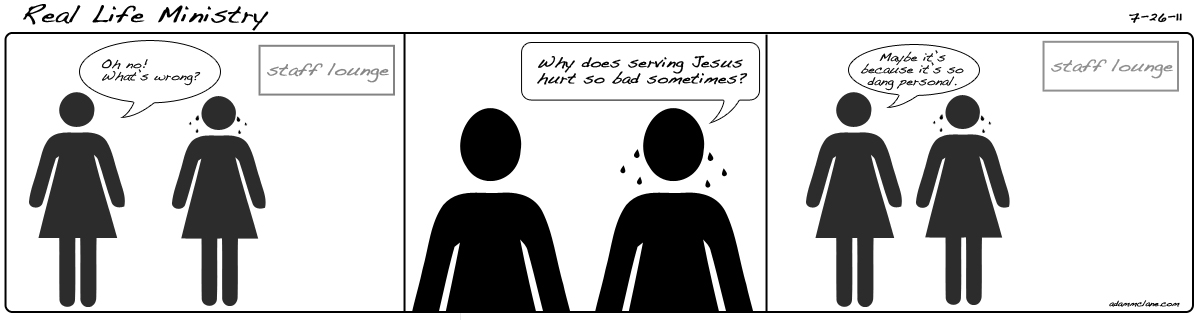
    Real Life Ministry: Why does serving Jesus sometimes hurt so bad?
    click for full-sized version

    If it didn’t hurt so much sometimes it wouldn’t be personal.

  • Jackson and Dad, 5 months in

    20110726-061043.jpg

    No DNA test required, right? This is my boy.

    JT has fit into our family from the first moment. We never knew he was missing from the family make-up until he invited himself to the party. He completes our little family.

    This baby is proof that there are no accidents in God’s eyes, just emerging possibilities.

    When an emerging possibility rocks you world, throw your hands in the air and enjoy the ride. His way is way more fun than your way.

  • The Big Picture of Parenting

    Original Cartoon published in Wall Street Journal (July 2008)

    Thinking about this– I know I have two huge handicaps.

    1. I didn’t grow up under “ideal circumstances” but I still turned out just fine.
    2. My own kids are only ten, almost eight, and five months.

    I’m not a parenting expert by any means. In fact, because I didn’t grow up with a strong relationship with my own dad (or any male whom I’d label a role model) I’m still learning how to dad.

    While I might not be there yet as a parent, and while I might not have the best native skills as a dad, I still have the power of observation.

    Here’s what I know from doing youth ministry and ministering to adolescents and their parents for my entire adult life: Parents who focus on the Big Picture have a higher success rate than parents who get lost in the daily battles.

    They win the battle but lose the war.

    What do I mean?

    Parents who are highly controlling, who don’t let their adolescent children experiment and find themselves in middle and high school, tend to see their children go wild in their 20s. The mistake seems to be that they focused on managing behaviors instead of trying to parent a teenager trying to figure out who they are. (The primary task of adolescent development.)

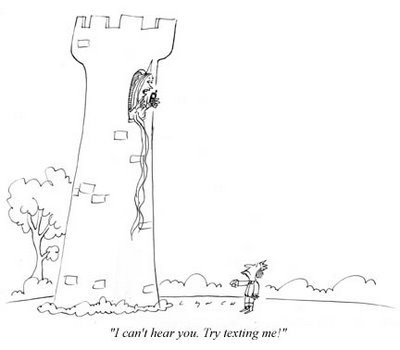
    So they freak when their 14 year old makes out with a girl at a dance. Or put them on lockdown when they try alcohol at a party at 12. Or force them to attend a church camp when they are 15 “to fix that nasty attitude.As if Repunzel-ing them were going to work.

    Sidenote: Isn’t the plot of every Disney movie a struggle to find ones self against the wishes of controlling parents? Ever wondered why those stories connect so strongly with adolescents? It’s powerful to them because it’s their life! 

    What’s the Big Picture?

    I like to look at my children with a long lens. What are the types of things I’d like them to be as adults? And then I work backwards.

    • I want them to be strong, independent thinkers. Not yes men. –> Arguing about things will be normal. Questions like “Why?”, my authority, and fairness are annoying, but fostering that.
    • I want them to enjoy simplicity. Reject the desire of plenty for the joys of saying no. –> While we live a pretty simple life, we allow them to experience luxuries. They want things, earn them, get them. In order to reject that stuff they’ll need to discover for themselves that there is no happiness in things.
    • I want them to have happy, healthy, and simple adult relationships. –> That means I can’t freak out about everything. They are going to like who they want to like. And they may make some mistakes along the way. But I don’t want them carrying around a daddy-phobia when they think about a partner. Is dad going to approve of this person? I want them to be happy. To have a healthy marriage. And to have simple adult relationships.
    • I want them to find pleasure in what they do. –> That means we want our kids to pursue their dreams for them, not ours. Not surprisingly, my kids are into nerdy things. (I mean, I’m kind of a nerd, right?) We’ve been open to letting the kids explore what they’re into. We exposed them to soccer early, I loved soccer growing up. But they hated it. So we didn’t force them to love it for us. Well beyond childhood we want to rally behind what they want to do vocationally. Sure, I have dreams for them. But their dreams for themselves are so much cooler than my dreams for them.
    What’s the Big Picture for Your Kids? Can you articulate it? And do you allow your Big Picture to overrule your cultural desires to over-parent?
  • The Godfather, Scene One

    Easily my favorite films.

    Right from the first scene you see that the world is controlled by two competing mores.

    First, the surface world where law & order seemingly rule in a land where everyone is equal. Second, the underworld which truly defines what law & order means for a certain class of people.

    This reveals something we all know: There are rules that apply to everyone and there is another set of rules which appear to not apply to everyone.

    Such is the way of the world. Such is the way of the world. Such is the way of the world. 

  • Plurality in Discernment

    Over the past few months I’ve processed some significant life changing stuff.

    Before I said, “1-2-3 Jump” to joining The Youth Cartel, I forced myself into a discernment process. I knew the Spirit of God was telling me to move. But, in truth, what I was hearing was more clues than it was clear direction.

    I knew it was time to do something else but I needed help knowing what it was.

    Two fact-based fears lead me to a discernment process rather than a solo decision:

    1. Fear of making the wrong choice and costing myself a few years of setback.
    2. Knowledge that, left to myself, I’ve made a couple of wrong moves in the past.

    The discernment group – plurality in decision

    When things got serious and I knew I needed to make a decision soon I moved from talking to only Kristen about it to including four people in the process.

    Here’s how I set that up:

    • I identified four people (they were all men this time) whom I respect, who know me in four different capacities, and whom I knew would not just blow smoke up my butt– they’d tell me the truth.
    • I asked them to be a part of it. To pray with and for me during the process. And to be available to exchange texts, emails, phone calls, or even get together a few times.
    • The four people wouldn’t ever meet. I’d meet with them separately and report back to Kristen what I was hearing and feeling.
    • I was up front that I needed to move quickly. So it would be a short, but intense, time.

    The buckets

    I knew I had five buckets of opportunity. These were five things I knew I could do. Discerning which bucket to fill was the first step, what to fill it with was the second.

    1. A youth ministry job in a local church or parachurch.
    2. A move to a similar role in another, existing, youth ministry organization.
    3. Freelancing McLane Creative.
    4. Starting my own youth ministry organization.
    5. Some combination of buckets.

    The early process

    There were a few significant points in the process. Each of the four drilled deeply into my time with YS. Each of the four sought to discover what I am passionate about. “If money weren’t a problem what would I dream about doing.” And questions like that.

    Early in the process I spent a half day with Marko. (One of the four) He lead me through an exercise which plotted things I’m competent at doing, things I’m passionate about doing, and things that were opportunities. And we talked a lot about the impact of my work on my family.

    At the end of that time two realities stared me in the face:

    1. As much as it was clear that I love the local church I shouldn’t seek a role in the church because that wasn’t a good mix for where I’m at right now.
    2. I really don’t want to live anywhere else right now. San Diego has become home our home.

    I reported these learnings to the other three and they agreed with those two things. Which pretty much eliminated buckets 1 & 2.

    Fear factor

    Buckets 3 & 4 were both starting my own business. Something I wasn’t sure I had the energy nor the guts to do at this stage in life. (I’m 35, married with three young kids. Paying for college feels closer every day! Health insurance is ridiculous. On and on.) Having run my own business before I know that it’s a lot easier to work for someone than it is to work for yourself. Plus, starting a business is crazy with all the legal and tax implications to think through. I’ve been there before. Do I really want to go through all of that again?

    The Aha Moment

    Somewhere along that process, actually fairly early on, Marko and I exchanged text messages late one night. We were talking through a situation he was facing with the Cartel and it all kind of clicked. “Instead of starting my own thing why don’t we just work together?” That led to a flurry of calls and emails over the next few days.

    I could do my own thing AND start The Youth Cartel with a Marko, someone I trusted and have walked with for a long time.

    I took that idea back to the rest of the group. In truth, I wasn’t sure what they were going to say. As excited as I was about the prospects of it I was also committed to submitting to this groups wisdom. I didn’t want to just trust my heart on this. I wanted it to be a good, solid decision.

    The resolution

    The answers came really quick. All of them were excited about that. It would allow me to launch both McLane Creative and The Youth Cartel in similar trajectories with separate audiences. (Bucket five) While it was scary to think about going into start-up mode as a family of five… it was less scary than settling for something I didn’t feel called to do.

    McLane Creative stuff would continue to push my creative and technological skills as I seek to best serve my non-church clients.

    The Youth Cartel would serve my church-based clients with marketing and web stuff, but also allow me to push into other arenas I have huge interests in. Coaching/consulting, resource development, and speaking/hosting gatherings.

    Maybe, if you’re going through something similar, this will help you? What decision-making processes have you used at significant moments? How could I improve this process? 

  • Summer babies

    There’s nothing quite as fun as new baby plants and their fruit. Here are three plants from our garden right now.

    20110721-083017.jpg

    20110721-083031.jpg

    20110721-083051.jpg

  • 1-2-3 Jump

    Photo by Carla MacNeil via Flickr (Creative Commons)

    Moses. Abraham. David. Joshua. Daniel. Jonah. Isaiah. Nehemiah. [Insert your Bible heroes name here____.]

    There is one important reason that you know their names and not the names of the thousands of people God may have called at the same time. People with higher status in their day. From better families. People who were probably more recognizable as they walked the face of the planet. 

    God gave those men an opportunity to do something for Him.

    And they jumped. They actually did it.

    We don’t know if God had called others who didn’t listen first. But the point is that you know their names because they jumped.

    They heard God’s voice in the desert or in a burning bush or through a prophet or in prayer or in the belly of a whale.

    And they acted.

    They could have heard God’s call and ignored it. And God, in His grace and benevolence, may have allowed them to live a very nice and safe life.

    But they didn’t.

    They heard God’s voice, turned around, and… jumped.

    Here’s the thing that blows me away: That same rare voice heard in the desert or the belly of a whale or in a burning bush… He lives in us as we are indwelled by the Holy Spirit.

    The question for us isn’t:Where will we have to wander to hear the still, calm voice as He lives inside of us.” The question is… “When He calls us to do something, do we jump?

    I don’t know what God has called you to do today. But I have committed my life to the idea that when I hear the still, calm voice– sometimes loud, booming, audacious voice– that I will jump.

    Jump first. Let God count the cost.

  • Christian Refugees

    Photo by Takver via Flickr (Creative Commons)

    Mid-City, the area of San Diego I live in, has long been a place where refugees start their new lives. Families have relocated here from war-torn African nations, fled the Khmer Rouge of Cambodia in the 1980s, or even escaped to here from extreme poverty in Central America.

    People from all over the world end up here to start over.

    Traumatized. Homesick. Hopeful. Confused. Off-balance. Grateful.

    Assimilation is both one of their greatest fears and one of their great hopes.

    Their lives are conflicted. Emotionally bouncing back and forth between hope and despair. They are here to seek a better life. But their hearts burn to go home and start a better life there.

    You Find Christian Refugees Everywhere

    There are lots of Christian refugees out there, too. People who grew up in church but fled somewhere along the way.

    You find them involved in local politics. Or coaching your kids soccer teams. Or living next door.

    They’ve fled the church. They’ve fled church culture and church life to seek a place where they could live out what they believed more than the church was comfortable with. All they wanted was to love God with everything they had and love their neighbors as themselves… but the church was hostile towards them. (Perceived or real) They didn’t fit the program. Or the mission. Or the pastor’s agenda.

    So they fled. They left quietly, found community elsewhere, and settled into a new life.

    They’ve rejected the abuse of the church but not Jesus. Disenfranchised but not disassociated.

    But they miss it. A piece of their life is empty. Just like the refugees who play soccer at the park down the street from me, they always hold out the simplest hope that they can one day return home. Reunited with the people they love without the fear of danger.

    When there is peace, they say– When there is something to return home to– they dream of returning.

    Church leadership is at fault

    Just like you can’t blame refugees leaving a country on the people fleeing, church leaders need to own the fact that they have caused a massive exodus from the church. Jesus tells us, his disciples, to call people to Himself. We need to quickly rectify our internal squabbles, give every person in our congregation a voice again, and go out to seek reconciliation with those who have fled.

    Blessed are the peacemakers, for they will be called children of God.

    Matthew 5:9

    To make peace. We need to go out and make peace.

  • Mexico isn’t Scary

    Not-so-scary street tacos and real Coke

    I spent yesterday with some folks from Amor Ministries in Tijuana.

    The point of our trip was to visit some recent Amor houses built in a colonia to create a video inviting NYWC participants to spend a day of convention there building a house. The houses we saw were anywhere from 3 days old to 10 months old. If you aren’t familiar with how it works, essentially Amor acts as an agent of blessing for a local group of pastors. Individuals from the community request help from their local church, and the pastor asks Amor to build a starter-house for a family. They intentionally don’t do everything because they want the family to come in and make it their own.

    You aren't afraid of a place where children buy neon colored baby chicks, are you?

    Here’s the reality for Amor (and YWAM, whom I visited last year): Fear of gang violence has lead to tons of people from the States stopping their annual trips down. Conversely, the downward dip in the economy has meant people already poor in TJ are now much poorer.

    All Amor is trying to do is help the local pastor answer the question, “How can the church be Good News so that the community will hear and receive Good News?

    Let me just say this: Forget what you’ve heard on the news. Yes, there are problems. Yes, drug cartel violence is horrible and deadly. But is Jesus always asking you to do the safest thing? 

    But TJ is still TJ. It’s a border town. And a border town is a border town. (No one ever claimed that Sarnia or Windsor Ontario were the hallmarks of Canada, did they?) If anything it’s much more developed than it was when I first went there 10 years ago. And I don’t think there is anything there to be afraid of for you or I.

    Now, if you’re buying or selling drugs. Or at a club until 2 AM. TJ might be dangerous for you. But so is Carlsbad.