• Let Grace be our language

    Is grace enough for you?

    Maybe I’m a cynic but I don’t think grace is a hallmark of a lot of Christians. We’re too busy having unrealistic expectations for one another and then wallowing in the disappointment of failed relationships.

    I’m too busy judging you for judging me for grace!

    Let’s get past this oddity of evangelical culture and descend into the heart of what we believe.

    We’re all perfectly imperfect. We need to expect imperfection from the people around us while individually, through the power of Jesus, trying to make our live more like Jesus. Not to celebrate it. But build it into our expectations for one another.

    I sin. I am messy. I hate things about my nature. Loathe even. I sadden myself with my sinfulness. Sometimes I disgust myself.

    Failure is a part of our walk with Christ. Some would say it is the beginning of our walk with Jesus. It’s part of being a leader. It’s part of maturing. It’s part of learning.

    You simply cannot walk with Jesus in a state of false perception of yourself, your mess, and your unique ability to do the wrong thing at the wrong moment.

    Think about it like this…

    The whole reason God created Eve was not for a sin bringing playmate. It was because the Father looked at his creation and said, “Its not good for man to be alone.”

    There is no more alone place than in a broken relationship. Conversely, there is little more powerful on this world than a grace-filled relationship with two people.

    Here’s my encouragement

    Every day you are given the choice between grace and judgement. In all things, chose grace.

  • Infantilization and deinfantilization of adolescence, part 1

    In the last year I read and was deeply disturbed by the book, Teen 2.0. If you are going to read a book in 2011, make it that one. It shook me.

    One of the primary things that Epstein brought up in the book and has dramatically impacted my view of youth ministry is the concept of infantilization. For years, youth workers (myself included) have lamented about how students are less and less mature and less and less willing to make adult steps. Epstein points out and asks us, “Why are students less and less mature?” To that question I offer something to chew on, Maybe because we’ve made them that way? And maybe we like it that way?

    I’d like to encourage you in the next 10 days to start recognizing infantilization in action.

    • Where are points where we don’t expect adolescents to take responsibilities for their lives?
    • Where are points in your ministry where you take away students ability to own their faith?
    • What are ways parents are holding their adolescent children back from healthy adult behavior?
    • What are words that you use which infantilize 12-18 year olds in your life?

    Don’t do anything but observe. Write them down in Evernote or on a piece of paper so you can keep track.

    And then, if you are so inclined, come back and share what you’ve observed.

  • YS Palooza Orlando

    This weekend I’m in not-so-sunny Orlando, Florida. We are here hosting our first ever YS Palooza. It’s super fun doing something for the first time! (Er, was that an innuendo?)

    The joy of launching a new event is that the whole thing is kind of an experiment. [insert evil laugh] So far, four hours into it, it’s feeling great!

    I ask that you pray with me for this weekend as we train and encourage hundreds of youth workers from all over Florida. Also, pray that we learn quickly from this thing! We love the idea of a two-day youth ministry training event that is kind of a mash-up between YS One Day and the National Youth Workers Convention. At the same time, we need to figure out what parts of what we’ve created works, what doesn’t work, and what needs to be tweaked.

  • The rise of the geek class

    Photo by Chantal Foster via Flickr (Creative Commons)

    Last Sunday, I was asked to pray in church for those of us in the tech industry, that we would use our skills as a means to Christ’s mission on earth. I opened my prayer by getting rid of the polite language. “Lord Jesus, be with the geeks and nerds among us. We were once made fun of but now are seen as the hope and solution for our companies. Let us use our new found influence for your glory and not our own. Let us point others to the Solution.

    The nerds and geeks have come to rule our nation logistically. We might not hold a lot of political offices but it is headline news when leaders change companies, retire, or even get sick.

    Long gone are the days when the rest of the room snickered when I said, “I run websites.” Now they wait for the meeting to end and then ask for my card so they can pitch their project to me.

    Becoming geek

    What makes a person a geek is that they have thrown away all semblance of generality and become hyper-knowledgeable in their sphere of knowledge.

    In some regard we are all geeks. It’s how you become a professional in a field. Last year, I was at a man’s house repairing his PC that had gotten clogged up with Spyware. About every 25 minutes he would come by and look at what I was doing and say, “Man, I’m glad you know how to do that. I wouldn’t have a clue.” After a few rounds of that I stopped him. “You know– this is just my skill. If my toilet blew up or my washing machine got clogged… I’d call you. The world needs both computer nerds and plumbers.” It was an aha moment for both of us.

    Geek isn’t just limited to tech. Geek is how you become an expert. And the world ceases to spin without experts.

    Lack of balance

    As a geek, I am perplexed at how some people judge me. They say it in subtle ways like, “I limit my use of the internet to just at work.” Or “I put up some boundaries so I don’t do that stuff while I’m home.” What they are really saying is that the thing they geek out in, say preparing for 25 hours to preach a 35 minute sermon, is somehow more noble than my task. They judge my expertise through the lens of their life and call for balance.

    At the same time becoming a geek at something brings joy and satisfaction far beyond a paycheck or acclaim.

    That’s the difference.

    Being a geek at something is the absence of balance. It’s really an acknowledgement of letting go of a desire to maintain balance as a generalist and completely go after one thing.

    Becoming a geek is making something others view as ignoble, noble.

    Some say I waste a lot of time observing and participating in all sorts of things. At the same time, I don’t waste a lot of time reading books or watching mindless television.

    No shame in geek

    That’s the nature of geek. Going after one thing in a completely unbalanced fashion. Geeking out for hours trying to figure out how something works, how you can improve it, how others worldwide have taken it to new heights, and trying to predict when your geek-subject will go in the future.

    May we stop judging and start embracing and supporting the complete lack of balance of the geek class. Stop trying to change them because, in the end, they will change you.

  • I live in SoCal, not Cali

    Welcome to California
    Photo by Kristina Sohappy via Flickr (Creative Commons)

    People are generally excited to come to Southern California.

    It’s a very cool place for our family to get to live! It is somewhere we never aspired to live but are completely enjoying.

    But I have to admit that I cringe a little when I see folks I follow on Twitter or friends on Facebook say, “I’m going to Cali.

    See, most people who live here don’t refer to where they live as “Cali.

    We aren’t offended by it. It just automatically self-identifies you as a visitor.

    Understand that California is a big state. VERY BIG. Venti. And extremely diverse geographically, regionally, in population, and culturally. On a perfect day it’d take you 13 hours to drive from Imperial Beach to Yreka along Interstate 5. (aka “the 5”) Just in San Diego County alone there are a bunch of different climates. Ocean beaches, mountain tops, arid desserts… palm trees and citrus trees to apple and peach trees; surfer to rancher.

    To smash the whole state into a phrase like, “I’m going to Cali” just doesn’t feel right to us.

    So what do I say?

    To generalize it, you can say you are going to NorCal or SoCal even though there is no official dividing line. When we lived in Northern California there was always conversations that the North should separate from the South… that’s how different they are!

    It’s perfectly acceptable to say, “I’m going to Southern California.” So don’t feel like you have to shorten it. But if you want to, it’s SoCal.

    Better yet, you can regionalize it by saying you are going to San Diego, LA, the Central Valley, Tahoe, or the Bay Area. Headed somewhere a bit more rural? Some people describe their travels by saying what county they are headed to.

    But few of our 37 million residents will post on their Facebook page, “I’m headed back to Cali tomorrow.” Just like you wouldn’t see someone say, “I’m headed back to Ala tomorrow.” Or, “Can’t wait to fly how to Wisc.

    At the same time. If you are coming as a tourist you can call us whatever you’d like as long as you leave some of your money here.

    Because primarily– you can call us capitalists.

  • Tunisia, Facebook, Privacy, and Freedom

    Most youth workers have developed a Facebook apologetic. That is to say, they know how to respond and argue for Facebook usage to engage with and interact with their students.

    One component of Facebook, which causes heart palpitations for adults, is that it is a place of dissidence and venting. And the motivating reason that adults see their blood pressure elevated about these activities is that they are either the object of said dissidence/venting or they are asked to clean up the mess created online.

    As a result, some parents and other caring adults use that as a case for Facebook being banned. (Which, as human nature dictates, just means adolescents find another place to carry out dissidence and venting. It is just taken off of the adult radar and disappears into adolescent-world. But you can safely imagine a William Wallace-like response, “You can take our Facebook, but you can never have our phones!“)

    Allow me to introduce to you a story from The Atlantic, which puts this into context:

    Expert analysts of the country couldn’t tell if Ben Ali would remain in power for a few more weeks or a decade. It did not feel inevitable that Ben Ali would be deposed. People had protested in the streets before. Revolution had been in the air. It wasn’t clear that this time would be different.

    There has been a lot of debate about whether Twitter helped unleash the massive changes that led Ben Ali to leave office on January 14, but Facebook appears to have played a more important role in spreading dissent.

    Imagine you are Ben Ali. You are the unpopular leader of Tunisia. You are an oppressor of freedoms. And you hear rumors that you may be deposed of your power.

    In youth ministry language– the youth pastor hears that his students are bad mouthing him on Facebook. And they’ve engaged with enough adults in the church that you might get fired.

    So what does Ben Ali do? He had long ago banned YouTube and other video sharing sites… but all of a sudden he discovers that hundreds of thousands of Tunisians are flocking to Facebook, networking, and sharing videos which document the terrors of his rule.

    While clashes with security forces took place in the streets, Rim, who asked we not use her last name, was in her bed in her apartment in Tunis. Like the blogger cliché, Rim sat in her pajamas sharing videos. In her hands, small protests that reached 50 people could suddenly reach another 50, who would share it with another 50. The idea that it might be time for the regime to change spread from city to city faster than street protests and even middle class places got involved.

    “There were rumors that Facebook or electricity was going to be shut down,” Rim IM’d me from Tunis. “Or both.”

    Did you get that? It was either shut down the electricity or shut down Facebook. But Ben Ali’s plan was more devious.

    After more than ten days of intensive investigation and study, Facebook’s security team realized something very, very bad was going on. The country’s Internet service providers were running a malicious piece of code that was recording users’ login information when they went to sites like Facebook.

    By January 5, it was clear that an entire country’s worth of passwords were in the process of being stolen right in the midst of the greatest political upheaval in two decades. Sullivan and his team decided they needed a country-level solution — and fast.

    Instead of just shutting down Facebook, Ben Ali had ordered that the very tool being used to create dissidence be used as a tool of the government to capture personal information.

    Facebook, the company with access to 800 million users personal information, had to make a moral decision. Was it going to get involved in support of a dictators withholding the reigns of power from the people of Tunisia by doing nothing? Or was it going to spur on political revolution by protecting their core values?

    They chose the latter. And, as we know now, their was a change in leadership in Tunisia.

    At Facebook, Sullivan’s team decided to take an apolitical approach to the problem. This was simply a hack that required a technical response. “At its core, from our standpoint, it’s a security issue around passwords and making sure that we protect the integrity of passwords and accounts,” he said. “It was very much a black and white security issue and less of a political issue.”

    The software was basically a country-level keystroke logger, with the passwords presumably being fed from the ISPs to the Ben Ali regime. As a user, you just logged into some part of the cloud, Facebook or your email, say, and it snatched up that information. If you stayed persistently logged in, you were safe. It was those who logged out and came back that were open to the attack.

    Read the rest at The Atlantic

    What does this have to do with youth ministry?

    I don’t know. Nothing and everything at the same time.

    I think a lot of adults feel teenage angst more than teenagers do. Deep down we believe that it is our role to save teenagers from themselves by putting up boundaries and barriers. At the same time we acknowledge that they carry the hope of the world forward in living out the Gospel in ways and to levels that our generation has failed.

    Instead of focusing our attention on somehow asking our students to be saved from the world, perhaps we need to focus on teaching them how to take over the world and lead it in a way which acts on their Jesus-influenced convictions?


  • A faith that costs you nothing is worthless

    When Jesus had called the Twelve together, he gave them power and authority to drive out all demons and to cure diseases, and he sent them out to proclaim the kingdom of God and to heal the sick. He told them: “Take nothing for the journey—no staff, no bag, no bread, no money, no extra shirt. Whatever house you enter, stay there until you leave that town. If people do not welcome you, leave their town and shake the dust off your feet as a testimony against them.” So they set out and went from village to village, proclaiming the good news and healing people everywhere. Luke 9:1-6

    You will be hated by everyone because of me, but the one who stands firm to the end will be saved. When you are persecuted in one place, flee to another. Truly I tell you, you will not finish going through the towns of Israel before the Son of Man comes. Matthew 10:22-23

    On hearing it, many of his disciples said, “This is a hard teaching. Who can accept it?” Aware that his disciples were grumbling about this, Jesus said to them, “Does this offend you? Then what if you see the Son of Man ascend to where he was before! The Spirit gives life; the flesh counts for nothing. The words I have spoken to you—they are full of the Spirit and life. Yet there are some of you who do not believe.” For Jesus had known from the beginning which of them did not believe and who would betray him. He went on to say, “This is why I told you that no one can come to me unless the Father has enabled them.” From this time many of his disciples turned back and no longer followed him. John 6:60-66

    When Jesus heard this, he said to him, “You still lack one thing. Sell everything you have and give to the poor, and you will have treasure in heaven. Then come, follow me.” When he heard this, he became very sad, because he was very wealthy. Jesus looked at him and said, “How hard it is for the rich to enter the kingdom of God! Indeed, it is easier for a camel to go through the eye of a needle than for someone who is rich to enter the kingdom of God.Luke 18:22-25

    When the members of the Sanhedrin heard this, they were furious and gnashed their teeth at him. But Stephen, full of the Holy Spirit, looked up to heaven and saw the glory of God, and Jesus standing at the right hand of God. “Look,” he said, “I see heaven open and the Son of Man standing at the right hand of God.” At this they covered their ears and, yelling at the top of their voices, they all rushed at him, dragged him out of the city and began to stone him. Meanwhile, the witnesses laid their coats at the feet of a young man named Saul. While they were stoning him, Stephen prayed, “Lord Jesus, receive my spirit.” Then he fell on his knees and cried out, “Lord, do not hold this sin against them.” When he had said this, he fell asleep. Acts 7:54-60

    If I am laying my life on an altar… what is the sacrifice? What is the cost? What are people testifying about my life? Am I doing things worthy of a stoning?

    Or am I just standing around, being religious, holding the jackets while my friends stone someone?

  • Moving towards the polite middle

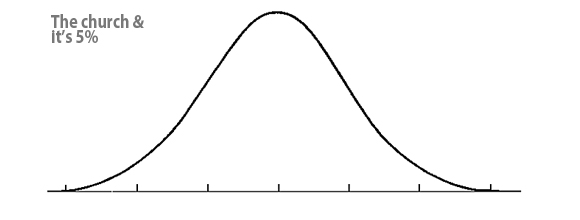
    As I think about the church and the 5%-10% of people we reach in the community I wonder where we fall on the bell curve.

    Something tells me that it looks a little like this.

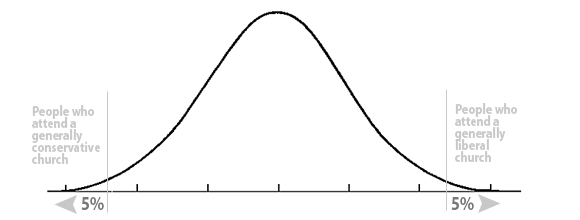
    I wonder if the positions we take attracts, appeals to, and connects a certain type of people? And I wonder if church leaders are going for the sucker pin of thinking of going more conservative (politically/socially/by American cultural definitions) or more liberal is going to lead to growth in their congregation? However, this is counter to what we know about behavior from the bell curve. This just means that to attract more people “like us” we need to have a wider reach and draw people from a larger and larger geographic area.

    Sidebar: Now, immediately I have some people who will read this upset because they don’t really like my labels. And they especially don’t like that I’ve lumped nearly all churches into two categories. And some are going to be quick to point out ways that their church is neither liberal nor conservative. That’s OK. This is just some generalization and hyperbole to make a point.

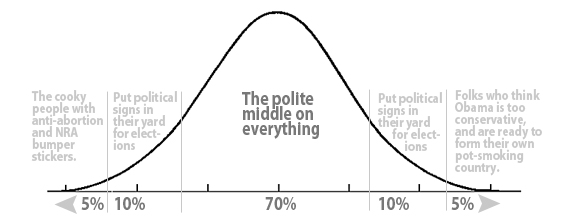
    Here’s my neighborhood on the bell curve. Again, full of hyperbole and generality.

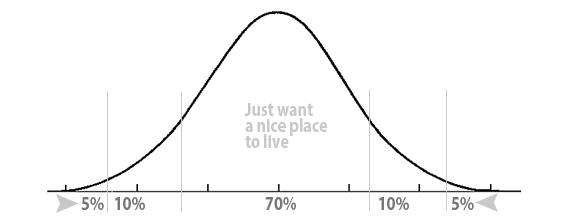
    Our neighborhood is not unlike any other urban or suburban neighborhood I’ve lived in. We have our cooky people on the fringes, we have our people who are just a little bit political, but who will quickly drop it for the sake of community… and we have the vast majority of people who probably have some personal opinions but just want the neighborhood to be a nice place to live, are willing to politely disagree on some stuff, and otherwise would rather be defined by their neighborliness than their political leanings.

    Think strategically church leader!

    Instead of trying to out-conservative or out-liberal ourselves, where we will find decreasing populations and have to incur the expense of widening our reach, the reality is that reaching the majority of the population will come as we lay aside our ideals and move towards the middle.

    As Stephen Phelan, my pastor, put it yesterday– The two extremes will come together when we focus on a common mission. For instance, if we focus on feeding and housing the poor, both extremes agree that we should do it for their own ideologies, and people in the middle are just happy to participate in something cool. The happy middle will agree to be a part of it because everyone knows it’s good to take care of the poor in your community.

    For example. I’m an egalitarian. I would love to see more women in the pulpit. And I’ve turned down positions on boards that were all male with the exception that I’d join the board if they moved towards 50% board membership by females. But I go, love, and support a church in my neighborhood that is PCA. (Which doesn’t allow women to preach or hold pastoral roles.) How do I deal with that contradiction between what I believe the Bible teaches about women and the church I attend? It’s easy… I’m in love with the mission of our church! Just like we overlook the flaws of our spouse because of our love, so I overlook this disagreement because of my love for the church. While I disagree with that one position, I am in full agreement with their strategy to reach our community and I love the staff as brothers and sisters in Christ. That over-powers my personal preferences.

    How to reach more people

    If you want to grow, from a population standpoint, you need to better represent your zip code and move to the middle. To do  this, you’ll need to take a sober judgement of your congregation. Walk around the place with centrist eyes. Ask yourself, “What is in this building that could be offensive to the general population? What would make people feel uncomfortable? What would make them feel like they didn’t fit in?

    Over the past few months people have approached me and said that I present both radical and simple ideas… that their church would never go for. The reality is this: Move to the middle to find growth and those naysayer voices will be overcome by the reality of your strategy. Focus on what we all know to be true… Jesus called the church to be good news to the neighborhood. It’s a centrist position that only feels extreme to people on the extremes scared to be pulled towards the middle!

    To move towards the middle you may need to realize that your leadership might just be on the leading edge one way or the other. That doesn’t mean that they can’t hold those positions. But it might mean that they can’t represent those personal convictions on behalf of the church.

  • The Parking Lot Movie

    I’m into obscure documentaries. Actually, anything biographical or anthropological intruiges me. So when NetFlix popped up with the suggestion of The Parking Lot Movie I was sold in about 8 seconds. Well, actually I pay $9.99 a month, so I guess I was already sold.

    What happens when you put a bunch of philosophy, anthropology, and religion students in charge of a job marked primarily by hours of introspective inducing boredom interrupted with terse moments of anger from people in fancy cars?

    That’s the 25 year question embarked upon by the owner of the Corner Parking Lot near the University of Virginia. To say that the job is cerebral is an understatement. Yet the owner of the lot is fascinated by the impact of tiny interactions with the general public. Instead of hiring people who would consider it “just a job” he has hired a cast of characters who try to find a deeper meaning in the mundane. Some of the attendants turn the experience into something fun and memorable. Others try to get patrons to think with witty philosophical quips. All of them get angry when people driving $50,000 cars try to talk them out of paying $2 for parking. And all of them teeter-totter between rage and zen-like peace with their lot in life.

    All of which makes this documentary completely fascinating and fun.

    The film raises interesting questions about entitlement, happiness, and the relationship between the stuff that we have and the people we are.

    What does that have to do with people in ministry? Just about everything.

    Fair warning: The film has plenty of foul language. Not intended as a recommendation for children or adults afraid of the f-word.

    Bonus: Here’s a music video from the filmmaker. This was buried in the credits unfairly.