
• Multi-Generational Communication

    multi-generationWhen I was in New Jersey, I had an intriguing conversation about communicating to multiple generations during the Sunday morning sermon. Kristen’s uncle, Fred Provencher, is a senior leader and one smart cookie. I loved this conversation on a lot of fronts. Fred is a great communicator, he is a great pastor, and yet he is doing bucketloads of research to try to figure out… “How do I become a better communicator and pass on some best practices to others?” How many senior leaders are really wrestling with this? I think most feel that their messages aren’t that effective, but very few will actually take the time to learn why and how to fix it.

    The task is nearly impossible!

    When I was on staff at a church we always had this feeling that Sunday was-a-coming. Like clockwork. It was always in front of you like a ticking time bomb. The local preacher has to prepare 50 messages a year, keep the attention of loads of different communication preferences, evaluate the effectiveness of last weeks message, prepare this weeks message, begin planning for stuff 6 weeks out so the worship team is can prepare, on and on. On top of all of that the preacher must try to factor in a way to communicate to builders, boomers, and all the rest of the generations… all of whom have strong preferences for how the sermon should be delivered. You can see why some teaching pastors just give up and do what their talents and preferences dictate. Which is why I’m so excited for Fred’s research.

    The task is wholly necessary!

    For 2000 years the Sunday morning sermon has been the primary communication tool of the church to the church body. Going forward I think it’d be hard to argue that the sermon will be less important in the future. The real question is, will it be as effective in leading the church going forward as it has been to date? Or will it fade into a tradition we do but see little fruit from?

    It’s about technology!

    The sermon is not about video, audio, big screens, dramas, special music, or even a talented speaker. But it is about finding the right technology for each audience. A communication style is a technology. Adapting to your context is a technology. The words you use to convey biblical truth are technology. The Bible is the content and the technology is how the communicator delivers that content.

    Context, context, context

    As I think about this I think about it as 3 contexts.

    Context of where you are: If your church is in suburbia and your audience is hooked on Facebook, YouTube, and are business people I’d think that you’d want to communicate differently than the church I go to which is mostly working class poor. I’m always shocked to see people emulating the communication styles and technologies of churches that just don’t fit the local context in which the church operates. That’s why Erwin McManus’s stuff is so powerful in his context but falls flat in other places. In the context and shadow of Hollywood, storytelling and visual arts are powerful technologies. I don’t think that would fly in rural Kansas.

    Context of the passage: I’ve been shocked to see misuse of technology in relation to the passage of Scripture the preacher is teaching. How can you teach the beatitudes… blessed are the poor, blessed are the meak… while using a $100,000 A/V system and by hiring professional actors to do a skit? Sometimes we get so worried about being hip and relevant that we actually offend the context of what we’re trying to teach. Imagine you are a working-class poor person attending a service that is supposedly teaching me that its OK to be poor. How can I undertand that message in a $20 million building from a pastor who makes $100,000 more than me! Sometimes we forget to look at the context of the passage through the lens of the the technology we use to deliver it.

    Context of who you are: Another shocker is seeing a communicator try to go outside of themselves. I’ve seen communicators put on a public persona or try to communicate in a fashion that just isn’t them. We visited a church in which a very type A, direct and to the point preacher tried to close his message with an artsy prayer experience. He fumbled through the instructions. He felt awkward telling people to get up. And he never stopped talking while people were supposed to be praying. The biggest thing a preacher should do is to be who they are. If you are hip, be hip. If you are a nerd, be a nerd. If you are artsy, show us. But if you can’t send an email don’t try to tell us you found this video on YouTube. When you do things that are out of context for you, it doesn’t matter if it was done to appease a generational expectation.. it just makes you look stupid.

    It matters who you are the other 6 days.

    The Sunday morning sermon is important. But it is validated by who you are when you aren’t preaching. Otherwise, they are just words. We live in a high expectation, low trust world. The true measure of your Sunday morning words must be lived out through your actions. That communicates to every generation that your message is worth listening to.
  • Balancing an attack-oriented life

    In this world there are people who attack life and people in which life attacks them. It’s a rational choice that becomes habitual and sets the course for your story. I am a person who attacks life. Most of the people reading my blog are people who attack life! Early in my Christian life I memorized a verse and this phrase stuck out to me, “make the most of every opportunity.” That struck me because I never thought Christians could be aggressive, but Paul makes a very aggressive statement!

    I just got back a 24 hour trip to Michigan. I am exhausted and pumped up at the same time! Basically, 12 months ago I did the same trip in opposite fashion so it’s not like I’ve never done it before. The truth is I’ve done that type of trip many times before. For example in October 2001, I flew from Chicago to Heidelberg, Germany for a five day trip in which I spoke 10 times. The mindset of, “I’m going there to do business and than coming home” is not new to me.

    The flip side of this is the notion of living a balanced life. A key reason we want to live a balanced life is sustainability. Which begs the question, “How do you live an attack-oriented life” It seems anti-balanced life to have some of your calendar year balance between family, friends, service, and work while other– big chunks– of your life is spent out attacking a project.

    I think its easy to over-compensate on both fronts. You meet people on the road who attack life too much. And you meet people at home who play the role of the attacked. The key is determining which things are opportunities that you need to make the most of because they advance your life’s purpose (whoppertunities) and which are just plain-old opportunities that will gain you some more income, notoriety, or just be an item to check off your list. And then there are things that masquerade as opportunities but are really distractions.

    In other words, part of being a leader is discerning which things are opportunities, whoppertunities, or distractions.

    Whoppertunities don’t come along often and they are worth dropping everything for. Opportunities come along fairly often and you need to take the time to discern if they are worth pursuing towards your stated goals. And ones that aren’t worth pursuing you need to label (at least mentally) as distractions.

    You ability to do that determines whether you can balance it all. Invest in too many distractions and you’ll soon be too busy to see whoppertunities or even opportunities you need to jump on.

    My stated goal is to change the world in which I live. By very nature that is an attack-oriented life as the only type of change the world does on its own is negative, entropy-driven change. Change for the betterment of an ecosystem is hard work. But it is never impossible!

    My advice to anyone who wants to change the world in which they live is to not give into the notion that you can’t be both balanced and driven by your work. That’s plain nonsense.

  • Candy Fight!

    I love working at YS. Here’s an example of our silliness.

  • A culture of fear

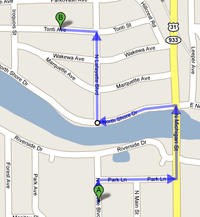
    walk-to-schoolLast night I got a Facebook wall post by a former neighbor and childhood friend. He posted some Google Streetview links to the places where we grew up, including the elementary school that we walked to. It didn’t take me long to get curious about our daily walk to and from James Madison Elementary School. I was a bit surprised to see it pop up and say .7 miles.

    When I thought out my daughter, entering 3rd grade, I thought to myself “there is no way I’d allow Megan to walk .7 miles to school without an adult!“It’s too dangerous. Too many bad things could happen. Plus we would worry all day wondering if she ever even made it to school. Couldn’t the school call me when she got there? Would someone call the police on us for letting her walk?

    Isn’t that an odd reaction? My mom was not cruel in making me walk to school. Nor was she considered a bad parent for not driving me. In fact, all the kids in my neighborhood walked to school! She would have been seen as a bad parent if she had driven me each day. Culture in 1980s permitted– demanded that kids walk to school.

    But the world is way more dangerous than it was when you were a kid, Adam! crime-rate

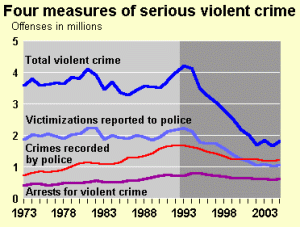
    That was my first reaction, too. Until I did some research and discovered that our country is much safer today than it was in 1985. While there is a general assumption in our psyche that things aren’t as safe as they were when we were kids… in fact, the world is a safer place. Less violent crime. Less petty crime. Even less violent crime against children.

    The culture of fear in America

    So why is it that we live in a safer society today but I would never allow my children to walk to school unattended? Why is it that it seems ludicrous to allow an 8 year old to walk to school with some friends? Why is it that I would be viewed as a horrible parent if I allowed her to do that?

    The answer is that in the last 10 years we’ve allowed a new cultural more of irrational fear for our children to creep in. It wouldn’t be illegal for my child to walk .7 mile to school but it would feel wrong.

    Culture mores are not always logical.

    Cultural mores are not always reasonable.

    Cultural mores are sometimes counter-productive for a society.

    When I think back to my childhood most of the good stuff happened as a result of long periods of time without parents. We walked to school, we were at school all day, and when we came home we played with our friends. We spent epic amounts of time in trees or playing games or creating sandlot baseball tournaments. Now we take our kids to school, ask the teacher to report their behavior to us, and barely allow them any unsupervised time without us. In effect, normative parenting skills inhibit a childhood like I had.

    Remember getting on  your bike and riding around the neighborhood all day?

    Remember going to the park with no adults around?

    Remember disappearing into the woods to build forts?

    All gone. Not because we live in a society that is more dangerous or litigious. But because culture has taken these things away.

  • Ah, ministry to students…

    Before Thursday night, I had spoken to exactly zero groups of high school or middle school students in the past school year. None. Zip. Zilch. For the most past that was intentional. I needed a break.That part of my life felt tired when I left Romeo. The grind of preparing 1-2 talks per week, year after year, really does wear you down. I was also feeling the type of exhaustion that lead me to say repeatedly, “I’m qualified to lead and teach, just too tired.” I’ve been especially thankful to the leadership of our church for being patient with me. They’ve allowed me the freedom to rest!

    So when Chris from Harbor asked me to host and teach his group of summer interns I was a little apprehensive. I always felt rusty after taking a vacation… how would I feel after taking a year off? Plus, I didn’t know any of the students so I couldn’t lean on relationship. Ah, the excuses I had created in my mind for failure!

    It all went great. Kristen completely rocked the hosting part. She made lasagna and salad… keeping it simple always seems to work best. The house was ready, the kids seemed to have a good time. 25 smiling faces when they came, while they were here, and when they left. Success! The only little bump was Stoney getting frisky with some guests. But that’s completely in character for him! The talk part went pretty smooth. If I had practiced a couple of times I wouldn’t have needed my notes at all and I would have had a better feel for some of the material. But I think I maintained their attention and the whole thing was pretty fun. (I was relieved that they actually did the discussion part… I never know how that’ll go.) Hopefully, I gave them something memorable, something worth thinking about, and something applicable to their service when they lead camp next week.

    As I’ve shared, the last year has really jacked with my identity in a good way. Switching from a full time role where my ministry was primarily to students and their parents to a role where I interact with a lot of youth leaders but not a lot of students… it’s given me a chance to think a lot about who I really am in Christ. Am I my work? Is my ministry outside the home more important than inside? What is it like to not be labeled “pastor” anymore? One thing Thursday night reminded me of… I was made to work with high school students. I can do a lot of other things at a high competency. And for this season of my life I am perfectly comfortable not working with high school students vocationally. Yet, this was a reminder that I need to be more intentional and giving in volunteering my service to high schoolers. I’ve got to figure that part. Reality tells me that I don’t have oodles of time. But reality also  tells me that something will be incomplete if I don’t find 3-4 hours per week to do something with high school students.

    That’s what I’m thinking about this Saturday morning. Now off to the beach so Stoney can hump his own kind.

  • This is so gangster

    This is the type of celebration a wedding ceremony deserves. I can’t lie, this made me tear up and feel all sappy.

    I really want to know what the pastor said when the ceremony started!

  • Evian Roller Babies

    OK, clever and cute. But does it make you want to buy water?

    HT to John Daly

  • Youth Worker Book of Hope ON SALE NOW!

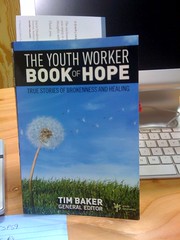
    At work today Mandy handed me an envelope from Zondervan. Holding it, I could feel a lump in it. As I opened it I joked to myself, “Geez, are they paying me in cash these days?” To my delight it was not a bundle of cash, it was my copy of The Youth Worker Book of Hope.

    Out of pure selfishness, I flipped to the table of contents and scanned for my chapter. Sure enough, on page 99 my name is in black and white. For a blogger that is a funny thing to see. I’m used to seeing my name on a computer screen… but printed in a book was a tactile experience I wasn’t quite prepared for. It was emotional and fun. I then dutifully read my chapter as if I hadn’t read it like 20 times before.

    When this project was originally pitched to me I was literally and figuratively thousands of miles from working at YS. As I’ve blogged about before I didn’t have a strong desire to be a part of a book project. When I walk into a bookstore I love seeing books written by people I know, but for whatever reason I’ve never had a strong desire to walk into a bookstore and find a title with my name on it. While my default answer about any book is always “no,” this project was on a topic near and dear to me– encouraging youth workers faced with crisis. That’s what my chapter is about… how do you handle a crisis in leadership in youth ministry. My working title was “what do you do when the crap hits the fan?” How do you deal with being dealt a bad deck of cards as a leader? I’ve been dealt some fun cards… and I jumped on board with this project because I felt like I had a thing or two to help others.

    Of course, the book isn’t about me. It’s about hope. There are lots of chapters and lots of authors sharing stories of how they found hope in hopeless situations. In that regard I think the book appeals to everyone, even people who don’t work at churches. That’s why I want to encourage you to buy the book. (Like right now! It’s only $11.04, you can do it.) It’s the type of book you want to have on your bookshelf for when hard times hit. It’s the type of book you’ll want to hand to a discouraged friend. It’s the type of book you may even want to come back to. Or even reach out and connect with an author.

    Youth Worker Book of Hope

  • Watch Cats Get Stoned

    I have a feeling someone is going to mash-up this video with Austin Powers music!

  • Facebook Morphs Blogging Again

    adam-head-09-100px-squareBlogging, by very nature, is a fluid art. Just a few years ago I thought I was pretty slick because I could journal on my computer using Microsoft Word. Flash forward a few years, to around 2000, and I learned that I could take those Word documents and convert them to webpages. It was cumbersome and I didn’t do it very often… but it was awesome. Then Blogger.com took “the web log” out of the hands of the HTML king and made blogging accessible to just about anyone willing to give it a shot. I was fasinated that I could link to friends blogs and that we could leave comments for one anothers posts. A few years later, 2005-2006 and Typepad and WordPress suddenly made it possible for blogs to live on their own domain easily.

    In 2007-2008, blogging became all about search and syndication. I started seeing my stats level off while I could tell my reach greatly extended. RSS (really simple syndication) made my content portable and SEO (search engine optimization) got my blog noticed high in Google search results.

    facebook2009 has seen blogging morph again. Facebook’s power in the adult demographic has brought blog syndication to a whole new level. Now my posts appear on my Facebook friend’s timeline, so a whole new audience of people has been added to the pool of people who read my blog. When they comment that ends up on their friends timeline, which greatly expands the pool of people reading and commenting on my stuff. (Though there isn’t yet a matrix for this so that’s a bit frustrating.) In the past few months I’ve run into tons of people who read my blog and I have no idea who they are or how they got here… but it’s awesome!

    More noticeably, in the past few months I’ve noticed a steep uptick in folks who read my blog posts exclusively on Facebook and comment there as well. Often times, I’m left with a post which generates two separate conversations. Which is really cool! On top of that, Twitter has further expanded my blogs discussion and reach. While there is some overlap, Twitter is mostly a different audience for my content.

    Wagon_WheelGoing forward, adammclane.com is now and will continue to be the hub of my online presence. It feeds RSS, search results, Facebook, and Twitter. I think of the personal blog as the engine that powers everything else. That said, my recommendation for beginners has begun to morph. You can certainly do the same thing with a WordPress.com blog (free) or even a Facebook account.

    And since I know about 75% of the people who are reading this post will never make it to adammclane.com, here are some ways we can connect. We can be Facebook friends. You can follow me on Twitter. We can pool links on delicious. You can be a contact on Flickr. You can subscribe to my blog via RSS. But you can’t be my Myspace friend. That’s so 2005.