This makes me so jealous. I want to go!
-
Football, Church, and polls
 August 1st arrives and I find myself drawn to coverage of football. I’m not really into baseball. With 164 regular season games I struggle to care between April and September. The NBA playoffs last almost as long as the regular season so that has never interested me. March Madness is fantastic, but it only lasts a month. And I can’t get into watching hockey on TV so that is out. College football is, by far, my favorite sport to get into.
The Pre-Season polls are starting to come out. This is the one thing that truly irks me about college football. So much is determined about the outcome of the football season before the ball is kicked off in September. It simply makes no sense to me that you pre-rank teams before they’ve played a game knowing that the polls will eventually determine who gets ot play in the national championship game. The same 25 teams are in the top 25 each fall. It’s as though the script for college football has already been written. Tim Tebow, back for his senior season, will play either Texas or Oklahoma for a national championship… depending on who wins the conference championship game. A playoff is the only thing that will fix this. And even that will be effected by pre-season polls.
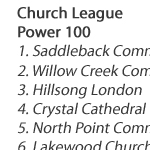 A few years back I was hanging out with some friends and we were discussing setting up a fantasy church league. You know, put out church rankings based on attendence, power of sermon, quality of worship service. Add to the mix some Church Center replays and postgame talk… we could probably get enough interest to put out weekly rankings. “Late in the sermon it looked like Craig Groeschell was losing his audience. Heads dipped and the internet interaction started to slow. But then he threw in an unexpected hail mary altar call and brought it down! What a pro finish!” or “John Piper’s delivery was flawless on Sunday. His precision in slicing and dicing that passage, tying in the joy application, that was a thing of beauty. Church Center play of the week nominee, for sure.” But then we thought it’d make the whole thing just weird if it blew up and pastors started spiking Bibles and dudes started getting endorsement deals. Can you imagine a postgame interview from Perry Noble? “First off, I need to give all the glory to Jesus Christ. Second of all, I couldn’t have done it without my Pepsi Worship Team and the Tommy Nelson Gospel Choir. Without them, we wouldn’t have won today.”
Thankfully, we came to our senses on that one. The last thing anyone wants is for megachurches to start lobbying supporters for all-star votes!
Football wouldn’t be the same without rankings. Church wouldn’t either.
-
When life crushes you
Awesome video. When I saw it I laughed and went “hmm” at the same time. Isn’t it ironic that the thing that cleans and refreshes us… in massive quantities crushes and destroys?
As an introvert stuck in an extroverts world I often feel relationally crushed by human interaction. For example, one of my biggest struggles in serving in ministry was the always on nature of events, retreats, and mission trips. I would ache for alone time to reflect on what was happening, but feel crushed by the urgent needs of my students. I’m ashamed that there were moments of imbalance where I would snap at an adult volunteer or student… not because of what they did or said but because they inhabited the space my introverted mind wanted to protect.What are the types of things that crush you with their goodness?
What are some centering activities you do when you feel crushed by things that are meant to refresh and cleanse?
-
Gran Torino Discussion Questions
 Walt Kowalski is a widower who holds onto his prejudices despite the changes in his Michigan neighborhood and the world around him. Kowalski is a grumpy, tough-minded, unhappy an old man, who can’t get along with either his kids or his neighbors, a Korean War veteran whose prize possession is a 1972 Gran Torino he keeps in mint condition. When his neighbor Thao, a young Hmong teenager under pressure from his gang member cousin, tries to steal his Gran Torino, Kowalski sets out to reform the youth. Drawn against his will into the life of Thao’s family, Kowalski is soon taking steps to protect them from the gangs that infest their neighborhood. link
Discussion Questions:
– Why do you think Kowalski stayed in his neighborhood when all of his neighbors had moved to the suburbs?
– Perhaps the hardest part to stomach of Gran Torino is the repeated use of racial slurs. Do you think Kowalski was a racist?
– The miscommunication between Kowalski and his sons was epic. Based on what is presented in the movie, what would be some steps the son could have taken to re-open the lines of communication?
– What changed Kowalski’s opinion of his Hmong neighbors?
– When confronted with the priest, Kowalski closed the door on his because he was too young to comprehend what Kowalski was going through. Should the priest have honored his parishner’s wishes, tried harder, or done the same as was presented in the movie?
– Kowalski fathered Thao in a way that he didn’t his own children. Why?
– The Hmong people celebrated Kowalski as a hero. Was he a hero, a vigilante, or a nutcase?
– Which character was more righteous, Kowalski or the priest?
– When Kowalski finally goes to confession, he confesses that he kissed a woman at a cocktail party and that he wasn’t a good father. Do you think there were other burdens that he needed to confess?
– Kowalski’s actions helped one family in a tough neighborhood. What action could you take to make a change in your nieghborhood?
– Ultimately, Kowalski embraced his Hmong neighbors, mentored the boy next store, and helped them seek justice where justice could not be found. What does that teach us about our individual responsibilities in the hood we live in?
– Which character represented the person you’d like to be. Why?
– Which character exhibited the type of faith you’d like to exhibit in your life?
– What do you think happened in the neighborhood after the story ends?
-
Going lean and mean

Yesterday’s church service was a celebration of what God is doing in our community. For those who don’t know, I attend a church plant called Harbor Mid-City. It’s an effort to do the impossible task of bridging cultures in one of San Diego’s most diverse communities. Mid-city is home to roughly 60 language groups and it’s socio-economic demographic stretches nearly as wide. In short, it is a place which embraces the awkwardness that these people don’t normally come together for the sake of living out the Gospel message of justice and equality while being surrounded by injustice and inequality.
No church has ever challenged my way of thinking more. In theory, I love everything Harbor is about. But in practice, I’m a wuss and have to actively fight my tendency to make church about my kind of people worshipping in my kind of way. I thank God for His challenging our to invest there for now.
For the last few weeks the church– and a hodgepodge of other ministries in the neighborhood– have run what they call The Urban Project. Essentially, this is a justice in action project. I don’t know all of the details of everything that was done but I do know that for these few weeks the whole church put forth an effort to do really cool stuff. They fixed stuff that was broken. They pointed out to local government injustices in our working class poor neighborhood. They employed high school students and taught them leadership skills. They ran a free day camp for the children of the community. I’m sure they did a lot more, too. But that’s the stuff I know of.
Here’s the point of this post: The church couldn’t do this if they didn’t operate lean and mean. Here are three ways they operate lean and mean that are worth thinking about:
1. No property. I think a lot of churches would be wise to sell their property. They have no idea what a distraction an office is for the staff nor how much time/effort/money is wasted simply by maintaing a building. It’s a gross inefficiency that most ministries don’t truly need. By not having property to hang at, maintain, or pay for… the church is able to focus much more attention on their actual ministry.
2. Low-tech service. If you are used to high production church you’ll be shocked to see how simple the services are at Harbor. Seriously, shortly after arriving at Harbor a couple of staff asked me to get involved helping them catch-up. My counter-point to them is that a pretty, produced service has little net gain for the amount of time invested in making it great. I’d rather them stay focused on what makes the church great than get distracted in trying to get pretty. It’s 90 minutes of people’s lives each week… to people in the pews it’s not nearly as significant as people in church leadership think it is. I’m glad to see that Harbor continues to keep the worship service in perspective and keeps it simple. (Yet powerful in its simplicity!) Moreover, I think a lot of churches think their worship service change lives and over do it. If there is one area of regret from my time in church ministry its that we wasted so much time producing a worship service. I kick myself for that all the time.
3. Preaching rotation. This is something I greatly appreciate about Harbor. You see, the lead pastor is very gifted. I’d put him on par with most of the people we bring in at YS events. And yet Stephen’s main ministry is not preaching. It’s leading the church and ministering to the people. If Stephen concentrated on preparing 50 sermons a year the churches overall ministry would suffer. A major reason we’re seeing so much success is that when he shares the pulpit with other qualified people he essentially has created an additional part-time position at the church! I wish more preaching pastors gave up the pulpit at least once per month for the sake of the church ministry. At the end of the day, life-on-life ministry has long-term impact while up-front preaching ministry tends to have short-term impact.
What are ways that you could re-evaluate your ministry to get lean and mean in the ministry season to come?
-
Humans and the pentatonic scale
This absolutely blew my mind. Check out what Bobby can do via audience participation. Not only is this facinating showmanship, it’s fascinating science. How does everyone in the audience just know what to do?
World Science Festival 2009: Bobby McFerrin Demonstrates the Power of the Pentatonic Scale from World Science Festival on Vimeo.
HT to Cory
-
So, you’re done?
At lunch yesterday 3 guys sat around the table getting to know one another better. In the course of the conversation we chatted about kids. Each man had two. The guy sitting next to me affirmed that two was enough for his family and barring a medical miracle, they were done. The guy across the table said that he and his wife hoped for one more. When they found out I had a 5 (Paul is 6 next Saturday) and an 8 year old, they said… “So, you’re done, eh?”
I have to be honest. Now that Paul is almost 6 it’s at that point where— adding a third would be like starting a second family. At the same time Kristen and I look at each other and joke about a third child all the time. Truth on that is, we usually say it in the most sarcastic way possible when Megan or Paul is having “a moment.” You know, the type of moment so horrific that you label it as birth control. You know, temper tantrums at the Capital building, or in Battery Park, or the one in a hotel recently in which I was certain someone would call the cops.
There’s a more personal angle to this. It’s hard for me to acknowledge that I’m somehow old enough to be done having kids! The crazy thing is that some of the people I went to high school think that 33 is the time they should get married and start a family. When people find out Kristen and I met when we were 18, got married at 21, and had Megan at 24, they feel uneasy about that. They say, “Oh, you were just babies!” We look at our peers and think, “You waited until your 30’s to get married? You’re so old!”
9 out of 10 times I just roll with the joke that Kristen and I got married as children. But every time that comes up I am overcome with self-righteousness… No, we were the normal ones. No, we were the ones making the good decisions at 19, 20, and 21. No, we were the ones who didn’t buy into the middle class notion that you have to be a certain age to fall in love or get married. No, we were the responsible ones while all of our classmates were focused on keggers and messy college relationships which required years of recovery and regret. Indeed, we were young and naive about life. But who isn’t? How dare people tell us we were immature to marry at 21! [Steps off soapbox, hands microphone back to street preacher and walks away.]
I’ve done enough pre-marital counseling to know tt doesn’t matter what age you get married, you’re always ignorant about what you’re getting into!
Something is completely broken in our culture when we begin labeling adults (18-22) as too young to be adults. It’s jacked up to say people old enough to serve in the military are too young to be in adult relationships or make adult decisions. What’s next? 30 is too young to get married and have kids? What else will our culture throw in the way?
Why is it that middle class white people consider 24 to be on the young side to have kids? [Physically, that’s prime time.] And yet people in the city would say… “Wow, you were 24 when you had your first kid?” The answer is culture. In affluence we keep our children immature a lot longer. (Just look at the super affluent British royal family, Prince Charles still acts very much like a 17 year old, doesn’t he?) When you are affluent you don’t have to grow up because you don’t have to feed yourself, clothe yourself, or make enough money to pay the bills. Part of what matured Kristen and I in our early 20’s was precisely that. We needed real jobs to pay real bills. We had responsibilities. We made a lifestyle choice that kept us out of clubs. A few years into marriage we knew we made enough money and were stable enough to start a family. In essense, we were not developmentally delayed like our affluent classmates.
So, does 33 with a 6 and 8 year old mean we’re “done” having kids? It kind of looks that way doesn’t it?. I know I don’t want to go back to baby seats, puke, dirty diapers, and finding half-eaten Cheerios tucked behind the couch! Maybe we should just focus now, in our old age, on helping our friends with their babies?
-
College Ministry 101
 Today, I am driving up to Los Angeles to meet with fellow YS blogger and YS author, Chuck Bomar. Chuck’s new book, College Ministry 101, is an important read for the church today. While church leaders have known of a significant drop-off of kids from high school into college few church are doing anything serious to rectify it.
Some churches run programs like glorified youth groups that really just delay the problem.(Eventually you do need to transition them to an adult-like ministry, right?)
Most churches do nothing. Their action provide an implied rumschpringer where Christian children go off and experience the worlds delights and horrors. (And 20% or so return later.)
Some churches expect 18 year olds to join adult Sunday school or small groups.
Long story short, Chuck has spent a lot of time helping churches figure out the college-aged ministry and now he has a book. Today I am meeting up with him to do some filming for the podcast as well as some stuff about his book.
I’m looking forward to meeting him. And I’m looking forward to what he has to teach youth workers about college ministry.