Here’s a list of headlines from the month of January 2016 for the Google News search term, “Youth Pastor.” I’ve deleted multiple links to the same instance.
Now that we’re homeowners again I’m in the midst of a whole litany of home improvement projects. (I’m even writing today in my half built Tiny Office to get a sense of where I’ll want furniture, install outlets, and stuff like that.)
Along the way I’m testing out home automation gadgets, trying to find some balance between playful stuff, home safety & security, and energy efficiency.
What is Nest Cam?
Here’s the official description.
Meet the Nest Cam security camera.
24/7 live streaming. No dead batteries. No missing moments. This is what a security camera should be.
Features
24/7 live video streaming – See your home on your phone in 1080p HD. And control Nest Cam from anywhere
Alerts on your phone – Get motion and sound alerts so you know if anything happens
Night Vision done right – See the whole room at night – not just a limited spotlight view
Talk and listen – Hear the baby. Or talk back to get someone’s attention
Quick, easy setup – Plug in Nest Cam and download the Nest app to get started. No hub needed
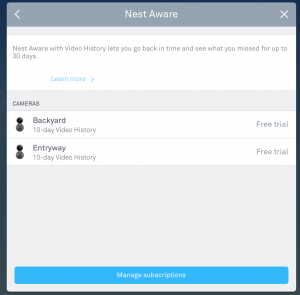
Don’t miss a thing – Subscribe to Nest Aware to get 24/7 continuous recording and powerful cloud algorithms that give you personalized alerts. Every camera comes with a free 30-day trial
Adam’s description
It’s a $200 web cam with a $100/year subscription service.
The Good
I’ve been testing Nest Cam for about a month. So far, so good It’s easy to install, easy to use, and works as advertised.
Nest Cam was originally developed by a startup called Dropcam, acquired by Google Nest’s Labs in summer 2015. Google, Amazon, and Apple all seem to be fighting to get a foothold in the emerging market of home automation things called The Internet of Things. So for Google, acquiring Dropcam probably just made sense and they wanted to get it before their competitors did.
Installation
Out of the box Nest Cam comes with a few physical installation options. It comes mounted on a well-weighted metal stand with a magnetic base. It’s good looking, nice enough to just plug it in, stick on a shelf, and forget about. The stand is easy to aim in whatever direction you’d like. There’s also a wall mount that’s easy to install, the camera then snaps to the base with a magnet.
The software is also super easy to install. You install the Nest app on your phone or tablet (iOS | Android) then plugin the camera. The only hitch for me was that I had to then create a Nest account on my phone when doing so on the website would have been a lot easier for my fat fingers. Following the instructions in the box you first pair the camera to your phone and then the phone app helps you install the Nest Cam onto your home wifi. This process takes about five minutes and then you’re up and running.
Features I Like
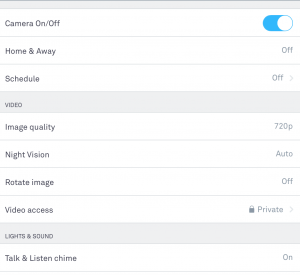
It’s a good camera that’s simple to use, set it and forget it. We use it to broadcast at 720p but you can also use it at 1080p or 360p. We chose 720p because it was clear enough for our needs but didn’t bog down our wifi. We found 1080p did.
I like that the corresponding app (and website) is easy to use, you can toggle features on or off based on your preferences. I like that we can set it up on a schedule or remotely turn it on or off, etc.
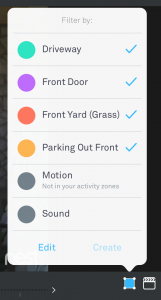
Nest Cam Alert Areas – You create zones and toggle which you’d like to receive alerts about.
I like that you can set alert areas. One of the key features is that you can chose to get a notification if there’s motion in an area you define. This is pretty simple… you just go into your account on the website, draw a picture around what you want to monitor, and indicate that you’d like to get an alert if there’s motion in that area. That’s helped us cut down on some of the annoyance we had with it originally, which I’ll share below.
I like it’s portability. While we have ours permanently mounted on the exterior of our home I’ve seen other users who move it around, even using it as a cheap and easy way to broadcast meetings, events, etc. That’s pretty cool!
I like that it’s efficient. We have one mounted outside of our house in a place where we don’t have power. So we’re actually using a Jackery Giant (USB battery pack) to power the camera, each charge lasting about 20 hours.
I like that it works with other Nest products. In the future I’ll write reviews of Nest’s other products, their thermostat and smoke detector. But, so far, we really like that all of those devices work together and are accessible from the same app.
I like that Nest is providing a way for other manufacturers and developers to interact with Nest products. I’m using things like IFTTT to automate a whole bunch of stuff around the house, more on that in another review.
The Bad
The first is the most obvious. It’s too expensive for what it is. I recently purchased web camera’s of similar quality for about $30 at Wal-Mart. Is the fact that it has a wifi capability and an app worth an extra $170? For me it was. But for lots of people I don’t think it is. I have a feeling that it’ll drop to about $99 before Christmas 2016 and that they’ll release a new $199 version about the same time.
I don’t like that it’s not waterproof out of the box. It’s not rated for outdoor use, per se. But let’s be honest… most people are going to want to use it outside. It makes no sense that you have to buy aftermarket accessories to make it waterproof. This reminds me of the first few versions of GoPro where you bought the camera and then you spent three times that on accessories just to get the silly thing to work. We added a $20 waterproof case from Dropcessories that allowed us to mount them outside where they might get wet. That’s $20 to fix what is otherwise a design limitation.
$100 per year for one camera, $150 per year for two cameras.
I don’t like that you need to pay for Nest Aware. To get all of the features of Nest Cam to work you really need Nest Aware, their subscription service that records live footage. Basically, without Nest Aware you can’t go back and look at things your camera has recorded. Say… someone prowling your home. Without the Nest Aware subscription you could get the exact same thing with a waterproof GoPro Hero 4 Session and their native app.
What About Data Security?
“But Adam, you’ve long said that anything you post online is not private, it’s public. How is this different?”
Well, first of all it’s definitely in the best interest of Google to protect the data of Nest users. Since they are investing billions of dollars in home automation, you better believe that they want to keep this stuff secure from hackers.
Second of all, the way that we’re using Nest Cam… to capture video of outside of our home… is not technically “our private space.” The Supreme Court has affirmed that things that happen outside of your home are not assumed to be private. Just like I can take a picture of you on the trolley without your permission, I can video things that happen outside of my house without needing anyone’s permission. (For non-commercial purposes, that is.)
Third of all, while I’m OK with the perception that what we’re broadcasting is indeed private, I’m aware that it potentially is not. I’m 100% aware that my privacy is a perception in a lot of ways. (After all, I carry around a recording & tracking device in my pocket all day…)
I would be more concerned about Nest Cam streaming 24/7 inside of my home. I’m sure that my account is somehow vulnerable to hackers (or government’s prying eyes) and I just don’t think it’s a great idea to make it easier for someone to see what’s happening inside my house are even pick up the audio of people in my house talking.
But the things that we’re using with Nest Cam (and the thermostat) aren’t directly tied to our house from inside of the account. For instance, while the thermostat is recording a lot of information about our house… it’s benign information like humidity levels, outside temperature, stuff like that. When/if we start using Nest for more sensitive stuff… I’d at least like to see my Nest account protected with 2-factor authentication.
The Money Line
We really like Nest Cam. While we initially were infatuated with it we’re finding it to fit into our household rhythm. We’ve used the advanced features to make the notifications work for us, so instead of alerting us of every car that drives down the street or every time the wind blows a tree… we’re getting adjusting it so that it’s only alerting us when we want to be alerted, like if someone is at the door.
Is it worth $200? I don’t know. What’s the cost of being able to check in on your house when you’re away? What’s the value in knowing who is poking around in front of your house when you’re not home?
I think $200 is buying us a little bit of assurance and, at least for now, it’s worth it.
Back in November I heard from an 8th grade student who wanted to interview me about Snapchat for a research project she was writing for school. Her questions were probing, interesting, and excellent!
With her permission, and the permission of her parents, I am sharing that interview today.
J: Why was snapchat created?
Adam: In my post, Why You Should Delete Snapchat, I wrote this: The fact is that Snapchat was created as a sexting app.Like a do it yourself version of Girls Gone Wild. You might not use it that way, but that’s what it was created for.
J: Has anyone’s pictures ever been leaked on Snapchat? If so, how?
Adam: This has happened LOTS. While Snapchat is more secure and better engineered now, they suffered many leaks of account info in their early years. See this post, 200,000 more reasons to Delete Snapchat
J: Would you consider Snapchat safe? Why or Why not?
Adam: Safe is a relative term, right? So I’d wonder what you mean by “safe”? Is your data secure? Yes, it is more secure now than 3-4 years ago. Is it safe for a teenager to use? I suppose that’d be determined by what you were doing with the app, what you were posting, what was being sent to you, etc. I would argue that the vast majority of Snapchat usage at this time is normal social media usage for teenagers. But you also can’t lose sight of 2 facts.
Snapchat’s early, explosive growth was fueled by it’s early sexting app history. Why did it take off? Because of sexting. How is it used now? In both safe and unsafe ways.
J: What age group do you think was intended to use?
Adam: The original intent was college-aged people. (See Why You Should Delete Snapchat post) Currently, 70% of Snapchat’s user base is female. My original argument, based on the founders own words, was that Snapchat was created to sexually exploit college girls. While I’ve softened that argument it is clear that the primary users and target audience of Snapchat remain female. Just look at their marketing, it’s geared towards younger females.
J: Do you think Snapchat exposes kids to online predators?
Adam: I have engaged with law enforcement officers in many places in the United States across many agencies investigating cases of adults targeting underaged women with Snapchat. Up until the FTC ruling, Snapchat has [sic] no way for law enforcement to force Snapchat to share information that’d be useful for prosecuting sexual predators. They had a reputation for not responding, ignoring court orders, etc. However, after the 2014 FTC ruling, Snapchat is in compliance and provides a way for law enforcement to get the data they need to prosecute sexual predators using their app.
J: In your opinion is Snapchat much worse than other social media sites such as Twitter and Instagram
Adam: The ephemeral nature of Snapchat (that the images “disappear” or that things are temporary) does encourage less thoughtful, more whimsical usage. That’s not always bad. In fact, researcher Dana Boyd basically predicted something like Snapchat two years before it was created precisely because teenagers had no where online they could just be goofy without leaving a searchable history. (Like Twitter, Instagram, etc) My reminder to teenagers is that just because the image disappears doesn’t mean that the memory of what you’ve seen does. That’s not the way our brains work! Likewise, I’ve worked with many teenagers who have sent things with Snapchat they regretted. So while the image may only last for a few seconds, the impact of what you’ve sent lives on.
J: What do you think appeals to teens about Snapchat?
Adam: This is a really important question, one which I do my best to get parents to understand at my workshops! In her book, It’s Complicated, Dana Boyd says that teenagers need places to hang out with their peers. However, increased busyness, over-involvement, and over-regulating the freedoms of teenagers (See chapter 1 of Robert Epstein’s book Teen 2.0 for more on that… his research shows that adult prisoners have more personal freedoms than American teenagers!) creates the need among teenagers for adult-free spaces. This is what she calls “Networked Publics” which is a fancy way of saying “Online places to hang out.
J: What age do you think people must be to use Snapchat?
Adam: Actually, this isn’t about an opinion. In the United States the age is 13. A federal law called COPPA (Child Online Privacy Protection Act of 1993) prevents any online company from collecting personally identifiable information about anyone under the age of 13. I wrote about this here – http://adammclane.com/2014/06/12/allow-children-get-social-media-account/
J: Do you believe that Snapchat collects information about its users?
Again, this isn’t a belief, this is a statement of fact. Snapchat collects lots of information about their users. They make this clear in their privacy policy. If you’ll read the privacy policy you’ll see two things I’ve taught people about social media since the early 2000s…
There’s no such thing as anonymity or privacy online, just the perception that your activity is private and/or anonymous.
You aren’t the customer of a social media company, you are their product. You are freely giving them information which they turn around and sell to advertisers, marketers, and other agencies.
They make this perfectly clear in their privacy policy. But marketing is powerful… it is, as Seth Godin says, a lie.
J: Can you think of any positive things about Snapchat?
Most users use Snapchat in a safe way. And certainly most users seem to enjoy using Snapchat. As I mentioned before, I think that Snapchat addresses a real need among teenagers… a place to just be a teenager without the prying eyes of adults. That’s a very good thing. I just wish that Snapchat were a better digital citizen. I think they are getting there, but it’s taking people willing to do the work to force them to be more responsible.
The Word became flesh and blood, and moved into the neighborhood. We saw the glory with our own eyes, the one-of-a-kind glory, like Father, like Son, Generous inside and out, true from start to finish.
Dr. King’s life reminds me that vocational ministry isn’t limited to church employment. Our calling is bigger than a job.
The incarnation of Jesus takes the Good News preached in our pulpits and invites us to live it out as good news in the neighborhood.
The Unmoored Ministry
It’s been several years since I last worked in a church. It’s a funny thing… you spend a decade pursuing one thing [a career on church staff] and then God invites you to explore something entirely different. [a career serving the church outside of church employment]
If I’m honest I’ve not really recovered. I feel “on purpose” in my work but not quite in the same way as every day grinding it out on staff. And as I’ve written before this sometimes leaves me feeling disconnected and lost. “What am I doing here?” That’s not an unusual question for a Sunday morning. The answer is unsettling: “Just sitting here in this chair, counting down the seconds until it’s over.”
For me, that’s where Dr. King provides some inspiration.
The things we celebrate about Dr. King? Most of them happened when he answered God’s vocational ministry calling by doing something else. Yes, some of that happened when he was leading a congregation. But the big things? They came later.
As I push through a season of feeling a bit unmoored that’s good news to me.
Yes, working in a church is honorable and good. I have many, many friends who work on staff at a local church.
But yes, serving God in whatever you do? That’s important stuff too.
I need to reflect and remember that vocation is different than work. My vocation hasn’t changed. In fact, I might just be leaning into it harder than ever.
The earthquake of January 12th, 2010 brought the world’s attention to Haiti. The Western world had become comfortable, casual even, in referring to Haiti as a place of political instability and extreme poverty. Phrases like the poorest country in the Western Hemisphere rolled off the tongue easily and most Americans had very little working knowledge of Haiti’s rich history, culture, and importance.
And yet the volume of destruction on January 12th kept the media’s attention much longer than a typical news cycle. With an estimated 100,000-150,000 killed, many more injured, hundreds of thousands displaced, and an entire nation impacted in some way, the world wanted to know what to do.
Governments responded.
Large NGOs responded.
And in February 2010, I joined a group of youth ministry bloggers on a trip to begin seeing how North American churches might respond.
Since that trip, tens of thousands of North American’s have gone to Haiti to do short-term missions work of one variety or another.
As I reflect back on that very first trip the thing that has stuck with me, the phrase I heard as much as any other, was: “Don’t forget about us.”
So I’m pleased to report that we’ve not forgotten. While I can’t speak for anyone other than my house we have remembered Haiti.
Friends, the Haitian Church is Strong
Much more has awoken in Haiti since January 12th, 2010.
In the immediate aftermath, in the hours, days, and weeks between the terrifying moments of the earthquake and when the emergency aid began to arrive from around the world, the church sprang to action.
Several Haitian pastors have told me that this was a seminal moment for them. The church in Haiti had largely been silent, meek even. It was active but under the radar. But when God’s people saw how He worked through them to meet the needs of the masses they were encouraged that they didn’t need to be quiet anymore. As I’ve written about over and over– when the walls crumbled thousands heard the call of Jesus on their life. Many gave their lives to Jesus because of the ministry of the Holy Spirit. And a Haitian culture who had long depended on voodoo priests and priestesses to keep them safe were quite aware that while the church took care of people, loved everyone, voodoo was largely silent.
Those forces combined to unleash what we see today. A strong, growing, and vibrant Haitian church.
Haiti is Beautiful
Just felt like sharing this moment with the people back home...
Posted by Mel Trollman on Wednesday, January 6, 2016
Over the past six years I've made several trip to Haiti. I'm there just enough to see the progress unfold. Mission work in 2010-2012 mainly focused on post-earthquake relief and restoration under the direction of the local church. Beginning in about 2013, short-term mission work shifted it's efforts to helping local churches meet the needs of rapidly growing congregations. Churches grow and divide to plant more church, grow and divide, grow and divide, and so on.
And just like my trips to Haiti have witnessed this project I've had the opportunity to push further and further out from Port-au-Prince to see more and more of God's work.
And everywhere I go I'm left with this reality: Haiti is beautiful.
The geography is beautiful.
The culture if beautiful.
The people are beautiful.
The language is beautiful.
The food is beautiful.
The church is beautiful.
I'm trying to tell you... it's beautiful.
Come With Me
As I've been involved in Haiti for the past six years I've met lots of church leaders who are intrigued, who feel a tug to get engaged with Haitian churches, but are just stuck in knowing what to do next.
That's why I continue to put my time and energy into vision trips. I believe that partnering with Haitian churches will transform you, the people who go with you, and your entire church. (I've seen it over and over!)
But I also know that Haiti is a place you'll probably need to visit for yourself before you can approach your church (or youth group parents) about going.
So that's why I'm inviting you to come to Haiti with me on April 2nd-5th, 2016. Together we'll travel to Port-au-Prince, Haiti to check out ministry opportunities. My friends at Praying Pelican Missions will handle all of the logistics.
Literally, your only responsibility will be:
Show up at the Port-au-prince airport on Saturday April 2nd around noon.
Come with a willing heart.
They'll take care of your transportation, housing, and together we'll spend four days visiting local churches and exploring what a short-term trip might look like for your church, young adults, youth group, or even a group of families.
Are you interested? If so, I'd love to hear from you. Drop me an email or leave me a comment and let me know.
I’m convinced I’m going to change you and visa versa.
Of course, neither one of us changes our minds. The banter ends and we move on.
This seems to be the course most online conversations take today. If we’re really honest– it’s the way most adults seem to respond to a lot of things.
Conversations is amicable. But true change of actions or opinions seem rare.
Is Change Possible?
Yes! I believe in change absolutely. Core to being a Christian is that He is God and I am not, His ways are right and I sometimes I find myself in the wrong. Without the possibility of change, without an acknowledgement that my ways are insufficient… the Christian life is a joke.
But what about life change? Is it possible to talk someone out of a firmly held position? Again, I believe the answer is yes.
The Pearl
Deep inside every firmly held belief is a pearl of doubt about that belief. Each of us have lots of pearls in our inward thoughts.
We believe in fiscal conservatism. We believe in the right to bear arms. We believe Tupac is still alive. We believe things are more dangerous today than yesterday. We believe in democracy. We believe GIF is pronounced with a hard G and not like the peanut butter. On and on are all of these beliefs make up who we are, some are firmly held while others we’re less sure of.
But behind each belief is a pearl of doubt. The key to changing someone’s firmly held belief is discovering what this pearl is. Here are two.
Pearl #1: Relationship
For most of human history being gay was a secret. Yet, in less than a generation, our society went from barely acknowledging the LGBT community even existed to seeing gay marriage become the law of the land. How did that happen? Relationship.
For centuries the narrative was that being gay was bad. But as it became more popular (and safer) for people to come out about their sexuality, all of a sudden the “bad narrative” fell apart. You would hear someone say being gay was bad and you’d think about your friends who are gay… You’d think to yourself, “Wait, they aren’t bad. They are my best friends.” And with that, the pearl of doubt that being gay is bad began to grow. Then, with each new mention of the “gay = bad” narrative, you started to doubt the narrative itself because your relationships proved the narrative false.
Pearl #2: Personal security
Politicians and alarm companies have learned that personal security is a great access point to your wallet. The United States is overwhelmingly a safe place. We take our personal safety for granted. We believe that when we drive to work the road will be just as safe and secure as the last 200 times we did it. But security expands beyond safety. We expect our finances to be secure, too. Why is the unemployment rate an indicator that most Americans know about enough to know if it’s high or low? Personal security. Why do we fund the Food & Drug Administration? Food security. These measures and a thousand like them provide assurance that we are secure and can live our lives without thinking about our personal safety or security. We have come to expect that.
So if you want to change a persons opinion about something you need to make them uncomfortable when it comes to their security. You don’t even have to provide a direct threat! When we lived in Michigan we used to joke that the weather forecasters were paid off by the grocery stores. If they forecasted a big snow storm, this threatened personal security, and people made a run on gas and bread and milk and salt like it was the storm of the century… every month!
Why does this work? Because everyone has a personal security pearl. They’ll change if their job is threatened. They’ll change if their commute is slow. They’ll change if they find out their neighbors house was robbed. We all sit on a pearl of doubt when it comes to personal security.
Hmmm…
So why do I bring this up? I bring this up because over and over again I hear a new narrative emerging that you shouldn’t even bother talking to people about change because they simply won’t change.
And that narrative is a lie.
People change every day. You change every day.
And, as a Christian, to give up on the hope of personal change is to give up hope on God.
I’m here for the Vertical Conference just a few blocks away. A thousand young adults crammed into a former Masonic Temple now Christian Church, connecting with God, and– no doubt— eager to hear the wisdom of a middle-aged man about how to live as a Christian on the internet.
Yes, I’m debuting a new talk tomorrow. One that I’m really excited about. Let’s set that aside for later.
Yes, this hotel is three blocks from Moody, where I got my ministry training and met Kristen. Let’s set aside memory lane for later, too.
Instead let’s talk about my hotel room. Actually, what’s outside my room.
It’s is on the 25th floor.
As you enter the room the dominant feature is a massive window. It’s the full width of the room. And the view? Other buildings.
Of Course You Look
Upon arrival, the first thing I did was open the curtains so that the natural light would flood in. Next, I sat on the bed and turned on a bowl game to enjoy because it’s New Year’s Day. And then I promptly fell asleep.
After about an hour I woke up and decided to do some work at the desk situated next to the window.
Of course you look.
You look down at the street and see the tiny cars moving around.
You try to peer between buildings to see more buildings down the block.
But you look directly outside at the 25th floor of the building across the street.
It’s human nature to look.
It’s taboo to look. Actually, it’s taboo to stare. There are people who have telescopes… I think that’s too far. I’m not talking about that. But to look for a few seconds when something catches your eye? Of course you look.
What You Learn From Looking
The first thing you learn is that not very many people are home. Maybe 10% of the windows are lit at a time. Where are all these people?
The second thing you learn is that other people’s lives are as mundane as your life is. Just like I fell asleep watching a bad bowl game, I woke up, put on my glasses, and across the street to see someone else laying on their couch asleep in front of the same boring bowl game. (Sorry, Iowa.)
The third thing you learn is that it’s just as easy for them to look into your room as it is for you to look into their apartment. Reciprocation is fair, I suppose. There are a couple of apartments in buildings that face the hotel that have telescopes. That’s taking it to the next level, I’m not 100% comfortable with that, but I can see how curiosity gets the best of you.
The fourth thing you learn is that it’s really awkward to momentarily look out the window and make eye contact with someone doing the exact same thing in another building 100 feet away. Nothing will make you close your drapes faster, it seems.
What does it mean to look? It means your human. What does it mean to be human? That we’re all that… just humans.
Is this what we’ve become? People of surveillance?
That’s a question I’m asking myself this week in recognition that something deep inside me has changed.
After living on this block since 2009, when the worst thing we’ve experienced was someone swiping Stoney’s leash off the front porch, a few days ago we awoke to news that our car was vandalized.
We’ve grown accustomed to the squad cars and police helicopters over there. Yet, on that day, they were buzzing around our house like bees on a flowering orange tree over here.
A couple hours later the police wrapped up their investigation and I was handed a case number with a promise that a detective will follow-up. (We aren’t holding our breath) Later, I got on the phone and made arrangements for a rental car and scheduled a visit from an insurance adjuster.
I matter-of-factly dealt with the facts of the matter.
Later in the morning, Kristen and I went around to several houses offering our thanks and reassurance that everything would be OK. Over and over we heard that out of the stillness of the morning, something bad happened, and ourneighbors were the ones left telling police about our house, “This is such a quiet neighborhood. They are good neighbors. Nothing like this happens here.”
And, to be clear, while we indeed live in the city we truly do live in a quiet neighborhood. That’s not self-assurance. It’s a statement of fact. Our area is relatively crime free.
And yet our collective stillness was shattered. Our nerves wrecked. And, at least temporarily, our trust broken.
Amid a fog of frustration and insurance claims, I found myself wandering the aisles of Best Buy in search of a solution. A camera. Sure, it’s not going to stop something from happening. But, at least we’ve convinced ourselves, if there is a next time we’ll have something to help police.
With the camera installed I find myself deeply conflicted. I’m asking myself questions like this:
Is this what we’ve become? A house of surveillance?
Do we really watch and record stuff now? Really?
Are we really people who want to keep an eye on things? Because if we are– than something fundamental has changed within us.
I want to be defined by a love of my neighborhood, not a love of security.
Our Children, Surveilled
This isn’t just our house, is it? We find ourselves living in a society of surveillance.
At my parent workshops about social media and mobile phones there are many questions about how to track and monitor children’s behavior at home and wherever they might go.
Apple’s devices have a built-in tracking service called Find My iPhone which allows me to pinpoint the location of every device my family owns.
You can buy devices, like the Circle, which attempt to track each family members internet usage and filter out apps and sites that parents don’t approve of.
Your cellular provider offers parental controls that monitor and track everything your child does with their phone.
If you look around you’ll see that there are nearly limitless devices available which offer nearly limitless opportunities to track and monitor your children’s every waking moment.
What started in the crib with baby monitoring continues in the classroom with daily coursework updates from teachers, notifications that your child missed the bus, and a million other things.
Why are we doing this?
All of this monitoring, tracking, and surveillance stands in stark contrast to what we know: We are living in the safest period of American Life in generations. The bad old days, when you and I were growing up in the 1970s, 80s, and 90s, offered no such surveillance and much more crime. The closest thing we came to Find My iPhone was mom picking up the other phone to listen in to my conversations with girlfriends.
So why are we doing this?
Has the sacred trust with our children been broken? Has our relationship with our children degraded from parenting and trust to CIA-level monitoring and inborn distrust?
If you think about it you’ll see that we’ve resorted to installing spyware on our home networks to track our children, we’ve planted tracking bugs on them and called them phones for communication, and we’ve retrained teachers as spies.
Stumbling backwards I’m left to ask: Is this really the relationship you want with your kids?
When I’m asked by [loving] parents about how to track their children’s online activities or read their text messages when they are sleeping I am deeply bothered and left with a single question: Why?
Has our role in the lives our our children shrunken to surveillance?
I want to know what’s broken inside of us– the parents— to feel the need to do that?
I want to know what it is in our culture– a culture fed daily by a news cycle of fear– that demands this insane Orwellian behavior.
It’s not the children who are broken. It’s the parents.
Moreover, as I reflect on this all in the scope of my own relationship with my children, all I know is this: I want my parenting to be defined by love, not a love of their security.
My bachelors degree is in youth ministry. I did about half a masters degree in youth ministry leadership.
That means I have exactly zero expertise in accounting, bookkeeping, or human resources.
When it comes to my part in leading our small business I’m really good at some aspects of what I do at The Youth Cartel. I’ve got a lot of natural intuition and curiosity and an ability to figure stuff out. But there are other aspects where I need serious help.
When you are starting a small business it’s easy to think all of your time and energy will be about passion, mission, and ideas. But pretty quickly after you get going– especially if you start doing well– you realize that if you don’t know how to do the backend of your business, you’ll never get to spend any time on the front end!
Every small business owner has to deal with this one way or another.
Yes, you can hire a bookkeeper or an accountant or an HR professional. But it’s expensive. And the real risk is that if you don’t hire the right people they’ll not do it correctly or do it in a way that reflects why you started your small business to begin with.
Yes, you can do it all yourself with Google Spreadsheets and by Googling stuff you really can figure out how to do it all yourself. But it’s going to take up a ton of your time and you’ll never really know if you’re doing it right until the tax man comes or you get a scary letter from the state.
Or, for not very much money, you can use some online tools that’ll let you do-it-yourself.
Here are two small business tools that I highly recommend
Gusto for Payroll & Benefits Management
If you’re running a small business you’re probably starting to think about the headache of W-2s and 1099s and all that year-end paperwork. (Cough, Obamacare. Cough. Cough.) We’re completing our second year using Gusto (formerly Zenpayroll) and I am still really digging it.
Basically, they do everything. You login and tell them who gets paid what and how and bam… it’s done. They even send you reminders until you get it done. Last year I processed our payroll while walking through the Phoenix airport between flights. Then, in June, I got a last-minute reminder while in Antigua, Guatemala right away. I popped into a coffee shop and 5 minutes later was done. Fast, easy, secure, mobile.
Gusto handles all the paperwork with state/fed government as well as to your employees. They’ll send me notes telling me stuff that they’ve filed for me and I have no idea what the form is, why I needed to fill it out, or any of that. But it’s done and I don’t have to worry about it. For me, the biggest thing they do is take away the fear that I’m doing something wrong.
What about the other guys? Before going with them I did demos and talked to reps with all the other payroll companies and Gusto is way easier and way cheaper than all of them, plus they are way easier to deal with.
That’s my recommendation for payroll. If you’re a small business, a small non-profit, even a church. Two thumbs up.
Freshbooks for Bookkeeping & Accounting
The Cartel has four lines of business– events, publishing, coaching, and consulting. For the first year or so we tried to track all of our accounting with Google Spreadsheets. It worked relatively well but as we grew it became more and more cumbersome to deal with. (A spreadsheet for 10 programs is fine. But a spreadsheet for 40 different programs?) Plus, we were missing stuff. And when it came to tax time? A bunch of spreadsheets was sketch city.
We’re in our second full year with Freshbooks and it’s made our lives so much easier. We use it to track every inbound/outbound payment whether that payment is a traditional invoice, an event registration, or buying a download from our store. Perhaps the best part is that it’s API connects to a bunch of the other tools we use… like our bank and our online store. So instead of manually creating every entry and coding it we basically just double-check to make sure things are correct. (Which is still time consuming but a major shortcut.)
And yes, I’m using “we” language because it’s a “we” thing. You can give other members of your team access, they can code their own expenses, create their own invoices, etc.
If you’re invoicing, tracking time or expenses, I can’t recommend Freshbooks enough.
Both of those recommendations are field-tested, I’m not a new customer, and are both under $100/month. (Most months they are under $100/month combined!) In both cases you can find even cheaper options but these are Best in Breed quality without being Best in Breed pricing.


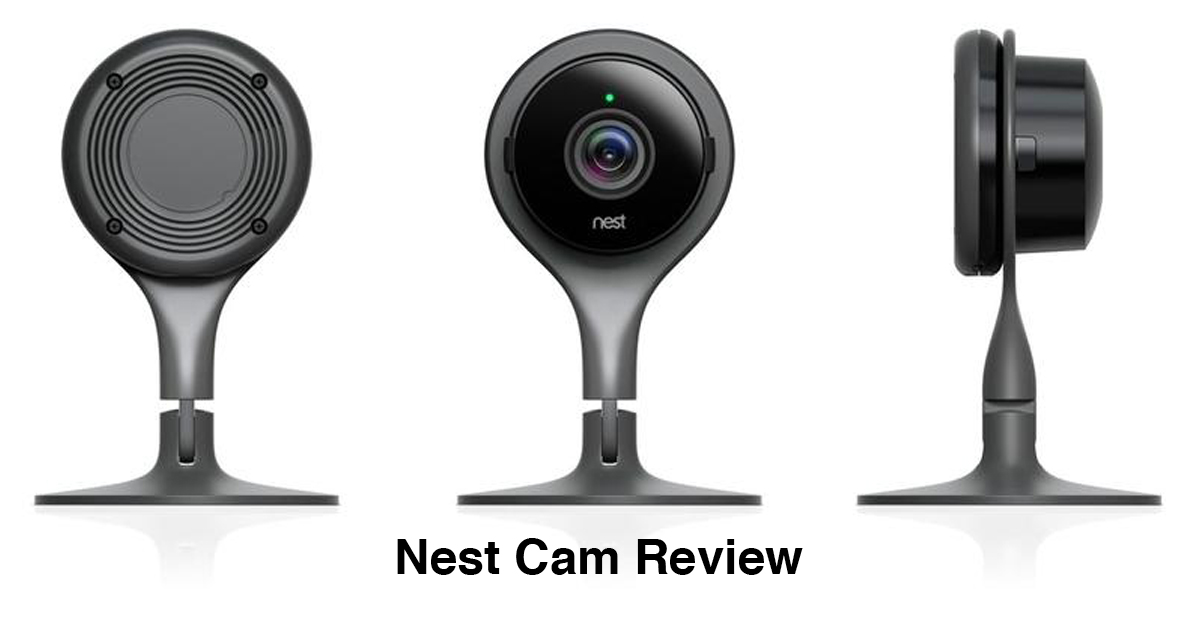
 Out of the box Nest Cam comes with a few physical installation options. It comes mounted on a well-weighted metal stand with a magnetic base. It’s good looking, nice enough to just plug it in, stick on a shelf, and forget about. The stand is easy to aim in whatever direction you’d like. There’s also a wall mount that’s easy to install, the camera then snaps to the base with a magnet.