• The Second Act

    The Second Act

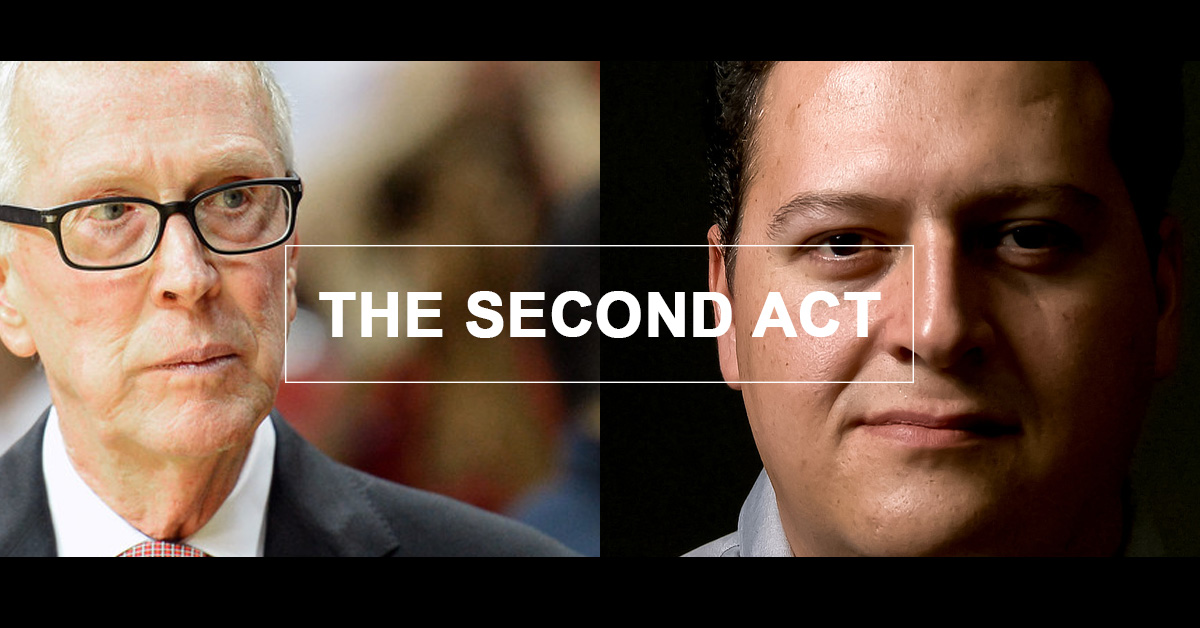
    Sebastian Marroquin

    Sebastian Marroquin is the son of one of the world’s most notorious criminals, Colombian drug baron Pablo Escobar. At the height of his powers Escobar was said to be the seventh richest man in the world. And he controlled up to 80% of the world’s cocaine trade. His unbelievable wealth and power were only matched by his brutality – he was responsible for thousands of deaths and kidnappings during the ’80s and early ’90s – a period when his cartel terrorised Colombia. Sebastian told Outlook his memories of growing up in the palatial Escobar family compound, Hacienda Napoli.

    Source

    You can’t listen to this interview and NOT hear the words of a forgiven man:

    • “I have been fulfilling the second promise instead of the first.”
    • “I created the documentary because I believe in forgiveness and reconciliation.” 
    • “It wasn’t safe for me to come back to Columbia… I took that risk because I thought peace in the country was much more important than my own life.”
    • “Thank God, I could start from zero. I am free of the past.” [On not having any of his father’s money.]
    • “I never hated my dad… I love him unconditionally. I am not his judge. I am a part of him. I was his son, one of the most important people in his life.”
    • “My dad was one of the best dads. But he was also one of the most dangerous bandits in the world. I have to live with both facts.” 

    Steve Fisher

    To some, Steve Fisher is most famous for having coached the Fab Five, for Chris Webber’s timeout, and for getting fired from Michigan when it was revealed that some members of that team were being paid by boosters.

    But to San Diego, he is known as the man who put San Diego State basketball on the map. He went from giving tickets away all over town to the hottest ticket in town. The school is entering it’s 5th straight season of selling out it’s 12,414 Viejas Arena before the season begins.

    At the same time, SDSU has transformed itself from a fallback school of commuter students to a top 100 research university bursting at the seams. There’s a direct connection between success on the hardwood and success on the Mesa.

    Second Acts

    It’s easy for your life to get defined by your first act.

    Sometimes, as in the case of Sebastian Marroquin your first act is defined for you— you’re born into a notorious family. But for most, it’s not that of a drug lord– but it might be a family history of divorce, addiction, abuse, or poverty that defined your first act, you were born into it.

    But for still others, like is the case with Steve Fisher, you might have played a role in your own first act failure. [To be clear, Steve Fisher was never tied directly to what happened at Michigan. But we can all agree that he somehow played a role. At the very least he was responsible for the actions of his team.] Or for still others, there is no doubt in your defining first act role— you were the addict, abuser, unfaithful, or carried the bad habits that lead to a life of poverty?

    In your first act you experienced failure.

    You were the bad news.

    Yet, when this happens, you are left with a choice only you can make.

    Are you going to allow your life to be defined by your first act or are you going define yourself by your second act?

    Some remain defined by their first act failure their entire lives. But other, a small percentage, get up… dust themselves off… and create a strong second act.

    This is, in Christian terminology, the crucified life.

    Therefore, if anyone is in Christ, the new creation has come: The old has gone, the new is here! All this is from God, who reconciled us to himself through Christ and gave us the ministry of reconciliation

    2 Corinthians 5:17-18

    Will you be defined by your first act or your second?

  • Place, Restoration, Hope

    Place, Restoration, Hope

    Tools

    By Sunday evening, things were calming down on our weekend home improvement projects, Kristen went to run errands, and I had a little time to reflect.

    In the search of wire cutter I opened a giant Rubbermaid that had tools poking out of it. As I started pushing things around I realized that I put all of these tools away in their new place instead of searching through the bins each time I needed a tool.

    Over the next hour I unearthed three more tool bins to put away, unpacking each into a giant set of drawers labeled: Hand tools, tool sets, power tools, and hardware.

    Place, Restoration, and Hope

    Unpacking my tools was oddly emotional.

    I hadn’t seen most of these things for more than seven years so it was like Christmas. Each tool was something I didn’t have to buy! Most of them I’d thought we’d left in Michigan, lost to the final stages of packing for a cross-country move, or our frantic garage sales, or one of many Craigslist binges. I still regret leaving a bunch of tools in one of the garages simply because I couldn’t figure out what to do with them in time.

    With each bin came a flood of memories about our house in Michigan. Using those tools on projects, learning to do things I never thought I’d do, and looking at the tools filled me with thankfulness for the many men from our church who’d helped me figure stuff out.

    I realized as I was putting these tools in their new spot that I’d packed away a lot of emotions about owning a house… for the past seven years we’d been forced to trade place-making for temporary shelter.

    As much as we loved our years across the street at the rental house– it was never ours and we’d never really unpacked. Kristen and I were sharing on Saturday night about how we’d coped with a house that wasn’t “ours” by spending as much time as we could not at home. We went to the beach, we went to the bay, we went hiking, biking, running, kayaking, spent endless hours at the zoo or Sea World or Balboa Park– so many of our weekends were spent trying to get away from home.

    There was something good about that. But there was something deeply wrong about that too, which we’re only starting to realize.

    Buying this house is more than merely finding a new place to live or the discomfort of moving.

    In many ways it is an act of justice– standing up for ourselves to make things right. How things ended in 2008, how that was a place of hurt and anger, lacking any sense of closing, not knowing what to do with the shame of foreclosure that wasn’t really our fault, all of that is now being replaced by this new house [itself having been rented for the last 20 years] and starting a process of becoming the home we’ll finish raising our kids in.

    So now, as we unpack, we’re also beginning to unpack those emotions of home and place. Putting things on the walls isn’t “I hope the landlord doesn’t get mad about these holes” but instead becomes “we want people to come here and feel connected to our family.”

    We’re unpacking tools but we’re really unpacking the unknownness of our future. We’re no longer wondering how long we’ll stay in San Diego, we have made the decision that this is our place– our city– for the foreseeable future.

    Another emotion ran over me as I put away the tools. Hope.

    The physical act of spending the weekend adding gutters and painting exterior stuff brought out a hope-filled energy I’d not felt in a long, long time. Again, it’s one of those emotions that’d been packed away somewhere deep that was starting to come over me like a ducked wave.

    And so, two weeks into home ownership, I’m remembering the crazy mix of physical labor… of the sink breaking and having to go to Home Depot to get parts… but also the emotional attachment of turning a commodity such as a house into a part of your family, that connection we call place.

  • David on Tinder

    David on Tinder

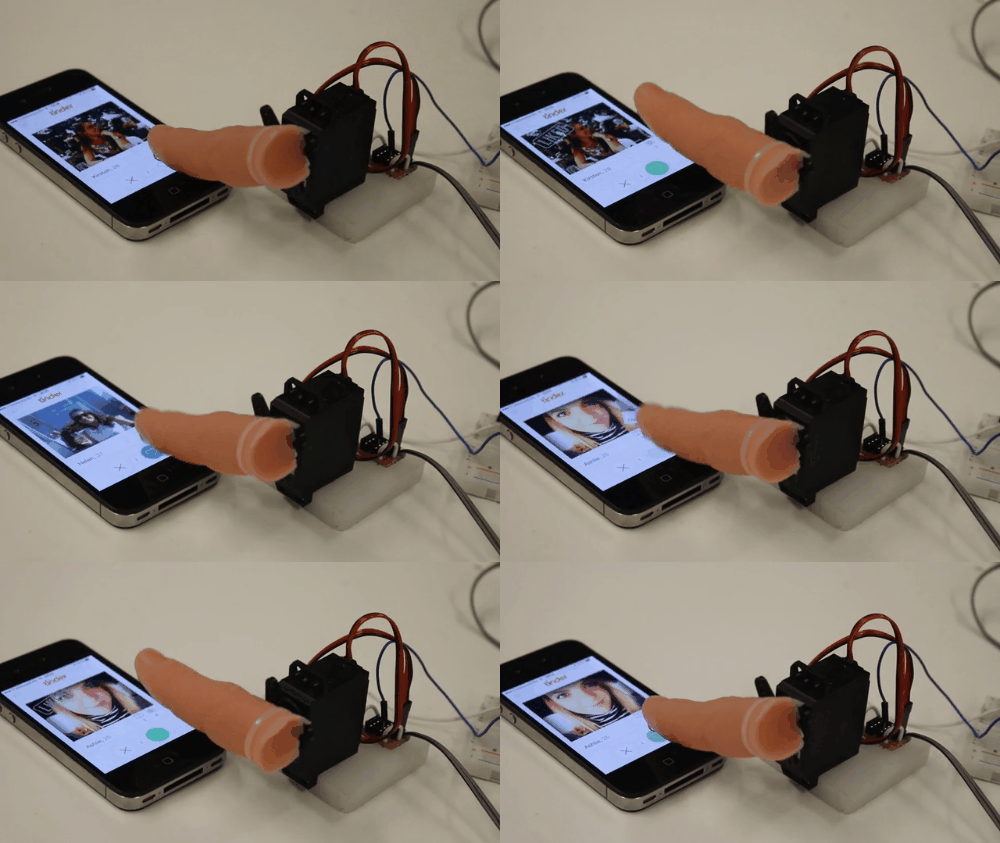
    One evening David got up from his bed and walked around on the roof of the palace. From his phone he saw a woman, the woman was very beautiful, and David swiped to the right. She came to him, and he slept with her. Then she went back home.

    2 Samuel 11:2-4, on Tinder

    I’ve been thinking a lot about teenagers and relationships in a social media saturated culture lately.

    On the one hand, I attended the Association of Youth Ministry Educators annual conference this past weekend, and the topic was Technology and Transformation. There I heard lots of presentations about adolescent life and the role technology is playing. Stuff which I’ll be unpacking in the weeks to come here on the blog.

    On the other hand, I’m engaged with lots of real life adolescents regarding issues of technologies is bringing to their life over and over again. One of which is a fundamental shift in how people meet one another romantically. The vast majority of young adults are meeting people for the first time online. Their parents? They didn’t do that. Most of the people in their life are suspicious of dating people they first met online. It’s a practice with lots of upside, but also lots of downside. Think about it: Judging purely on looks or the ability to create a profile… how many married people would have ever met their spouse in that context? Likewise, what does it feel like to have your romantic prospects judged purely on looks alone?

    Women are seemingly left with endless choices.

    Men are like…

    tinderbot

    And both, from what I can tell from talking to people, are left feeling shallow. Even people who are allegedly looking for a cheap hook-up encounter are really looking and hoping for something more.

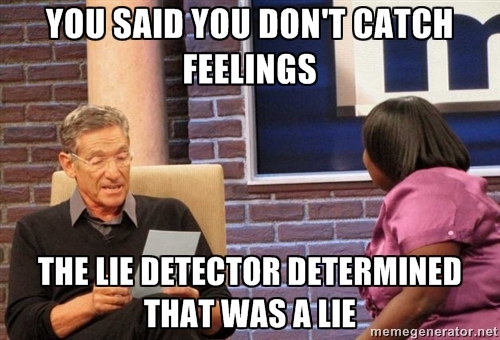
    There’s a great meme floating around about “catching feelings” for someone you’ve hooked up with or have a “friends with benefits” arrangement with.

    50568042

    It’s as if there’s an assumption that you can have emotionless sex. Becoming attached to someone isn’t just a thing rooted in morality or religion, it’s rooted in biology.

    Can the Bible help? Do Christians have a message of Good News for our Sexuality? Do we have anything to say in a world of ever-evolving attitudes about sexuality? This was the question Adam Mearse asked a room full of Christian educators yesterday.

    I believe we do. 

    But I think we’re going to have to deal with our own selves first. We’re going to have to set aside the crap we taught in the 1980s, 1990s, held on to during the 2000s, and clung to in the early 2010s like it’d somehow come back.

    Ready to get started? Start by checking out Amanda Linhart’s latest research at Pew Internet, Teens, Technology, and Romantic Relationships

  • Slow Your (devo) Roll

    Slow Your (devo) Roll

    “You better slow your roll, homey.”

    Before hearing that phrase while waiting in line at Home Depot the other day, the last time I heard that was probably 10 years ago.

    Slow your roll.

    You’re a bit out of control.

    Chill out.

    Relax, what’s the rush?

    Slow down.

    Devotions

    The idea of a daily devotional goes back to the Reformation. For centuries many Christians went to daily mass, observed the hours, or similar practices.

    The Reformation marked a turn from spiritual practices done largely in community towards practices that were more personal than communal. Private Bible ownership was extremely rare prior to the Reformation. And personal Bible study was largely frowned upon… seen as potentially dangerous even since you didn’t have a community of people or a religious leader to help you.

    All of this has shifted, of course. A daily devotional is seen as a measurement tool that you are serious about your faith. You’ll hear people say things like, “My life was spiraling out of control a bit. But then I realized that I had just gotten away from my daily devotions. I fixed that and things have gotten better.” Is that truly a cause and effect? Like, does God punish you for not doing a personal Bible study every day? And does God make your day more smooth if you spend 30 minutes reading the Bible?

    Of course not. Those things aren’t mutually exclusive. Jesus’ love for you is not conditional, nor is God’s benevolence.

    A daily reading of the Bible or reading a devotional is just fine, I’d even say it’s good. But it’s not a biblical command. Millions of Christians are enjoying heaven right now having never done a single daily devotional. None of the Apostles read a single line of My Utmost for His Highest. None of them even owned a Bible! (And none of them ever said, in their lifetimes, “Open your Bibles to John chapter three…“)

    Slow Your (devo) Roll

    I’m not anti-devotional or daily Bible reading. I’m for it. It’s something I’ve practiced for decades now. So please don’t misread me in that.

    But I do want you to consider slowing down. I really think one of the challenges we are all facing is that we’ve become consumers of the Bible and not recipients of the Word’s revelation.

    As Christians, we believe every Word is inspired by God. Of all of the things God could write down for us to have… these 66 books are it. In some ways, it’s so giant. But in light of God’s omniscience it’s the summary on the back of a CliffsNotes, right?

    Last night, one of our exercises in our  high school small group was to read Proverbs 21 aloud. As Keith read my 2004 brain kept thinking… “Slow your roll, homey.” Actually, I stopped him over and over to say things like, “Whoa… let’s think about that for a second.” There was so much in there to contemplate… moving so quickly kind of devalued the wisdom in each proverb. It made my head spin!

    We can’t just consume the Word of God! A devotional life isn’t just checking off a box to say, “Yup, I’m good to go. Spent some time in God’s Word this morning.” It doesn’t work like that. Instead, sometimes  we need to slow down… S-L-O-W-W-A-Y-D-O-W-N. We need to make room for digestion, contemplation, contextualization, and application. To use a theological term we need to leave room for revelation. The Holy Spirit can’t do His thing if you don’t make room for Him to do His thing.

    So maybe instead of a daily devotional you need a weekly devotional? Maybe instead of meditating on a new passage of Scripture every day you need to spend a month on it? Maybe you don’t need a daily Bible reading, maybe you need to download the message from Sunday and listen to it over and over again? (You know, the Holy Spirit works through your pastor, right?)

    Or maybe you need to keep going back to the same passage until it sinks in, until it gets past the callouses and into the meat, until it literally becomes part of you? Maybe– though Christian culture tells you that you need to move on– you need to resist that temptation. Maybe you need to stop moving so fast?

    Maybe you need to slow your devo roll, homey?

    Anyone who listens to the word but does not do what it says is like someone who looks at his face in a mirror and, after looking at himself, goes away and immediately forgets what he looks like. But whoever looks intently into the perfect law that gives freedom,and continues in it—not forgetting what they have heard, but doing it—they will be blessed in what they do.

    James 1:23-25

  • The House of Things

    The House of Things

    I got home from Open Seattle Sunday afternoon. And I’ve been consumed by the move ever since. Yesterday, I worked a half a day and spent the rest of the day moving stuff across the street one load at a time. I’m using “I” like I’m doing all of the work. In reality, Kristen has moved a lot more than I have as she got started on Thursday and I was kind of worthless to the process until Sunday afternoon.

    Two prevailing thoughts as we move from a long-time rental situation to our new, permanent home across the street.

    Holy Smokes We Have Stuff

    By my count we’ve moved 10 times in 18 years of marriage. But we had lived in our last place since Spring 2009. A lot has happened in our lives since then. We had a baby, our older kids entered adolescence, we both started working at home full-time, hobbies have come and gone, on and on.

    The result is that we’ve got a ton of stuff. Back and forth we go across the street and with each trip we make a decision: Move, sell, donate, or pitch.

    We will be doing all of that in the next 10 days as we close out and clean the rental house. (A new family is moving in across the street November 1st!)

    Let’s Make the New House Cool

    The Internet of Things was the theme of last year’s Consumer Electronics Show in Las Vegas. While we were renting I didn’t have much interest in this, it all seemed kind of silly. But now that we’re homeowners again I’m looking at all of that stuff again.

    Sure, we’re going to make some physical changes over the next few years to invest in our investment. (We’ve got a big list!) But I also want to see if there are new technologies out there which will help with that.

    So, as often as I’ve avoided product reviews here on the blog, I think that it’s time to test out some of these things to see if they are just a gadget or if they can actually make a house better.

    I’ve got my own curiosity… but I have a feeling that I’m not alone, that there are other folks who read my blog who also want to know if these things are just gimmicks or if they can really save you time, money, and provide some level of assurance.

    Here’s what I want to test:

    • Efficiency tools – Devices that monitor our utility usage.
    • Environmental monitoring – Stuff that measures, logs, things like temperature, carbon monoxide, smoke, pollen and warns us about potential hazards. (I’m a dork, I’d love a weather station)
    • Remote monitoring and security – Did you know there are apps that unlock your door as you walk up to the door? Or apps that control your garage door? Yeah, I want to see if that stuff really works. Plus, both Kristen and I are kind of OCD about remembering to turn things off. If there were a way to know for sure that our oven was off or that we remembered to lock the patio door… we’d like to test them out.
    • Family-specific stuff – We’re a digital family. Our kids have lots of devices, I have lots of devices, so we are always looking for things to keep track of all of that, keep an eye on who is doing what, and keep everything charged & running smoothly.

    What do you want me to test?

    Fellow readers. What are the things you’d like to see me test for you? Leave me your ideas in the comment section below.

    Want me to test your thing?

    Drop me a contact and let’s connect.

  • That booth life

    That booth life

    My feet, ankles, and knees are tired in that “I just stood on concrete for 3 days” kind of way.

    It’d been about 8 years since I’d last run a booth at the National Youth Workers Convention. Generally speaking, I’m not convinced that something like that is really our sweet spot at the Cartel… but with the forthcoming Student Justice Conference locally at Point Loma Nazarene University we felt like we kind of needed to be there since it’d be the largest gathering of SoCal youth workers we know about.

    Here are some observations from my weekend.

    The Good

    • Have you heard about The Youth Cartel?” This was my line… and it was super fun to introduce a few hundred brand new people to our lil start-up.
    • Just like we’ve experienced on the phone, via email, and on social media… people love the idea of the Student Justice Conference. I guess the trick is just getting people signed up.
    • Wes Trevor is the man. He helped me run the booth, he made it fun, and we did better when he was there.
    • The exhibit area was well organized, everyone played by the same rules, stuff like that. It was nice to have a volunteer floating around and making sure everything was OK.
    • It was great to run into regular blog readers. That was a bit mind-blowing. I see the stats, I know people read, but when it’s “real people” in front of you… it’s just kind of cool.
    • I was privileged to spend two days with my kids. Paul worked the booth with me all day Friday and Megan did all day Saturday. It wasn’t always fun but I think it was great that they were willing to do it.
    • Being a local event was awesome. Sleeping in my bed is awesome. And I liked offering friends advice on where to eat and stuff. Yeah, San Diego!
    • I loved seeing a bunch of friends. Even though the booth was generally slow I had a steady stream of friends stopping by to chat and catch up. Sometimes life gets lonely and it’s good to remember that you actually do have friends.
    • It was fun hearing, “Oh, you are the guys who ship stuff with green soldiers… right?” Yep, that’s us. It’s always great to connect with the #tinyrevolution.
    • As an event organizer it was important to change perspectives and see the event from the vantage point of the exhibitor. That perspective will continue to make our events better for our exhibitors.
    • We sold a few books. Not as many as we’d hoped or needed to, but I brought home fewer than I took.
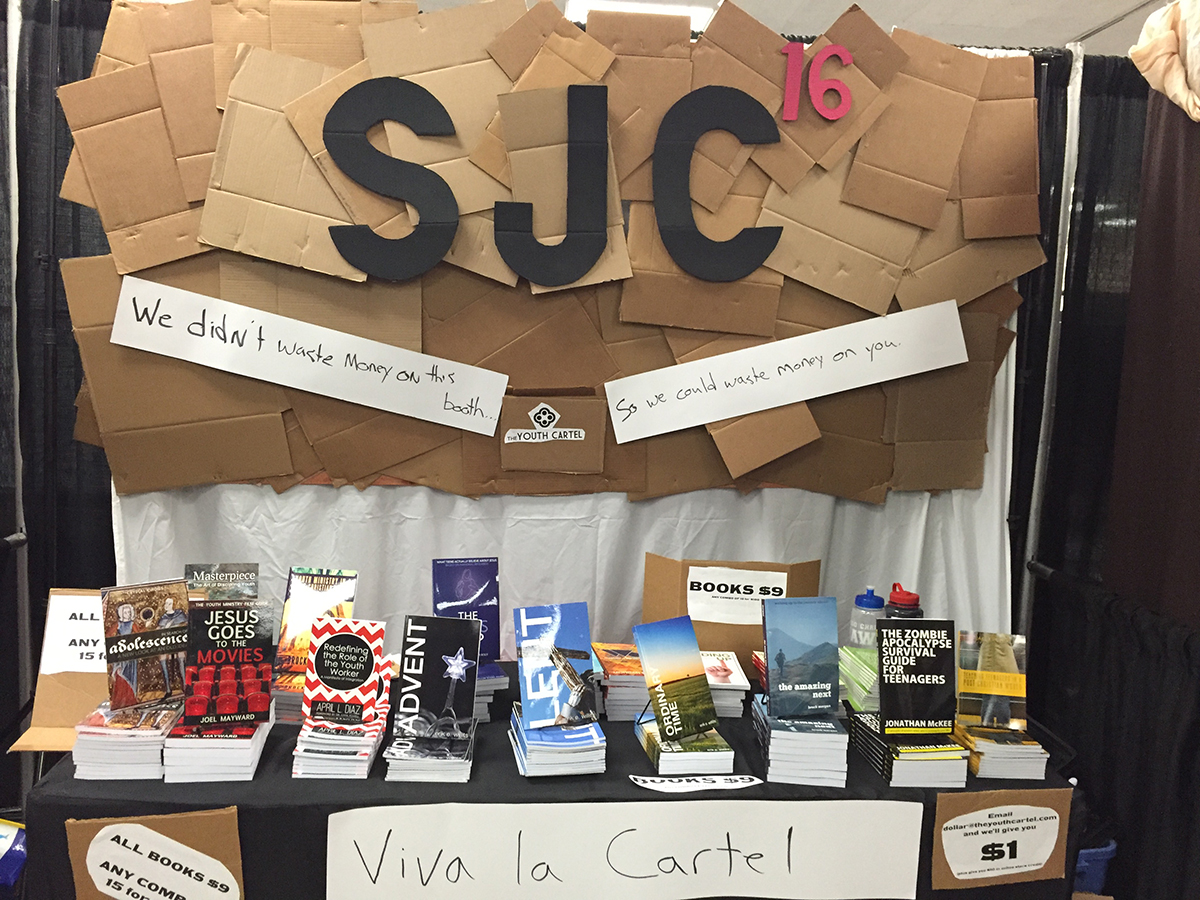
    • We did the booth our way. As we brainstormed having a booth for the first time we looked at the costs and thought… “It’s not any fun or ‘Cartel-y’ to spend all of that money on buying one of those pop-up booths and more money on little stuff with our logo on it.” So we decided to make our booth out of stuff laying around in my garage… mostly cardboard… and then just give people money instead of pens or t-shirts. Most people got our slogan “We didn’t waste money on this booth… so we could waste money on you.” It was the honest truth of what we were doing.
    • We seemed to do better than a lot of other exhibitors. People hung around, they were curious, while they were suspicious– as soon as they got who we were and what we were all about, their suspicion turned into something more fun. We aren’t out to appeal to everyone– but when we connect with someone there’s energy there and it’s fun to see in real life.

    The Bad

    • When you are exhibiting at an event the only matrix that really matters is traffic. And there was good traffic on Thursday night when they promoted it big time and Friday night after the big room. Outside of that? It was very, very thin. We would have done just as well if they’d only opened the exhibits after the last evening session. I slept on the floor Saturday afternoon and no one noticed.
    • Relatively few people at the event seemed to come into the exhibit hall. Again, as an organizer, I know how hard this is and we are just learning how to get it right more than we get it wrong. But it’s hard to justify being there when a good majority of the people willing to go through the exhibit areas are just looking for free stuff. We were giving away dollar bills and we had a hard time finding people to give them to. For real. I brought home lots of $1 bills.
    • I didn’t like the side stage they put in there. I get why they do it… it is an incentive to buy a booth… but it made it very hard to talk to people when there was a person talking over you on a microphone.

    The Odd

    • There were people who turned down $1 bills. They must have been senior pastors. 
    • The schedule was such that I didn’t do anything at the event outside of the booth. I have no idea who spoke, what the seminars were all about, etc. Literally, all I did was work the booth, eat a meal, or go home.
    • As much as I love our tribe, there are people who are so wounded that they seem to take it out on everyone. It seems they need to remember mom’s advice: “If you don’t have anything nice to say, don’t say anything at all.
    • I’m happy to be out of the loop with what’s going on inside the host organization. (and my former employer) People would ask me about it and quite frankly, I just had no idea what they were talking about and that was super refreshing. My focus is on what we’re doing and that’s plenty for me.

    If you were at NYWC this weekend, what were your favorite things? 

  • Teenagers and Gaming

    Teenagers and Gaming

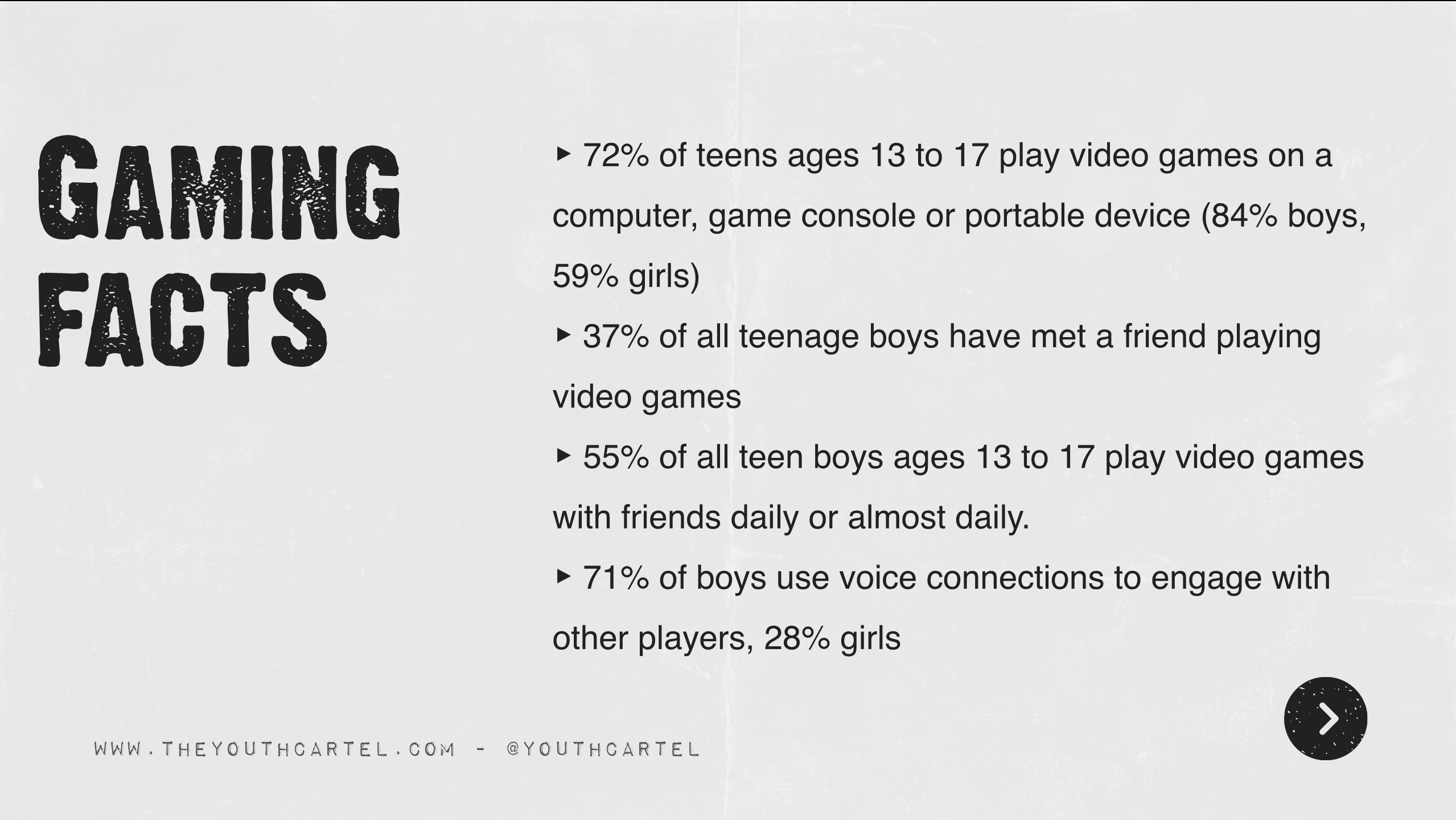
    I’ve been a bit shy to talk about the important of gaming as it relates to teenagers, you know… mostly because I like to back up what I say with facts as opposed to sharing anecdotal stuff as fact. (Which is the case with MOST of the stuff out there about teenagers and social media.)

    But Amanda Lenhart’s latest research release in August highlighted some gaming statistics that instantly went into my presentation. I’ve got the highlights above… read the full study here.


  • Other People’s Sin

    The past few months have been a reminder that sin splatters like a can of paint falling off of a shelf.

    It’s messy. It gets on you. But it also sprays out indiscriminately on things near and far, related and unrelated.

    We tend to think of the impact of sin as being mostly personal. Not so.

    The Example of Porn

    When a person looks at pornography they are committing a personal sin that is sexual. Jesus said:

    You have heard that it was said, ‘You shall not commit adultery.’ But I tell you that anyone who looks at a woman lustfully has already committed adultery with her in his heart.

    Matthew 5:27-28

    Yet that sin has a spiraling impact beyond that person’s personal sin of lust…

    • Lust impacts sexual relationships with a spouse, future spouse, other people in your life, etc.
    • Looking at pornography generates revenue which, in turn, generates more pornography.
    • The pornography industry exploits people by degrading and objectifying a person for financial profit… this is also a sin.
    • The people participating in and profiting from pornography are having their sin encouraged. Even if it’s consensual, their acts are sinful.
    • Of course, most would argue that the coercion involved in the creation of pornography is sexual exploitation. That doesn’t even include the rampant amount of sexual exploitation that generates pornography as a direct result of threat or force.
    • The “normalization of pornography” in a society fosters the idea that it’s OK to objectify people sexually since “everyone does it.” When we get used to the idea that it’s OK to commercially sexually exploit someone, we look at things like prostitution as a “victimless crime.” As if, as is the case just 1000 feet from my home, a 16 year old girl who has been trafficked to the United States by a gang and subsequently sold as a slave and is forced on the street as a prostitute isn’t a victim of an entire society who looks at her as doing it by choice.

    As you see demonstrated… the “personal sin” of someone looking at pornography isn’t so personal at all. It’s like a paint can falling from a shelf.

    Closer to Home

    Here in McLandia, the past 2 months the trajectory of our household has been dominated by the impact of sin from a person we don’t even know, we’ve never met, and has no idea the chaos they’ve created.

    It’s caused untold amounts of stress, lost sleep, anxiety, inability to concentrate or work at a normal rate, and a whole lot of other things. Chaos.

    And you know what? The other person involved likely has no idea.

    We’ll be fine. We are fine.

    But dang, we got a lot of paint on us on this one.

    There’s no such thing as a little sin. Even a little sin has a lot of impact.

    Instead, pursue righteousness and let your life be good news in the neighborhood.

  • Youth Pastors in the News

    Youth Pastors in the News

    Here’s a list of headlines from the month of September for the Google News search term, “Youth Pastor.” I’ve deleted multiple links to the same instance.

    Moral of the story: Don’t like the news? Make Good News in Your Neighborhood.

  • Extended Parenting

    Extended Parenting

    Kristen and I have become aware of something recently.

    MEGAN IS FOURTEEN! 

    We aren’t freaking out about high school. We’re not even really freaking out about the potential of paying for college.

    But we are both kind of freaking out about the not-so-far-off word: Adulthood.

    The Parent Test

    The true test of your ability to lead a group of people is “What happens when you’re gone?” If things carry on largely as if you were there, you’re doing a good job as a leader. If chaos reigns than you’re not doing a very good job as a leader.

    But is the same true for parenthood?

    Is the true test of your job as a parent determined by what your children do into adulthood? Yes and no. Your parenting certainly determines a trajectory for them, you can certainly foster things in your child, you have a lot of impact… but you aren’t truly responsible for them indefinitely.

    Have I turned out the way my parents probably aspired for me? Not really. Am I in the vicinity of what they were hoping for? Yes.

    Extended Parenting

    I think one of the things I’m wrestling with as I consider what the next 4, 8, 12 years look like is what it will look like to shift roles in Megan’s life?

    I’m well aware and versed in the discussions about extended adolescence / emerging adulthood. But, practically speaking, I’m not sure I really want to extend my parenting well into my children’s twenties. Specifically, I’m not sure I want to finance and house a perfectly capable adult while they figure stuff out indefinitely.

    At some point, just like we see in nature, you’ve got to kick the bird out of the nest. I’m not going to feed you forever… the most caring thing for me to do is to prepare you for that moment, right?

    But what I see, particularly in middle-class suburban white parents is an unwillingness to kick a birdie out of the nest and mean it. Instead, they tell their children in actions and words that they won’t let them suffer… so these young adults never flourish because they don’t have to. And the parent is satisfied that they still get to parent even if it’s not healthy for them, expressing a codependency, if you will. Is there something wrong with that? Not if all parties are happy about it. But understand it’s not not about cognitive emotional development or physical capabilities… it’s about values. 

    One reason, it seems, why young adults can’t make decisions (codify) about what they want to do is that they might not feel the pressure to take responsibility for themselves. As I’ve seen over and over again in my work… it’s amazing how fast a person can mature and take financial responsibility for themselves when the alternative it’s about eating vs. not eating or having a place to live vs. not having a place to live.

    The seemingly never-ending existential question of “What do I want to do with my life?” is a question of affluence. Rich kids get to ask that. Again, that’s a values expression that we’re wrestling with because, quite frankly, even if we can afford to finance the 20s for our children… we don’t really want to.

    It’s not what we’re about.

    We want t raise strong, independent, critical-thinking children– dumb enough to chase their dreams who become strong, independent, critical-thinking adults dumb-enough to chase their dreams.

    In other words, we’re OK with this stage of parenting coming to an end. We’re kind of looking forward to it.