• 5 Nights of Youth Group

    Lately, I’ve been thinking a lot about youth ministry strategy. About two weeks ago I published an article on Asbury’s Seedbed which caused a lot of spin off conversation because I had the audacity to state the obvious:

    The current bi-modality of youth ministry, one mode built around church kids and the other built around outreach, has failed to deliver numerical results over the past 20 years and which is forcing church leadership to invest resources elsewhere. 

    If you want to see my thoughts about the reasons for this failure, check out the article.

    But I’ve been locked on this concept for a while: Every youth ministry is basically built around the same one-model structure.

    They do one thing (either youth group/small groups plus occasional outward facing events to bring new people in) pretty well, but it’s impact is known and finite. It is going to reach a certain circle of people in a community and no matter how much harder you try or how much you refine it, you’re never going to really “pop” and see hundreds/thousands of students impacted.

    And no one in youth ministry is satisfied with the numerical result. I know it’s hard to quantify the value of impact. And I know that relationships are priceless. But people want to get paid and to get paid you better have some numbers. (Your paycheck is a number, by the way.) All I’m saying is that 5%-10% youth engagement in a community isn’t enough. We can and must do better to see community transformation.

    So, to recap.

    • On one hand we can agree that the current modes we do are going to reach a limited number of teenagers in a community. Only a certain number of people will be interested in the mode  your youth ministry is built upon.
    • On the other hand, we’ve been training people to “do youth group” or small groups for 30+ years. It might not be perfect, and it might not be reaching a statistically huge amount of people in a community, but it’s what we know how to do and it is functionally working. (It’s not broken, it doesn’t suck, it’s just fixed in its numerical  impact.)

    Last night, all of that lead to this simple thought: Why don’t we just do what we’re good at… just more of it? 

    • What if youth group happened 5 nights per week, same program flavored 5 different ways?
    • To give you some for instances by inserting some flavors… What if Monday was for band/choir people? What if Tuesday were for people into R&B/rap? What if Wednesday night was in Spanish? What if Thursday night were for all the sports teams? What if Friday night were for the church kids? 5 nights, same content, different flavor.
    • What if volunteers served 2 nights in a row. Let’s say Monday was the night they helped with band/choir people, but Tuesday night they did follow-up… like, not at the church?
    • What if we stopped trying to make every student fit into one youth group and just gave them flavors they already sub-divide in?
    • What if we stopped asking youth ministry staff to hold business hours and just had them come to work 1-9 PM so they could prep and do what they do best without all the pretending to be office rats?

    OK, so that’s my off-the-wall idea for a Tuesday.

    I think there’s a lot of people asking the question, “What’s the future of youth ministry?” And I think it’s time we embraces the reality that there are probably a lot of futures of youth ministry. Looking for a single, silver bullet solution, will only lead you to angst. Instead, let’s encourage one another to drink deeply from the well of ethnography and create ministries & programs which serve  the needs of our students. (No more felt needs!)

    Photo credit: Open 24 hours by Eric Auchard via Flickr (Creative Commons)
  • 10 Ways to Make Olympic Sports More Interesting to Watch

    The commercials have begun. The summer games are coming and we have a moral obligation to care. Soon you will know what the official toilet paper and sports drink is of the 2012 Olympic Games.

    But let’s be real. For 3 weeks NBC is going to pretend like these are sports the average American cares about. Seriously? Sailing is must-see TV? Are you going to watch a preliminary field hockey match between Slovenia & Finland at 3:20 AM?

    Not unless they can make it interesting.

    Here’s 10 ways to tweak Olympic sports to make them interesting TV:

    1. Move the equestrian events around to other random events. Nothing would spice up round 3 of fencing event like some horses in the background. And think about how much fun water polo would be with a couple horses in the water?
    2. Put archery and shooting in the rough of the golf course. You want to see some golfers sweat? If a dude slices into the rough he should have to time his shot to avoid getting shot with an arrow. “It’s going to be a tough up and down, especially after he lost his sand wedge over on the shooting range.
    3. Have all the discus, javelin, and hammer throw people go at the same time. (Not each discipline, mind you, each of those separately) If you survive a round and your object goes the furthest… we will crown you champion. Think of the international incident possibilities? “Well, Jack. The real interesting thing here is that the Russian threw his hammer the furthest, but the Turk accidentally hit him in the head with his, so it looks like the Russian will fail to advance.”
    4. Badminton and table tennis should be played on the roof of Canary Warf. At 771 feet above street level and with some of London’s notorious drizzle, this should make both of these event worth watching.
    5. Several modifications to soccer would make it more fun to watch. I appreciate the toughness, but let’s bank the sidelines so that the ball flows into the middle better. And a motte at the half line would be appropriate for London. Also, when a team scores a goal they should lose a player until they can score another goal so the other team is advantaged to score. Go up by 3 goals and you lose your goalie for 10 minutes.
    6. Track would be better with more chaos and less stretching. Time the 100 meter to go at the same time and in the opposite direction as the 400 meter and you’ll have some TV worth watching. Combine the 100 meter final and pole vaulting? Dang, I’d get a Tivo for that.
    7. Distance running should include some chase scenes. Who wants to watch some poor dude run 26 miles? Not this guy. But add a dog or some bulls every once in a while and I’m IN!
    8. Field hockey needs some checking. No doubt it’s a fun game to play. But we need some hits! Also, change the time on the quarters to say… 5 minutes. We need to pick up the pace.
    9. Combine weightlifting and the canoe/kayaking events. I’d love to see those big bulky dudes wedge themselves into a tiny little kayak, then beach it to try to pull-n-jerk 450 pounds on a little raft in the middle of the Thames. Are you kidding? With the clock running? This is amazing TV.
    10. Gymnastics, swimming, and diving need some defense. How about some gladiators during the floor competition? Or what if swimming included some goons in the middle of the pool? “Did you see Michael Phelps, he swam right underneath the Italian defense. Unbelievable!” 

    Do some of that stuff and I’m all in. That would even make the closing ceremonies worth watching as it’d be a parade of survivors and unlimited montages of great hits and unforgettable moments.

  • Love God. Love Neighbor. Simple. Right?

    Want to teach the students and young adults in your life HOW to do this? Pick up my 6-week curriculum, Good News in the Neighborhood.

    ht to Steve Knight for the link. Shouts FTE.

  • The Realistic Truth of Chasing Dreams

    I’m chasing a dream. 

    And,  to be perfectly blunt, dream chasing is more fun at 36 years old than it was at 18 years old.

    Hard work pays off

    As long as it’s hard work towards your dreams, that is.

    In June of 1994 I worked 14-18 hours per day, 7 days per week. It was the summer before my freshmen year at Moody and I needed to have $5000 in savings before August 15th to pay for my first semester.

    I worked on a paint crew from 6:00 am – 2:00 PM. I painted dorm rooms, locker rooms, offices, and hallways. I made $4.80 per hour, plus free summer housing. Then I’d go back to the dorm, shower, and run to my second full-time job where I scooped ice cream from 4:00 PM – close. Most nights I came home from that job between 12:00 AM – 1:00 AM. There I made a whopping $6.50/hour. On Saturday & Sunday, when I didn’t work on the paint crew, I’d often work from open to close at the ice cream shop.

    I did this for the entire summer. Before the first day of freshmen orientation I picked up both my paychecks and when I made the deposit my savings balance was $5200.

    Truth? This was an awesome season for me. Yes, I worked hard. Yes, it’s all I did. But I was chasing a dream of paying for college with cash. And it paid off. I was very proud of myself because I had a lot to be proud of.

    In June of 2011, after a long process, Kristen and I decided to chase our current dream. I wish I could say that it is less work in 2011 – 2012 than it was in 1994. But that would be a lie.

    Dream chasing is hard work. 

    Practical realities

    • I work 12-16 hours 5-6 days per week. That often means going to the office from 9-5 and  then after the kids go to bed working from 9-1.
    • I’m not a fan of bookkeeping & accounting. I just kind of stink at it.
    • Working from home & co-working is funky. People tell me all the time, “You must love the flexibility.” I suppose I have a lot of flexibility. But one way or another I’ll be sitting in front of this screen 12 – 18 hours per day.
    • As our businesses grow so do the levels of complexity. Mo’ money, mo’ problems I guess. More like, mo’ money, mo’ lawyers.
    • Vacations are SUPER expensive. Sure, I’ve budgeted to take weeks off. But it can be hard to relax when you know the meter isn’t running.
    • The payoff can be great. My friends are quick to point out how awesome it is to “keep what you make.” Unfortunately, I also keep what I don’t make.
    • Taxes are no fun. Small business ownership involves a complex game of juggling taxation. Sales tax, city tax, income tax, write offs, lots of stuff you don’t think about if you’ve got a regular gig.
    • Juggling takes concentration. Working with lots and lots of people on lots and lots of projects at the same time is a rush. But it also means you always have to keep focused. Take your eye off what’s next, even for a minute, and you have 3 conference calls scheduled for the same 30 minute time block.
    • It’s all about risk management. It takes a while to get into the rythym of knowing when to play it safe and when to gamble. The simple truth is that if you never gamble a little you’ll never reap the rewards of a bet. Business ownership depends on some of your projects paying back 10x the bet. The trick is knowing when to take those risks and when to walk away.
  • 3 Things Teenagers Wonder About the Adults in Their Lives

    Teenagers are good at asking questions. But I’ve found they often have a hard time coming to you about things they wonder about.

    More specifically, what are the things they are wondering about as it relates to the adults running their youth group that they have which they can’t quite put words to?

    Here’s the three things I wrote down which could all start with the phrase… So, I’ve been wondering…:

    1. If I can’t think/process/apply what you are teaching me right now, how can I grow?
    2. If you won’t listen to me– really taking the time to get to know me– how can you help me?
    3. If I can’t be as involved as you want me to be, do I still matter to you?

    How are you answering these questions with your actions?

    What are things students in your life are wondering about the adults in their lives?  

  • Taking the wrong turn onto the right path

    Right or left?

    This was a game Kristen and I used to play on Saturday’s before we had kids. In the late 1990’s we lived in Chicago, we had a new car, gas was 97 cents, and we shared a love for summer adventure.

    I’d drive to the corner of Chicago and Damon and say to Kristen, “Right or left?” We’d have our debit cards and no plan. Each time we came to a red light we’d pick a direction and keep going. When we saw something interesting we’d stop. When we were hungry we’d find a little mom-n-pop. Some days we’d explore the city and other days we’d end up in Illinois corn fields or somewhere deep in Wisconsin. At the end of the day we’d head back to a highway and drive home.

    One day we found ourselves headed north on Lakeshore drive and we decided to just keep going.This took us on a slow march via side streets and county highways all the way to Milwaukee. Another time we explored all of the fancy houses in Chicago’s northern suburbs. Another time we wandered aimlessly up and down Chicago’s south side.

    The joy in this game was that lots and lots of intentional wrong turns lead to a glorious experience. Sometimes it just didn’t feel right so we’d do a u-turn and go from the wrong way to the right way. And other times we’d take a wrong turn and just go for it.

    Have you ever taken a wrong turn and ended up with a more beautiful experience? 

    I can think to specific instances where life dealt me a curve ball, something that felt like a wrong turn, and it turned out more beautiful than if I’d stayed on the “right path.”

    Now, I’m not talking about sin. While I think God can redeem us when we sin and things can still turn out great I don’t think God expects us to sin our way to a beautiful life.

    What I mean is the more mundane sin-free wrong turns we take in life. I’ve talked to a bunch of folks lately for whom life has bypassed dealing them a lemon for a big turd. (TIP: Don’t try to turn a turd into lemonade. Just get rid of it ASAP.)

    Life has dealt me my fair share of  turds. While sometimes we live a storybook life I’m also fully aware that plenty of things have come my way which weren’t fair– even downright evil things done to me. (I’ve done a good job of bringing bad things upon myself with my stupid choices, as well.)

    When I think about the beauty of the space I’m in right now I can see that I only got here by playing a lifelong game of Right or Left?

    I think we waste a lot of effort in making 10-20-30 year projections of where our life is supposed to go. What if we just agreed that at the end of the day we’ll head home but day-to-day life will just be a series of simple choices, right or left?

    Photo Credit: Choices by AnemoneProjectors via Flickr (Creative Commons)
  • The Upside of Boredom


    “I’m bored.” 

    Paul, age 8, says this roughly every 30 seconds. It’s not that he’s spoiled or overly entertained or more addicted to the internet than his parents. It’s that he’s 8 and 8 year olds bug their parents by saying they are bored even when they aren’t. (Paul said he was bored during the previews for The Avengers. I thought about the $40 I just spent to take him and rolled my eyes.)

    I’ve turned the I’m bored syndrome into a bit of a game between us. When Paul says, “I’m bored” I look at him and say “Good. And do you know why it’s good?

    Here’s what I’m teaching Paul. It’s the upside of boredom. 

    Boredom leads you to creativity. And creativity leads to figuring out things that no one else can figure out. And when you figure out stuff that no one else can figure out that will lead you to world domination. Therefore your boredom will lead you to the world domination you desire. Therefore boredom is a very good thing, right?

    It’s a not-so-subtle thing I’m trying to plant in my son’s head. I’m combatting my nature to roll my eyes or scold him by teaching values:

    • Creativity happens when we create space for it.
    • There’s a difference between staying occupied and doing something amazing.
    • I actually think he can create something which might dominate the world.

    What are other upsides to boredom?

    Photo credit: I Can Has Cheezeburger.com
  • You’ll never know

    Clearly nervous, her voice wavered to say hello as she gave me an awkward side hug and handed me a gift. She’d driven a hundred miles or so “just to swing by and say hello.” No one drives that far just to eat greasy food and say hello.

    After some niceties the reason she drove all the way to our house became clear. She wanted to say thank you.

    She hadn’t been particularly faithful to youth group. She was always kind of one foot in and one foot out. In truth, I never really knew why she came. She was always too cool for it. I figured she just came because her friends were there and she felt comfortable.

    Since high school graduation she’d gone down some dark roads. But she drove to our house to tell us thank you… and she was back.

    I’ve done this a long time. And most students don’t come back to say thanks. You wish them well on the next stage of their life and they ride off into the sunset.

    That’s the thing about youth ministry. You’ll never know.

    You’ll never know, in the moment, what is sinking in and what isn’t. You’ll never know if the lessons you work so hard to prepare are making a difference. You’ll never know if your ministry introduced them to a lifelong walk with Jesus or if they just kind of held Jesus’ hand through high school. You’ll never know who is going to walk away, who isn’t coming back, and who will come back. You’ll never know if your ministry helped a person become a better parent or soldier or engineer.

    Your impact will always surprise you a little bit. The Prodigal will always take your breath away upon their return.

    Think about the worlds or moments in your life which had the deepest impact— that truly put you on the right course. Chances are good that person who impacted you will never know their impact on you.

    You might not ever get a chance to say thanks. That’s just how life works. 

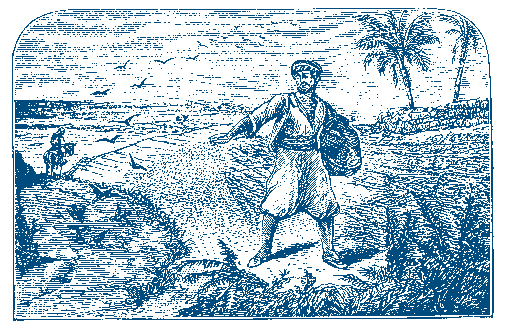
    It’s the same thing in youth ministry– You just keep scattering the seed.

    Your job is to keep planting seeds of hope, love, and joy found in Christ. Youth ministry can never be judged solely by today’s harvest… It’s just too short of a time with an individual… It has to be judged in the amount of seed spread.

    Friends, just keep reaching into the bag and scattering seed.

    Because you’ll never know.

  • Watering the Garden from the Perspective of the Hose

    Melinda’s Ohio garden is banging! What a fun perspective on caring for the harvest.

    Who knew the GoPro could be used in the garden?

    ht to Tom on editing & Melinda on watering.

  • Abuelos

    This week we have Kristen’s mom in town. While our kids are playing it cool– they were over-the-moon excited that grandma could come spend a few days with us.

    There’s a lot of talk about the impact of family in the development of Sticky Faith. Obviously, mom and dad are the most influential figures in a child’s life. But watching this video and hanging out with Kristen’s mom is a strong reminder of the power of grandparents in the lives of children.

    I wonder how strong the correlation is between decreased religious affiliation of American youth (something we could call religious elasticity) and the decline in strong, central extended nuclear families? 

    Anyone seen a study on that?