Category: social media

  • Fall in love with your content

    Every day I read all sorts of blogs. I follow hundreds of blogs with Google Reader and I’m constantly following links on Twitter and Facebook to various people’s blogs.

    And I’ve gotten used to the mediocrity of most stuff out there.

    There are very few people writing about what they love. But there are a whole pile of people writing about what they think will make them money.

    You see, blogging is hot. Trendy even. Just about every company, church, start-up, and author I meet will quickly tell me… “I need to have a blog.” So the first thing people see is that blogging can somehow make them money. (Build a tribe, generate leads, sell product, sell ads) And in every marketing meeting in every corner of every market someone is in charge of getting bloggers to talk about their product. “User-generated content is what we need.” (aka free advertising!)

    But they are missing the point. And their metrics always come back emptier than they’d hoped.

    Why?

    The reason people read a blog is because they connect with the content. A reader can tell the difference between a crappy post to promote a product or service and something they genuinely care about.

    There are a lot of people, many of them my friends, who will sell you a big bag of tricks about how to make money with a blog. They will tell you it’s about design and whistles and SEO and mixed media. Most developers care more about the functionality of a site than they do the one thing that will actually work. (And make unlimited money.) Really, really good content. 

    But the truth is that all that matters is that you love your content. You have to love it or no one else will. 

  • Learn from me next Saturday in Chicago

    Here’s the deal. I am scheduled to teach two classes next Saturday in Chicago. But as of right now… no one has signed up! I’ve got plenty of people interested as watchers on Skillshare but no one has ponied up the money to attend the class. If I don’t get 4-5 people by Monday at midnight Pacific I’m going to cancel the classes and watch football instead.

    I’ve actually just lowered the cost of the class from $25 to $20 to make it a bit easier.

    Growing Your Business with MailChimp

    Mailchimp is an amazingly powerful tool. Whether you are a small start-up, a restaurant, a band, or a non-profit– Mailchimp can help you grow your business. In this 2-hour class we’ll quickly cover the basics of the service and quickly dive into unleashing the power of this amazing email marketing webapp. We’ll talk about lists & groups, templates, integrations with tools like Eventbrite, Facebook, and Salesforce, and email marketing strategy.

    Register here

    Blogging 101

    This class will be laid back but full of experience, practical application, and practice. As a full-time blogger and blog coach I’ve helped countless bloggers get going for their own blogs and even launch small businesses. Topics covered: (But not limited to) – Getting started for free – Choosing the right platform – Customizing your blog – What to write about – How to write for response – How to build a tribe – Intro to analytics and other measurement tools – Principles of social media interaction The class will be two hours. But the format is loose and I won’t leave until I’ve answered all of your questions. My goal is that you walk away with a firm understanding of what to do AND ready to get started.

    Register here

  • Facebook shrank the world, literally

    Some recent research using Facebook’s social graph has shown that the world’s largest social network has actually made the world about 20% smaller, socially.

    Some highlights from the study.

    • There are more than 800 million active Facebook users, 50% of which log on daily.
    • The median Facebook user has about 100 friends.
    • If that number feels low, check out this 1991 study “Why your friends have more friends than you
    • Stanley Milgram performed a study in the 1960s showing an average of 5.2 “hops” between any two people on the planet, hence “six degrees of separation.”
    • While the worldwide population in 1960 was just over 3 billion, today it now 7 billion. Logic would tell you that we would have more hops between more than 2x the amount of people on the planet.
    • Faecbook partnered with a university in Milan, Italy to develop an algorithm which measured the seperation between any two Facebook users. (800+ million worldwide)
    • The distance between hops on Facebook in 2008 was 5 degrees of separation. But now it is 4. And within people in the same country? 3 degrees of separation.
    • This research has revealed that your Facebook social circle is at once both global and local. (84% of people’s friends reside in the same country.)
    • Source

    What does this mean for you?

    • Mostly, it’s just really cool and has no real impact on your day-to-day life.
    • You’ve got to be more careful than ever about talking smack about someone online. Because one of your friends now has a friend who knows that person.
    • Your Facebook status is 3-4 shares away from reaching every person in your country. And 5-6 Facebook shares from any one person in the world.
    • As these online networks continue to interconnect our world, it also reveals a greater and greater desire within each of us to form more localized offline connections. (Support groups, farmers markets, small networks of personal friends, etc.)
    • In general, the larger a persons social network the less likely they are to keep their thoughts/opinions out of the public arena. I think we will see an increase in “private spaces” in social media to foster the open discussion we all so greatly enjoy.
    • Thomas Friedman’s 2005 book, “The World is Flat” was spot on. Fewer degrees of seperation gives more and more power to people with less and less means. This is contributing to a rise in the entrepreneur and socially activated class.
  • Every idea is a network

    Ideas as networks

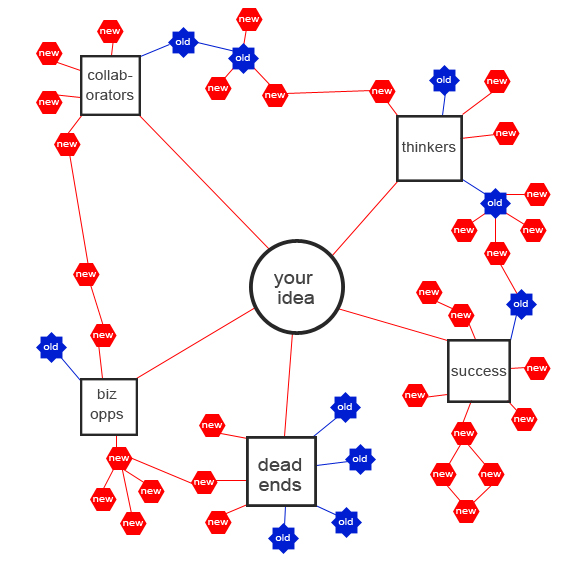
    You have ideas. We all have ideas. Some of them are brilliant and some of them aren’t. But every idea (pursued) is a network.

    As you explore your idea you bump into people. Some are new people to you and some are old friends. Each of those connections makes connections with other people based on the concept of your idea. And you might bump into people who have a very similar idea, something the 18th century philosopher Johann Gottfried Herder called zeitgeist.

    The result of your idea– something you conceived of while sitting on the toilet or in a dream or while you were bored in a staff meeting– can create a vast network of interconnected people whose primary connection is your idea.

    A good idea generates energy and momentum. Sometimes even a dead end generates new connections which further energize the idea. Can you help my idea? Can you collaborate on it? Can you make the idea successful? Can you help me think about the idea? 

    Here’s the deal: Whether you have an idea that will make your neighborhood a better place to live or an idea that will make you a bagillionaire… you need to give your idea the freedom to breath, to live, and to take on a life of it’s own.

    The difference between an idea that changes things and an idea you have on the toilet? The network you allow that idea to ignite.

  • It’s time to deliver

    Yesterday was gut check time. 

    I woke up anxious. At 5:00 am I got up to start re-working my WordCamp talk– scheduled for 4:00 pm. I added all new slides, completely reworked the content, and I seriously considered calling the organizer and telling him I was sick. Like all fears it was completely illogical.

    Why was I nervous? I was nervous because I knew that this was a big moment for my fledgling business, McLane Creative. The last thing I wanted was for the Southern California WordPress community to think I was lame or didn’t know what the heck I was talking about.

    It was a risk. And the closer my time got the more it felt like a stupid risk to take. I’d never even been to a WordCamp… much less spoke at one. What the heck was I thinking?

    After lunch I went to my car and went through the talk 2 times all the way through. After the first time I actually started the car to drive home. I had sat in on a couple other sessions and I knew my talk was drastically different from the style of everyone else’s. This compounded the risk. And it felt like a dumb risk to take. My instinct was saying, BAIL, BAIL, BAIL!!! But my integrity would never allow that. That’s not the Adam McLane I want to be.

    4:00 pm arrived. Feeling completely unconfident I stood there and realized that it was time to fake it. My last thought before my talk began was, “Just shut up and deliver.

    And it went great. The audience was engaged. They asked great questions. And I think that for a few people, those who I was targeting with the talk, were really equipped.

    Last week I talked about jumping out and starting my own thing. And how glorious and scary it was at the same time. Yesterday I felt the amazing joy of free fall! And it was beautiful.

    I walked off that stage proud of myself. I looked a scary moment in the face. Risked it all. And it paid off.

    3 Tips for fellow jumpers

    1. Being afraid – There’s no shame in having fear. Fear is natural. But if you allow fear to drive your decision making you’ll live a life of regret. Learn to look at fear, recognize it for what it is, and push through it.
    2. Being myself– There were elements of my talk that referenced being a youth pastor and even the defining question of my blogging life. I was open about the role of my faith in Christ in my life, the positives and the negatives, and the audience was appreciative of that. (And not shy about affirming my decision to go there.)
    3. Being welcomed- As someone who “is known” within my niche` it was very scary to walk onto a stage as a complete unknown. The organizers knew that and welcomed me into their tribe, my fellow speakers were very gracious, and the audience was amazing in making me feel welcome on their stage.
    “Be strong and courageous. Do not be afraid; do not be discouraged, for the LORD your God will be with you wherever you go.” ~ Joshua 1:9
  • Teaching Principles vs. Trends

    Today finds me at WordCampLA. WCLA is a one-day conference for WordPress users, developers, and fans.

    Last night I had a great time getting to know some of the speakers and sponsors of the event. If anything, it was a reminder of just how far WordPress/blogging/small business development has gone in the past 5 years. When I first did some meet-ups with WordPress users in the Detroit area it was dominated by amateur bloggers and novice developers (more like modders) who would gather to talk about very basic stuff. Last night, I sat at a dinner table with serious developers, designers, and highly honed entrepreneurs.

    Over and over again I was asked what my talk is about. (Since I’m new to the WordCamp circuit.) My talk is called, “” Typically, when I bring up this topic people will say things like, “Oh, so you tell people what’s hot and what the trends are?” No, actually I teach the opposite of that. Fads fade. Trends change. Tools age. Instead of teaching trendy things that come and go I try to give people a philosophical framework of principles to build and sustain a presence. That way, when something trendy like Google+ or Klout or the next SEM/Affiliate marketing scheme pops up, you know how to frame the trend instead of the trend framing you.

    If you want to be a part of this workshop, I am presenting it next at NYWC.

    Which is more important in your communication? Principles or trends? 

  • The Power of Poop

    Working together, we firmly believe that reinventing a long-lasting, safe, and sustainable answer to the world’s sanitation needs is not just necessary, but within reach.

    Sylvia Matthew Burwell, President of the Bill & Melinda Gates Foundation [link]

    Re-thinking poop. Turning poop into power and fertilizer. Turning waste into opportunity.

    I like it.

    A lot.

    Safe to make a guess for where the genesis of this idea happened, right?

    Most of us never thought of the toilet as a place for innovation to occur. Something so simple that could make such a huge difference to the plumbing-less. Who knows? Maybe that technology will flow back to the States in a decade or two?

    Kudos to the Gates Foundation. It’s a great idea that I think could make a huge impact on world health.

    What’s the lesson for us? How we got here is not how we get out of here. 

    ht to Fast Company

  • Dealing with streakiness in the creative process

    I’m finishing my seventh year of daily blogging on May 25th. Over the past 2,555 days I’ve written 3,523 posts or about 2,000,000 words. Nearly every day over the past 2,555 days I have sat down at my computer and written something that was worth my time in the moment.

    Streaks

    So what has changed since 2004? An o-crap-this-better-not-suck-amount of people read what I write every day. And the amount that each post gets shared, tweeted, and emailed around is completely determined by the remark-ability of what I write. In some ways it is a self-created pressure cooker.

    It’s fun that the process doesn’t change but the response does. I have no ability to predict the outcome of each post. There are weeks or even months where my blog experiences a hot streak. Everything I write gets lots of feedback. (Even the stuff that sucks.) Conversely, there are weeks or months when nothing really happens to my posts. I just write and that’s it.

    Many days I press “publish” and I anticipate a massive response to something that seems brilliant to me but nothing happens. Then there are days when I write something flippantly and publish it with almost no thought and it explodes and goes viral.

    Same process. Same style. Different response.

    Some might find that infuriating or that it frustrates the process. Not me. I find it fascinating.

    The creative life

    Everyone claims to have been a Seinfeld fan all along. But, in the moment, the most popular way to talk about Seinfeld was that most people didn’t find it nearly as funny as the people in New York said it was. Seinfeld didn’t really become funny for most people until it hit syndication because when it was fresh they didn’t get it.

    Chances are that Shakespeare’s favorite piece wasn’t Romeo and Juliet. It was just what became most popular. The same is probably true with Hemingway’s Old Man and the Sea or Salinger’s The Catcher in the Rye. Sometimes for a creative what takes off is not what they have the most fun doing.

    Response to creativity is always streaky and unpredictable.

    So here’s a tip: If you want to write, just write. Don’t worry about the response too much. Just write, write, and write some more. Ultimately, you are the audience.

  • How to repost a blog post with style and grace

    Since I first wrote about people stealing my content last November, “How to blog, write, and speak with integrity” I’ve gotten lots of contacts asking me how to properly repost or cite blog posts, web articles, and news stories.

    Here are some tips for reposting internet content with style and grace.

    • Never repost an entire article without permission from the site owner. First, its a breach of etiquette. Second, nabbing someone’s content without their consent is theft of their intellectual property. Third, even if you link back, most agree that search engines will punish both domains for duplicate content. How do you get permission? You ask! Email the author or use their contact form or just leave a comment on the post. Most will, happily and free of charge offer you their content.
    • Use an excerpt of no more than two paragraphs. Chose the part of the article that reasonated with you the most or makes the point most clearly, and excerpt it. You can wrap the excerpt in the context of a point you are writing about or simply post the excerpt with a question or thought for discussion. Bloggers consider this a high compliment. And news agencies (and other sources very sensitive about their intellectual property) won’t be concerned that you are trying to gain traffic off of their content.
    • Set your excerpt apart graphically. For any quote of more than two sentences use the block quote feature of any blog editor. To make it even more clear that I’m quoting something, I like to italicize the whole piece.
    • Link directly to the source content. Typically, I link to the source two times just to be absolutely certain my readers know the excerpt is not mine and where to find the source. I set the the quote up (or follow-up) with linking the article to the authors name. “I was reading Adam McLane’s dare for pastors the other day…” Then, after I’ve posted the excerpt, I link to the source with the words “Source” or “Read the rest.
    • Hat tips and Trackbacks are still good manners. A hat tip is simply a gesture that another person provided the idea for your post or otherwise recognizing another person for contributing to your post. (ht to Adam McLane) A trackback alerts the blog owner that you’ve linked to them. On some sites, the trackback appears as a comment on the original post while on other sites it never appears publicly but is tracked by the owners site software. In WordPress, I manually enter a trackback for every link I put in a post to a news site or blog.

    I hope these tips are useful. Each of these things only takes a few moments but makes a big difference in creating professional quality content. More importantly, to your readers it communicates that you aren’t a slob with other people’s intellectual property.

    Have more questions about this topic? Leave a comment!

  • Blame the Internet

    There are a lot of jerks out there empowered by the internet.

    Why is that?

    Affinity grouping vs. Geographical grouping

    Whereas, in the past, your social network was largely defined by geography, in the internet age your social network is self-selected. This is a double edged sword.

    Let’s say there is a guy on my block who likes to listen to Southern Rock, drink Southern Comfort, and dance on his front porch to Dolly Parton classics while yelling at passing cars, “Jap Crap!” And on the other end of the block is a woman who puts a leash on her 2 cats and 1 iguana and takes them for a walk around the block around dinner time. Every community has people like this. The iguana lady, the red neck, and a whole bunch of people in the polite middle who kind of roll their eyes at them.

    It used to be that the people on the fringes really had a quiet voice in the crowd. They’d espouse their views and everyone would politely nod. When family came to visit from out-of-town we’d point out the lady walking her iguana and cats to stare. And that social pressure kept the extremes just a little bit more palatable and innocent.

    Today, each of those oddities on my block can find other odd ducks on the internet. And chances are that finding other people like them will embolden them. So, instead of that person knowing they are on the fringe and kind of keeping it socially acceptable, now that they know 1-2 other people out there who like to rock out to Dolly Parton and yell at Toyota’s… they feel like they can be a little more loud and proud about it. The same goes for the cat and iguana lady. She found another woman in Florida who has 2 iguanas and 6 cats that she walks, so she figures she can, too!

    In their minds, all of a sudden, lots of people walk iguanas so that makes it OK. And those Dolly for President shirts are selling like hotcakes somewhere, just not here.

    That’s why there are more jerks out there. They found each other and started a Facebook group.

    I blame the internet. Who do you blame?