Category: social media

  • 5 things you don’t have to tell me in your bio

    I look at every bio for each new follower on Twitter and friend request on Facebook. And let me tell you, there’s some pretty important stuff missing and some pretty unimportant stuff that is taking up space.

    Hint: Clean up your bio. People look at it.

    5 Things you don’t have to tell me in your bio

    1. That you love Jesus (Show me, don’t tell me.)
    2. That you are married to your best friend, that she is smoking hot, or whatever. (Is that how you talk about all women in your life?)
    3. Your age. (I don’t care.)
    4. Anything about your children. (I’m happy you are a parent, but not really relevant at this point in our relationship.)
    5. A quote. (I’m glad you like C.S. Lewis, but is that all you want me to know about you?)

    5 Things that you should be in your bio on Twitter or Facebook

    1. Your name. (Doesn’t have to be first name, last name. But if you aren’t in the witness protection program, it might as well be.)
    2. Where you live. (Not the street address, just where in the world are you?)
    3. What you do. (Occupation, employer, etc.)
    4. What you are about. (Keep is simple)
    5. Something fun. (Why would I want to follow someone who is boring?)

    Who do I follow on Twitter?

    I don’t have a hard and fast rule. I used to follow everyone who followed me. But that got annoying real fast. Then I followed everyone who @replied me. But that got messy, too.  In general, if a bio looks interesting and might add something, I’ll add you. But I’m also pretty ruthless about unfollowing people who are annoying.

    Who do I follow on Facebook?

    If you look like a real person, I’ll accept your friend request. If I am suspicious that you might be a spammer from Africa or India, I’ll check the “limited profile” button.

    One thing I do, and it’s mostly for my own sanity, is that I keep my entire friend list in two categories. “Friends” and “People I haven’t met.” I don’t want anyone to really think I know 1400 people.

  • New is dangerous, old is noble

    The flood of print has turned reading into a process of gulping rather than savoring.  ~Warren Chappell (1904-1991)

    I find that people have a curious attitude towards new ways of doing things.

    If I were to tell you that part of my job is to remain informed by reading journals on the study of adolescence, magazines to keep up with the latest trends in adolescent culture, network with youth workers around the world to hear what’s going on in the field of youth ministry, and read book after book of youth ministry training materials… you’d likely have a noble attitude towards my lifestyle.

    Wow, Adam McLane is a well-read, well-informed guy.

    But if I were to tell you that I do all of that sitting in front of a computer all day, reading dozens of blog posts, networking with people on Twitter and Facebook, and reading hundreds of pages of stuff every day to find the very best stuff out there.

    Oh, Adam McLane is addicted to the internet. [Make ugly, judgmental face]

    People’s attitudes towards acquiring news information and reading.

    6 hours of sitting and reading a book or digesting the latest newspaper = noble use of time.

    6 hours of sitting and reading online or digesting the latest news online = evil use of time.

    The same could be said of people’s attitudes towards mobile devices.

    6 hours of sitting behind a desk pushing paperwork around = noble use of time.

    6 hours of actively doing stuff in the field with 30-40 minutes of time away from that to send emails or communicating with co-workers = evil use of time.

    The same could be said about interacting with ones friends.

    I either see or call all of my friends nearly every day = noble use of time & energy.

    I connect or exchange messages with all of my friends nearly every day on either Facebook, Twitter, or text messaging = evil use of time & energy.

    What’s the point?

    I find it disturbing that people say, “You need to manage your time online or with your mobile device. You are probably addicted.” But you will never hear someone say, “Pray for Adam, he’s addicted to reading books. Holy cow, he sits and listens to his friends way too much. I think he is addicted. He’s a communication-aholic.”

    I’m not saying that there aren’t times when I’m horribly out-of-balance or that I’m somehow really perfect. (Because I’m actually quite messed up.)

    What I am saying is that people have had negative attitudes towards people who do things in new or innovative ways for as long people have invented stuff.

    Several thousand years ago there were probably people challenging villagers to not use this new thing called a “bridge” too much or you’d get addicted to it and not really appreciate walking around the canyon or wading through the icy river.

    It’s always been this way.

    Old is noble.

    New is dangerous.

  • 5 Things the App Store Teaches Us

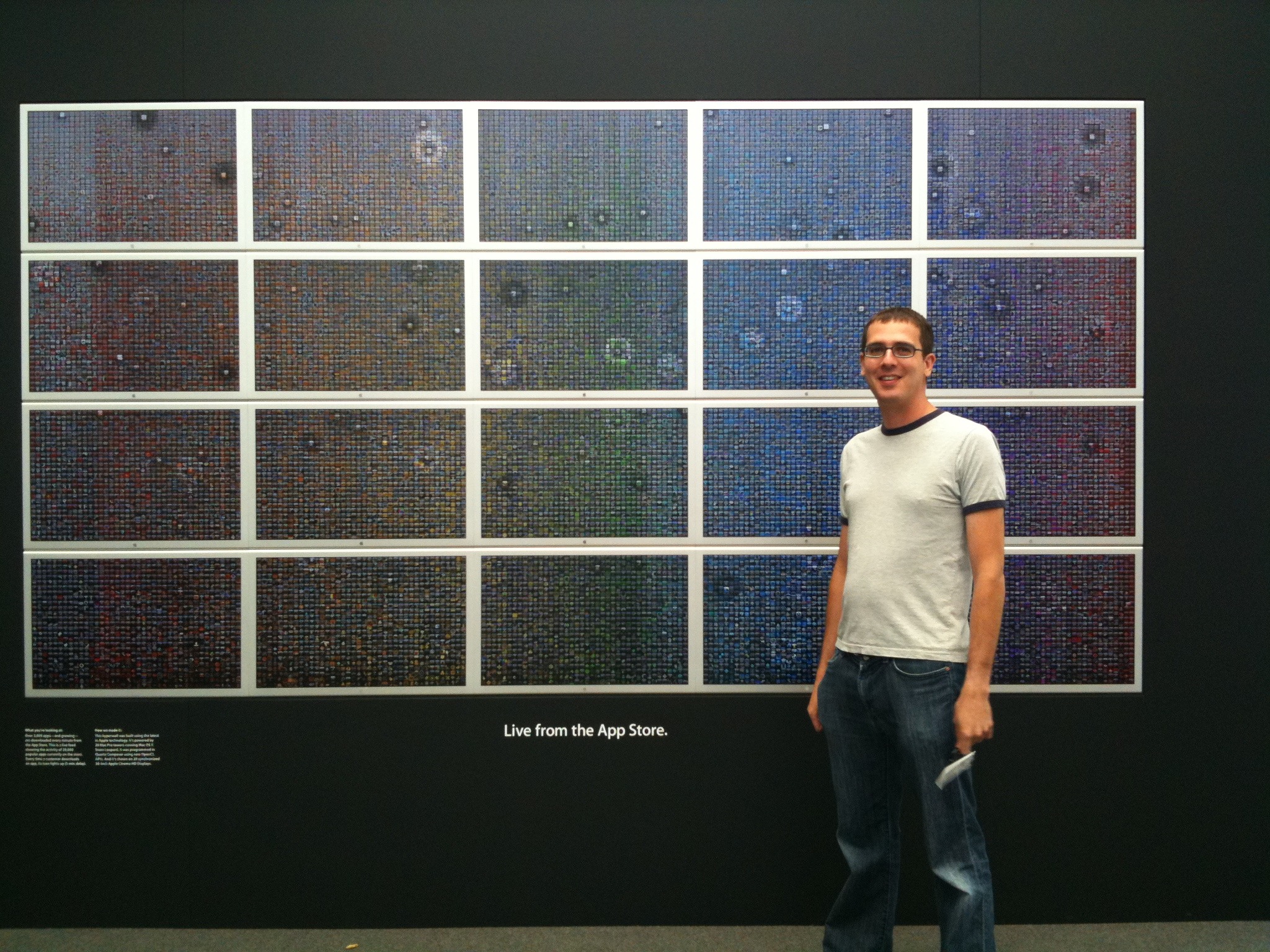
    A living exhibit of current apps being sold. Photo HT to Sachin Agarwal

    More than 1 billion apps have been downloaded from the iTunes app store. Believe it or not, there are lots of people who still don’t think of it as a serious marketplace. A billion is 1,000 million folks. That’s pretty serious.

    Here are 5 things that the app store has taught me

    1. Free is a legitimate business plan.
    2. Financial success isn’t so much about profit margins, it’s about price point.
    3. Traditional high margin businesses with complicated business plans can’t compete.
    4. The one hit wonder is just as powerful today as it was yesterday.
    5. Big business will always manipulate a free market system.

    Some brief explanations to unpack the list above.

    Free is a legitimate business plan

    Would you have an account on Facebook, Twitter, or Gmail if it cost you $2.99 each to belong? Of course not. But how did Google, Twitter, and Facebook get to become some of the most powerful companies in the world without charging you a dime? TV has been doing it for years.

    Financial success isn’t so much about profit margins, it’s about price point

    When I developed my first apps for YS, the content was valued based on the retail price of the book. Consequently, they never took off. People aren’t going to pay the same $7.99 for an app version of a book that they’d pay for a hard copy because the perceived value is different. The question app buyers are asking is, “Will I get the free version or will I pay $.99?” Remember… all of Facebook, Google, and Twitter are 100% FREE! So your buyer wants to know why your app, compared to what they know is already free, has more value to them than that. To pay more than $.99 for an app you have to demonstrate ridiculous value. Consequently, if you lower your price point or eliminate the cost, you will access millions more customers and potentially make infinitely more money as a result.

    Traditional businesses with complicated business plans can’t compete

    Traditional media and brick/mortar retailers are struggling to figure out how to take advantage of apps. Look for yourself. Retailers apps aren’t really necessary but are just attempts to have “something” in the app store. An online catalog is pointless because of Google. A store finder is pointless because of Google Maps. Most traditional brands apps aren’t adding value– they are marketing. And people are extraordinarily good at sniffing out marketing thanks to the popularity of bloggers like Seth Godin. Companies with simple business plans are beating them in the app store because simple business plans have lower overhead, can take more brand risk, are more nimble, and will rely less on expensive “experts.” (If an app maker is an “expert” than why would they sell your company something for thousands when “experts” are becoming millionaires? Additionally, the counter-intuitive business strategy of free is nearly impossible for traditional business leaders to comprehend.

    The one hit wonder is just as powerful today as it was yesterday

    Angry Birds is to the app store what Don McLean is to the record business. Except we live in an age when a company that has a one-hit wonder in the app business will get a royalty checks from Apple for millions of dollars per month. Not bad for some college students from Finland, eh? Take that– Mattel or EA or any of the other major players in the game industry! Each of the original creators of Angry Birds will not only make a lot of money off of Angry Birds… they are now solid gold for life.

    Big business will always manipulate a free market system

    The editors at Apple have always claimed a certain level of editorial control of the app market. In other words the stuff at the top of the pile is at the top of the pile mostly because it is the best in the marketplace. But, in truth, they have allowed that to be manipulated by some levels of marketing of new stuff. Go to the app store today on your iPod, iPhone, or iPad and you will see ads for featured items. That wasn’t free and it is almost always big, publicly traded companies, who have bought that influence. Consequently, some of the biggest selling apps are not, indeed, the best apps in a totally free marketplace. There has been some manipulation.

  • Just Write

    So, you want to blog? And you’d like to build a following. Great. I’m here to help.

    Here’s a quick reality check:

    • Success has nothing to do with a fancy blog design.
    • Success has nothing to do with learning the latest SEO tricks.
    • Success has nothing to do with finding advertisers to fund you.

    So save your money. And don’t waste your brain cells.

    Success as a blogger is so much simpler than that.

    Just start writing. That’s 99% of the battle. Write, write, and write some more.

    Success will find you when you are satisfied with who you are and how you write.

    Start at the beginning

    Chances are, as a reader of my blog, you’ve read something I’ve written and thought… “I could have said that, just better. I am smarter and a better writer than Adam McLane.” And you might be.

    So what is the difference between you and I? Experience.

    Go ahead and look at a tab on the right sidebar called, Archives. Then drop down all the way to the beginning. Go all the way back to May 2004 and read a few posts. I was horrible. But I was consistent, I was trying, and I was listening. And over time I wrote less about things that were interesting to only me and more about things that might be interesting to both me and you.

    2004 was my beginning. Next, skip up to 2006, then 2008, then 2010. You’ll see a progression. I got better. I’d like to think that the progression continues.

    If you are starting, just write. It doesn’t even matter what you write. Or if anyone reads it. Just write and write and write. You’ll figure it out.

    You don’t have a reputation to protect

    The biggest block to most people getting going (and later, to you growing) is a fear of embarrassment. Get over yourself. Stop it. You aren’t famous and you don’t have a reputation to protect. And if you can’t stop worrying about your reputation… write under a pen name and don’t tell anyone you are doing it. All that matters is that you start writing.

    I wrote for two years on a blogger account not tied to my name directly. Then for the next two years I wrote on a Typepad blog… I didn’t move to adammclane.com until I’d been at it for a few years. I didn’t have a reputation to protect. But I probably thought I did.

    Don’t make an announcement

    I think letting people know that you are going to start blogging is the worst thing you can possibly do. Telling people seems to mount pressure. Pressure to perform steals the joy of expressing yourself. And once the joy is gone– you will convince yourself that you don’t have time or that it isn’t a priority.

    Just write. Don’t promote. Forget about Twitter or Facebook or anything else. Just write. If it’s good, people will find it.

    Measure the right things

    I’m 7 years into this. I measure some pretty sophisticated things. If you are just starting out the only thing worth measuring is, “Did I write today?” Get a year into it… then add to that, “What kinds of posts draw comments?” Once you have enough confidence… then worry about things like, “What’s my niche`, who is my audience, and is my blog growing?

    But for now… just write.

  • The rise of the geek class

    Photo by Chantal Foster via Flickr (Creative Commons)

    Last Sunday, I was asked to pray in church for those of us in the tech industry, that we would use our skills as a means to Christ’s mission on earth. I opened my prayer by getting rid of the polite language. “Lord Jesus, be with the geeks and nerds among us. We were once made fun of but now are seen as the hope and solution for our companies. Let us use our new found influence for your glory and not our own. Let us point others to the Solution.

    The nerds and geeks have come to rule our nation logistically. We might not hold a lot of political offices but it is headline news when leaders change companies, retire, or even get sick.

    Long gone are the days when the rest of the room snickered when I said, “I run websites.” Now they wait for the meeting to end and then ask for my card so they can pitch their project to me.

    Becoming geek

    What makes a person a geek is that they have thrown away all semblance of generality and become hyper-knowledgeable in their sphere of knowledge.

    In some regard we are all geeks. It’s how you become a professional in a field. Last year, I was at a man’s house repairing his PC that had gotten clogged up with Spyware. About every 25 minutes he would come by and look at what I was doing and say, “Man, I’m glad you know how to do that. I wouldn’t have a clue.” After a few rounds of that I stopped him. “You know– this is just my skill. If my toilet blew up or my washing machine got clogged… I’d call you. The world needs both computer nerds and plumbers.” It was an aha moment for both of us.

    Geek isn’t just limited to tech. Geek is how you become an expert. And the world ceases to spin without experts.

    Lack of balance

    As a geek, I am perplexed at how some people judge me. They say it in subtle ways like, “I limit my use of the internet to just at work.” Or “I put up some boundaries so I don’t do that stuff while I’m home.” What they are really saying is that the thing they geek out in, say preparing for 25 hours to preach a 35 minute sermon, is somehow more noble than my task. They judge my expertise through the lens of their life and call for balance.

    At the same time becoming a geek at something brings joy and satisfaction far beyond a paycheck or acclaim.

    That’s the difference.

    Being a geek at something is the absence of balance. It’s really an acknowledgement of letting go of a desire to maintain balance as a generalist and completely go after one thing.

    Becoming a geek is making something others view as ignoble, noble.

    Some say I waste a lot of time observing and participating in all sorts of things. At the same time, I don’t waste a lot of time reading books or watching mindless television.

    No shame in geek

    That’s the nature of geek. Going after one thing in a completely unbalanced fashion. Geeking out for hours trying to figure out how something works, how you can improve it, how others worldwide have taken it to new heights, and trying to predict when your geek-subject will go in the future.

    May we stop judging and start embracing and supporting the complete lack of balance of the geek class. Stop trying to change them because, in the end, they will change you.

  • Tunisia, Facebook, Privacy, and Freedom

    Most youth workers have developed a Facebook apologetic. That is to say, they know how to respond and argue for Facebook usage to engage with and interact with their students.

    One component of Facebook, which causes heart palpitations for adults, is that it is a place of dissidence and venting. And the motivating reason that adults see their blood pressure elevated about these activities is that they are either the object of said dissidence/venting or they are asked to clean up the mess created online.

    As a result, some parents and other caring adults use that as a case for Facebook being banned. (Which, as human nature dictates, just means adolescents find another place to carry out dissidence and venting. It is just taken off of the adult radar and disappears into adolescent-world. But you can safely imagine a William Wallace-like response, “You can take our Facebook, but you can never have our phones!“)

    Allow me to introduce to you a story from The Atlantic, which puts this into context:

    Expert analysts of the country couldn’t tell if Ben Ali would remain in power for a few more weeks or a decade. It did not feel inevitable that Ben Ali would be deposed. People had protested in the streets before. Revolution had been in the air. It wasn’t clear that this time would be different.

    There has been a lot of debate about whether Twitter helped unleash the massive changes that led Ben Ali to leave office on January 14, but Facebook appears to have played a more important role in spreading dissent.

    Imagine you are Ben Ali. You are the unpopular leader of Tunisia. You are an oppressor of freedoms. And you hear rumors that you may be deposed of your power.

    In youth ministry language– the youth pastor hears that his students are bad mouthing him on Facebook. And they’ve engaged with enough adults in the church that you might get fired.

    So what does Ben Ali do? He had long ago banned YouTube and other video sharing sites… but all of a sudden he discovers that hundreds of thousands of Tunisians are flocking to Facebook, networking, and sharing videos which document the terrors of his rule.

    While clashes with security forces took place in the streets, Rim, who asked we not use her last name, was in her bed in her apartment in Tunis. Like the blogger cliché, Rim sat in her pajamas sharing videos. In her hands, small protests that reached 50 people could suddenly reach another 50, who would share it with another 50. The idea that it might be time for the regime to change spread from city to city faster than street protests and even middle class places got involved.

    “There were rumors that Facebook or electricity was going to be shut down,” Rim IM’d me from Tunis. “Or both.”

    Did you get that? It was either shut down the electricity or shut down Facebook. But Ben Ali’s plan was more devious.

    After more than ten days of intensive investigation and study, Facebook’s security team realized something very, very bad was going on. The country’s Internet service providers were running a malicious piece of code that was recording users’ login information when they went to sites like Facebook.

    By January 5, it was clear that an entire country’s worth of passwords were in the process of being stolen right in the midst of the greatest political upheaval in two decades. Sullivan and his team decided they needed a country-level solution — and fast.

    Instead of just shutting down Facebook, Ben Ali had ordered that the very tool being used to create dissidence be used as a tool of the government to capture personal information.

    Facebook, the company with access to 800 million users personal information, had to make a moral decision. Was it going to get involved in support of a dictators withholding the reigns of power from the people of Tunisia by doing nothing? Or was it going to spur on political revolution by protecting their core values?

    They chose the latter. And, as we know now, their was a change in leadership in Tunisia.

    At Facebook, Sullivan’s team decided to take an apolitical approach to the problem. This was simply a hack that required a technical response. “At its core, from our standpoint, it’s a security issue around passwords and making sure that we protect the integrity of passwords and accounts,” he said. “It was very much a black and white security issue and less of a political issue.”

    The software was basically a country-level keystroke logger, with the passwords presumably being fed from the ISPs to the Ben Ali regime. As a user, you just logged into some part of the cloud, Facebook or your email, say, and it snatched up that information. If you stayed persistently logged in, you were safe. It was those who logged out and came back that were open to the attack.

    Read the rest at The Atlantic

    What does this have to do with youth ministry?

    I don’t know. Nothing and everything at the same time.

    I think a lot of adults feel teenage angst more than teenagers do. Deep down we believe that it is our role to save teenagers from themselves by putting up boundaries and barriers. At the same time we acknowledge that they carry the hope of the world forward in living out the Gospel in ways and to levels that our generation has failed.

    Instead of focusing our attention on somehow asking our students to be saved from the world, perhaps we need to focus on teaching them how to take over the world and lead it in a way which acts on their Jesus-influenced convictions?

  • Blog economics of hate

    The easiest way to draw traffic to your site all you have to do is hate on people.

    My definition of flaming content online: To bad mouth purely for the sake of creating traffic, link baiting, retweeting, Facebooking, and otherwise bad-mouthing a person, organization, company, or news item for a purely selfish reason. (Read here to see what it is like to receive these criticisms)

    Why does this work? When someone reads something that you write, they are left with a number of choices. Do nothing, comment, talk about it, share it, tweet it, email it, or bookmark it.

    Over time, you learn that people are more likely to link to or forward something that is salacious than they are something that is benign, informative, or encouraging. That’s just the nature of consuming new media. The result is that some people write purely to draw traffic and since “flaming sells” they know that flaming people/organizations will draw more notoriety, traffic, and the hope for… income.

    Here’s a formula that I’ve seen play out for the past several years.

    • Normal content = x1
    • Flaming content = x5

    That’s pretty much what it looks like. If your Twitter account, Facebook profile, or blog flames someone you’ll get more traffic. Why? People love to read rants.

    So are you saying that all blog traffic is drawn to flame speech? Not at all. And here is why:

    • Remarkable content = x10 (or more)

    Which leads to my point: Most people write hate/flame based content because they don’t have the time/guts/brains/skills to write something remarkable in the first place. In other words, it is easier for them to draw traffic with flame-worthy content than it is to draw traffic with remarkable content.

    Adam’s Law of Traffic: Write something remarkable and everyone will talk about it. Write about something you hate about someone and some people will talk about it. Write about normal stuff and only your mama will talk about it.

    Bonus math: Since mountains of people like to copy the thoughts of others… sometimes giving credit and other times not.

    Copied content + traffic = x5

  • Stupid Forms of Activism

    Stupid Forms of Activism by Adam McLane

    I don’t care what color your bra is.

    And I really don’t care who your favorite cartoon character was as a kid. Nor do I care about a twibbon.

    And yet these meme‘s make their way through social media sites over and over again as if they made a lick of difference. “You just have to do this, it’ll raise awareness about ____.

    Don’t kid yourself. Changing your avatar or posting a one word Facebook profile status update isn’t changing the world or raising awareness. It’s just clutter.

    Passive activism never works.

    You want to change things? You want to be an activist?

    Activism is by nature… active.

    Speak out. Act out. Write out. Video out. Stand out. Get out. Stand out. Jump out.

    There is a whole world full of worthy causes to activate people about. And God may be calling you to be that voice for that cause. So do it.

    But don’t fall into the trap of passive activism. Be bold, loud, proud, a pain in the neck, a thorn in their flesh, a force to be reckoned with. Stick it to the man. Get kicked out of school. Live in a tree. Whatever it takes.

    Just don’t ask people to change their avatar. Ask them to give money. Go to the place you are trying to make a difference and make a video to activate resources and your friends. Ask them to join you actively in a movement.

    If you ask people to do something passive for your cause they will do something passive for your cause.

  • From RSS to Today

    Is RSS dying? Quick answer: No

    But RSS (Really Simple Syndication) has a lot more to compete with in 2010 than it did in 2005 when it took off.

    In 2005, the advent of aggregators like Bloglines, Google reader, and even the über popularity of my.yahoo.com made RSS the best way to grow your reach as a blogger. If you could just get them to click that orange button– they’d get your blog post every time you published automatically!

    RSS was king.

    For a few years RSS was one of the easy measurement tools of blog power. As people visited a site for the first time they were more likely to subscribe to a blog if they knew say… 1034 other people already did. (And yes, tons of the names in the Christian blogosphere you know today got known simply because they figured out how to manipulate the Feedburner subscriber chicklet. They made it seems like they had tens of thousands when they really had about a hundred. Tricky, tricky. It was dirty but you bought their books. Sorry.)

    In 2006, the apple cart began to get upset with the popularity of sites which sifted through thousands of relevant RSS feeds within a niche` and curated the niche` into a website. Power wasn’t just measured in your ability to have thousands of RSS subscribers… it became measured in your ability to get your conent brought to the front page. Sites like Boing Boing, TechCrunch, Huffington Post, and Mashable exploded simply by curating their respective niche`. (Imagine editors looking through tens of thousands of RSS feeds and choosing 10-12 things a day to link bait.) Interestingly, since that’s essentially what newspapers and television news folks do, these curators became recognized as legitimate news outlets within their sector. All because they subscribed to thousands of RSS feeds and started to bring the best stuff to the top. Along the way they earned more than your RSS subscription– they earned your trust.

    In 2008 and gaining strength through today RSS has become less important. Why? We don’t need to have tons of content automatically sent to us via an aggregator. Nor do we need the big niche` sites to curate the conversation generally. Instead of subscribing to Mashable or Boing Boing or the New York Times, I monitor my friends feed on Facebook or Twitter. I allow them to go through their aggregators and allow them to be my curator. In other words… I read what my friends tell me to read because they thought enough of it to retweet it or recommend it to me on Facebook.

    Here’s the new reality bloggers, news agencies, and marketers are wrestling with every day: We’ve gone from RSS to FFS.

    What is FFS? I just made it up.

    Friends and Fans Syndication: Delivering your content through relationship-based platforms.

    Learn how to manipulate FFS and you will be king in 2011.

  • Two quick updates from McLane Creative

    A fun outlet for me is building WordPress sites, consulting, and social media campaigns at McLane Creative. Since it’s a creative outlet I tend to be pretty picky with who I work with. Here are three quick slogans I use to describe my work there:

    • Guaranteed to be on budget and past deadline.
    • I tend to chose you more than you chose me.
    • I pick projects that matter to me, regardless of budget.

    Interestingly, this tiny business has continued to grow through 2009-2010. And with marketing slogans like that… how could it not?

    I’ve fallen into a pace where 7-8 projects per years is just about right. Any more or less and it’s just not worth it.

    Two quick structural updates:

    1. I’ve moved all of my hosting from Bluehost to 6sync. More importantly, I’ve moved from a shared hosting environment which lead to some unexplained downtime and nasty malware, to a VPS environment where I’m much more in control. More on this move.
    2. I installed a client collaboration tool. The way MC works is that I build a custom team of freelancers for each project. This is an ultra efficient model of web development for the client… but the pitfall is that it requires that I manage a bunch of people working together for the first time over and over again. The new client area (powered by Collabtive) centralizes the teams communication with the client. More on this move.