Category: social media

  • Measuring Success in Social Media

    I laugh when I see the term, “social media expert. Let’s be honest. It’s an emerging field and the only thing that makes someone an expert is that they have labeled themselves as such and they read Mashable and Seth Godin.

    With that in mind, I’ll just point out that for the last two years I’ve gotten paid to handle social media. I don’t know if that makes me an expert in the field, but it does mean that I’m employed in the field. (And I read Mashable and Seth Godin just for good measure.)

    So, how do I measure success?

    False positives

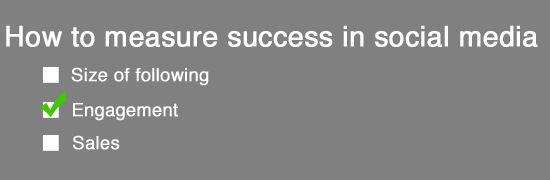
    • Size of following. Having 25,000 followers on Twitter or 10,000 fans of your Facebook page doesn’t mean jack.
    • Contest excitement. I love hosting contests as much as the next guy, but hosting a big contest doesn’t mean jack.
    • Being active. Utilizing the tools of social media is important, but just showing up doesn’t mean jack.
    • Atta boys. [Or atta girls] When you first get started everyone in your organization will be excited, but that doesn’t mean jack.
    • Sales or lead generation. This may make the boss happy, but in most cases it doesn’t mean jack.

    True positives

    • Engagement. Are your followers, fans, subscribers listening to the stuff you send out in a measurable way? Do they click on links you recommend? Do they comment on stuff you post? Do they open the emails you send? Having a large following is only as valuable as your ability to engage those people. Otherwise, your just another message they are ignoring. I’d rather have 100 engaged Twitter followers than 25,000 who ignore me. What to measure: comments, likes, open rates, click rates, number of clicks, mentions on fan/followers feeds.
    • Users who contribute. Is your effort a two-way conversation? Traditional marketing is about pushing a message. Social media is about pulling a response. It’s shocking to me how many organizations have large followings but only push. And they wonder why they think their social media efforts are a waste of money? They are! What to measure: Submissions, Facebook messages, Twitter direct messages, unsolicited or solicited ideas.
    • Repeaters. This post is the perfect example. When I press publish on this blog post, my own network will draw a couple hundred visitors. But this post will be read several thousand times in just 7 days. How did that happen? Repeaters. What to measure: Facebook shares, Twitter retweets, add-to-this analytics, trackbacks, blog posts about your content/product/service.
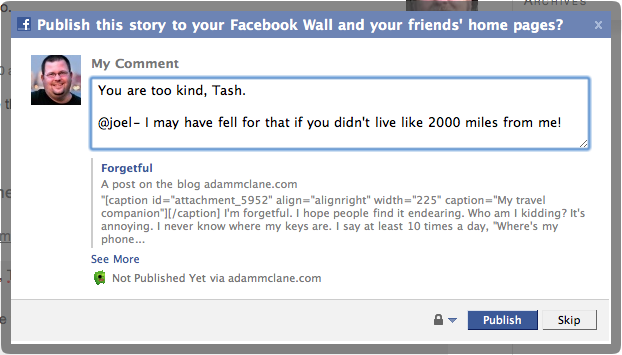
  • Facebook connect

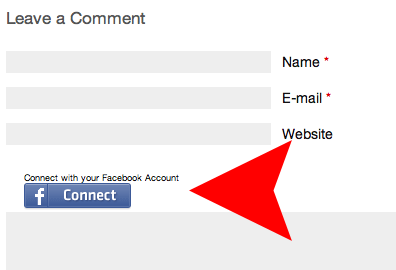
    You now have the ability to post your comment at adammclane.com onto your Facebook profile. It’s completely optional, and as you can see in the image above, if you do link your comments to your Facebook profile you’ll have the chance to control how you’d like that to look.

    Over the past year or so I’ve noticed that a big chunk of the discussion for each post has happened on Facebook. That’s fantastic, but makes it hard for me to keep track of. This is an attempt to try to bridge the blog and Facebook comments together so more people can join the conversation easier.

    Ready to give it a try?

    To test it out, simply leave a comment on this post. When you are done click on the Facebook Connect button.

    Setting up Facebook connect on adammclane.com

    Facebook will ask you to verify that you’d like to connect, agree to that and you’re done!

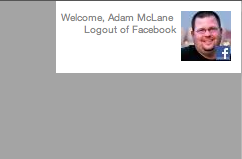
    From now on when you come to the blog, if you are logged into Facebook, you’ll see your Facebook badge in the upper right hand corner of my blog. When you see that, you’re already logged in and ready to leave a comment– and share the discussion with your friends!

    Easy, right? Thanks for giving it a try!

    adammclane.com on Facebook
  • A Pastor Who Gets It

    There’s a tiny amount of cynicism when you hang out with church leaders. We have a hard job and it comes out in funny ways.

    That guy just doesn’t get it.

    There are lots of conversations where church leaders don’t get it. Talk to any associate level pastoral staff member, church secretary, maintenance person, van driver, or ministry volunteer and you’ll hear it. “My pastor doesn’t get it.

    And, in all fairness, the job is too big to “get everything.” You simply have to chose what to “get” and what to “punt” on.

    In my world when a pastor doesn’t get it— that usually means that the suck at all things computer related.

    How these people got through seminary I’ll never know! But I’ve met too many pastors who can’t use Microsoft Office or manage their email or find stuff using Google.

    And when it comes to social media– some pastors get it but most don’t. Facebook, Twitter, blogging, live broadcasts online… they glaze over as I talk about these things!

    And yet over and over again, when I meet with pastors, they tell me “I want to get it.

    This is precisely why I contacted Doug and Tony over at JoPa productions and asked them to bring Pastors’ Social Media Bootcamp to San Diego next week.

    Pastors want to get it. Let’s make sure they get the training they need to get it.

  • Social Media Training for Pastors Coming to San Diego

    I bump into church staff all over San Diego County who have the same question, “I hear that social media is a great way to reach people, but I don’t know how to get started, and I don’t have a lot of time to figure it out.

    Youth pastors. Church planters. Senior pastors. They all have the same questions!

    I love the heart behind that question! It shows an earnest desire to try to reach people in their community, but also acknowledges a need for some basic training.

    So when I saw that Doug Pagitt and Tony Jones had put together a one-day training seminar which teaches church staff the basics of blogging, Twitter, Facebook, and live streaming your church service— I knew I wanted to bring them to San Diego.

    I love training church staff over coffee, but the truth was that there are way more pastors who need help on this stuff that time that I have to train them over a cup of coffee. This way is just a lot better and more thorough than I can handle. (Plus, Kristen says I get goofy when I drink too much coffee)

    The first half of the day talks about social media philosophy and the second half is nuts and bolts of getting started. In talking to them about the content, this is entry-level– right where most pastors are. The feedback from participants in other cities has been fantastic.

    I hope to see you (or your boss) there!

    Here are the details:

    Date: March 9th, 2010
    Time: 9:00 AM – 4:00 PM
    Location: Christ Lutheran Church – Pacific Beach
    Registration cost: $95, lunch included
    All the details are right here
    Presenters: Doug Pagitt and Spencer Burke
  • A new kind of missions trip

    I’ve been on a lot of missions trips. But never one that was three dimensional before.

    The three dimensions of the Haiti trip:

    1. Going and experiencing for myself.
    2. Using Twitter and Facebook to tell stories live, sharing pictures and videos with thousands around the world.
    3. Watching the experience change my friends while they participate in the trip from their living rooms, offices, and cars.

    Here’s how this scenario played out over and over again.

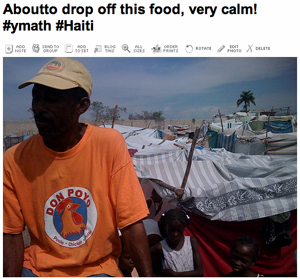
    We would load up the team van and head to a destination. Whether it was a meeting of pastors, a prayer meeting where thousands spontaneously had shown up, or walking around a devastated community and meeting people effected by the earthquake.

    All of a sudden, my iPhone became a powerful ministry tool.

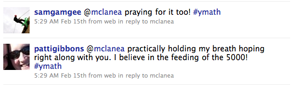
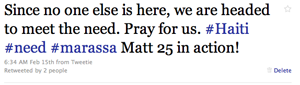
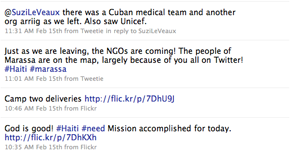
    I would post on Twitter a simple message.

    And instantly, my friends were engaged in what we were doing.

    As free moments were available, often times while walking or driving from one place to another I was able to update my Facebook status or post a tweet so that people could continue to pray for what we were doing… and more importantly join in the story of what God was doing.

    It’s important to note that this wasn’t a distraction from what I was doing on the ground. I was deeply engaged in the moment. But as free we walked from one place to the next or as we drove, I was able to utilize that otherwise down time as ministry time. Doing these things didn’t distract, they amplified what we were doing.

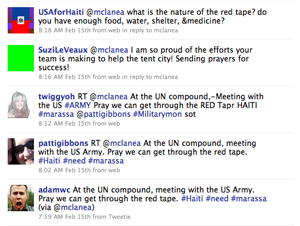
    Thanks to the power of Twitter retweets and hastags, there were now hundreds of people engaged in our ministry, watching every step of our journey. People gave us advice. Sent us links. Added our efforts to databases and websites. Encouraged us. On and on. This was missions far different from what is documented in Acts, when reports from missionaries trickled in from letters!

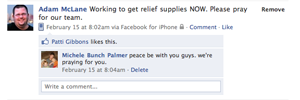
    As the need for more specific prayer arose, I was able to update these friends… who were now looking for ways to pray for our team.

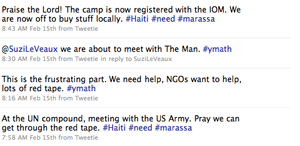
    Read the updates from bottom to top, in sequential order

    At this point in our day, I was in hog heaven. This was the convergence of all of my favorite things. I was engaged in social action as we advocated for people. I was engaged in social media as my cloud community prayed and sought solutions for the problems I was experiencing on the ground. And I was engaged as a pastor as we prayed and worked with people in the camp.

    And social media was also documenting a miracle. (and my getting punk’d by Marko!)

    Little did I know that the three dimensional missions we were doing had taken on legs of its own. My friend Tash was updating her radio audience in Auckland, New Zealand with my Twitter updates so people could pray. Tons of people retweeted and added commentary . Literally, people around the world were following this story and about to see God do something amazing.

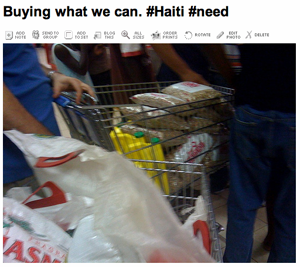
    Using $2000 we had raised on Twitter the night before. We were able to go to the only supermarket in Port-au-Prince and buy nearly all of the rice, beans, and baby food they had. (The money was given one day, utilized the next!)

    While hundreds of people back home participated in our journey, we were able to continue pressing into what God was doing.

    I don’t think this is somehow the beginning of a new age of missions engagement, but I do know that for our team this was a powerful way to tell stories as we went and amplify/report on what God was doing.

    As a fellow youth worker, I know thousands feel compelled to respond to the humanitarian need in Haiti. But the concerns of safety and appropriateness will over-power the prompting of the Holy Spirit to take a team for most. (This is a faith issue, but that’s another blog post.)

    It’s my hope that this new variety of missions will embolden many more to pray for Haiti, give to NGOs doing good work on the ground, and go to Haiti to see for themselves what God is doing.

  • Smart Media

    The most important lesson I’ve ever learned about business and social media was from Duck Tales Scrooge McDuck.

    Work smarter, not harder

    This mention of my work by Derek Johnson of Tatango proves my point.

    I’m not a guru. I don’t have a degree in media design. I have never taken a marketing class. I don’t have an MBA. The truth is that there is nothing special about me— all I do is stuff that is obvious.

    That’s good news for un-experts like you and me. You don’t have to have a bigger budget, you don’t have to have a pedigree, you don’t have to schmooze a newspaper editor, you don’t have to buy Super Bowl ads.

    In today’s world a smart message is all you need. Spend all your energy (cough, and money) investing in working smarter not harder.

  • McLane Creative

    McLane Creative

    If you pay close attention, you may see a links to mclanecreative.com on some websites. What is that all about?

    Essentially, McLane Creative is for stuff I do outside of my work at Youth Specialties. Sometimes there may be a project I want to experiment with that has nothing to do with my full-time gig, so I fly those things under that banner. Those are personal projects… stuff I play with when I’m bored.

    But I also do some projects for people under the McLane Creative name. Up until this point I’ve kept those projects very small, kept closely within my network of friends, and kept my involvement in them below the radar. The simple truth is that for every project I had time to work on I was saying no to about 20 inquiries.

    As an entrepreneur– this drove me nuts! There are so many great ideas out there and it is super annoying to have to say no to 95% of them. (And about 99% of my own) I simply don’t have the time/energy to do more than what I’m already doing… but there must be a third option.

    That third option was such a simple solution. Why didn’t I think of this before? I’ll keep doing the 5% of projects completely on my own. But I’ll also start saying yes to more projects I’m passionate about, just won’t do 100% of the work myself. Instead, I’ll work with my network of existing friends who are all themselves brilliantly creative. In football terms, my role with McLane Creative will be primarily to distribute the ball. (Unlike in the NFL, this will be a fair trade deal. I don’t believe in hiring coders in Eastern Europe or Asia, you need to ask about that these days when hiring creatives.)

    So these are the 4 types of things I’m now open to under the banner of McLane Creative: (*super-important disclaimer below)

    • Web design/development/implementation
    • Social media and online marketing consulting
    • Full-on marketing campaigns (print, video, web)
    • Speaking, staff training, one-on-one nerd coaching, writing

    Last, it’s probably good to say up-front that I don’t work for free. (I do a fair amount of pro bono work, but I pick those projects on my own for my own reasons.) Since I pick only projects I am passionate about, my rates tend to reflect that passion. But free? No can do. Barter? I do like tacos. I’m looking for a country club to exchange a free membership for web design!

    Want to know more? Hit the feedback button on the side of my blog or head over to the website and contact me.

    *Super-important Disclaimer. I’m not starting a business in any way, shape, or form! I’ve got a job that I love enough to call two full-time jobs already. The only way I can say yes to more is to hand most of it off. Nor will I consider any project, even one that I’d hand off to a friend, which competes with Youth Specialties/YouthWorks in my opinion.

  • Social Media and Youth Ministry

    Today I had the chance to talk to youth workers in East County about all sorts of internet and technology stuff. Here are some highlights of that discussion.

    • It’s important to identify WHY you are a part of social media. Youth workers must get past the passive-praxis response of just doing it because it feels like we should and all the cool kids are doing it. Please pause and reflect on the theology behind what you are doing. I’ve got an article in the Winter 2010 issue of The Journal of Student Ministries which talks more about this.
    • Teens are multi-tasking everything. They watch TV while texting and having a friend over– and both are listening to music on their iPods. This results in some funky relationships where people are “together” physically but don’t talk to one another. Though they might text each other about the movie they are watching. If you need to see this phenomenon go do some observation at Target. You will see teen girls shopping together while talking via text to other people. True confession: I’m guilty of this one, big time!
    • Text messaging is king in youth ministry. You text a student, you know you are getting to them. Do more of that! go unlimited, baby! Engage them where they are with how they are willing to engage you.
    • Don’t forget to go to stuff like games. Technology makes some things easier, but you physically showing up in their life is still a big deal.
    • The new report from the Kaiser Family Foundation on media consumption by teens is mandatory reading for youth workers everywhere. Here’s the link. Don’t come to conclusions, read articles, or do anything else about the topic until you digest this new study.
    • Parent issues with technology are a big deal in some circles. But it seems like there is less of a battle with Facebook compared to Myspace.
    • Fewer ministry dollars and time are being spent on building a web presence as we all just cave in and do stuff on Facebook. I think this is a good thing.
    • Tools like Hootsuite and CoTweet are perfect for busy youth workers. Sit down once a week and schedule Facebook profile messages and tweets.
    • Presence is becoming a major issue. Kids don’t even know how to just sit and have a conversation anymore. Of course, this starts with adults. I’d suggest everyone reads Flickering Pixels by Shane Hipps. I love how he approaches the topic.
    • IRL is back. All of this technology is leaving kids hungry for real life experiences. Events, retreats, concerts… experience are all hot this year. It might not be in traditional ways, but real life stuff is becoming cool again.

    One trend that I meant to talk about but ran out of time with is this: I’m seeing fewer and fewer teens reach out to become content creators. It’s not just that I am around shy kids, it really is that there are fewer teens out there who are contributing substantive thoughts/comments. Attention spans are about that of a flea right now. Which is why sites like Fail Blog, FML, and TFLN are so popular among teens. (Those links are not safe for work) Look at the comment sections of these sites. Nothing of substance whatsoever. There must be $1 billion in text messages sent in 2010 containing either “lol” or “k.”

  • Facebook App Gets a Facelift

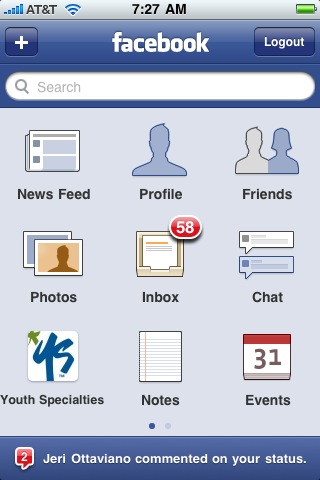
    I use the Facebook app for iPhone all the time. It is my #2 most frequently used app behind Tweetie. While periodically they have released updates, they’ve mostly been cosmetic or UI in nature.

    Last week’s update offers something brand new and fun. But it’s also something you need to be aware of even if you aren’t an iPhone user.

    Two new features:

    1. Push notifications. Starting with version 3.1.1 you will get notified any time a friend does something on Facebook. I haven’t decided if I like this yet or not. I’ve got a lot of friends on Facebook and consequently a lot of activity on my account. People leave comments, wall posts, reply to threads I’m replying to, and send me lots of messages. I love this activity on Facebook, it’s one of the coolest things about the site. And now, each time they do something, a little announcement pops up on my phone. The good news is that it doesn’t make a sound to alert me that there is a new notification. The bad news is it is an interuption and I’m trying to eliminate those from my day-to-day, minute-by-minute life. It’s not that I’m super important… it’s that I need to eliminate distractions so I can give people/projects my full attention. If you don’t know how to turn it off, go to your iPhone settings> Facebook>Push Notifications> and you will see that you can decide what types of notifications you’d like.
    2. Massive data schmooshing commencing

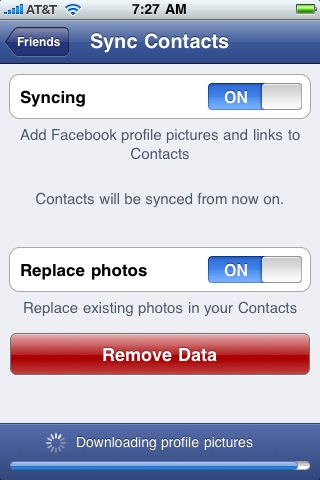
      Contact synching. This is, by far, the coolest new feature they’ve added to the Facebook app. If you turn on contact synching the app will look at your iPhone contacts on Facebook and merge stuff. So if a contact has a phone number listed in Facebook, it will automatically import. The fun feature is that it also pulls their current profile picture and uses it as the picture for that contact on your phone if you don’t have one already. That’s just slick! Here’s the kicker that will make some people mad. The iPhone app doesn’t care if you are friends or not. If you have a profile and you are in the iPhone’s contacts… it will pull that picture. For those concerned about personal branding, that’ll force you to be more professional about your profile picture on Facebook. If you represent your organization… it might be a good idea to keep that profile picture looking good too.

    More data schmooshing to come? I’m sure there is a more technical name for this, but I call it data schmooshing. That’s where information from one application/website is merged with data from another application/website and out of that comes a new, more complete data set. I’m excited to see where this Facebook app takes things. I’m hoping that as time goes on it will schmoosh data with my Google contacts as well as my Google calendar. If they all start talking better the Facebook app could become a must-have application for everyone.

    This is precisely why people are saying that Facebook could make a run at building their own operating system, just like Google. Yes, the Facebook phone may just be one of those surprise 2010 products.

  • 5 Tech Trends to Watch in 2010

    What’s going to be the next cool thing? Of course, I can’t predict the future. But I can see some technologies that are just on the edge of getting to the masses which I think will be game changers in 2010. All are just a price-point change away from radically changing the way we interact with the world.

    Here’s what to look for in the coming year:

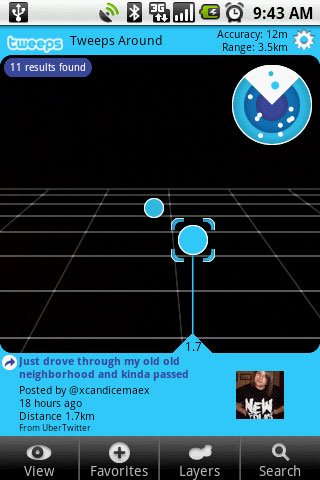
    1. Location-based mobile everything. Smart phones have taken over the mobile phone world. GPS-enabled smart phones. With the incredible popularity of iPhone 3G3 and the recent emergence of Droid OS phones, I think we’re about to see an explosion in the sophistication and participation of location-based games. Two that are on the market already, Gowalla and Foursquare, have gained traction among early adapters from Twitter and Facebook. While fun, I think in a year we’ll look back at them like we did at Pacman after Nintendo hit the market. Also, once more mobile Twitter clients become geolocation enabled I think we’ll really see some games (and utilities) pop onto phones that are wildly popular.
    2. Augmented reality takes off. This technology is getting increasingly cheaper. And as this comes out of the lab and high-end marketing applications to generally available among web/graphic designers… look out. Here’s a video that gives you an idea of how cool augmented reality is:
    3. Scams are back. Technology has a Wild West feel to it again. And any time you have a wild west feel, you have scammers waiting to cheat you out of money. The interconnectedness that we all love also makes us vulnerable to scammers. As we link more and more of our lives to Facebook and Twitter, we are lured into trusting that those gateways are safe and secure. But they aren’t! Let’s say you connect your Twitter account to your Amazon.com account or Mint.com accounts. Bam, you are a sitting duck. Scammers have proven they can trick you into giving them your Twitter password and from their they can/will gain access to all sorts of personal information. The unhealthy trust we all have that Twitter/Facebook are ensuring that people who access their API will truly adhere to the terms of service has set us all up for scams. This will be big in 2010.
    4. IRL. The first three things on this list point to the need for In Real Life to be a tech trend to watch. Experience is back. Meet-ups, events, and tech free zones are a trend to watch out for in 2010. Of course, those things don’t really provide the intimate relationships our souls crave, but they are legitimate experiences people seeing the world through augmented reality and redefined friendship will seek out in 2010. In the church world I think we’ll see the closing of many online church campuses, satelite-feeds, and other non-IRL “ministry” things as people seek human interaction more than the convenience of church from their laptop or mobile phone.
    5. Interactive storytelling. In 2009, YouTube enabled a feature which allows you to post links to other YouTube videos from within the player. I think we’re just at the beginning of some fun storytelling and “choose your own adventure” types of viral videos. Here’s one that I really like to give you an idea: (enjoy your adventure)