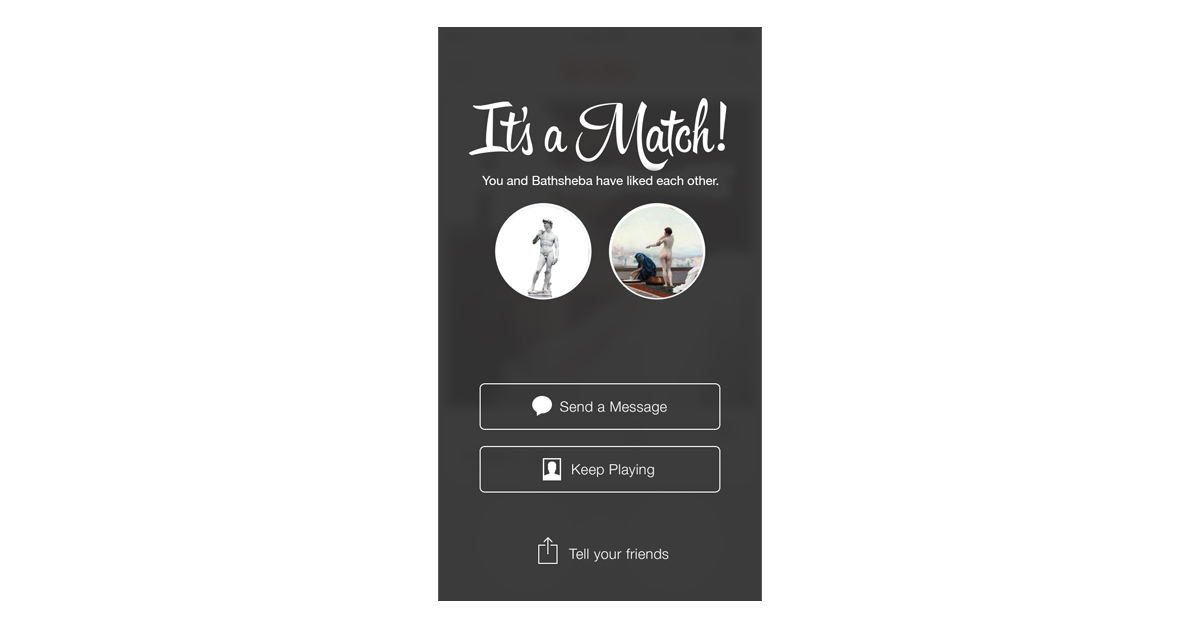
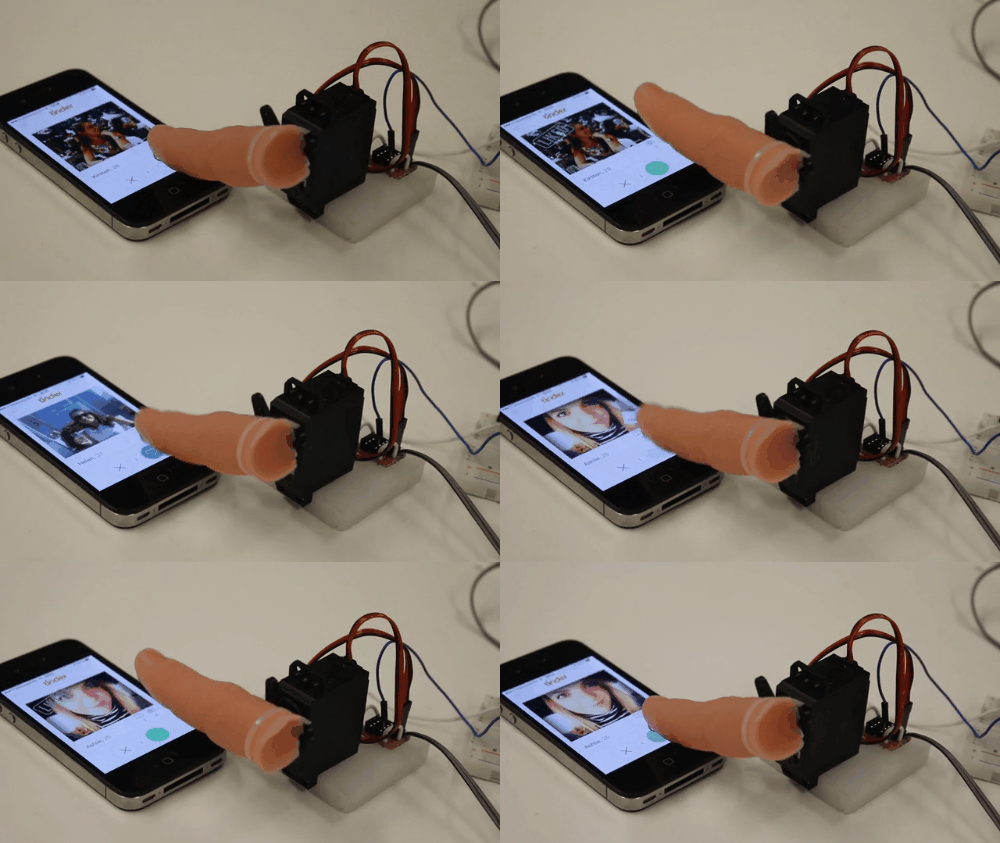
One evening David got up from his bed and walked around on the roof of the palace. From his phone he saw a woman, the woman was very beautiful,and David swiped to the right. She came to him, and he slept with her. Then she went back home.
2 Samuel 11:2-4, on Tinder
I’ve been thinking a lot about teenagers and relationships in a social media saturated culture lately.
On the one hand, I attended the Association of Youth Ministry Educators annual conference this past weekend, and the topic was Technology and Transformation. There I heard lots of presentations about adolescent life and the role technology is playing. Stuff which I’ll be unpacking in the weeks to come here on the blog.
On the other hand, I’m engaged with lots of real life adolescents regarding issues of technologies is bringing to their life over and over again. One of which is a fundamental shift in how people meet one another romantically. The vast majority of young adults are meeting people for the first time online. Their parents? They didn’t do that. Most of the people in their life are suspicious of dating people they first met online. It’s a practice with lots of upside, but also lots of downside. Think about it: Judging purely on looks or the ability to create a profile… how many married people would have ever met their spouse in that context? Likewise, what does it feel like to have your romantic prospects judged purely on looks alone?
Women are seemingly left with endless choices.
Men are like…
And both, from what I can tell from talking to people, are left feeling shallow. Even people who are allegedly looking for a cheap hook-up encounter are really looking and hoping for something more.
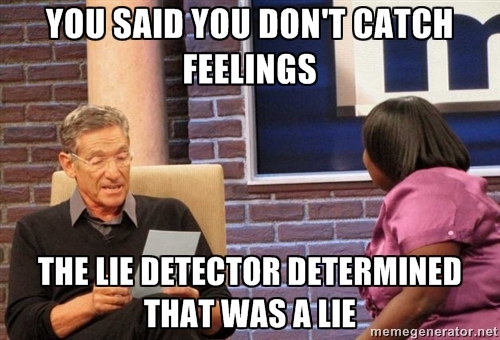
There’s a great meme floating around about “catching feelings” for someone you’ve hooked up with or have a “friends with benefits” arrangement with.
It’s as if there’s an assumption that you can have emotionless sex. Becoming attached to someone isn’t just a thing rooted in morality or religion, it’s rooted in biology.
Can the Bible help?Do Christians have a message of Good News for our Sexuality? Do we have anything to say in a world of ever-evolving attitudes about sexuality? This was the question Adam Mearse asked a room full of Christian educators yesterday.
I believe we do.
But I think we’re going to have to deal with our own selves first. We’re going to have to set aside the crap we taught in the 1980s, 1990s, held on to during the 2000s, and clung to in the early 2010s like it’d somehow come back.
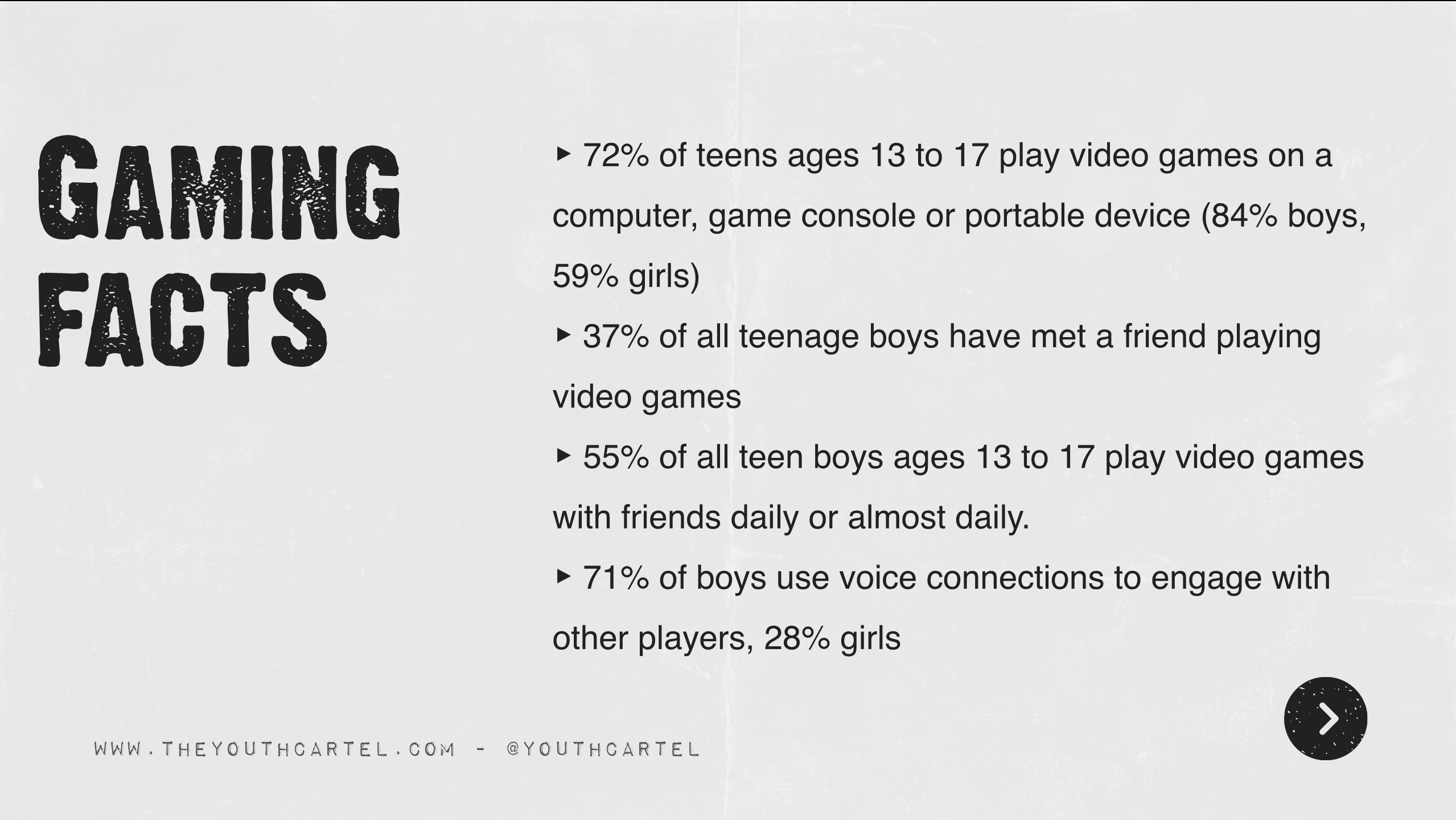
I’ve been a bit shy to talk about the important of gaming as it relates to teenagers, you know… mostly because I like to back up what I say with facts as opposed to sharing anecdotal stuff as fact. (Which is the case with MOST of the stuff out there about teenagers and social media.)
But Amanda Lenhart’s latest research release in August highlighted some gaming statistics that instantly went into my presentation. I’ve got the highlights above… read the full study here.
In 2010, just as I was getting into San Diego State sports, I posted a video of the Aztecs taking the field on YouTube.
To my surprise it got a lot of traffic. Like, there were maybe 3,000 people in the stands for this game and 1,000 people watched my video in 24 hours on YouTube. And when I poked around to see where all the traffic was coming from, most of it pointed to a thread on an online forum, AztecMesa.
So I created an account and claimed the video as mine. From there I’ve been an occasional poster, mostly lurking, but sometimes jumping in and even starting conversation.
At AztecMesa I’ve met a couple new friends. But, quite frankly, I also met too many 1990s era internet trolls.
I’m no rookie to online forums. After all, from 2005-2008 I helped lead YMX, a forum with thousands of members who created hundreds of thousands of posts. And for 9-10 years prior to that I’d been actively part of many, many only forums.
Kingdom of the Trolls
It only took me a couple of days of poking around at AztecMesa to see that they had a troll problem.
What’s a troll? Wikipedia offers a good enough definition:
is a person who sows discord on the Internet by starting arguments or upsetting people, by posting inflammatory,[1]extraneous, or off-topicmessages in an online community (such as a newsgroup, forum, chat room, or blog) with the deliberate intent of provoking readers into an emotional response[2] or of otherwise disrupting normal on-topic discussion,[3] often for their own amusement.
AztecMesa topics consistently either started off negative or quickly turn to the negative.
In fairness, it’s not just that San Diego State fans tend to troll their own fans… it’s that San Diego sports fans, in general– even in real life— tend to troll their own teams. I’ve attended sporting events my entire life and I’ve never seen people who will pay good money to go to a sporting event just to complain. But that’s fairly common here.
When I first started engaging with folks at AztecMesa I was determined to help people see the positives. And there were a few fellow fans who seemed interested in the same thing, so it was fun.
You see, really, truly, and factually… San Diego State is undergoing an epic turnaround as a university. A school once known as a doormat on the athletic field now competes, sometimes dominates the conference in many sports. (except football) While hundreds of thousands of alumni remember State as a fallback commuter school, State has become much more residential and hard to get in to. It’s no longer a fallback school. In fact, it’s a pretty cool place to live near.
But, alas, I’m giving up on AztecMesa.
From time to time I experienced successes. I could help people see the positive. But, in the end, the trolls there are simply too powerful. It doesn’t help that moderators often participate in the negative bent unchecked and uncheckable.
Since it’s gotten to the point that I actually find myself less enthusiastic about attending SDSU games because of the trolls at AztecMesa… it’s time to walk away.
You know it’s bad when the local newspaper calls out a fan forum:
Chat boards had threads titled things like “SDSU football is stuck in coaching purgatory” and “The program has regressed under Long.”
Were moderators embarrassed that the unchecked stuff they allow on their forums got picked up in the local newspaper? Nope. They probably thought it was good publicity.
I’m not walking away from cheering for SDSU. I just am leaving that negative space to itself.
What Does This Have to Do With You?
99.9% of my daily readers are not Aztec fans or care about any of this, and so you may be wondering why I’m writing about this on my blog?
I’m sharing it because it’s relevant to all of us.
And with that in mind we sometimes we allow ourselves to step into negative space in hopes that we can be a change agent. Maybe we can be the voice or the person who makes an impact?
But you don’t always get to win.
Sometimes you need to give up!
You might “be the change” all day but you don’t always get to see the change you want to see.
That’s ultimately not your choice.
And so you have to decide… at what point are you willing to walk away? At what point is enough enough?
My advice?
Enough is enough when you no longer find joy in it.
Enough is enough when you find yourself alone in it.
Enough is enough when you feel the vortex of what you’re up against pulling you in.
It’s one thing to be a change agent. It’s another thing altogether to get that negativity on you, literally feeling dirty with it, and see no real change for a significant period of time.
Quitting doesn’t make you a quitter. Sometimes quitting is necessary.
After an insane run of speaking engagements in 2014 I backed off for Winter and Spring 2015 so I could concentrate on family and my responsibilities with the Cartel… both growing really fast! It was too much, too fast, and I needed a break.
In other words, I said no to a lot.
With that in mind I want to post publicly that I’m ready to take on a healthy amount of bookings for the upcoming school year. (5-6 in the Fall; 5-6 in the Winter.)
Here’s what I can offer:
A parent seminar on healthy social media habits (Perfect for parents of 4th-9th graders, based )
A youth leader training seminar (Called “Teenagers + The Small Screen“)
A school assembly, lecture, classroom talk and discussion (Customized to meet the needs of your school. I’ve done this in public, private, parochial
and Christian schools)
Youth group or retreat talks for middle & high school students. (Most often about social media, but I’m open to other topics.)
Sunday morning preaching/teaching.
I’m pretty flexible and will work to meet your needs. Some folks bring me in just to do a single talk while others bring me out and book me back-to-back for 3 days straight.
New Material
All of the talks above are constantly morphing and adapting to current trends, data, and movement. So if you read the book, A Parents Guide to Understanding Social Media, and you think that is what I’ve got, material-wise, understand that the book was based on material I was talking about at the time of writing but it’s continually refined.
Along the same vein, I’ve been working on a brand new talk for youth groups and Sunday mornings that I think is really powerful. It starts with the facts-based approach I take on social media and takes a very interesting turn into a biblical narrative, with a strong personal application.
Let’s Do This
I try to keep these things affordable and I’m happy to work with you. Even though it’d be way easier I’ve been able to avoid using a booking agent, which benefits the folks bringing me in far more than it benefits me!
If you want to talk about a speaking opportunity please connect with me via my contact form. (If you have my contact info, feel free to connect that way!)
I have read a few of your posts about Snapchat. Snapchat can be used badly, as you have said in your articles. Also your pictures can be (most likely are) stored on Snapchat servers for them to use. For me I use Snapchat with my friends, and have never received or used it in a harmful way. I guess I am just wondering what you think about using Snapchat (in a non-harmful way)?
Amber, the quick answer is– Yes, of course you can. I’d just ask you to consider a longer answer with some things to think about, as well.
Is Snapchat, Inc. trustworthy?
First off let’s all recognize a fact. Some of the things I wrote about Snapchat in August 2013 have changed. Snapchat, as a platform and company, have matured as a more responsible ecosystem for it’s users. [And for the sake of its investors who, no doubt, would like to see a return on their $1.8 billion in investment to date.]
These are all good things. Very, very good things which I applaud them for. These changes show that Snapchat is trying to make their app more safe to use like Twitter, Facebook, and Instagram and less prone to abuse like say… Tinder or Kik.
But let’s also recognize that none of these changes came from within. Evan and his team didn’t implement any of this for altruistic reasons to protect their users… the type of self-regulation that’s very common at companies like Apple, Google, Facebook, and Twitter.
Instead, all of these changes were forced on them as the result of an unprecedented settlement between Snapchat and the Federal Trade Commission. (FTC) The scope of the agreement is 20 years of active monitoring at Snapchat’s expense. Meaning, they have government regulators constantly monitoring what they are doing and they have to report back to the FTC every quarter on what they are doing to remain compliant with applicable privacy and security laws.
I’m not aware of a similar standing agreement among any other social media platform and I’ve been at this a long time. (Cough, since AOL 1.0 days)
So, I am less concerned about Snapchat today than I was 2 years ago. But I’m not giving them a lot of credit for a change of heart.
Many times you’ll hear people complain that the laws move slower than technology, this is how companies are able to get away with so much invasion of privacy– they exploit technology within legal loopholes. This simply wasn’t the case with Snapchat as they admitted in the settlement that they broke century old laws in making false claims to consumers.
What I see is a company that has often struggled to fully own their faults. When their app was hacked, they place the blame everywhere but their leadership, when it is… in fact… the sole responsibility of the company leadership to protect user data. When the app was being used by pedophiles to groom teenagers, they hid and made it nearly impossible to get usable data… that’s monstrous and nearly unforgivable. But perhaps this too is changing? I can’t really say because I only know the team externally. (Though I’d love to meet them in real life.) Evan, their frontman, CEO, and co-founder, seems to be doing a better job at owning mistakes and apologizing when necessary in this interview. In regards to the emails posted on my post, he half-owns it and apologizes… he says that it was inapppropriate and he’s sorry but he couches it by saying they were sent while he was in a fraternity— that’s not entirely true, those emails were sent when he was launching Snapchat, so while he might have still been in a fraternity, he was also creating a sexting app called Picaboo that since morphed and was rebranded to become Snapchat. So, that old habit is still there but I’m hopeful for his sake that he continues to mature as Snapchat’s frontman. Certainly, he’ll need to if he truly wants to see his company have an IPO before those investors force him to sell.
So, long story short? I think the jury is still out on whether Snapchat, Inc. is a trustworthy company.
Can I Use Snapchat Responsibly?
I really suppose that has to do with your definition of “responsibly.”
If you are using it for fun in a benign way, is that responsible? Probably for you individually. But again, I’d like to offer you a couple things to consider as you decide that for yourself.
The app’s design does a good convincing users that you’re sending something private and temporary, that you can control privacy, etc. And just like that benefits you and makes the app more fun, it can also be a weakness that another person can use against you when you are vulnerable. And I’ve talked to dozens and dozens of young women who have been solicited to do something with the app that they later regretted. The images may be ephemeral but the exploitation that can happen on the app lasts a lot longer. (And yes, for some reason, Snapchat is more commonly used for this than any other app I’m aware of.)
Understand that others are targeted and groomed for exploitation using the app. I know that sounds yucky, because it is. But the simple fact is that the nature of the app has a tendency to bring out a dark side in people. As a leader, I’d be aware that my usage of the app makes it OK for people who look up to me. So your responsible usage may be giving permission to someone to use the app that could result in them being harmed. (To be clear, I don’t mean people use the app to rape people. But I do know that many young women have been coerced/manipulated to send things via the app they regret. They’ve been exploited pure and simple.)
If I’m an adult using the app I would NEVER EVER send a snap to someone who is a minor that isn’t my child. Yes, Snapchat is the new cool way to market to teenagers. But that shouldn’t mean that teachers, coaches, youth workers, etc. should be sending magically disappearing images to minors. That’s a quick way to prison if you ask me.
So, to answer your question again: Yes, I think you can use Snapchat responsibly. While it was once an app I would deem as “Dangerous, to be avoided by teenagers” I’ve changed my recommendation to “Use with extra caution.” Personally, I still think Instagram or texting are better choices.
I hope this long, but hopefully informative answer, is helpful to you. I’d love to hear from readers about how they are using Snapchat responsibly or places in this post where they disagree with my thoughts. Leave me a comment or drop me a line.
Snapchat. I feel like I am using it too much. I’m not worried about Snapchat not really deleting my pictures. I just feel that I’m using Snapchat to seek something else. I feel bad when I have all these stories and it looks like I am bragging but everybody does it so I think it’s okay. I Snapchat everything and I wish I could stop.
You’ve made a great observation, Aaron. What you are talking about is important for anyone that uses any app, not just Snapchat.
Sometimes we all need to take a step back and remind ourselves that we own the phone, the phone does not own us.
Why is Snapchat so addictive?
Long story short, the app is designed to trigger a response in your brain that makes it so that you check the app without even thinking about it. (It’s not just Snapchat, virtually every app does this.)
Any time you get a new snap or scroll through stories or send a snap, your brain’s reward system is triggered. Getting a message or like or even sending a message feels so good at a sub-conscious that your brain just can’t get enough… kind of like your favorite candy… you don’t know why you ate the whole bag, but you did.
I first wrote about dopamine and interrupting the loop in 2012 in this post, Notifications are of the Devil, please take a few minutes to read that.
With something like Snapchat, which often might include flirtatious or even sexual content, it kind of “double triggers” your brain. You have the dopamine effect found in receiving any type of notification PLUS you have the normal hormonal response found in any potential sexual encounter. It doesn’t matter if you’re 13 or 39 or 99… if something sexual might happen, your brain will give it your full attention.
What can I do to make Snapchat less addictive?
I’m not a Snapchat user, but I do use other apps that are equally addictive. (Instagram, Facebook, Twitter, YikYak, etc.) Here’s how I take control of my usage… well, at least get better control of my usage:
Schedule Do Not Disturb to block out hours where you need to concentrate (work, school, sleep) – Here’s how to do that for iPhone and Android.
Only use your phone in public spaces of your life – Over the last 20 years of working with individuals and families I’ve learned that most addiction problems occur when internet connected devices are used in private. (Bedrooms, basements, bathrooms, etc.) No one sets out to get addicted to an app, online gambling, porn, etc… but it happens when we use the device in isolation for long periods of time. If you form a habit that you’re not going to use the device in private, you’ll eliminate most internet-related addiction problems.
Have a tech related question? Drop me a note on my contact form or send in your question via the form on the sidebar of my blog.
GREAT content on social media and the issue of whether or not anonymous apps really are anonymous! I am giving a presentation to 1,000 college students with an emphasis on what future employers will look for when looking at social media posts. I’m also looking for info on how to prove to them that what they believe they’re posting as anonymous really isn’t.
If you have other posts or sites that would be helpful about this, I would love to see them. Thanks again, Adam. Great content!
— Kristin
This is one of those pressing questions, right? Adults feel the need to provide some fair warning that college life is not real life and what’s cool in college might actually be detrimental to the reason they are at college. Meanwhile, college students stare blankly at an adult who they think speaks another language about their social life. I really think this is more about extended adolescence than specifically social media, but I digress.
With the popularity of so-called “anonymous” or “ephemeral” apps, it’s good to remind everyone from time to time that the only one who thinks these apps are private or anonymous are the users themselves. Snapchat isn’t anonymous. Nor is YikYak or Tinder or whatever.
A few ways they are not anonymous:
Your account is linked to your device ID, your phone number, your email address, or something that you use to sign-on. That points back to you.
The app recognizes your device beyond your username and login info, often times recognizing unique identifiers.
Most apps use geolocation, logging your general location based on your ISP info OR using the GPS function in your phone to pinpoint your exact location every time you access the app.
Your phones carrier is logging your usage. (Text, data, messaging, voice calls, etc.)
You can mask your identity but your language is a unique identifier. The things you talk about, how you talk about them, your phraseology, the way you spell/misspell words, etc. All of these things point directly back to you.
Images you share often have metadata in them that point directly back to your device, geolocation, etc. Save an image to your computer, open in basic image viewing software, and voila.
As soon as you take a photo/video with your phone, you’ve already lost control of that file. Many phones backup your images directly to the cloud automatically. Even if that’s later deleted, it’s more likely just not shown to you but still in your account for a period of time in case you want to “un-delete it.“
As soon as you send an image/message/video to another person, you’ve completely lost control of what happens to it. They can do whatever they want with it, their device may or may not store it automatically, on and on.
What does this have to do with employment?
This is a complicated question because every employer and every hiring process is somewhat different. Likewise, boundaries between what’s acceptable, what’s normal business practice, and what’s legal in the hiring process are somewhat blurred lines.
Common sense tells you that there’s a difference between what companies are allowed to do in screening candidates for a position and what they actually do. Someone hiring a person is putting their own reputation and their future with the company on the line, so they are wise to do whatever they can to make sure their candidates are right for the company.
A few things that an employer might want to know that aren’t on the resume:
Character qualities
Approximate age
Relationship status
Background
Hobbies, passions, attitude, and stuff like that
Different employers are going to use different techniques to figure that stuff out. Some will figure that out in an interview or pre-screening phone call. But it’s easy enough to look at public profiles of a candidate on social media.
Are most employers going to do a full-on investigation that might include seeing if they can find out what you did for Spring Break 2013? Probably not. But don’t be surprised that employers sniff around on your various profiles to see what kind of person you are.
Expect it.
If you don’t have anything to hide than none of this matters.
But this might mean you have some cleaning up to do, as well.
Have a Tech Tuesday question for Adam? Submit your question on the sidebar of his blog.
A couple weeks ago I had the opportunity to record a podcast with Rhett Smith, a friend, Texas therapist, long-time youth worker. His book, The Anxious Christian, has been extremely helpful in our home, helping us understand the role anxiety plays within ourselves and our kids.
In this extended interview Rhett brought out many good points and nuances. If you’re trying to figure out how to integrate your families digital life into your home, I think you’ll find this show helpful.
Show Description
I first got to connect with Adam McLane when we were driving through the Dominican Republic, and across the border into Haiti. It was only about a month after the devastating earthquake that hit Haiti, and we were part of a youth ministry team that went down there (though as Adam points out, it was more like a bunch of youth pastors and me — a therapist). Over the course of those last five years I have had the opportunity to really connect and get to know Adam better, as well as speaking at his initial Summit in 2012, on the topic of, The Anxiety of Teenagers.
But in the last 5 years Adam has become one of the leading experts on youth and technology. In August of 2013, Adam’s expertise really gained attention when his blog post, “Why You Should Delete SnapChat” went viral. But don’t mistake Adam for some kind of anti-tech Luddite, rather he is a very thoughtful, thinker on technology and how it shapes our lives. And one of the things I really like about Adam when talking to him about technology, is that he’s not one to just lay down rules and put tech tools into action, rather he really encourages the consumer of tech to think about how they use their technology, and how they can create “sacred spaces” and practice sabbaths in their lives.
In this episode Adam and I dive deep into the work of Danah Boyd, and more specifically her latest book, It’s Complicated: The Social Lives of Networked Teens. It’s a great book, and Adam recommends that all parents buy the book, if only to read the first chapter. We also explore bullying and cyberbullying and how what takes place online is most often modeled offline.
We also explore the issue of trust between parents and kids, and talk about why Adam doesn’t recommend filtering or monitoring devices on computers. One of Adam’s concerns that he addresses is that too often parent’s turn over their parenting responsibilities to devices, rather than to help their kids think critically about how they engage technology. This was a fun conversation, and ultimately, I think both Adam and I mourned a little bit the loss of a lot of the freedoms that we had as kids (taking off on our bikes and being gone all day; cruising; loitering, etc.), but that kids today don’t/can’t experience (Danah Boyd’s work explores this cultural shift). This episode is for any of you who use technology (which is you if you are reading this). So whether you are a parent, or not, I highly recommend listening and discovering how you can more thoughtfully consume technology in your own life.
Whipser, Secret, Yik Yak, Snapchat, Burnbook, et al.
These are apps low on the “get it” list for adults. We look at them and wonder… “Why would I want that?” And it goes back to a fundamental difference between why teenagers use social media and why adults use social media.
Adults use social media to network. Public benefits that effort.
Teenagers use social media to hang out with friends. Public inhibits that effort.
Remember Monica?
We all remember Monica Lewinsky, the butt of every late night television and shock jock radio joke for a year. But, as she points out in the video below, along the way we forgot that she was a real person. No matter what she does in life she’ll always have an asterisk next to her name.
Last week, Ms. Lewinsky had the opportunity to talk about the impact of her public shaming and offered some challenges for what needs to change in our society when it comes to public shaming people online.
Literally, she isn’t saying anything new. The reason she’s on that stage is because nothing is changing.
In 2007, I wrote a post about an emerging Economy of Hate gaining steam via ad revenue online. In January 2014, I wrote about Reaction Porn, revisiting this concept to talk about the actual economics at play.
Without the economy of hate and reaction porn you wouldn’t have things like TMZ or Buzzfeed, two entities who proclaim their worth as bastions of free speech when in fact they are merely the Larry Flint and Hugh Heffner of the shame business.
Let’s be clear:These aren’t bastions of free speech, they are purveyors of shame. They profit by dehumanizing. And your enjoyment of them, those minor indiscretions of keeping up with the latest gossip, aren’t all that different than looking at pornography. (Not sure if that’s true? Both sell dehumanizing, damaging, and false views of real life. One is about sex while the other is about gossip. Both are highly profitable forms of exploitation.)
Why Snapchat?
The “why” of ephemeral apps is simple.
What happened to Monica on a national stage happens on a small scale at middle schools, high schools, and colleges every single day.
Here’s how: A person makes a mistake… let’s say getting drunk at a party and throwing up. Someone takes a picture of it and it gets spread around the school.
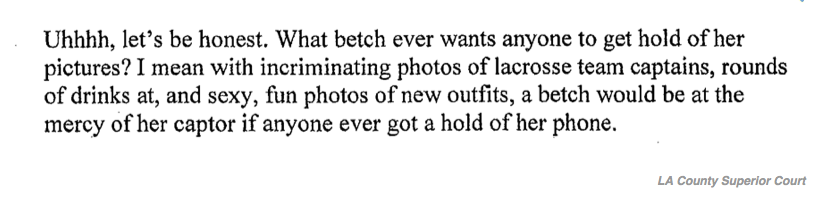
Now, all of a sudden, the only thing anyone knows about that person is that they are the drunken girl who pukes. She’s a slut, whore, idiot. She’s not a human anymore. She’s a character in a narrative. Forget the fact that 25 other people were at that party… she just got labeled. (see The Scarlet Letter from 1850. This isn’t new. Heck, it’s in the Bible, right? How did things turn out for Bathsheba?)
But what is new is that social media moves fast and lasts forever. And most apps offer so little control of privacy, that teenagers actually need methods of privacy.
Literally, to see how ephemeral apps took off watch the video below from social scientist danah boyd, author of the groundbreaking work It’s Complicated, and take note of solutions teenagers were creating pre-2011 to this problem.
So why Snapchat (and Whipser, Secret, Yik Yak, Burnbook, et al.)?
The technology followed the actions of teenagers. They needed a way to say things anonymously or have things they did (from silly to mistakes) disappear… and so these things emerged.
This is exactly the utility (function) that Snapchat’s creators were describing as they created the app, as Picaboo messenger.
“I’m so glad social media didn’t exist when I was a teenager…”
I hear that line all the time. Teachers say it, parents say it, youth workers say it.
Why do we say it?Because we did stupid stuff when we were 16 and it isn’t following us today.
But today’s teenagers do live in a world with social media and they are fully aware that stupid stuff they do, even if it’s exactly the same stuff their parents or grandparents did, will follow them.
Last week, San Diego county schools went coo coo for cocoa puffs about the social media app Burnbook.
Megan, our 8th grader, missed school on Monday. When she came home on Tuesday she said the joke on campus was an assembly she missed on Monday. “No one had the app or had even heard of Burnbook. What is it?”
Yeah, this is what I mean when I say… “Don’t educate 99% of students about something 1% or less are doing.”
Face meet palm. Seriously.
I see schools do this all the time. And it’s why my social media talks are based in principles instead of a single app… let’s educate the 99% about good, healthy habits, and deal with the 1% of problematic students in the counseling office.
So what’s Burnbook?
Basically, Burnbook is Yik Yak for middle and high school students with a couple plot twists.
Plot Twist #1
You opt into a community whereas Yik Yak merely implies a community based on your geolocation.
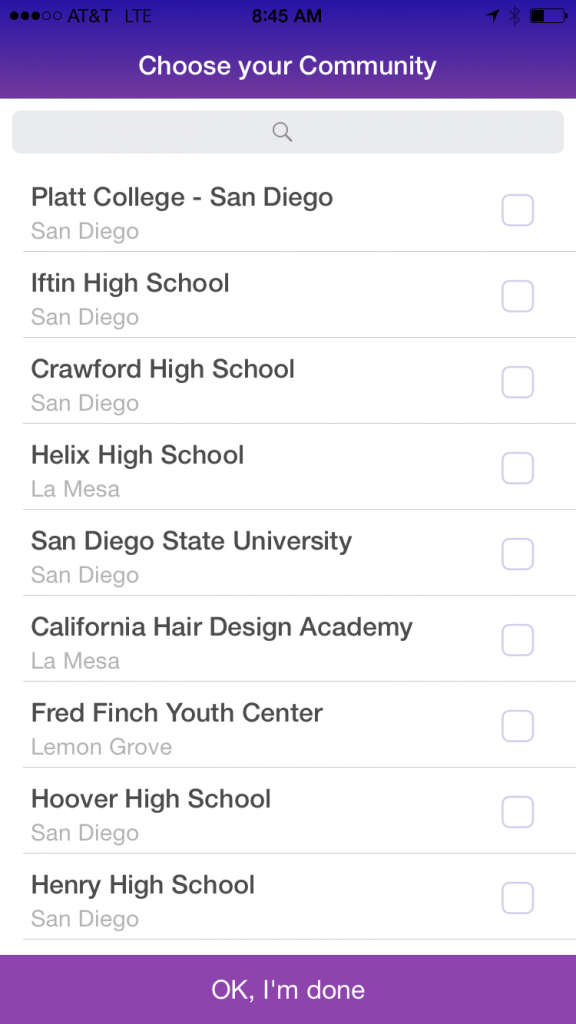
So when you open the app, you create an account and you pick your community. (Most users would pick their school)
The plot twist is that you can pick a different school…
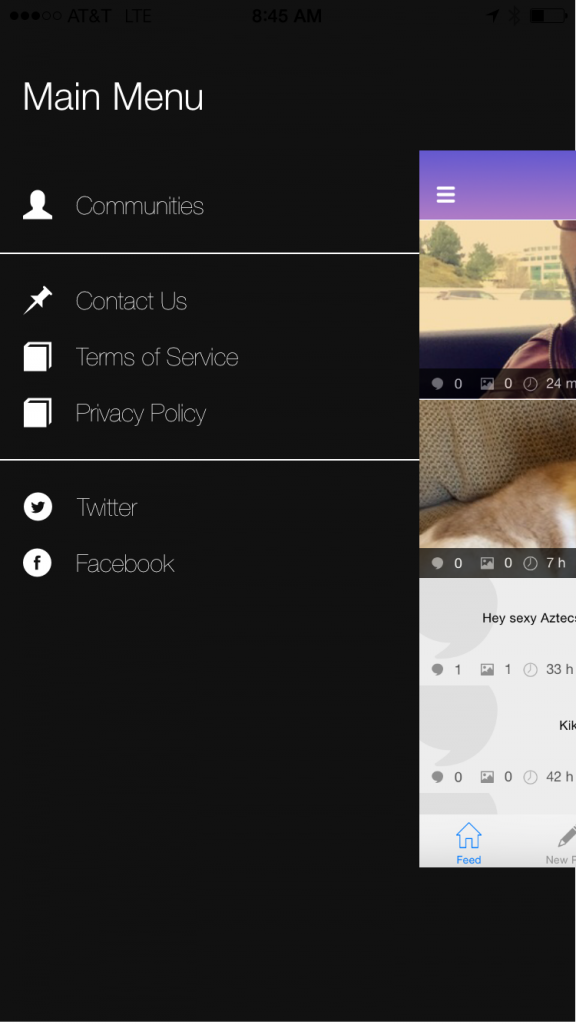
Just go to the menu, click on Communities, and you can move from one high school to another, or a college or whatever.
I think this is a problem. Particularly for high schools. You don’t even have to be part of the school to talk about it or be in that community? Moreover, you can just hop from rival school to rival school and post whatever you want?
Meh, not a fan of that. I’d rather you picked a community and the app made it hard to switch to another one. Maybe only allow you to do that weekly? Seems like the current model allows for and encourages trolling.
Plot Twist #2
App administrators are unashamed about monitoring communities.
Don’t get me wrong, every app does this to some extent. But the Burnbook crew is intentional about trying to moderate things by being visible, correcting bad behavior, highlighting the behavior they want to see on their other social channels, etc.
For an anonymous and ephemeral app… this is unique. I like that idea. It’s a little old school but in a good way.
Don’t be fooled. All of the other anonymous apps do this one way or the other. For instance, Yik Yak has paid community people on college campuses which make sure the “Yik Yak game is on point”. But Burnbook seems to have a rather old school mindset of community management from the forum days. They are around and real people. It’ll be interesting to see if this can scale up as the app takes off. But I’m sure that’s something Team Burnbook would see as a good problem to solve.
I had a brief chat with Burnbook’s creator Jonathan Lucas about his app last week. Flat out, his philosophy is that school campuses are in need of a way for people to say what’s on their mind. He feels like they can help moderate and sell the idea that this is possible… that teenagers won’t just melt down into being a community that bullies or harasses people online… but that anonymity can and will lead to something positive.
So when I asked him if he had plans to geofence schools based on pressure from school administrators… he didn’t have any interest in doing that. Instead, he said that they are doing anything they can do to work with schools/law enforcement to rat out the bad stuff in an effort to highlight the good stuff.
“The majority of people are good,” said Lucas, but you have to “design the app with the most sinister person in mind.”
To that end, Lucas has implemented several key tools for Burnbook. The first, and most effictive, is a simple down vote system wherein five down votes (perhaps 3 soon!) automatically removes a post. 2-4% of posts are destroyed this way.
He also has a “blur” option for every photo to protect people’s identities.
This launched in September 2014. It’s really small. That’s part of why it was so odd that San Diego county schools freaked out about it. I mean, compared to Snapchat it’s tiny. (And Snapchat is tiny compared to Facebook… even among teenagers who say they don’t use it.)
As of right now they are reporting 400,000 users. (.9% of teenagers in America) Snapchat is about 5.4 million teenage users according to Pew. (13% of teenagers in America) Facebook is well over 50%.
What do I need to know?
There’s a few little side stories which I think are interesting.
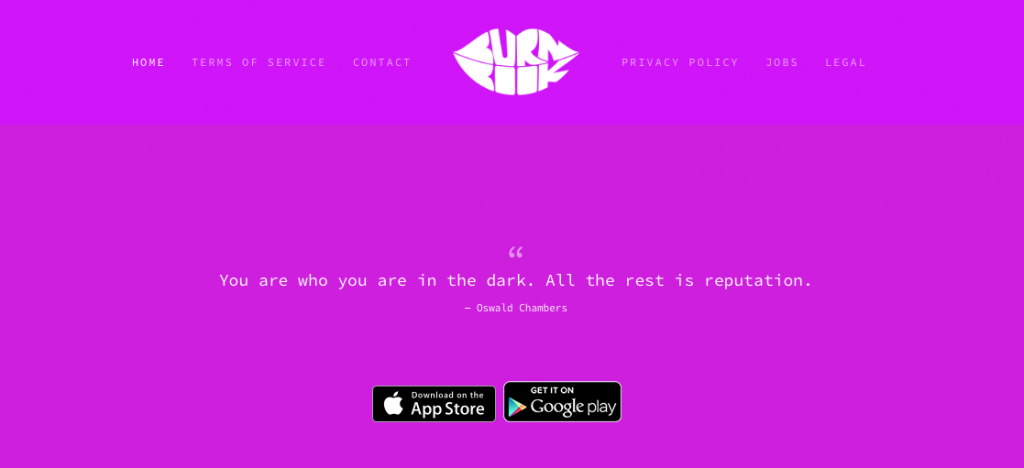
First, I got clued into Jonathan Lucas’s faith before I spoke to him… he has an Oswald Chambers quote on the homepage of his app. (see screenshot above) He grew up in a Christian home, in many ways he’s a typical student from any of our youth groups. All of that helps me view what he’s trying to do with Burnbook through a certain lens. He’s a newbie to the development world, he taught himself to code, he’s built a small but very interesting little company. All of these are endearing qualities to me. Maybe it shouldn’t– but it makes me a little less judgmental about the whole thing.
Second, Burnbook is a sapling in a forest of ephemeral, anonymous apps. I’m not saying it won’t make it but I’m not sure it should really be on anyone’s radar at this point, while gaining steam it’s also tiny. What I see in the app and the organization is still beta. But who knows? It could be the next big thing and Jonathan might be on next years Forbes list like Snapchat’s co-founder, Evan Speigel?
Acquisition seems far more likely than it becoming a big thing. (Whisper, Secret, After School, on and on) That’s a fine exit plan for a first time developer.
Third, I’m not sure the idea itself is realistic or helpful or developmentally possible. I’m on the fence about it.
The name Burn Book is a Mean Girls reference. It strikes me as weird that the app has an idea that good can come from anonymously sharing things on a school campus when the app is named after something that happened in Mean Girls.
It’s kind of an obvious clash of narratives. According to Wikipedia (the collector of all truth… ha!) the Burn Book is “a notebook filled with rumors, secrets, and gossip about the other girls and some teachers.”
Geez, I wonder why this would make administrators nervous?
What do I do?
This is the easy part.
Keep reminding the teenagers in your life that there is no such thing as anonymity, only perceived anonymity.
In the end, Burnbook is no different than all of the other ephemeral and/or anonymous apps out there. I like to tell teenagers, “The only one that thinks it’s anonymous is the users.”
Burnbook does a better-than-average job at telling students that their posting are linked back to them via their phone number and that they will absolutely cooperate with law enforcment if you do something dumb, like post a bomb threat. [You click OK to several acknowledgements when you create an account with your phone number, there are reminders… maybe too often.]
But, in the heat of the moment, it’s easy for anyone to forget that that tiny bit of gossip or bragging about an indiscretion ultimately points directly back to you.
There’s no such thing as privacy online.
There’s not such thing as anonymity online.
There’s only the perception of anonymity or privacy.