One of the hardest things about investing your money is deciding who to listen to for advice. There’s a myriad of financial advice-givers out there, both paid and free, and fueled by the internet it’s really easy to find them all.
(more…)Category: stocks
-
Things are looking up
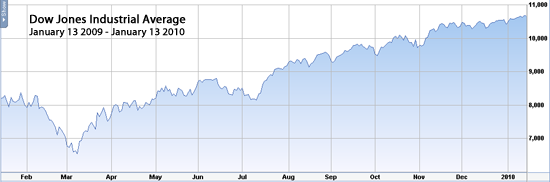
You want this chart to keep going up It may not look like it yet where you live, but there are signs of life in America that things are looking better.
As the chart above shows- stocks have been rebounding for basically 12 months.

You want this chart to start going down The unemployment rate, while still horribly high, has begun to turn… following the comeback of Wall Street.
As church folk, we know that these two charts are closely tied to people’s ability/willingness to give. When people feel good about their money [and 401k, and for retirees, their investments] than they become more generous. Once unemployment starts to turn, then happy times should come in the offering plate… and begin trickling into staff dollars and budgets.
The upside of 2009’s double crotch kick
Let me explain what I mean by the double crotch kick.
First, going into 2008-2009 pretty much every church in the country was re-evaluating and re-thinking how they do ministry. This was a crotch kick as we all wrestled through the realities that our ministries probably need to change significantly to adapt to culture faster and reach more people.
Second, 2008-2009 were rough years financially. While not in every single church, most churches saw a dip in contributions. This was a swift kick to the groin because you either had to cut staff or cut programming (or sell assets at the bottom of the market) to balance the budget.
The upside, just like in real life, is that getting kicked in the crotch twice in a row causes most people to wise up and get ready to fight.
As I talk to ministry people all over, almost universally they have come through 2008-2009 with a new sense of calling and determination.
While the signs of life haven’t trickled into every corner of the church just yet. It is awesome to report that there are signs (more than the two economic ones I’ve shown here) that things are truly looking up.
May we take to heart lessons learned in the hard times. And may we never again need to get kicked in the crotch twice to be awoken from our slumber.
-
A Failing Battle to Fight Foreclosure
Ángel Franco/The New York Times This headline caught my attention this morning:
Ten months ago President Obama announced a $75 billion program to keep as many as four million Americans in their homes by persuading banks to renegotiate their mortgages. Lenders have accepted more than one million applications and cut three-month trial deals with 759,000 homeowners. But they have converted just 31,000 of those to the permanent new mortgages that are the plan’s goal.
It’s hard to fathom how many people are battling or have succumbed their life’s savings (their home) to foreclosure. In the third quarter of this year, 937,840 families received a foreclosure notice. (up 23% over the same period in 2008.)
It is important for me to state this fact– I don’t know a single person in which a bank has permanently helped during this housing crisis. They have done some short-term things. But every person I know, including ourselves, who has needed their bank to re-negotiate or process a short sale, has eventually had to accept foreclosure.
The government bailed the banks out, they’ve given them significant incentives, and yet they take the governments money– money clearly given to help re-negotiate loans– and just accept it as profit. Here’s another quote from the New York Times article:
The servicing companies make money either way. The Obama program pays them $1,000 for each loan modified, and another $1,000 per year for three more years if the borrower avoids foreclosure. On the other hand, the companies make large sums charging late and legal fees on overdue mortgage payments, and sometimes it is cheaper to foreclose than to cut the mortgage payment. link
Simply put, if your home is underwater (you owe more than it is worth on the market) and you need your bank to help you there is nothing they are going to do. They are going to stall, hem, haw, and outlast you. They know, relying that you are an honest person, that you’ll pay fines to try to keep your home but eventually you’ll get tired of the process and accept foreclosure. At least that is the banks great hope.
Maybe it isn’t always that way? Certainly, there are enough short sales going through to fuel the market and keep people’s hopes up. But for every person I know selling their house who has tried a short sale, it is merely a holding pattern– a glimmer of hope to hold on to– on the path of accepting the humiliation of foreclosure.
Bottom line, why is this happening? The banks make more money when you foreclose than if they do a short sale or modify your loan. It is in their best interest that you foreclose! The nature of how loans were created the entire Bush administration was that a loan was generated on a house, then the banks commoditized the loans and sold them off as securities. (Something like a bond) Then they hired servicing companies to make sure you paid your mortgange and that the investors got money.
Then the bank took out bets (credit default swaps) against the people they lended to. That’d be you and me. Read this little article about a 19th century confidence scam, it’ll sound pretty familiar to anyone who has bought a house! Don’t think it is possible to dupe the entire nation? Two words, my friends: Bernie Madoff.
See, in essence, the bank wants you to foreclose so they can make more money. And their processors (subsidiary companies) want you to struggle so you keep paying interest and penalties as long as possible. Then, when you finally give up, they still get the property. Cute, eh?
What’s the solution? The easy solution is for people to start paying 20% more for a house than it is actually worth. But who wants to do that? I’m afraid the government may be the only entity that can help. (Short of every American just stopping payment on their mortgages.)
Someone needs to help people on a wholesale level, renegotiate their loans. Like a one time amnesty program or something like that. It would seem reasonable that the local assessment office, which values your home for tax purposes, should be able to act as an independent agent to your mortgage company. “This home is now worth 25% less, you’ll need to reduce the principle on the loan by 12.5% to meet the homeowner half way or face a $50,000 fine fr0m the municipality and lose your license in this state.”
Of course, that isn’t going to happen either. There is too much money to be made.
This is why people say this is a mess! It’s a big ugly mess.
Want to learn more? Check out this special from This American Life called “The Giant Pool of Money.”
-
Stock Market Rally
Americans are addicted to bad news. So this may come as a surprise. There are stocks within the market that are on fire! I’ll give you one example from my portfolio.
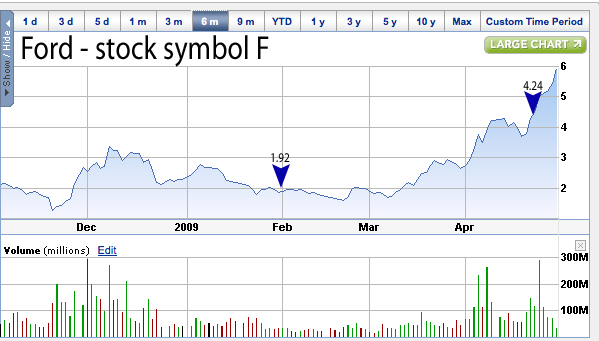
In February, I took dividends from Honda Motor Company (a stock I’ve owned a long time, having a flat year) and invested those dividends in Ford Motor Company. For those who don’t know what that means, investing dividends means that I didn’t put any of my cash in from my accounts, this is money Honda “gave” me as my share in their profits. It wasn’t “real money” but untouchable income, “free money” to me in my IRA.
I bought Ford stock at $1.92 per share on a hunch. (Remember, I was playing with dividends… just cash sitting in my account.) Zooming out on their 3 year history I could see that Ford is traditionally a $10 per share stock. And while they aren’t doing well in the U.S., their European line is doing fine. Since they have a lot less debt and cut deeper, not taking government bail out money, it was reasonable to assume that their sector (American auto maker) had dragged their stock down more than real losses.
Look at March and to-date in April and you will see a massive rally. As of this moment, shares of Ford are trading at $5,98. That’s $4.06 more than I paid for them. Roughly 200% interest. Of course, looking at the chart you can see that I sold some shares at $4.24. Last week, I locked in some of those profits by selling enough shares to cover my original purchase. That means that I guaranteed that I wouldn’t lose any money on Ford… the balance of those shares becomes more free money. So, I took dividend money, which was free to me, and in less than 90 days was able to double it while still holding on to free shares in Ford.
My point is not to make myself look like a genius. Though, right now, I’m feeling pretty good about this investment. Certainly, in the last 5-6 years I’ve made the exact opposite mistake. I invested a ton of my portfolio in Sirius Satellite Radio because they started putting free radios in every car being made, never thinking it was an overvalued stock. The iPod hit it big and Satellite radio became the 8 track player. Shares I bought at $7 and $10 in the early 2000’s… I sold at $3 per share. (Currently trades at .43!) So you can see I am not a perfect investor.
My point is that you can’t base how you feel about yourself on news reports. There’s a lot of talk about our nation being in a recession. Certainly, millions of people are out of work and we are facing a very real housing crisis. But, that doesn’t mean that everything in the world is bad and we should wallow in our depression! There is certainly lots and lots of money to be made. People on Wall Street are making BAGILLIONS of dollars right now while the rest of the nation thinks we are in a borderline depression. (The swine flu is also a great cover for this! Can you say, “distraction?”)
Think of a recession as a shifting of how money is being spent. It’s not that people aren’t spending money. It’s not that there is less money in the marketplace. It’s that they aren’t spending it in places that we expect them to.
How do I know what to look for?
Companies are typically slow to react to that shifting. Ones who jumped the trend, even a little, will do well. Companies that tried to ride out the last few dollars on yesterday’s trend (Just look at every car General Motors had on their line in 2008… another example would be AOL/Time Warner) are going to get punished because they don’t have a product people will buy. You have to be like Warren Buffet. Before you invest in anything, see it. Do your research, read the reports… but that shouldn’t replace walking around a store… or in this case a car lot.
-
From Wall St. to Your Street
 Faced with sobering conditions, companies that issue MasterCard, Visa and other cards are rushing to stanch the bleeding, even as options once easily tapped by borrowers to pay off credit card obligations, like home equity lines or the ability to transfer balances to a new card, dry up. Story
Just like it takes a few weeks for us to see the difference between the price of oil and the gas pump, the recent crash of the stock market takes a few weeks to filter into our lives.
And from there it takes a couple weeks to filter from your street to your pew.
Are you feeling it yet?
-
Quick Note to Investors
 The sky isn’t falling. As all of that money pours out of Lehman Brothers, Fannie Mae, Freddie Mac, and other financials today… just be reminded of one thing. That money is leaving one place and going somewhere else. As you know, there’s a bull market somewhere. It’s not like all of those investors are taking that money and putting it in their savings account.
 -
Find the value somewhere
I don’t talk about stocks very much, but I would consider the stock market a passive hobby of mine. It is a very fascinating time to own stock as the markets are all over the place. One day the market is on fire and you’ll add a few points here and there only to see that evaporate the next day.
Here’s a couple of simple trading tips that help keep me making money in times like this:
- If one industry is down, it means another industry has to go up. For instance, today my automotive stocks got nailed. But my oil stocks went up. When the economy slows it means bad news for high end retail and good news for Target, Wal*Mart, and other places people are likely to shop when short on cash.
- Have firm high and low points to sell. I’ve got a stock that has returned almost 100% in 3 months. It’s ripe for the picking and I can sell it comfortably knowing I’ve locked in an amazing return. Likewise, I’ve had some stocks that have “safety valves” built into my E*Trade account. It hits a certain number and I dump the stock to secure I don’t lose too much.
- Invest in companies that pay dividends. A lot of investors don’t like dividends. I do. If I made some money by investing in your company, dump it in my account and let me decide to invest it somewhere else.
I’m no expert. But we’ve consistently survived in good markets and bad. What are your tips?
-
Cedar Point is in the portfolio
 My family has a habit of investing in companies that we believe in. Our family portfolio includes an automaker and an oil company that are serious about making money while remaining serious about caring for the world we live in. In short,
We added a fun company to our portfolio, literally. Cedar Fair Entertainment Group (stock symbol: FUN) is the company that owns two of my favorite places in the world: Cedar Point and Michigan’s Adventure. [As well as a few other amusement parks, hotels, water parks, and other stuff]Why invest in this company now… in a recession? The play for us is that we think that families are still going to take their kids on trips this year… and an amusement park is the perfect place to drop off a few hundred bucks in a day while feeling like you can’t afford to go on a big trip. Put that with this family-friendly businesses habit of distributing profits to its investors and I was sold!
-
Goodbye Sirius and Texas Roadhouse
Today I sold some stocks. There were a couple of dogs in my otherwise solid performing portfolio.
I had been a huge fan of Sirius and backed up my personal enthusiasm with investments from my IRA. After a couple of years of listening to the promises of long awaited profit and the ever present merger with XM Satellite I have decided we’ve waited long enough. While satellite radio is cool for those who travel a lot my guy tells me that the satellite radio fad is quickly fading. And unless they unleash low-cost TV and internet, there doesn’t seem to be any hope of explosive growth without undergoing much more R&D and launching more satellites… meaning they’d have to go into more debt!
We also had been fans of Texas Roadhouse. We like the food. We like the prices. My issue is that the business model doesn’t seem to represent who I am. While they are a nice chain I’m just not seeing enough out of them to want to keep investing in them. And apparently with recent performance on the markets, my feelings are not unique.
This market is all about value. And a satellite radio company mired in debt and a not-so-unique food chain represent two things, to me, which consumers will easily cut out of their family budgets. So I’ll be investing the proceeds from these sales into companies who better represent my own convictions for profiting in a value-driven economy. After all, it’s not like people stopped spending money.
-
It’s Official: Worst Housing Market in America

According to Forbes Magazine, the Detroit Metro area maintains it’s hold as the worst housing market in the United States. Don’t know about other home owners around here… but consecutive years leading this list is kind of expensive. (More than 15% decrease in 2 years!)When you turn your gaze to the Midwest, the issue becomes where the
money is not coming from. Based on MBA calculations, Ohio, Indiana and
Michigan account for 8.7% of the nation’s loans but account for 20% of
all loans in foreclosure nationwide. The reason this is happening is
because people are losing their jobs and leaving the area.And this trend should continue into next year.
"We
expect another two to four quarter of modest rises in delinquencies,"
says Duncan. "And foreclosures lag one to two quarters behind that."What is truly disturbing about this is that the morons in Lansing see fit to continue to raise our property taxes in line with the nations cost of living. (Not dependent on Michigan’s economy) When coupled with the county assessor who valued my home at 10% more than I paid for it despite the 15% dip in home values in the last 2 years, there is a 25% difference between what our home should be taxed at and what we are actually paying.
And people speculate why Michigan’s population is shrinking? Who can afford to live here? We’ve got inflation all around us and politicians telling us it isn’t inflation.