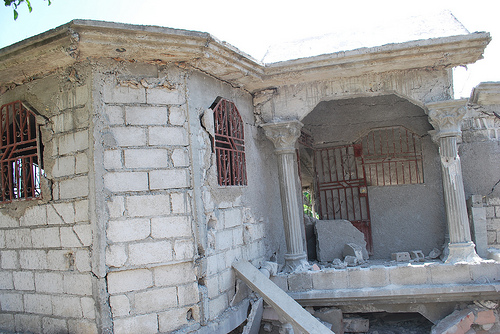
If you are interested in helping fund the school in Wilnard’s church or perhaps your church (Or a group of Christian educators, or any combination) is interested in adopting this school to help pay the teachers, provide uniforms and shoes, or even feed the students, please let me know.
If you’d like, we can plan a trip together and I can introduce you to Pastor Wilnord myself.
The needs in Haiti are still real. The opportunity is still huge. Please don’t forget.
Books are great. Reading is fundamental. I’m all about practical resources and history and stories that carry you away to far away lands.
But lets not get to the point where we stop thinking creatively about resourcing ourselves. Or acting in a way worthy of a historian writing about us. Or living a life that is a fantastic story which carries us to far away lands.
You don’t change the world by sitting on a couch and reading a book. Change is an action.
Don’t use books as a way to wuss out.
Think for yourself.
Act for yourself.
You can create.
Put the books down and get outside– live a story-worthy life.
Inspiration is one thing. Inaction is unforgiveable.
I think a lot of people question our involvement in Haiti. I’ve heard it over and over again, “We have so many problems here in our country. Let’s take care of our problems first.”
Yada. Yada. Yada. We can’t turn a blind eye to the world because our backyard isn’t perfect.
That rant aside. Stories like this are excellent reminders that outsiders come into Haiti with a different set of lenses. They see the forgotten and help call the church to act. Now if only outsiders would come to our churches from places like Haiti to point out the big planks in our eyes… that’d be something.
If I had a dollar for every time someone said that to me about the people of Haiti I wouldn’t be $1700 short in my fundraising!
There are a few answers to that question. At least from my über limited perspective.
Haiti is so poor that they just don’t have the infrastructure and resources to even conceive of a solution. It’s just too big and they have been too dependent on the outside world to help them to solve it themselves.
Culture has put up some major barriers. There are laws and traditions to be obeyed which make seemingly easy problems to fix nearly impossible. For instance, you’d need a permit (which costs money) to haul away the rubble of a home you rent. (which you are still paying the rent for) You have to find the owner, (who might live in Haiti or the U.S., you’ve never met him but only paid his cousin) who has to provide the government (which fell down) with proof of ownership (which was destroyed when government buildings collapsed) before you can hire workers to remove the rubble. (which costs money, and the government hasn’t yet determined where to take all of the rubble)
The poorest of the poor don’t have the social currency to not worry about breaking the law/culture and looking past a lack of resources for the sake of doing some good.
I first thought of this often debated online phrase in the real world while in Haiti in February. Like a lot of relief workers I struggled with what I saw. It just didn’t reconcile with the world I know.
I’m not a sociologist. But this is how I think of social currency.
If my house partially collapsed, killing my family, what would I do? Obviously, I’d call 911 and 6 minutes later a miniature army of highly trained firefighters would show up. Then a news helicopter would fly overhead so that the entire metro area would know what had happened within the hour. In shock and not knowing what else to do, I’d get in an ambulance and go to the hospital. At some point soon after that my insurance agent would call me. I’d call some friends who would rally around me. Within about 48 hours I’d be planning funerals, talking to endless insurance people about life insurance and property insurance, while a group of friends would help me “get back on my feet.” In the meantime, I’d probably stay with some friends or relatives before settling into a long-term hotel that my insurance company would pay for (and going to a years counseling that my health insurance company would pay for) while they took care of hiring contractors to pull permits and level the house before rebuilding it.
That’s a lot of social currency. I’d call on all of those government and financial institutions without thinking about it because I’ve paid into those institutions! I’d call on friends to help because we have a perceived reciprocal society. Just the thought that “they’d do the same for me” would compel them to help.
How would that change if I were the poorest of the poor, living in a country with no infrastructure, and the entire city I lived in collapsed? Those with financial means would leave immediately. This would be the land-owners and business people. Those with no means (the homeless, the orphans, the widows) are just kind of frozen. They don’t know what to do because they don’t know the questions to ask nor the ramifications of what would happen if they “just fixed stuff.” Nor do they have the resources to fix stuff. Nor do they have the energy or equipment to fix stuff.
I remember Seth Barnes asking people what they were going to do and the dialogue always went like this:
What are you going to do about your home?
– I don’t know. I’m waiting for the government to help me.
Has the government ever helped you in the past?
– [laughter] Of course not.
The poorest of the poor are, unfortunately, dependent on help. The real question for them seems to be… what will accepting help cost them? Remember that Haiti is a place of both spiritual and real oppression. Accepting help may land them into a debt that costs a lifetime to repay. This is a place where children are trafficked and labor is unregulated. This is a place where, on a good day, the police are uncaring about your plight. But on a bad day, the police are just as dangerous as the oppressors. They may even be the oppressors in some neighborhoods.
What would you do? You’d laugh at those silly barriers in full knowledge that the landlord wouldn’t care that you cleared the property. At the very least you’d knock down your condemned home and pile up the rubble to be hauled away. Chances are pretty good that you’d also try to organize your neighbors into a group of workers who would go around clearing rubble for other people. Say, old women. That’s the power of social currency. You aren’t frozen. When everyone is stuck, you’d naturally rise up and take action.
This is why you should consider a relief trip to Haiti
If you are a reader of this blog I want to encourage you to find an agency of relief and pray about going to Haiti in the next 12 months. You have resources. You are ignorant of culture barriers. And you have social currency to spare.
Lars Rood kept telling me, “You need to meet Phil and Amy, you’ll love them.” Lars even took the first step and set up a dinner where we could all get together. He was right.
It’s not hard making friends with them. In fact, our hearts beat for the same types of stuff in life. Justice, Jesus, adventure, family, and a good taco. The big difference between Phil and myself is that Phil is doing a lot of the stuff I only dream about. In other words, he’s brave while I’m a wuss with a keyboard and a camera.
Steps of Justice
Last month, when Phil was gracious enough to take me to Tijuana for a day, he showed me something he was just about to launch. It was this very visual and powerful 30 day prayer journal he is calling Steps of Justice.
Let me encourage you. If you hear about injustice in the world, whether in San Diego county or your neighborhood or on television in far away places, and you wonder how you can get involved… this is a great little resource. Allow Phil to take you on a journey, show you some of what he’s seen, and allow the Spirit to challenge you along the way.
Here’s the pitch
Phil is giving this thing away. You can go to the site and download a free version right now. He’s a little too nice if you ask me. Phil and Amy are full time missionaries, they have poured their lives into this little resource, at the very least pay $5 to download the high resolution version. Better yet, order some hard copies for $6 for your small group or youth group. It’d be a great encouragement to them.
I’m always amazed how little leading most leaders actually do.
If a leader takes someone where they would otherwise not go on their own— the fact is that most people we label as leaders are just people who talk about leading. On a good day they are administrators. On an average day, they are do-nothings with leadership titles. On a bad day, they are busy saying they are leading while they aren’t actually leading.
Nobody cares how you intend to lead.
When you are a leader you are measured by your results, not your intentions.
Go through your own list of your favorite leaders. They all have great actions tied to their words we quote.
Leaders have a responsibility to lead. They need to say the words that move people. They need to prepare people to go somewhere or do something they are afraid of.
Then they need to take their people there.
Call yourself a leader?
No more excuses. No more coulda done this. Or second-guessing woulda done that. We’ve all failed, but dwelling on the shoulda just makes you sound like a loser.
The LORD had said to Abram, “Leave your country, your people and your father’s household and go to the land I will show you. Genesis 12:1
Can you imagine? 75 years old you hear from God loud and clear– leave, start a new life, leave everything behind.
Abram’s entire life was judged based on this one decision! Would his life be defined by faith or by fear?
The first thing that comes to my mind as I try to put myself in Abram’s shoes is fear:
How will I make the trip?
How will I start over?
My wife will kill me.
I’m 75 years old, the only move I’m making is to Florida
Yesterday, I was doing a little check-in on Tash’s morning radio show in Auckland. (You know, I’m huge there! Well… er, probably not.) And she asked me the one question I don’t have an answer for right now, “So Adam, what is going to change as a result of your trip to do relief work in Haiti?”
It is the question I’m afraid of. I don’t really have an answer for that yet.
If I tally the faith I exhibit in my life I see a difference in the reconciliation. Fear is winning over faith.
As I talked to the Lord about it I kept coming back to that central question… right back to the defining moment in Tin Cup… “Will your life be a life defined by radical faith, or will it be defined by an avoidance of fear?”
What about you? What are ways you a living a life driven by faith and not fear? Teach me!
As I mentioned in my post last night, my head is spinning a little as I think about today’s evangelical church.
And yet I know that simply by saying that the evangelical church should stop doing church the way they currently that some people will instantly categorize my thought as “social gospel” in order to ignore what God is doing in my heart.
Here’s the thing. The gospel a social gospel. Pure and simple. Jesus didn’t just come to make a way for us to experience salvation. He also came that we may “do good works” to help bring the Kingdom of God to the people. This means bringing justice and mercy to people who experience injustice and no mercy.
This is what I’m really asking. Is there any way that the church can stop discriminating? Is there any way we can try to reach all people? Or are we doomed to see the evangelical church target rich white people for another generation? And will that generation tolerate classism towards everyone who is not rich & white?