Tag: creativity

  • Everyone is a Creative

    The Creative Class is a socioeconomic class that economist and social scientist Richard Florida, a professor and head of the Martin Prosperity Institute at the Rotman School of Management at the University of Toronto, identifies as a key driving force for economic development of post-industrial cities in the United States.

    via Wikipedia

    I wish I were as creative as you.” I hear that regularly from people who don’t think they can be creative. And they would never consider themselves “a creative.”

    (more…)

  • The Machine & The Magician: What you need to know about distraction

    I’ve been learning a lot about the creative process lately. Like you, so much of my life is built around the concept that sometimes I need to be highly productive and other times I need to be highly creative. But, at all times, my work is best when it is both on time and creatively completed.

    The Machine

    Since childhood, we’ve been taught that there are times to sit down and focus all of our efforts on a task. I remember being rewarded as a 6 year old in kindergarten for my ability to sit down and do my work. My teacher had it set up so that each child, during a segment of the day for learning, could work at their own pace. I was really, really good at doing this. But if you looked at someone or whispered to your neighbor or suddenly got up and did a wiggle dance, that was inappropriate & bad.

    In college, you were probably truly challenged academically for the first time– you had to learn how to study and knock hard projects out quickly. Further, you learned that there were times that if you disciplined yourself to focus that you could turn your brain into a task-master machine.

    I knew that I could disappear into the corners of Moody’s library for four hours with a mug of coffee and emerge with a 10 page paper, 25 definitions memorized, a test prepared for, and 2 chapters of a book read with annotated notes for later review.

    The machine is the opposite of creative. It pounds out work. It produces. And when the grades came out the one with the most powerful machine often won the highest grades.

    As an adult I depend on turning on this machine. It takes me a while to get to that “machine” space, but if I put my headphones in with some improvisational jazz, turn off social media, and get into a project I can get there– knocking out a lot in a short amount of time.

    The Magician

    Have you been around babies & toddlers? I’ve had 3 of them crawl around my house in my lifetime. They are born magicians… incredibly creative in what they do. Turn your head for a second and BAM– they’ve done something amazing. Children can take two seemingly unrelated things and tie them together magically. In an instant they can disappear into a pretend world full of adventure, they can create stories out of thin air complete with backstory and plot twists.

    You don’t have to teach a child how to be creative, it’s intuitive. If you allow them to just be themselves they are automatically creative.

    To Review

    The Machine is learned behavior to concentrate hard on a task, it is good.

    The Magician is your natural creative self, the part of you that sees clay and stcks and smiles, it is also good.

    Distraction isn’t bad

    When I am in work mode I tend to think distractions are bad. Positive reinforcement from teachers and success in college taught me that. I get somewhere quiet and predictable. I work very well after the kids go to bed or at my office. Interruptions and distractions feel like the enemy. Phones, texts, Facebook, Twitter, visitors, going to the bathroom… all feel as though they will disturb the machines production.

    But that’s not how it works. Your best work happens because an idea is sparked. When I get peer review of my work and overlay positive feedback with the timing of its production, the things that are most often the best– a creative solution, a breakthrough, an insight, a great paragraph— most often are in my work because the machine got turned off for a time and the magician was allowed to play. Perhaps I was in full machine mode and needed a lunch break? While walking there, my mind still churning on the work, I’ll get an idea or a solution or a insight into that work that I add. But sometimes this happens because a phone rings in another room, or a someone at a coffee shop drops something. Those breaks from Machine mode allow the Magician to play with the thing I’m working with and mix it with something else.

    In fact, I’ve learned that intentionally allowing myself to become distracted can be an excellent way to generate new ideas. Taking a walk, shower, phone call, checking Facebook, listening to a sermon, catching up on the news, pulling weeds in the garden, playing with my kids, goofing off, even doing a small task like packing a box– all of these things allow me to turn the Machine off and allow my naturally creative mind, the Magician, to begin playing with ideas.

    The Machine and the Magician are Playmates

    I’ve learned that the Machine and the Magician are not adversaries. I will not truly be productive if I see the Machine as the winner and the Magician as the loser. (Though many people perpetuate that myth & it certainly seems productive.) My work is at its best when I foster interplay between getting things done and getting things done playfully. My work is best, not when I have hours and hours of uninterrupted Machine time, but when I have concerted time which builds in intentional distractibility so that the Magician has his voice.

  • How to Push Through a Creative Drought

    I don’t know if it’s the workload or the time of year or just fatigue. But I’ve had a hard time being especially creative lately.

    That’s bad news for a person who runs a company called McLane Creative. My projects and my deadlines could care less how I’m feeling or if I’m inspired. There are people depending on my creative, timely solutions and that’s that.

    I have to push through. And I do push through. Getting stuff done is the bottom line.

    How I Push Through Creative Droughts and Get Stuff Done

    1. Rest – It might seem counter-productive when you have a deadline and are staring at a blank canvas or a mounting todo list, but the most obvious cause of a creative drought is a lack of rest and play. So take a nap in the middle of the day. Give yourself two hours to read a book and dose in the park. Take Saturday off. You are not a machine, you cannot produce 24 hours per day, 7 days per week. This isn’t a reality show. Making time to rest is the most productive thing you can do.
    2. Exercise – When I hit a creative wall during my day I take a walk. Pushing my son in the stroller or riding my bike for errands instead of driving or even doing jumping jacks in my office helps. I like to think of ideas as a heavy substance inside my body. When I get the blood pumping fast the ideas are able to get pumped up closer to my heart.
    3. Discipline – Sometimes I’m hitting the creative wall because I’ve procrastinated. But most often it’s because a project I finished in the past comes back for immediate changes and edits. That little bit of chaos throws me off. Instinct lies to me, building a desire to both finish my current project and go back and make some quick changes on the existing work. Being disciplined means pushing through what I’m currently working on and making late-breaking changes work with my schedule.
    4. Momentum – As creative people we know that productivity is the result of keeping the fly wheel going. So when I have something flowing I know I need to keep going, even if that means working until 1 AM. I’ve found that when I am in a drought I can’t build or sustain momentum. So set-up your work time or todo list in a way that builds momentum instead of starting and stopping all day.
    5. Change Mediums – Just about everything project I do will end up in a digital format. But when I’m not feeling it I’m quick to try another medium. I am not a great artist, but I use paper and colored pencils. Sometimes I go take photos of architectural elements for a project or shoot some video just to try to sparks something I wouldn’t have seen if I’d just sat down in front of my computer with Photoshop or Illustrator.
    6. Documentation – When things are really, really bad I spend 20 minutes taking all of my tasks for a project and adding them to a Google Docs spreadsheet. This turns my project into a series of small tasks that I can easily do without needing much creativity.
    7. Suspend reality – I have two offices. One in my home and one in shared, rented space downtown San Diego. (Little Italy) That helps me have fresh space in which to work. But sometimes I need to do even more than that in order to manufacture some creativity. Sometimes I work in a favorite coffee shop, sometimes  I book time to work for a day at a friends office, and sometimes I sneak a half day or whole day onto the end of a work trip just so I can work somewhere else. Suspending reality also means shutting down all of the distractions which pull you away from your creative space. (Shutting down chat software, putting your phone on silent and not returning text messages, logging out of Facebook and Twitter, etc.)
    8. Finish something – Perhaps my biggest droughts come when I have lots and lots of projects going and none of them finishing. I’ve found that finishing a project helps me be more creative on my others. It’s as if I can put that project behind me and that gives me more energy/space to think about the others. So finish something! (Or suspend another project to get it off your shoulders!)
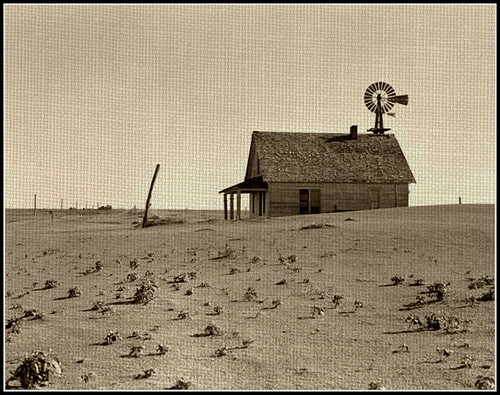
    Photo credit: Dust Bowl 1936 by erjkprunczyk via Flickr (Creative Commons)
  • Dealing with streakiness in the creative process

    I’m finishing my seventh year of daily blogging on May 25th. Over the past 2,555 days I’ve written 3,523 posts or about 2,000,000 words. Nearly every day over the past 2,555 days I have sat down at my computer and written something that was worth my time in the moment.

    Streaks

    So what has changed since 2004? An o-crap-this-better-not-suck-amount of people read what I write every day. And the amount that each post gets shared, tweeted, and emailed around is completely determined by the remark-ability of what I write. In some ways it is a self-created pressure cooker.

    It’s fun that the process doesn’t change but the response does. I have no ability to predict the outcome of each post. There are weeks or even months where my blog experiences a hot streak. Everything I write gets lots of feedback. (Even the stuff that sucks.) Conversely, there are weeks or months when nothing really happens to my posts. I just write and that’s it.

    Many days I press “publish” and I anticipate a massive response to something that seems brilliant to me but nothing happens. Then there are days when I write something flippantly and publish it with almost no thought and it explodes and goes viral.

    Same process. Same style. Different response.

    Some might find that infuriating or that it frustrates the process. Not me. I find it fascinating.

    The creative life

    Everyone claims to have been a Seinfeld fan all along. But, in the moment, the most popular way to talk about Seinfeld was that most people didn’t find it nearly as funny as the people in New York said it was. Seinfeld didn’t really become funny for most people until it hit syndication because when it was fresh they didn’t get it.

    Chances are that Shakespeare’s favorite piece wasn’t Romeo and Juliet. It was just what became most popular. The same is probably true with Hemingway’s Old Man and the Sea or Salinger’s The Catcher in the Rye. Sometimes for a creative what takes off is not what they have the most fun doing.

    Response to creativity is always streaky and unpredictable.

    So here’s a tip: If you want to write, just write. Don’t worry about the response too much. Just write, write, and write some more. Ultimately, you are the audience.

  • The Innovation Gap

    The pessimist complains about the wind; the optimist expects it to change; the realist adjusts the sails.” ~ William Arthur Ward

    “A pessimist sees the difficulty in every opportunity; an optimist sees the opportunity in every difficulty.” ~ Sir Winston Churchill

    “Sometimes when you innovate, you make mistakes. It is best to admit them quickly, and get on with improving your other innovations.” ~ Steve Jobs

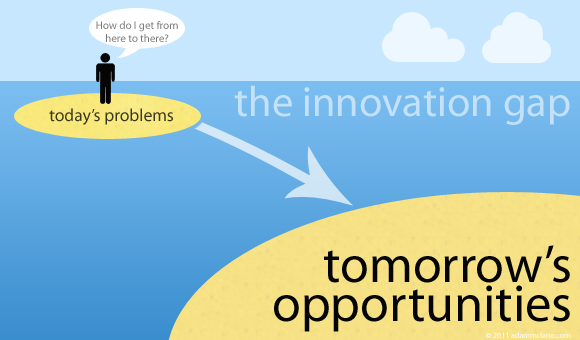
    I don’t pretend to know what today’s problems are for you.

    But this much I do know–

    • The best ideas comes from those on the front lines. That’s the great joy of innovation. Today’s heroes count their riches while tomorrows heroes work all night.
    • Avoiding failure is a failure in itself. The trick to creating new stuff is to fail fast. Risk isn’t the enemy, comfort is.
    • Celebrate every milestone. A step towards your ultimate goal is still a step forward. Plus, moving forward will gain you momentum.
    • Every person has a creative mind. Don’t sell anyone short. Rarely are the best things innovated alone. Your best idea might come from listening to another person talk about the same problem.
    • Look at your problem from every angle. The best putters in golf walk all the way around their shot.
  • Unleashing a Feeding Frenzy

    Photo by Iggy via Flickr (Creative Commons)

    Last night, we dropped a bucket of chum in the tank and ran away.

    Back in December we introduced Inductive Bible Study at our winter retreat. It wasn’t anything fancy– in fact I thought it was a little cerebral for a retreat. (This coming from a guy who did a high school retreat based on the spiritual disciplines of Richard Foster!) We broke up into groups, each team given a part of a parable, we tore into it, and came back together a little later to share what we’d learned.

    Sparks flew.

    In my group a key moment happened when we were studying the parable of the sower. One of the guys in my group had been a little frustrated… “Why did Jesus teach in riddles like this? Why didn’t he just tell them what he wanted them to know. This is so confusing” Another person in the group looked at another part of the parable and said, “I think it’s like rap music. Jesus was speaking to people who understood the words like he did, but people who didn’t get, he wasn’t talking to them.” (Maybe Kanye and Jesus really do have something in common?)

    Kanye ain't Jesus, but Jesus taught like KanyeWhen our leadership group met a couple weeks later, the students told the adults… “We don’t want you to lecture us. Instead, teach us how to study the Bible on our own.

    Collectively, our  heads tilted 10 degrees to the right. We didn’t see that coming.

    Last night my task was pretty simple. Get the students thinking like investigative reports. Questions, questions, questions. Ask the text lots of questions. And get them to grasp that in Luke 1, Luke was setting out to do the same thing we were asking them to do. “Put the story in order so it makes sense.

    I created an object lesson where each student received a sealed envelope, each envelope containing a fragment of a vaguely familiar story, and they had to piece it together, chronologically, in three minutes. They were frustrated, some gave up, and in the end they didn’t quite get it in the right order.

    They saw that putting a vaguely familiar story together in chronological order was a nightmare unless  you took the time to carefully examine every fragment.

    After we read the worst rendering of ‘Twas the Night Before Christmas in history I gave them the background information they’d need to understand why the Gospel of Luke was written. Theopholis, either a new believer or an investigator of Christ, had likely hired Luke, a believer and doctor, to go back and document what actually had happened. He’d find witnesses and put together the story to document an orderly account of Jesus’ life. (Luke 1:3) There were all sorts of fragments, little letters, floating around. But someone had to put all the pieces together so that the story would stand up to histories glare.

    From there it got noisy as students went into their groups.

    Group time was disorderly. It was messy. Loud. All over the place. Markers coloring. Pens circling. And the group leaders had to poke and prod to move things along.

    But students were asking questions of the passage. Good questions.

    • Why did Gabriel pick Mary?
    • Who was this Zechariah guy? And why was it important that Gabriel made him not speak?
    • Even though Mary was scared, why did she consider it an honor to become pregnant with Jesus?
    • Why did Luke mention that Joseph was a descendent of King David?

    At the end, when we shared what we learned, I think students were left with more questions about Luke 1 than answers. And that’s a very good thing.

    I closed our time by asking them what this passage had to do with them. Those dots had not quite gotten connected… and that’s OK.

    A process

    As we cleaned up… the leaders were exhausted. I could see it on their faces. What have we gotten ourselves into? We really had to work hard to keep it together. But I was left with a few thoughts of encouragement.

    • We aren’t after quiet compliance. To change this community we need students who investigate God’s Word for themselves, ask hard questions, and put it to work.
    • It’s OK if it is messy and loud. Being quiet doesn’t mean they are engaged any more than being loud means they are disengaged. And finding the right answer isn’t as important as learning how to look for the right answer.
    • It’s OK to ask more questions than provide answers. Leaders have a desire to wrap everything up in a neat little bow. But that’s not how Jesus taught. He got the crowd thinking and then sent them home.
    • Teaching critical thinking skills takes time. In truth, today’s educational system isn’t designed to teach critical thinking skills. It teaches to regurgitate facts more than to comprehend them. Retraining the brain takes time.
    • We’re teaching a life skill that can transform our church. Imagine what would happen if our pews were filled with people who self-fed God’s Word in community? Imagine how that would change our Sunday morning worship services? The focus would step away from teaching and move towards celebration.

    Messy. Exhausting. Intriguing. Fascinating. Thrilling. Scary.

    These are words I’d use to describe unleashing a feeding frenzy of God’s Word on our students last night.

    And I like it.

  • 5 Sources of Creative Inspiration

    Getting stuck is a big deal. In my world it means progress stops. So getting from an uncreative space to a creative space is integral to thriving.

    One thing I’ve learned about myself is that restarting the creative process is typically a matter of moving in one of two directions. I refind my mojo by taking things from very structured to very unstructured or visa versa.

    5 Sources of Creative Inspiration

    1. Improvisational jazz or intensively introspective classical music. I have a few works from Miles Davis and Rachmaninoff that seem to come in handy at different times. The ordered chaos in Miles Davis seems to help my brain make sense of things when I’m going a million different directions on a project, all of which I like but can’t figure out how they fit. And the acapella All Night Vigil has a unique ability to both calm and awaken my senses. Anxiety, particularly that my work will be rejected, is a major block. For some reason Rachmaninoff helps me release that.
    2. Magazines. I like the staccato pace of magazines. While I do get a few regularly I can’t say that I read one all the time. But when I’m stuck I tend to gravitate to a magazine. There’s something about the page turning, the ads, and getting stuck on a story that always leads me to my notebook to draw or sketch. (Or Evernote if I’ve got new ideas.)
    3. A walk or bike ride. Sometimes I just need to think about something else for a while in order to think about a project in a new way. Taking the dog for a walk in our neighborhood or riding my bike somewhere is a great stress relief and for some reason typically helps me clear my mind enough where eventually, almost accidentally, my mind will free enough to release a creative idea.
    4. Web design showcases. For some reason this helps me even if I’m not working on a web project. I subscribe to several web design sites and when they publish showcases of cool designs I always bookmark them for later. There’s something inspiring about seeing how people are using the latest HTML5 tags or what’s hot in Polish web design or the hottest trends in mobile app sales.
    5. Deadlines. I’m a middle schooler on the inside. The pressure of a deadline gets my juices flowing. Maybe it’s the desire to get stuff done on time and maybe it’s the pending reality of failure? Who cares! I find the approach of a deadline an important part of the creative process. It helps me get to past the point of something needing to be perfect and into the frame of “What is the best I can do with the time I have available?”

    Creative buzzkills

    These are probably unique to me but maybe they are stopping your flow, too?

    • Novels and non-fiction books. I find biographies sources of inspiration. But novels and non-fiction works tend to suck creativity from my brain.
    • Pressure to perform in the moment. There are times when I can come up with amazing things in a group setting. But typically, my best group work comes in lulls in the action. But if you walk up to me and demand three ideas for something I know nothing about, I’ll punt every single time.
    • A palette too big or too small. I do best with some parameters. A few, not too many.
    • Interruptions. It can take me a couple hours of fiddling around to really get into a creative groove. But it can take only a single interruption to get me out.

    I suppose this all just proves one thing. I’m a pain in the neck to work with!

  • Inspiration: Street Art

    This stuff fascinates me. I love the mystery of public reactions. I love surprise and wonder. I love the feeling of “why didn’t I think of that?

  • This Too Shall Pass

    Brilliant. Simply brilliant.

    HT to PJ

  • Megan is a reader


    Megan having fun

    Originally uploaded by mclanea

    My oldest daughter, Megan, is just like her mommy. Besides being endlessly sassy, sarcastic, and competitive… Megan is a hard core learner.

    Her latest weakness is reading long chapter books. We will send her to bed at 8:30, but she’ll stay up super late enraptured by her latest book. And just like her mommy, it’s all top secret.

    It’s impossible for me to get angry with a little girl wanting to expand her imagination. Dream big girl.