Tag: leadership

  • Anxiety in Youth Ministry

    Over the past several days I’ve started to put words to what I’ve been observing: The tribe of youth ministry is anxious.

    2009 has been a ridiculously hard year. Last October when Tony Campolo spoke in Sacramento he said something like… “Church, as we know it today, will collapse with the economy. And we will shake ourselves off and ask, ‘what do we do now?

    Prophetic words.

    A year later we have to step back and acknowledge that in many ways Tony was right.

    • A down economy has forced tens of thousands of churches to re-evaluate how they spend money. Not a bad thing, but has caused stress at all levels of church staffing.
    • A shifting culture, and the owning of the reality that traditional youth ministry programs are fading in their effectiveness… more stress for youth workers.
    • Time to think, causes that stress to bubble to the surface.
    • The length of time things have been stressful (for some, 2-3 years now) causes this stress to manifest itself.

    And the manifestation of what we are all feeling is this anxious elephant in the room at the National Youth Workers Convention. It’s the tears shed as we go to worship. It’s the hunger in conversation. It’s the sleep in the hallways. It’s the lack of eye contact. It’s the nervous laughter.

    We are an anxious tribe. We fidget. We wring our hands. We bang our heads against the wall. We wonder what to do with ourselves. We wonder what the future of youth ministry is. We hypothesize. We position ourselves. We take our stress out on others. We blame ourselves. We blame our leaders. We blame our calling. We blame God.

    For me… recognizing this tribal anxiety and the disorder that goes with it is 90% of the battle. All of those symptoms in our tribe, I don’t know what to do with them. But anxiety, I know what to do with that.

  • Is God Still in Charge?

    who-is-in-charge

    It’s kind of funny, isn’t it? We live as though we are in charge. As if we decide and determine everything. Do we put the Bride of Christ into a cheap box and make it seem as though church is just a company?

    – Church growth can be boiled down to a formula? You need training for that. 4 easy payments of $19.95.

    – Church boards decide who is the leader? They pray at the beginning and end of each meeting.

    – Want a thriving church? Follow these 6 steps.

    – Want to experience life-changing worship? Hire some great musicians.

    – Need to reach the community? It’s all about your marketing strategy.

    – Want to change people’s lives? You need a gifted preacher to do that.

    Jeremiah 17:5

    This is what the LORD says: “Cursed is the one who trusts in man, who depends on flesh for his strength and whose heart turns away from the LORD.”

    Romans 9:14-16

    What then shall we say? Is God unjust? Not at all! For he says to Moses, “I will have mercy on whom I have mercy, and I will have compassion on whom I have compassion.” It does not, therefore, depend on man’s desire or effort, but on God’s mercy.

    Colossians 2:8

    See to it that no one takes you captive through hollow and deceptive philosophy, which depends on human tradition and the basic principles of this world rather than on Christ.

  • 3 Musketeers of Church Staff

    three-musketeersThere’s a lot of smack talk about church staffing these days. Senior pastors rightfully elevate the role of various staff members and do their best to put all staff on the same “level” as themselves in people’s eyes. There are even a few places where church leaders will acknowledge that the childrens ministry professional, youth worker, and music minister are equally valuable. Within the non-denomination world this is emerging as a style of government where the paid staff are the elders.

    All for one and one for all: Brilliant. Biblical. Awesome.

    I agree with the premise. As a person sitting in the pews my family is ministered by all staff pretty much equally. Certainly, there is headship and we acknowledge that one of the staff is “in charge.” But that is really just a role, isn’t it? It’s not that being the leader is necessarily harder or more important. It’s a different role, equally important and dependent to the others. And in many cases each person on staff has an equal level of education while each chose a slightly different career path. So the education argument seems to prove that most staff is equal. Another argument is that the preacher should  get more money than the rest of the staff. Really? As if the stuff taught to the kids and teens isn’t as important as what’s preached? This merely shows the ignorance in the process of how churches work on a week-to-week basis. As someone who has done a lot of roles on church staff I can tell you that there is nothing more or less difficult about preparing a sermon. In fact, its a lot easier than preparing curriculum for 5-6 age levels. So, again, the argument that somehow the person preaching is more valuable to the church organization falls apart. The day-to-day reality is that all of the church staffing roles are equally important.

    Don’t believe me? Watch your senior pastors face when you tell him the chidlrens worker or worship leader are AWOL on a Sunday morning.

    The real question is… when will that be reflected on pay day?

    If church staff are equally valuable to the organization why is there inequality when it comes to taking care of staff? Why does the senior pastor make 2-3 times what the childrens worker makes? Why does that person get perks not available to the rest? Why does that person get more time off? Sabbatical? Conference budget? Book budget? Car allowance? Special tax perks. It may shock you to know that most associate level staff makes less than half what the senior pastor makes… before the perks kick in.

    This gets really strange when staff have kids the same age. The staff all have equally important roles but can’t afford to live in the same neighborhood. One family sends their kids to private school, goes on lavish vacations, and never have to worry about their kids getting new clothes. The rest of the staff live paycheck to paycheck. They watch Extreme Makeover: Home Edition and wonder when someone will turn in their house?

    I’d like to ask you to consider a new way. What if every pastoral team member made the exact same amount of money? (Perks and all.) What if they weren’t just equal in importance, recognized 1-2 times per year, but were recognized in the one way that would keep those associate level people in the game for life?

    Want to attract talent? Pay them. Want to keep staff? Pay them. Want to change a community by having talented people in place for a generation? Pay them.

    All for one and one for all. Brilliant. Biblical. Awesome.

  • 3 Tests of a Leader

    1. Are they attracting leaders? A great leader surrounds herself with other talented leaders. Other leaders make sacrifices to work for her. A leader doesn’t just attract talented leaders, she keeps them. Established leaders pop in to hang out with her. She raises up leaders from within. She creates a culture of education and mentorship. If you are new to organization– you don’t have to be an insider to see this happening, it’s obvious.

    2. Is the vision happening? Lots of people call themselves leaders. And lots of leaders say they are visionaries. But I measure a leader by their fulfillment of the vision. Is it really happening or are they always one thing away from it really taking off or always starting something new and changing courses without admitting that they failed? Is the company, church, or organization funding their vision to rally behind the leader? Does the vision show measurable results in the last 30, 60, 90, 180, 365 days? (More income, more people helped, better customer satisfaction, etc.)

    3. Do they stick around? This is a little tricky for emerging leaders as they have a tendency to try a lot of things out until they find the right fit. But by the time they reach the highest levels of leadership they should be steady. If they have a tendency to get big jobs and stay for 2-3 years before moving on… chances are they will do that to you, as well. There’s nothing wrong with that type of person… you just need to know that they are like that and you’ll soon be a part of something without them. When I think of powerful leaders I think of people who have lead an organization successfully for a long time.

    There are so many other tests I use to know if someone is a leader I want to follow… but those are my top 3. They are big, obvious, and universal. I can see them on the surface. From there I need to know core stuff like, “Are they open/honest with me or do they hide stuff?” “Are they a leaders outside of their job or is it just a work hat they wear?” “Are they fun to be around?” “Is their leadership about them or is it about the good of the organization?” “Do they flee notoriety?”  Things like that are obviously super important, as well.

  • Towards Holistic Youth Ministry

    degrees-360I’ve been blogging the Harbor Mid-City journey as we head towards a launch of student ministry. Up until now in the life cycle of the church plant youth ministry has always been around– part of the DNA– but never emerged as a priority. That’s changing rapidly as the church has formed to the point where ministering to adolescents is bubbling to the top of needs.

    Here is where we are:

    – We are doing a “soft launch” next Tuesday. 8-10 students are coming to one of the pastors house where we will eat dinner, get to know one another, we’ll crack open the Bible, and break off into discussion groups.

    – We’ve got a core team of 4 to start “youth group” with. (That doesn’t seem like the right term, but it’s what we have.)

    – We are creating a ministry aimed at ministering to the whole needs of our students. So Tuesday night youth group is really just one part of the greater sum of what we’re doing. We already offer mentorship, we’ll be adding to that academic help, regular community service projects, leadership development, and family assistance and probably more stuff as we go. The antithesis of what we’re after is entertainment.

    – For now, we’re focusing on high school and recent graduates. The church has a pretty solid kids ministry and for now, that’s where the middle schoolers will be ministered to.

    – For the first quarter, we are meeting in a house. But an early goal is to secure a meeting site somewhere more suitable.

    – Unlike anywhere else I’ve worked with students… getting rides is a big deal.

    – The concept of plural leadership seems to be in the DNA of what we’re creating. I’ve committed to leading up to 25%. For now that means I’m in charge of content. (Either teaching or lining up the teaching, but helping develop the content for the group.)

    – There’s a lot of excitement as we get started. I’d call it naive but the truth is that there’s a lot of experience in the leadership group. We know what we’re getting into and we’re pumped at what God is doing!

    – I think it’s a good idea that we don’t have all of the details, vision, and particulars nailed. Since we already have a solid group of students to launch with… it just seems better to launch with what we have and line-up the rest as we go.

    – We are looking to learn. I’m picking the brains of the urban youth workers I know, putting feelers out to meet more, and our team is all doing the same thing. We know we aren’t inventing something even though it feels like it.

    – Yes, we have a sexy acronymn for what we’re doing. I just can’t remember it.

  • Fears of a new venture

    What does youth ministry in this neighborhood look like?

    That’s the big open question in my mind this week. A week ago I met with a couple of leaders of Harbor and let them know… I think I’m at a place where giving my energy to lead something makes sense. I’ve completely enjoyed stepping back– forcefully– and spending time in the pews. And yet it’s clear within my soul that I need to help Harbor figure out what is next with student ministry.

    Replication is my fear. Honestly, that’s it. I am fearful that I’ll help lead them a direction towards “adamisms” and things that I’m comfortable with. I’m fearful that I lead them to replicating stuff that other practitioners are already doing without being sensitive to the needs of our church and community. I’m fearful that we’ll be too ambitious or not ambitious enough. I’m fearful that in our zeal to meet the tangible needs of students we won’t be Gospel-driven enough. I’ve lived in cities for half of my adult life, but all of my ministry experience is with suburban kids. I’m not fearful of the kids. But I am in full knowledge that I don’t know how to identify with their struggles. So that’s an over-arching fear mixed in there, as well.

    Fear. It’s where I’m at. Not the trembling kind of fear before embarking on an unknown ministry for the first time. Thankfully, I’m not that 21 year old kid grabbing the mic for the first time. On the one hand this is a more carnal fear. Some fear is based in the success of my past and present ministry. What if I screw it up and everyone looks at me and says, “Doesn’t he work for Youth Specialties? Isn’t he supposed to be an expert? How come he sucks so bad?” On the other hand, this is fear based in saying to Jesus… “OK, I’ll try something completely out of my experience and culture. I’ll go where you want and do what you need done. I’ll swallow pride and embrace not getting it right and risk the humiliation of starting over.” It’s a fear based in a life dedicated to saying to the Lord, “I want to change this world, help me be that leader that changes things in my world.

    I’ve learned a thing or two. I’ve lead enough stuff to know that fear can be useful. Fear ultimately forces you to the core of what you’re trying to do. Fear forces you to look at the proposition of failure with a knowing grin. I may be afraid of failure but I’ve got enough experience to know what makes a success too.

    3 life lessons I’m applying— If you are in the same boat– I’d suggest these things.

    1- This is no one man show. Not that I’ve ever really run a one man show, per se. But from the onset of this I want to be clear that I’m no more than 1/4th the leader. I wish I had set this rule up 10 years ago!

    2. This is about developing leaders for influence. If I’m going to invest my time in developing leaders, it’s not going to be so that they can be the shift supervisor at Starbucks. This is going to be about something much more important than this.

    3. No more babysitting complacent teens. Since I’m not drawing a paycheck on this thing, I feel less-than-zero pressure to entertain. I want to invest in students, I want to invest in developing leaders. I want to teach God’s Word. And I have the ability to say no to the rest. Fun is always part of the equation. But watching kids be bored with the most exciting stuff on the planet… not my cup of tea.

    More coming on this, I’m sure.

  • The Dark Side of Attractional Ministry

    dark-side-attractional-ministry

    The dark side of attractional ministry is that it’s a short term strategy.

    True confession–

    I was a perveyor of an attractional ministry model. It never permeated any youth group that I’ve been a part of, but the structure of our last ministry was– at it’s very core– an attractional model within our two biggest demographics. (Children and adults 40+) Time and time again here on the blog I’ve made generalizations about attractional ministry, not just as an outside observer, but as someone who has participated and performed within the model. I critique because I know!

    Three quick reasons attractional ministry doesn’t work:

    1. A life with Christ isn’t entertaining. At the end of the day, a day-to-day walk with Jesus isn’t filled with flash pots, set design, video screens, and compelling skits, and crafted messages for the heart. So the premise itself presents a well-intentioned lie about Jesus.

    2. When the lights go out, people feel empty. Whether its an amazing kids program or a great event for adults. The reality is that people leave feeling empty and longing for more. Just like 2 hours of television doesn’t fill the soul quite like an intense conversation with a good friend, an amazing night of Jesus-y entertainment just leaves you tired and empty. The attractional model had the same effect as a visit to a casino. A huge build up and a huge let-down. (With free drinks along the way.)

    3. It’s unsustainable. This goes in a few directions. It isn’t sustainable in that a single church cannot entertain all the demographics/age groups you will attract. Also, it isn’t sustainable among volunteer and paid staff. (People don’t volunteer to entertain, they volunteer to minister) Lastly, it isn’t sustainable as it doesn’t prepare people to leave your church and fulfill the Great Commision.

    You can’t sustain it as a church

    When we first began our attractional ministry to children it seemed so innocent. The idea was if we could make the kids program awesome, kids wouldn’t want to miss church. We’d target kids knowing that parents would follow and support something that was great for their kids. It wasn’t about attracting money, it was about attracting families. Our hearts were in the right place as less than 5% of our communities families were part of a church. It wasn’t a false Gospel, it wasn’t evil or about self, it was just a short-term strategy that worked very well at first.

    The dark side of that is that entertaining people is an ever-hungrier dragon. Our initial efforts were simple and fun. But expectations quickly swelled. It didn’t take long for us to rethink our plan… we needed bigger casts, more production money, more planning, and if we just upped our game a little bit we could attract more people. When we got to the next level, people were excited and wanted more. Within a very short time people were expecting an experience we couldn’t create. They’d watch television or go on vacation and their expectations increased as they wanted those experiences with a Jesus-twist. More money, more people, more production… this is not a model for sustainability. I don’t care if your congregation is 200 or 20,000. You simply cannot compete in a sustainable fashion with the entertainment industry.

    Your leadership can’t sustain it

    The same truism played out among the leadership. The folly of turning one area of the church into mini-Disney quickly caused unintended consequences. Within a few months I went from ministering to the hearts of people to the host of a three ring circus. I had a hard time getting into spiritual conversations. It always came around to “I loved what you guys did, what’s happening next?” It was such a time-sucker that in all reality… I was the host of a three ring circus who did the bare minimum relationally to be called a minister. The community recognition was useful, the day-to-day reality wasn’t useful.

    Among the leaders, people turned on one another when one attractional ministry got more attention or funding than another. Remember that dragon? He always needs to be fed and as he grows he gets hungrier and more demanding. And a church only has so much talent that is functional for entertainment. As expectations for better entertainment attracted new and more people– competition for resources began. Feelings were hurt. Rank pulled. Volunteers stolen. Guilt laid. Moral shrank. Frustration set in. We all wondered in our silence, “How can we spend the same amount of time and money and get a bigger and better product?” We had fed a dragon that now spit fire.

    That’s right… the church staff began thinking of worship services, kids ministries, and adult outreach as product to be perfected and sold to an audience. Before we could figure out what was happening, it all turned into one tragic game a bigger or better. The problem this model was created to solve really just made the original problem ten times worse.

    The whole time I knew we couldn’t sustain it forever. There wasn’t more money. There weren’t more people. The questions went from “what are we looking to do in the next 3-5 years?” To “what are we trying to do this year?” To “what are we doing this quarter?” To “what are we doing this month?” To “what are we doing this week?” In desperation you just get into a survival mode of… how can we get through this week? No one entered into this foreseeing this problem. But that’s how dragons go, I guess.

    Ever increasing expectations + lack of resources + staff frustrations = burnout. I wasn’t alone in feeling burnt out. All of our staff and volunteers felt it. But none of us would admit to it because we were all too busy feeding the dragon. He wanted more.

    You can’t sustain it as a model for walking with Jesus

    The model itself sounds so Christ-like when you start. We justified, “Hey, this is exactly what Jesus did. He drew a crowd, then invited them in to a relationship.” But our theology was short sighted. We forgot John 6, didn’t we? When Jesus confronts those following him with the reality that following him was going to mean they’d have to carry His burden and that in order to follow Him lont-term they’d have to eat his flesh and drink his blood… John writes... “From this time many disciples turned back and no longer followed him.

    Within a year, the most dedicated volunteers were still following us but the majority had pulled a John 6:66 and gone home. Who could blame them? The leaders were defeated, but still had people coming– expecting to be entertained. Pride set in as we doubled down to say, our plan MUST WORK! We couldn’t admit our mistake or tell those people that ultimately our vision failed. We knew a walk with Jesus wassn’t about fun skits, silly songs, games, and great music. Ultimately, our attractional-style of ministry worked in one way and had devastating effects in another. All the staff hated what we had created. All of the staff lied to themselves that it was worth it. All of the staff openly questioned themselves, “Is this what ministry is all about?

    A life with Jesus isn’t about making it from one event to the next. It isn’t about getting inspired by an event. Teaching people that by depending on entertainment to draw people is ultimately not the Gospel. It looks like Jesus. It smells like Jesus. But its just a shadow of the real thing. Luke documented this phenomenon in Acts 8.

    Now for some time a man named Simon had practiced sorcery in the city and amazed all the people of Samaria. He boasted that he was someone great, and all the people, both high and low, gave him their attention and exclaimed, “This man is the divine power known as the Great Power.” They followed him because he had amazed them for a long time with his magic. But when they believed Philip as he preached the good news of the kingdom of God and the name of Jesus Christ, they were baptized, both men and women. Simon himself believed and was baptized. And he followed Philip everywhere, astonished by the great signs and miracles he saw.

    I share this story as a warning to my friends in ministry— tough times make us all look for easy solutions. It’s Fall. A lot of churches are in the same position we were in when we started our attractional ministry. They have vision, they have unreached people, but right now money is tight and you think… “If we could only attract 20 more families, we’d be OK. We wouldn’t have to lay off staff.” That’s right where we were when we brought the dragon into our church.

    That dragon may be cute and cudely today– but trust me, it will breathe fire soon enough. He will eat you up, spit you out, and leave you quoting Ecclesiastes.


  • Is what the new who?

    who-a-what

    The last three or four years has seen a major technological leap that no one can ignore. With the rise of social media (marketing, tools, networking) there are a new set of rules and people who once found it impossible to become known for their competence now have a place to elevate above the people who are known for who they are. All of a sudden Robin Williams has to wonder… “if I’m not on Twitter, do I stop being a celebrity?” The mocking of the nerds on the internet stopped being quite so funny in the last 18 months, didn’t it?

    This isn’t the first time that the who apple cart has been upset by the what. The what’s of the industrial revolution become the who’s to take out when the automobile revolution took over. The who’s of the auto age where taken out by the what’s of the technology boom in the 1970’s. The who’s of the technology boom were taken out by the what’s of the software developers. On and on it goes. The what’s replace the who’s to become the who’s that’s taken out by the next round of what’s. The who’s desperately hold on, invest their billions to say “who matters” and “who’s still have it” while the what’s laugh as the transfer of wealth once again takes over.

    The obvious example of this is Microsoft’s Bing vs. Google. Microsoft is the who of the software boom. For 20+ years no one could touch Bill Gates. But now, next to the innovators at rivals like Apple, Google, Facebook, and even Twitter… Microsoft looks like the Ford, GM, and Chrysler at a congressional hearing. Microsoft is spending billions of dollars on Bing and all it does is remind people how much they love Google. People used to dream of working at Microsoft. Now if an up-and-coming software engineer, UI developer, or otherwise tech talent announces they are going to Microsoft… there is a certain snicker that goes around. “Couldn’t get a job at Facebook, eh?” Why is that? Unless you are turning Microsoft around, you can’t become a who by being a what at Microsoft.

    Being a what gives me hope. Let’s face it, I’m not a who. There aren’t many who’s out there. But I know that if I get really good at being a what, there’s hope. There’s opportunity for what’s. We’re in a transition time that comes around only so often when the apple cart is upset. And if you’re a pretty good what at what is new, you’ll do OK.

    Something even more encouraging. There isn’t just one set of who’s vs. what’s anymore. Right now there are so many who’s that the opportunities are unparalleled. You could become the next who of ____ if you make your what better than their what.

    More encouraging than that? In a transition time between who and what, money isn’t that important. Innovation is now cheaper than ever before. Becoming a what is easier. Becoming a what takes less time. And the amount of time you need to invest to become known as a what gets shorter every day.

    Tired of working for the who? Become a what. Worst case scenario… there’s always good work in convincing a who that they can become a what again.

  • Two views of the local church

    church-views

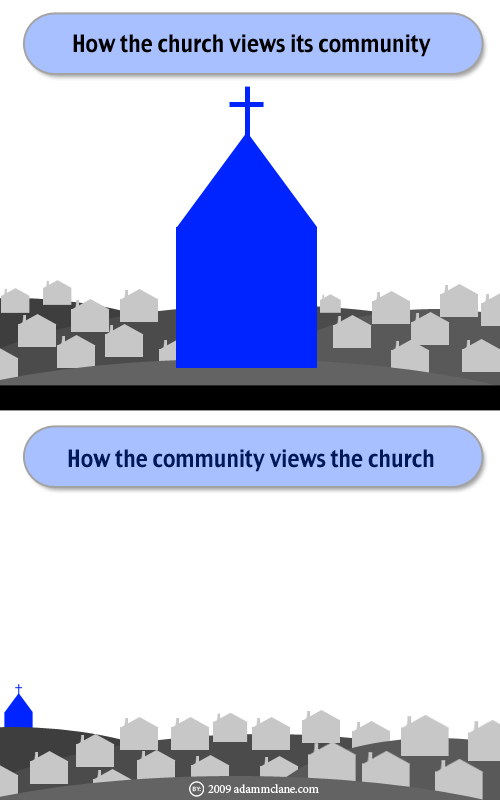
    There are two sides to every coin, aren’t there? I’ve had this post stuck in my head for several weeks– and I think the illustration says it all.

    Church leaders: Complacency sneaks in. We surround ourselves with people who go to church. We spend a lot of our time at the church. Our perspective becomes that the community revolves around activities at the church. Pretty soon we become ambivelent about the neighborhood we live in. Our schedule is defined on what’s convenient to those who come to church. Our agenda becomes to serve them.

    We perceive our ministry as a “city on a hill” when in fact the people living in our neighborhood are completely unaware of our existence. Before we know it, we are so comfortable with our programs, budgets, staff, and people who come to church we forget reality.

    The reality is that in most communities about 5% of the population attends a church. And yet we are comforable with that. Go ahead do the math yourself. Spend 30 minutes calling every church in your community and get actual attendence numbers. Next, simply divide that number by the population of your community. In most places that number is 5% or less of people who attend church on any given weekend. And we all know that just because someone attends church on Sunday doesn’t mean they are Christians, right?

    Why not take some time to get to know how 95% of the population views your church? Think of it like this. Count the next 20 cars that drive past your house. Only the 20th car will attend a church this weekend. In the illustration above there are 18 houses in view of that church. And none of them will attend that church this weekend. If your theology is like mine, you recognize that Jesus died for all 20 of the people in those cars and all 18 of the people who live in those houses. But who is our ministry serving? The 5% who show up. Most of our money and time is spent serving Jesus from the perspective of the 5% and not the 95%.

    That perspective should change things. 1 in 20 people will attend church this weekend. Any church. Even that church that is so bad you won’t even meet with the pastor to pray.

    I’m speaking to you out of deep gratitude for all that God has given me, and especially as I have responsibilities in relation to you. Living then, as every one of you does, in pure grace, it’s important that you not misinterpret yourselves as people who are bringing this goodness to God. No, God brings it all to you. The only accurate way to understand ourselves is by what God is and by what he does for us, not by what we are and what we do for him. Romans 12:3, The Message

    And yet church leaders reassure themselves that numbers don’t matter! This is the state of the church and people say we don’t need to fundamentally change how we do ministry. We worry about offending the 5%. We worry about changing too much too fast while our sworn enemy puts up victory statues all over. We follow leaders who look at this reality, shrug their shoulders, and move on with their lives. We go to denominiational meetings which agree to spend more money on organizations which are smaller every year. In short, we invest all of our time and energy in a broken model.

    And then when someone really breaks through. And that community reaches 6% of the population so we flock to hear how they did it? Got a book? Teach a seminar? Our perspective is jacked up, isn’t it?

    New leaders are needed. I dream of church leaders coming to the forefront who are drastically interested in the 95%. I long to surround myself with leaders who keep the 5% in perspective. We celebrate those lives changed! But I want to be with men and women who think differently. Where are the leaders who look at those 5% as just the beginning? Where are the people who recognize that a model cannot be built around an individuals talents? Where are the leaders who know they need to start a swarming movement?

    Point me to those people. I am tired of those who are satisfied with the failure of 5%.

  • Youth workers are nuts

    DSC_0046I guess I’ve always known this. Heck, I know I’ve been nuts a long time. But this weekend I got a lot of glimpses at just how crazy some youth workers are. In fact the craziest youth workers are volunteers who wil bring 45 kids from Kansas to Los Angeles for an event– by car– is absolutely insane. It’s one thing to do that for money. It’s an entirely new level of nuts to take your own vacation time to do that.

    Isn’t it interesting that people who are crazy enough to change the world look absolutely nuts? I suppose that’s a fair assement of an everyday superhero as well? While most sane adults do everything in their power to flee from the presence of sweaty teenagers wondering the streets of Los Angeles, God has created a special group of people who gleefully serve them.

    Acts 2 says: (emphasis mine)

    That’s when Peter stood up and, backed by the other eleven, spoke out with bold urgency: “Fellow Jews, all of you who are visiting Jerusalem, listen carefully and get this story straight. These people aren’t drunk as some of you suspect. They haven’t had time to get drunk—it’s only nine o’clock in the morning.

    DSC_0001People who are faithful, full of the Holy Spirit, and willing to take big risks for the Kingdom of God often look crazy. It’s a good kind of crazy. It’s the kind of nuts that gets me excited.

    This past weekend I was able to watch students get a little nuts too. On the first night they were pretty reserved. This is typical of an event as they are excited and into it– but they aren’t quite willing to look nuts just yet. But by Sunday afternoon kids crowd towards the front in order to express their nut-itude. This is the type of memory they can take home with them and memory bank for the next time they feel awkward about their faith.

    This weekend was a powerful reminder for me that we need more people who are absolutely out of their mind lunatics for the cause of Christ. Not fired up in a fake way. Not full of nonesense. Just legit willing to do whatever it takes. The world needs people who encounter the Word of God, catch a vision for how God wants them to respond, and are crazy enough to lean into its realities in their everyday life.