Free their minds… and their hearts will follow. (Sorry En Vogure, I changed it.)
Is the primary task of my ministry to cram as much of what I know into their heads or is it to teach them how to think? Rhetorical, right?
Wrong. My actions say the former while my brain says the latter.
Think about the typical day of your students as it relates to adults.
Early morning: An adult tells them to get out of bed and get ready for school. (Either by word or edict)
Morning: A parent tells them to get in the car, get out of the car, to have a good day, etc. If they ride the bus they might make a couple words of small talk.
School: Adults are largely in charge of the classroom and do most of the talking.
Between class time: Students cram a few minutes of conversation with friends as they dash from place to place. (Adults dictate the parameters of this.)
After school: Coaches instruct, students listen and obey.
Home: “Have you done you homework? Your chores? How was your day? Tell me about….“
To overgeneralize, most interaction students have with adults is either structured or adults talk at students. They are almost always put in a position of learner or otherwise lack power.
We would all say that they have power to own their faith. But are our interactions with our students validating that or putting them in a powerless position?
It’s relatively rare that a student would have a conversation with an adult.
It’s even more rare that a student would have a conversation with an adult where the adult does the majority of the listening and the student does most of the talking. (The adult in the lesser role while the student is in the power role.)
Shaddup Already!
As this Fall has ramped up and I’m starting to get to know my small group of guys my inner dialogue is, “You don’t need to talk at, just listen. Listen. LISTEN.”
The best thing I can pass along isn’t what I know. It’s how I think. I don’t care that the guys in my small group know what I know or have answers for everything we’re talking about. But I desperately want them to know how to find stuff out for themselves, to compare and contrast what people are saying, to not just grab wisdom for the sake of acquiring knowledge but actually discovering the source of wisdom.
Sure, I want them to know what God’s Word says about this and that. But I really want them to know how to wrestle with things in a way that moves/changes them.
Curate vs. Dictate
I can’t do that if I do all the talking. I’m not helping them learn how to think critically if I tell them what I know. They will only grasp hold of their faith, truly own it, if they can articulate it for themselves. That means I am not in their lives to tell them the answers. I am there to teach them how to find the answers themselves.
My theory is that I need to talk less and less for them to think more and more. That means my job is less to provide answer and more to create questions. Which is good. Because I have lots of questions. And I’m really good at creating doubt.
Photo by Phillip Howard via Flickr (Creative Commons)
Then how are you measuring what people are learning?
As a youth worker I’m always aware of leakage in my teaching. That is, the difference between what I am teaching and what learners are learning.
There is a naughty little educational word called “retention” we need to deal with. If there isn’t, what is the point of my teaching if my pupils aren’t learning?
Questions I ask myself as a communicator of Biblical truth:
Why am I teaching them?
How do I measure if they are learning?
How do I teach all levels of learners, interest levels, and learning styles at the same time?
Those who have sat under my leadership know that I do a lot of repetition and context to my regular teaching.Why do I do that? Because I want some things to stick. It doesn’t matter to me if you write it down in your outline or talked about it in a small group, I believe the Bible has incredible value for believers, we are called to know God’s Word, and we as leaders as told that one of our qualifications for biblical leadership is an ability to teach. I repeat and quiz because I want to burn an image of God’s Word on your heart. It’s not enough to know about the Bible… the teachings of Jesus have to be in your heart to impact your daily life.
I also know, as a leader, I’ll be judged by what people actually learn and what people actually do with what I am teaching them.
As the years have gone by I’ve become less enamored with perfecting my lecture-styled teaching and more enamored with a discussion-based, conversational-style.
Why? Because I’ve found, for me, that method to be a solid way to engage with the middle 70% of my audience. Folks in the top 15% aren’t my target. And folks in the lower 15%… I hope to teach them with other methods that work for them.
Some commenters took the post as an attack on the church, going to church, and those who lead at church. Others seemed offended that I’d even bring up Sunday morning as something we could collectively improve upon.
My intention was to the contrary. It was an attack on doing something that is largely ineffective for the sake of doing what we know in opposition to what might work better. For all of the thousands of hours the average church goer has listened to we should have seen so much more fruit. Let’s not forget that the church is on decline.
That pushes questions to the forefront of my mind:Is it the hearer who is disobedient to the teaching? Or is it the teacher who is failing to teach truth in a way that influences action? Probably some fault lies on either side.
It is my hypothesis that the primary method we are using for educating our congregations on Sunday mornings needs alteration. Church leadership is full of brilliant minds. We should show off our brilliance in our ability to lead people in innovative way: Not just talk about leadership but do it. Not merely preach a message that doesn’t move people, instead allow the message we preach to move us.
At the end of the day results are all that matter. Jesus isn’t going to look at you and say, “Awesome preaching, my good and faithful servant.” He will look at your body of work and judge you by the results & intention of your heart.
Photo by byronv2 via Flickr (Creative Commons)
What are the physical restrictions to learning on Sunday morning?
Nearly all churches are constructed the same way. Rows of seats all facing forward with a person on stage or behind a podium. That person lectures, sometime passionately, sometimes you fill out an outline, sometimes words are put on a screen.
But the Sunday morning experience is typically based on a single teaching method: Lecture.
Is that how you learn best? It isn’t for me. I learn best by hearing, discussing, and practicing. Passive-learning bores me. I need something to do!
And when I look around on Sunday morning I don’t see a lot of learning going on. (Bear in mind, my pastor is off the charts good at what he does, he is my favorite preacher. Week in and week out, he’s just as solid as people who have sold as who we have at our conferences.) Instead, I see a lot of polite nodding, the occasional taking of notes, and virtually no way to respond.
Sunday morning is highly assumptive.
There is an assumption that people in the pews are going to live this teaching out in their lives.
There is an assumption that people are going to talk about what they heard at lunch or with a small group, or somehow try to knead the message into their lives.
There is an assumption that the church staff spends the majority of their work week living that message out.
There are no checks and balances to make sure anyone is putting anything into practice. (Staff and attendee alike.)
The proof is in the pudding. There are hundreds of thousands of churches in America. Most use the same methods, few grow. Conversely, where the church is growing around the world and even here in the United States, different methods are in play.
The “It’s not about Sunday morning argument.“
I’ll be the first to admit that the Christian life isn’t 100% about Sunday morning. But, for most people, it’s the centerpiece of their walk with God. People aren’t just whining about being busy, they are. And they are sitting in your pews, bored, and saying to themselves… “You kind of waste my time on Sunday morning, why should I trust you with more of my time? We don’t need another program. We need this program to work for us.” If it isn’t about Sunday morning than why do we even do it? Of course Sunday morning is very important! Let’s not fool ourselves with double talk.
Are the methods we use on Sunday morning “sacred?“
Sure, Paul preached until a young man fell from a window and died. (Then Paul healed him.) And Jesus preached both at the temple and in public. No doubt, he was taught by rote memory as a boy growing up attending the synagogue. At the same time, oral tradition and discourse were both forms of education and forms of entertainment. We see from the New Testament that Jesus didn’t instruct his disciples to build churches and hold meetings. Instead, he taught them while they were on the road from place to place. Or by sending them out in pairs to do ministry in His name. Or using parables. Or by asking them questions. In truth, we see a variety of teaching methods to communicate biblical truth in the Bible.
While the way we’ve always done church is held as sacred, the methods we use aren’t Biblically sacred. But what is sacred is the simple command to teach.
A challenge
Photo by SparkFun Electronics via Flickr (Creative Commons)
I want to challenge you to try something. Maybe it’ll sound crazy. But maybe it’ll just be crazy enough to change your church. (And maybe you don’t have access to try this with the whole church, so try it with your youth group!)
Conduct a six-week experiment.
Week one: Teach a normal Sunday service. On Thursday, send out a 5 question email (or Facebook) survey for Sunday morning attendees, asking them 4 basic questions about your message, and one open-ended question about how they applied the message on Sunday morning. (What was the passage? What was the main point? Which of the following was an illustration? What’s one way you are applying last week’s teaching today?)
Week two: Teach, again, in your normal fashion. This week, acknowledge after the sermon that they will again receive a survey via email on Thursday. This will tip them off that it is coming, so expect the results to be higher.
Take weeks three & four off from the experiment. You’ll be tempted to peak at the results so far. Show discipline!
Week five: Try a different teaching method on Sunday morning. Maybe teach by discussion. Or get people into work groups. Do anything that isn’t one person up front teaching. Don’t warm people that this is coming! That’ll mess up the experiment. Then send out the same 5 question survey again. (Expect some negative comments, people coming on Sunday might hate any type of change.)
Week six: Use the same method one more time. Send out the same survey. Just like in week two, tell them to expect a short survey on Thursday.
At the end of the six weeks unseal the results and meet together as a staff to look at them. Did retention scores increase or decrease? Did the change in method cause more people to apply teaching? Did the workgroups hold each other accountable? Overall, what was the net change? (Heck, maybe the old method was statistically better!)
Week seven: Send out one last email sharing the full results.
This will serve two purposes. First, it’ll communicate to your congregation that you are taking your biblical role as a teacher seriously and being professional by sharing the results of an experiment which involved them. Second, it’ll invite the congregation into the problem solving. Chances are good that you’ll get a lot of feedback simply by conducting the experiment.
Of course, I’d love it if you shared your results with me as well. Email me a Word document and I’ll share them on my blog.
The reason I [Paul] left you [Titus] in Crete was that you might put in order what was left unfinished and appointelders [some translations use the word leader] in every town, as I directed you. An elder must be blameless, faithful to his wife, a man whose children believe and are not open to the charge of being wild and disobedient. Since an overseer manages God’s household, he must be blameless—not overbearing, not quick-tempered, not given to drunkenness, not violent, not pursuing dishonest gain. Rather, he must be hospitable, one who loves what is good, who is self-controlled, upright, holy and disciplined. He must hold firmly to the trustworthy message as it has been taught, so that he can encourage others by sound doctrine and refute those who oppose it.
Here is a trustworthy saying: Whoever aspires to be an overseer [elder, pastor, overseer are basically the same word] desires a noble task. Now the overseer is to be above reproach, faithful to his wife, temperate, self-controlled, respectable, hospitable, able to teach, not given to drunkenness, not violent but gentle, not quarrelsome, not a lover of money. He must manage his own family well and see that his children obey him, and he must do so in a manner worthy of fullrespect. (If anyone does not know how to manage his own family, how can he take care of God’s church?) He must not be a recent convert, or he may become conceited and fall under the same judgment as the devil. He must also have a good reputation with outsiders, so that he will not fall into disgrace and into the devil’s trap.
6 things that Paul doesn’t say that American church culture often says are qualifications to be considered a pastor.
You have to be a leadership expert, a proven leader with years of experience, a reader of books on leadership, aspiring to be a leader, and a regular at Willow Creek’s Leadership Summit and/or somehow tangentially related to John Maxwell.
You have to be an employee of the church. The same passage describes the biblical qualifications for a pastor as they do positions the American church almost never considers staff-level. (Elder, overseer)
Aspiring to be a well-known preacher. “Able to teach” is a pretty low standard. I am fully “able to run” but you won’t catch me out there doing it too often.
Be in possession of an Masters in Divinity from a denominationally approved seminary prior to seeking ordination. That said, education was a high priority in the early church. You couldn’t even be baptized or label yourself a Christian until you’d gone through about a one year process of intense discipleship. (Prior to baptism, new believers were called catechumen.)
Be a great manager of programs and projects. Since the early church was organized around the idea of family, you didn’t need to take classes in organizational leadership to understand the dynamics of a family.
You have to be an amazing self-promoter of both the church and your “personal brand.” Paul didn’t have a blog, Twitter, or Facebook. And yet he somehow managed to be spur on the most powerful viral message of all time.
Teaching is a core competency for youth ministry. If you’re going to make it… you had better be an above average communicator of God’s Word. Titus 1:9 gives a simple description of a ministry overseer that is tough to escape:
“He must hold firmly to the trustworthy message as it has been taught, so that he can encourage others by sound doctrine and refute those who oppose it.”
As I chat with professional, full-time youth workers around the country I think I can categorize most of them into basic 4 categories. Forgive the generalizations. It’s not clean and I think people hop in and out of different categories at different parts of the school year and their life cycle in ministry. I think I’ve been all of these at various times in my life.
4 Types of Youth Ministry Teachers
The artist: These people consider their teaching a craft. In their eyes, their lessons are as much art as a photographer, an architect, or a ballet dancer. They spend countless hours lost in crafting their teaching series, messages, etc. These folks look down on those who buy resources. Though, they may buy stuff occasionally for inspiration.
The time manager: These people understand and were maybe once “the artist.” But they don’t have time for that anymore. They look at their role as a teacher a task and they want to prepare quickly. They are always on the look-out for a quick idea. They love ministry resources, video curriculum, and have a mantra that if they spend a little money on a resource that they’ll spend more time with students and less time preparing lessons.
Copycats: These folks are always looking for someone else’s idea. It’s all equal in the Jesus economy, right? They listen in 6-8 sermons a week to glean ideas… not be taught, they love free downloads and hunt them, and they are always trying to take something someone else did and tweak it for their own use. They may not have many of their own ideas in play, but they’ll also be the first people to label their ministry as “very creative.“
Processors: These youth workers believe that their teaching will be better when they work through the content as a team. So they draft concepts and have a team of friends/volunteers look at it. By the time a lesson is taught, it has gone through 4-5 levels of revision. These people love their process.
Here’s the kicker. I don’t think any of them are necessarily better or worse than the others. I think they all have a place. And I think each category can lead you to be a better-than-average communicator of biblical truth to adolescents.
Ultimately, it doesn’t really matter that much which process you use. It matters far more that the message/teaching/lesson is delivered in a way it is absorbed than it is how the message/teaching/lesson was produced.
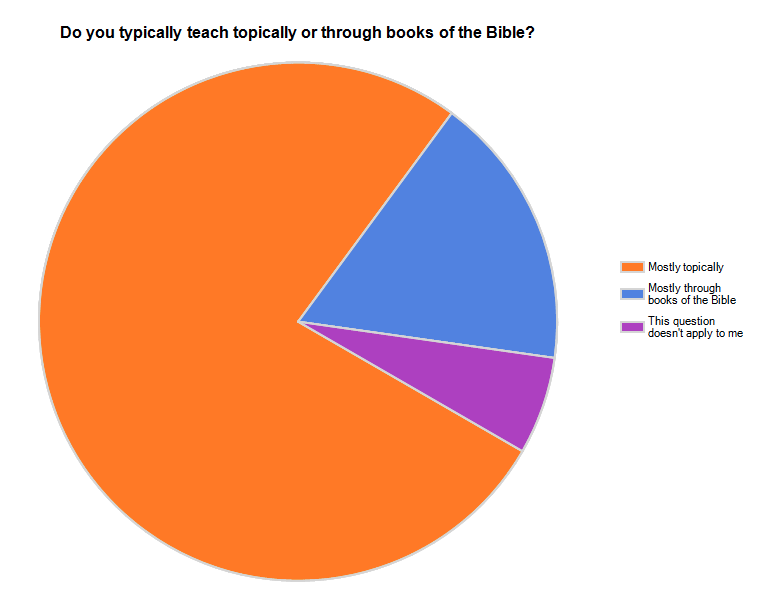
Recently we took a survey of Youth Specialties customers. The results of one particular question completely shocked me. Here it is:
When I was looking through the initial survey results I turned around to Tic, and said… “Wanna know why so many youth groups are struggling to keep students for the long haul? There’s the problem, right there.”
Of our sample of 600 youth leaders 76.8% of them teach mostly topically?
The words of Paul echoed in my head:
All Scripture is God-breathed and is useful for teaching, rebuking, correcting and training in righteousness, so that the man of God may be thoroughly equipped for every good work. 2 Timothy 3:16-17
But apparently many youth workers don’t believe this is true. They believe that topics are more important than Scripture!
Let’s review:
All topics are not God-breathed.
All topics aren’t useful for teaching, rebuking, correcting, and training in righteousness.
All topics are not equipping the man of God for every good work.
But God’s word is!
Look at it another way– Most youth workers are getting in the way of this.
But as for you, continue in what you have learned and have become convinced of, because you know those from whom you learned it, and how from infancy you have known the holy Scriptures, which are able to make you wise for salvation through faith in Christ Jesus. 2 Timothy 3:14-15
Don’t even give me the parent comeback. “It’s a parents role to teach their kid the Scriptures.” That’s a joke. Youth workers aren’t paid to babysit, are they? Certainly, parents have a role in teaching their children. But, as a person called and equipped to teach and reach middle and high schoolers doesn’t teach the Bible– what kind of example is that?
Don’t give me the “all the kids in my youth group know the Bible” comeback either. If all you are reaching are kids who were born and raised in the church than you’ve lost sight of what youth ministry is all about in the first place! I would argue that if you aren’t reaching teenagers for Christ than you aren’t likely doing discipleship while going anyway.
Here’s what I am saying.
Get back to your first love.
Teaching the Bible is more useful than teaching purely topically.
Teaching the Bible is taking students to the primary source.
Teaching the Bible is equipping your students for every good work.
Teaching the Bible is long-sighted and strategic.
Teaching the Bible is teaching a man to fish instead of giving a man a fish.
Get back to your first love.
If you want to change a persons’ life, you need to get them in God’s word.
It’s becoming increasingly popular in large churches for pastoral staff positions to be filled with people trained in business skills and not ministry skills. (i.e. They’ve got the title “pastor” and all the perks that go with it, without going to Bible College or Seminary.)
Let me know what you think about that trend. Vote in the poll below and leave a comment with your thoughts.
I’m just going to state my opinion up front. I think its a dangerous and scary trend. Particularly with some of these church structures where “pastors” are only accountable to an elder board… made of largely of successful business people who didn’t go to seminary! I think this trend is a reason we’re seeing so much open and proud heresy preached.