Category: management

  • Two Small Business Tools for Non-MBA Business Leaders

    Two Small Business Tools for Non-MBA Business Leaders

    My bachelors degree is in youth ministry. I did about half a masters degree in youth ministry leadership.

    That means I have exactly zero expertise in accounting, bookkeeping, or human resources. 

    When it comes to my part in leading our small business I’m really good at some aspects of what I do at The Youth Cartel. I’ve got a lot of natural intuition and curiosity and an ability to figure stuff out. But there are other aspects where I need serious help.

    When you are starting a small business it’s easy to think all of your time and energy will be about passion, mission, and ideas. But pretty quickly after you get going– especially if you start doing well– you realize that if you don’t know how to do the backend of your business, you’ll never get to spend any time on the front end!

    Every small business owner has to deal with this one way or another.

    • Yes, you can hire a bookkeeper or an accountant or an HR professional. But it’s expensive. And the real risk is that if you don’t hire the right people they’ll not do it correctly or do it in a way that reflects why you started your small business to begin with.
    • Yes, you can do it all yourself with Google Spreadsheets and by Googling stuff you really can figure out how to do it all yourself. But it’s going to take up a ton of your time and you’ll never really know if you’re doing it right until the tax man comes or you get a scary letter from the state.
    • Or, for not very much money, you can use some online tools that’ll let you do-it-yourself.

    Here are two small business tools that I highly recommend

    Gusto for Payroll & Benefits Management

    If you’re running a small business you’re probably starting to think about the headache of W-2s and 1099s and all that year-end paperwork. (Cough, Obamacare. Cough. Cough.) We’re completing our second year using Gusto (formerly Zenpayroll) and I am still really digging it.

    Basically, they do everything. You login and tell them who gets paid what and how and bam… it’s done. They even send you reminders until you get it done. Last year I processed our payroll while walking through the Phoenix airport between flights. Then, in June, I got a last-minute reminder while in Antigua, Guatemala right away. I popped into a coffee shop and 5 minutes later was done. Fast, easy, secure, mobile. 

    Gusto handles all the paperwork with state/fed government as well as to your employees. They’ll send me notes telling me stuff that they’ve filed for me and I have no idea what the form is, why I needed to fill it out, or any of that. But it’s done and I don’t have to worry about it. For me, the biggest thing they do is take away the fear that I’m doing something wrong.

    What about the other guys? Before going with them I did demos and talked to reps with all the other payroll companies and Gusto is way easier and way cheaper than all of them, plus they are way easier to deal with.

    That’s my recommendation for payroll. If you’re a small business, a small non-profit, even a church. Two thumbs up.

    Freshbooks for Bookkeeping & Accounting

    The Cartel has four lines of business– events, publishing, coaching, and consulting. For the first year or so we tried to track all of our accounting with Google Spreadsheets. It worked relatively well but as we grew it became more and more cumbersome to deal with. (A spreadsheet for 10 programs is fine. But a spreadsheet for 40 different programs?) Plus, we were missing stuff. And when it came to tax time? A bunch of spreadsheets was sketch city.

    We’re in our second full year with Freshbooks and it’s made our lives so much easier. We use it to track every inbound/outbound payment whether that payment is a traditional invoice, an event registration, or buying a download from our store. Perhaps the best part is that it’s API connects to a bunch of the other tools we use… like our bank and our online store. So instead of manually creating every entry and coding it we basically just double-check to make sure things are correct. (Which is still time consuming but a major shortcut.)

    And yes, I’m using “we” language because it’s a “we” thing. You can give other members of your team access, they can code their own expenses, create their own invoices, etc.

    If you’re invoicing, tracking time or expenses, I can’t recommend Freshbooks enough.

    Both of those recommendations are field-tested, I’m not a new customer, and are both under $100/month. (Most months they are under $100/month combined!) In both cases you can find even cheaper options but these are Best in Breed quality without being Best in Breed pricing

  • Monday Morning Routine

    Monday Morning Routine

    Today is the start of a new week.

    And a new month.

    And for new graduates it’s the dawn of a new journey.

    For many in my world, summer is a time of transition and change.

    For others, today marks the shifting of gears from school mode to summer mode.

    For lots of families it’s the home stretch for school. (2-3 more weeks in the McLane house!)

    Leaders Set the Tone

    One of the many things about leadership I learned from working with Tic Long [back in my YS days] is the importance of Monday morning. Pretty regularly, usually on a Monday, Tic would grab a cup of coffee and work his way around the building to check in with everyone. It was almost never about work. It was almost always conversational.

    Hey big fella, what did you guys do this weekend?

    I’m pretty Type A so I come into every Monday morning like a bull comes into an arena. I’ve got an agenda, stuff to do, a checklist… and Monday morning always feels like a horse race to me. Go. Go. Go.

    Tic interrupted me. He’d pop in and I’d have to stop what I was doing. It bugged me in a way that I looked forward to it over time.

    Was it that Tic didn’t have a list of stuff to get done? (When I first started I was really put off by this, he was bothering me, and I thought he was just wasting time.) Nope. There was a habit and (presumably… intentionality) to walking around and checking in with everyone in the building.

    Yes, Tic is social so it felt natural. But, doing this, it had a net effect that mattered in three specific ways:

    1. You were reminded that you were known, you were more than what you produced.
    2. You were reminded that you were important, what you did at work wasn’t your whole life.
    3. He got to check-in with each person one-on-one.

    The point isn’t to copy what Tic did. What he did worked for him but might not work for you. The point is that if you’re a team leader, you set the tone for your team.

    If you come into Monday morning dragging your butt or feeling grumpy or hiding in your office, scheduling meetings, etc.– expect the same from those you lead.

    Conversely, if you get out and set the tone for your team– expect others to follow.

    Positivity begets positivity.

    Care begets caring.

    Valuing others begets others feeling valued.

    Photo credit: Hot Coffee on a Cold Day by David Joyce via Flickr (Creative Commons)
  • 3 Keys to a Healthy Ecosystem for Growth

    3 Keys to a Healthy Ecosystem for Growth

    I spent a lot of time in Freshbooks last week. This revealed three important things to me. First, it’s clear that Marko and I have no training in accounting or bookkeeping. We try really hard and we are learning a ton. But it’s way harder than I’d like to admit. Second, while living in the daily grind of our little business makes it hard to see it… there’s no denying the exponential growth of everything we’re doing. Third, there’s a huge need for the position we’re hiring for to help us administratively so that our growth doesn’t stall. I’m actually starting to think of our next couple hires after that.

    So what’s the secret to the Cartel’s growth? I think the biggest secret is that we cultivate a healthy ecosystem where growth is a natural byproduct of the health– instead of worrying about creating a home run product. Since it’s opening day in Major League Baseball… I describe what we do at the Cartel as “small ball.

    2100738_o


    We do a lot of little things right and success is the outcome. And when we do things wrong… we fail fast and small.

    3 Keys to a Healthy Ecosystem for Growth

    We don’t always get these things right. But when we’re at our best, this is what we’re striving for.

    Consistency


    It’s easy to overdo it on consistency. Like, worrying about something being done at a specific time as opposed to being done well. But consistency is a sign that things are going well, that we’re on a good pace, and that things are sustainable. People are naturally drawn to consistency in quality of what you’re doing or consistency about timing on an event or even consistency of how long it takes to follow-up on something.

    For instance, we don’t change the size of our books or the paper quality or even the thickness of our covers… ever. It’s not that we can’t do that. It’s that by being consistent people know what to expect from our books. And while we’re still perfecting our editorial process, the process of how a book becomes a book is pretty consistent. Why? Consistency leads to health.

    Playfulness

    Core to who we are, from the onset, is cultivate playfulness. There’s a fine line between playfulness and corniness… and we make sure we stay firmly on the playful side. This isn’t just something we do on the outside in what we do, it’s kind of who we are as an organization. I won’t extrapolate how that actually plays out on a daily basis, I’ll just leave that to the imagination. 

    I find that as we’re playful it spreads to people we work with and into the stuff that we do. Last year, at The Summit I had a joke with the woman at our host hotel about wanting a really, really big gift basket because we completely sold out the hotel. Well, we we checked in to our rather modest little hotel room there it was… a candy gram with a hand written note.

    It wasn’t over the top ridiculous but she was being as playful as her very serious job would allow.

    Desperation


    Nothing good comes out of a research & development department.

    That’s something I’ve learned over the years.

    • IBM had all the money in the world and missed on the home computer.
    • Apple had all the money in the world and missed on Dropbox.
    • Google had all the money in the world and missed on Facebook.

    Fat and happy never leads to innovation… only iteration.

    Innovation is directly linked to desperation. One of the key things we do at the Cartel is always keep things a little desperate. We make things work because we have to make them work in order to keep going. Take that away and we get really, really safe.

    Desperation is to innovation as safety is to iteration. 

    Start Composting

    DIY Composting Bin - http://www.instructables.com/id/compost-bin/
    DIY Composting Bin – http://www.instructables.com/id/compost-bin/

    So what do I do with these 3 things? Start composting.

    Literally, you cannot buy health. You can’t hire health. You can only cultivate a healthy environment and patiently mix these things in over time. The bad news is that you can’t do this overnight. The good news is that once you’ve got it going it’s relatively easy to keep it going… just like a good compost in your garden.

  • Inspiration is for amateurs

    Inspiration is for amateurs

    Amateurs sit and wait for inspiration, the rest of us just get up and go to work.

    – Stephen King

    Not a big Stephen King guy, myself. But I love that quote.

    So true.

  • How to Lead Young

    How to Lead Young

    I got my first “real job” when I was 21.

    After Kristen and I got married in June 1997 the big boss at my company called me one day. “Adam, we’re going to post a job today supervising your area. I want you to apply for it because I want to hire you.

    A couple weeks later I got the job.

    At 21 years old I was put in charge of one of those jobs in a company that’s really important but no one wants. Weird shifts, overseeing three shifts of workers, union issues, very expensive and complicated equipment, constant unrealistic expectations and impossible deadlines, and higher ups who constantly reminded me that it’d be way cheaper to outsource my department to another company. Oh, and just for fun, this little mini-department had just been moved offsite to a warehouse where we were hated.

    Looking at the facts it was a no-win situation. I was a new manager, in charge of very expensive equipment, doing a very important job for the company, but put on an island and given a hodgepodge team of full-time, long-term employees in their 40s and temporary workers… many of whom had felony convictions and never had a “real job.”

    I never saw it as a no-win situation because I had one thing in my corner… a boss who really believed in me. She didn’t hire me to be lead to the slaughter. She hired me because together we were going to kick some butt.

    My charge was pretty direct:

    • Meet or beat every deadline.
    • Create a team that believes in itself.
    • Figure out how to do this cheaper than outsourcing.

    Over the next five years that’s exactly what I did. We never missed a deadline, we created the proverbial “mail room” for the company where a crew of temps and union employees became family, and every year I was there we lowered the cost-per-item produced.

    But, in all honesty, this little feat only happened because I had a boss who invested in me. I believed it was possible because she believed in me. She didn’t just hire me and stick me in no man’s land in that warehouse. She continually invested in me and taught me the right things to do.

    And most relevant for you? She taught me how to lead young. The things she taught me about being a young leader were directly transferable to my next life as the young leader on a church staff. So I wanted to pass them along.

    5 Things Every Young Leader Can Do to Earn Respect

    1. Be Prepared – Each week we had a weekly staff meeting. Like a lot of organizations, these meetings were predictable, we were going to go around the conference table and each person was going to give a brief report on their area. I was surprised how many people got fired as the result of performing poorly in the meeting. They came unprepared, they didn’t have the right information, they didn’t have answers, they didn’t offer solutions for the rest of the team– they thought it was casual because we served coffee and donuts.  Before my very first staff meeting I was pulled aside and told the truth: This might seem casual and even friendly sometimes. But don’t ever show up to this meeting unprepared. Sometimes you’ll get away with sharing very little info, but other times the pressure will get applied. Always be prepared. Never show up without all the information you need.
    2. Be on Time – Living in Chicago, it would have been easy to be late a lot. (Traffic is always an issue.) I saw managers come and go in my time and one of the big reasons was simply that they couldn’t manage to control their time. They were late for meetings, they were late for work, and they fostered this expectation that they wouldn’t be on time. The flip side is that when you are young you want to establish that you are dependable. Being consistently 15-20 minutes early told older managers I valued their time enough to be on time. We live in a culture who expects young adults to be lazy, disorganized, and otherwise undependable. Get on the other side of that and you’re winning hearts.
    3. Dress Right – I worked in a warehouse. A dusty, hot, place where I might go a week between seeing someone from the main office. But I learned the value of dressing right. As the years of success built it became more and more normal that my little area became part of the tour that the people wearing suits showed off to visiting company presidents. Our success story became part of the success story for the whole company. I can’t tell you how important it was to be dressed appropriately so that when I got a call that the “big bosses” were coming to tour our facility or I needed to go make a presentation at the headquarters, that I was ready. It might seem silly, but one thing I was queued into early was that it was important to have a nice watch and a nice pair of shoes. I might have left for work at 3:45 AM, I might have had a lot of laughs with my team, but I also rocked those uncomfortable dress shoes and that gold watch day in and day out.
    4. Don’t Make Excuses When You Fail – Mistakes will happen. Your team will fail. You will not always meet every last expectation. I’ll never forget seeing a high level boss catching a co-worker in a lie during one of those staff meetings over a mistake in her area. She was trying to cover for someone and got called out on it like a shark on a baby seal. Reduced to tears by the embarrassment, credibility lost, she transferred to another area of the company. I learned right away that having “sober judgement” about failures, being clear with the facts, holding the people at fault accountable, and owning your own mistakes grows respect and credibility. Those who tried to cover things up or sugar coat their failures… they didn’t survive when their blood was in the water. A failure is a test of character, nothing more and nothing less. Own it, deal with it, and move on.
    5. Don’t Kiss Butt – One of the biggest mistakes I see young leaders make is kissing butt. It’s one thing to kiss a ring… there are a lot of rings to be kissed as a young leader… but it’s another thing to kiss someone’s butt. Kissing butt can get you attention. But it’s the wrong kind of attention from the wrong kind of leader. If you want to establish respect in an organization you’ll let your results speak for you. If you’re resorting to kissing up to get what you want, your boss already knows you aren’t a leader… you’re a butt kisser. That boss owns you and you’ll never lead. Worse yet, your coworkers see it and respect you less and less as the butt kissing goes on.

    What advice do you have for young leaders in an organization?

  • Start-up Success: Big Heart, Big Ears, Tiny Head

    Start-up Success: Big Heart, Big Ears, Tiny Head

    The Youth Cartel is my second start-up.

    My first, Youth Ministry Exchange, had acquisition in its DNA from it’s day one. Launched in 2005 and sold in 2008 we wanted to acquire as many users as possible, as quickly as possible. We wanted as much activity as we could get, as quickly as possible. The “why” of that was simple. Get big and sell quick.

    It was all heart and balls. 

    We had no idea what we were doing.

    And, my hope, was that we’d build it up and sell it rather quickly. Literally, that took 3 years. At the end of 3 years we’d grown like crazy, nearly collapsed because of the insanity of our structure, and regrouped enough to sell it.

    Personally, as an owner, I learned a ton with YMX. I made some terrible mistakes along the way. But in those 3 years I got an MBA from the business school of life, kept it all legal, kept all our documentation, and managed to grow it enough to sell. We didn’t get rich off selling it. But we took something that we started for less than $100 in capital investment and sold it to a subsidiary of one of the largest media companies in the world.

    Not bad for a first try!

    A lot is different about the Cartel. But in a ton of ways, we’ve picked up from the lessons of YMX and built upon that success. Because of YMX I had a clue about structuring the business side, was a lot faster to keep the right documentation, and all of that.

    One core difference between YMX and the Cartel is one of acquisition. We never built YMX to last because we had a short-term goal of building it up and selling it. The flip side is that, since the beginning, the Cartel has been designed to be “it” for Marko and I. We’re not interested in a 3-4 year build up to acquisition. Instead, we’re looking at how to build something that’ll last and be significant for a long period of time. We think we’re offering something that folks in ministry to adolescents need now and will always need.

    The Garage

    The Cartel is just about ready to outgrow it’s “garage” phase. American culture has a fascination with small businesses that got started in a garage. Companies like HP, Apple, and Microsoft had their earliest years in a garage. Our team is dispersed… so it’s more accurate to say the Cartel is in a Living Room phase. But, several hours per week I am quite literally in our garage working away. So I know that while it’s romantic to think of a start-up working out of a garage, in the moment it’s far from sexy. It’s sometimes 120 degrees in the garage. It’s always full of cob webs. And you just have to get used to people walking by and staring at you. “No, this isn’t a meth lab. We have a business license. Yes, the UPS truck really does have to come every day… sorry if it is loud.”

    The point is sharing all of this is simply this: I’ve learned some things along the way. Not very many people can say they’ve bootstrapped two start-ups… and both of them have worked out.

    3 Lessons for Those Thinking About Starting Up

    Here’s 3 things I’ve learned from two successful start-ups that I think are universally transferable.

    1. Big Heart – You have to love what you are doing. You. have. to. love. it. But beyond love, you have to have a heart for what you are creating and the people whom you are creating for. Having a big heart means saying yes to the right things. And it also means saying yes to the wrong things sometimes because you need to make some sacrifices in order to pay the bills. I can’t tell you how many times with both YMX and the Cartel that we’ve had to go back to the heart of the matter. “What in the world are we doing right now?” To make it, you have to love what you’re doing, the people you are serving, and the vision for what you’re trying to do. Starting up ain’t easy. There are going to be times where you have to will it to succeed… and that comes only from the heart.
    2. Big Ears – If you’re “all heart” you are screwed. I can’t tell you how many start-up businesses and non-profits that I’ve seen fail because they started with all heart but were completely deaf. The earliest phases of starting up, you’ll hear from your friends. People will be super encouraging. They will love what you are doing. They will buy something or invest a little. But you need to be really careful with that because if you aren’t careful you can start listening to the wrong people. If you are really going to make it you need a big heart and big ears. What I mean by big ears is: You need to listen better than anyone you know. You need to listen to the advice of experts. You need to listen when someone tells you that you need help. You need to listen to that little voice that asks, “Um, think I need a license to do this?” Listening will save you so much pain when it comes to creating your start-up. But I find that having big ears goes further than just the operational side of things. You need to have big ears to really listen to what your target audience needs from you. Often times they’ll tell you they want something but really don’t. And the only way you’ll know what to do is to listen with big ears.
    3. Tiny Head – Starting-up is going to feel arrogant and selfish. Not because it necessarily is, but it takes some amount of brashness to strike out on your own and seek to make your ideas a reality. But you need to understand that if this thing you are creating is going to make it, it’ll be grow out of your humility and struggle where you are arrogant. This is particularly true beyond the initial start-up time of getting things going. Once you’ve launched and things start moving fast… if you’ve got a big head, it’ll be an anchor dragging you down. You have to constantly hold onto the heart part of your start-up but let go of your desire/need to make every decision. The best start-up leaders hold firmly to the heart of the organization but loosely to “how we get there” bits. Big head is death, tiny head is life.

    These are 3 things I think you can take to the bank. Did you find this helpful? 

  • Undervaluing People in the Age of the Sawzall

    Undervaluing People in the Age of the Sawzall

    One thing that irks me is undervaluing a persons abilities in an organization.

    Here’s how it works:

    • A rising star gets hired for a starter role.
    • They dominate it. They do a great job and even make their job look easy.
    • A few years of domination go by.
    • A role opens up in leadership of that organization.
    • That person gets their hopes up that their dominance in their role will have drawn the attention of others.
    • They are passed over for that role.
    • They realize that they’ll always be seen as someone filling their current role.
    • They move on to another organization.
    • The original organization suffers twice. Once because they are no longer dominating at that one spot. Twice because they missed out on a rising star who was passionate about their organization but left feeling burned.

    “We just don’t think of that person in that way.”

    That’s what people say when you ask them about that rock star person in their organization. They got hired at a specific role, not as a “leader.” And so, in the people that matters’ eyes… they’ll always be that role. 

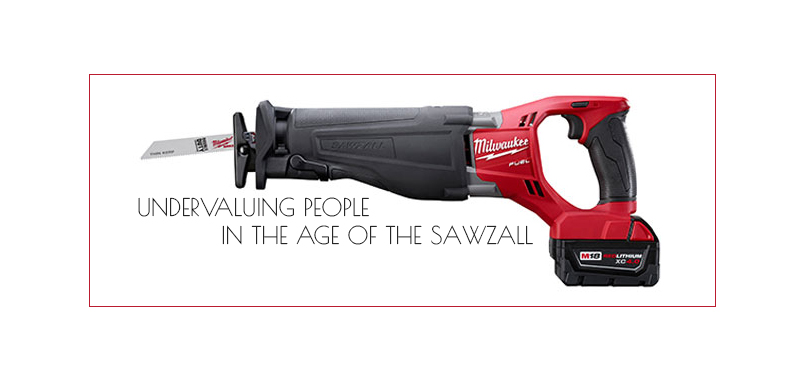
    Sawzall

    Kristen: “What’s that?”

    Me: “What?”

    Kristen: “That. What is that for?”

    Me: “It’s a Sawzall. Everyone has one.”

    Kristen: “Um, we don’t need that. We rent our house.”

    Me: “But it’s the 75th Anniversary edition. It’s limited.”

    Kristen: “…”

    Me: “Think of it like a hope chest. One day we’ll own a house and you’ll want me to take down a wall. This will be the perfect tool.”

    Kristen: “…”

    Me: “Are you saying you want me to put it back?”

    Kristen: “We came here for light bulbs.”

    There is No Ceiling

    Centuries ago you needed a lot of money to chase your dreams. That’s just not true today. Anyone can start a business with a laptop and about 45 minutes on LegalZoom.com. You can start a legit 501 3c in your spare time over a couple weeks. You don’t need an office, you don’t need a big staff, and you don’t even need a pile of special skills.

    My advice for those who wake up to the reality that their organization “doesn’t look at them that way” is simple: Buy a Sawzall.

    We used to have to wait for doors of opportunity to open. We used to spend decades positioning ourselves for the right moment.

    But today? You don’t have to wait.

    When all the doors around you are closed and locked to your dreams go buy a Sawzall and make your own door.

    p.s. If someone wants to buy me a Sawzall for me for Christmas. I’d appreciate it. 

  • To be Dynamic You Need Tension

    To be Dynamic You Need Tension

    Kicking Butt vs. Counting Butts in Seats

    I’ve been around organizations that are dynamic, where risks are taken, new innovations fly, and the response is incredible.

    And I’ve been around organizations that used to be dynamic, where it seems people are remembering big risks, iteration has taken over, and the response is flat, predictable even.

    (more…)

  • Don’t Get Bored

    Don’t Get Bored

    The other day I was thinking about all of the people I know going through job changes, struggles, and frustrations.

    Work isn’t supposed to be fun all the time. In fact, the Bible promises that work will often suck. (Genesis 3:117-19)

    (more…)

  • Simple Growth Strategy

    simple-growth-strategy

    A big term in college basketball this year was, “Are you the hunter or are you the hunted?” In other words: Are you the aggressor?

    (more…)