
Category: management

  • 6 Questions for Those Starting a Business

    Grand Opening
    Photo by whizchickenonabun via flickr (Creative Commons)

    The Great Recession of 2009 has created a new breed of entrepreneur– the I-don’t-have-a-job-but-I-was-once-successful-in-business-and I-don’t-know-what-to-do-with-my-life-since-I-can’t-find-a-good-paying-job-that-satisfies-me-quite-like-my-old-job-did-entrepreneur.

    What’s interesting about this group is that they have great ideas, limited capital, and a mixed bag of preparedness for starting a business. Honestly, that’s a perfect combination!

    Tunnel Vision
    Photo by rcameraw via flickr (Creative Commons)

    The bad part is that since they don’t have jobs, they need this thing to take off instantly and provide for their families before their unemployment benefits run out.

    I have a fundamental belief that people are at their best when up against that type of adversity. But while that kind of desperation can create tremendous energy to succeed– I’ve found that it can also lead to dangerous tunnel vision.

    So here are my 6 Questions for Those Starting a Business as a result of getting laid off by the Great Recession of 2009.

    1. How little capital will you need to start generating positive revenue initially? In other words, how little can you invest to start making money with your idea now?
    2. What will you do to acquire customers outside of your sphere of influence? Your biggest weakness is thinking you have the contact base to maintain a business beyond 180 days– if you had that strong of a contact base one of them would have hired you by now. How will you grow your sphere beyond yourself in the first 30, 60, 90 days?
    3. Who are the gatekeepers to your success? Who are the power brokers in your niche and what do you need from them in order to succeed in this space?
    4. Have you defined the boundaries of your niche? What safeguards have you put I’m place to keep you in your niche?
    5. Is the product or service dependent or repeat business? If a repeat business, how will you manage customer relationships beyond the transaction?
    6. Is this a product or service that you need? If you don’t need it what makes you think it will keep you up at night making it awesome or that it will motivate others to evangelize your product?

    What makes me qualified to ask these questions? In 2005 I started Youth Ministry Exchange with a small group of friends. We turned a profit on the first day and had positive cash flow every quarter until we were acquired by Youth Specialties in June 2008. In other words, I’ve done exactly what this breed of entrepreneur is attempting.

  • The Dark Side of Attractional Ministry

    dark-side-attractional-ministry

    The dark side of attractional ministry is that it’s a short term strategy.

    True confession–

    I was a perveyor of an attractional ministry model. It never permeated any youth group that I’ve been a part of, but the structure of our last ministry was– at it’s very core– an attractional model within our two biggest demographics. (Children and adults 40+) Time and time again here on the blog I’ve made generalizations about attractional ministry, not just as an outside observer, but as someone who has participated and performed within the model. I critique because I know!

    Three quick reasons attractional ministry doesn’t work:

    1. A life with Christ isn’t entertaining. At the end of the day, a day-to-day walk with Jesus isn’t filled with flash pots, set design, video screens, and compelling skits, and crafted messages for the heart. So the premise itself presents a well-intentioned lie about Jesus.

    2. When the lights go out, people feel empty. Whether its an amazing kids program or a great event for adults. The reality is that people leave feeling empty and longing for more. Just like 2 hours of television doesn’t fill the soul quite like an intense conversation with a good friend, an amazing night of Jesus-y entertainment just leaves you tired and empty. The attractional model had the same effect as a visit to a casino. A huge build up and a huge let-down. (With free drinks along the way.)

    3. It’s unsustainable. This goes in a few directions. It isn’t sustainable in that a single church cannot entertain all the demographics/age groups you will attract. Also, it isn’t sustainable among volunteer and paid staff. (People don’t volunteer to entertain, they volunteer to minister) Lastly, it isn’t sustainable as it doesn’t prepare people to leave your church and fulfill the Great Commision.

    You can’t sustain it as a church

    When we first began our attractional ministry to children it seemed so innocent. The idea was if we could make the kids program awesome, kids wouldn’t want to miss church. We’d target kids knowing that parents would follow and support something that was great for their kids. It wasn’t about attracting money, it was about attracting families. Our hearts were in the right place as less than 5% of our communities families were part of a church. It wasn’t a false Gospel, it wasn’t evil or about self, it was just a short-term strategy that worked very well at first.

    The dark side of that is that entertaining people is an ever-hungrier dragon. Our initial efforts were simple and fun. But expectations quickly swelled. It didn’t take long for us to rethink our plan… we needed bigger casts, more production money, more planning, and if we just upped our game a little bit we could attract more people. When we got to the next level, people were excited and wanted more. Within a very short time people were expecting an experience we couldn’t create. They’d watch television or go on vacation and their expectations increased as they wanted those experiences with a Jesus-twist. More money, more people, more production… this is not a model for sustainability. I don’t care if your congregation is 200 or 20,000. You simply cannot compete in a sustainable fashion with the entertainment industry.

    Your leadership can’t sustain it

    The same truism played out among the leadership. The folly of turning one area of the church into mini-Disney quickly caused unintended consequences. Within a few months I went from ministering to the hearts of people to the host of a three ring circus. I had a hard time getting into spiritual conversations. It always came around to “I loved what you guys did, what’s happening next?” It was such a time-sucker that in all reality… I was the host of a three ring circus who did the bare minimum relationally to be called a minister. The community recognition was useful, the day-to-day reality wasn’t useful.

    Among the leaders, people turned on one another when one attractional ministry got more attention or funding than another. Remember that dragon? He always needs to be fed and as he grows he gets hungrier and more demanding. And a church only has so much talent that is functional for entertainment. As expectations for better entertainment attracted new and more people– competition for resources began. Feelings were hurt. Rank pulled. Volunteers stolen. Guilt laid. Moral shrank. Frustration set in. We all wondered in our silence, “How can we spend the same amount of time and money and get a bigger and better product?” We had fed a dragon that now spit fire.

    That’s right… the church staff began thinking of worship services, kids ministries, and adult outreach as product to be perfected and sold to an audience. Before we could figure out what was happening, it all turned into one tragic game a bigger or better. The problem this model was created to solve really just made the original problem ten times worse.

    The whole time I knew we couldn’t sustain it forever. There wasn’t more money. There weren’t more people. The questions went from “what are we looking to do in the next 3-5 years?” To “what are we trying to do this year?” To “what are we doing this quarter?” To “what are we doing this month?” To “what are we doing this week?” In desperation you just get into a survival mode of… how can we get through this week? No one entered into this foreseeing this problem. But that’s how dragons go, I guess.

    Ever increasing expectations + lack of resources + staff frustrations = burnout. I wasn’t alone in feeling burnt out. All of our staff and volunteers felt it. But none of us would admit to it because we were all too busy feeding the dragon. He wanted more.

    You can’t sustain it as a model for walking with Jesus

    The model itself sounds so Christ-like when you start. We justified, “Hey, this is exactly what Jesus did. He drew a crowd, then invited them in to a relationship.” But our theology was short sighted. We forgot John 6, didn’t we? When Jesus confronts those following him with the reality that following him was going to mean they’d have to carry His burden and that in order to follow Him lont-term they’d have to eat his flesh and drink his blood… John writes... “From this time many disciples turned back and no longer followed him.

    Within a year, the most dedicated volunteers were still following us but the majority had pulled a John 6:66 and gone home. Who could blame them? The leaders were defeated, but still had people coming– expecting to be entertained. Pride set in as we doubled down to say, our plan MUST WORK! We couldn’t admit our mistake or tell those people that ultimately our vision failed. We knew a walk with Jesus wassn’t about fun skits, silly songs, games, and great music. Ultimately, our attractional-style of ministry worked in one way and had devastating effects in another. All the staff hated what we had created. All of the staff lied to themselves that it was worth it. All of the staff openly questioned themselves, “Is this what ministry is all about?

    A life with Jesus isn’t about making it from one event to the next. It isn’t about getting inspired by an event. Teaching people that by depending on entertainment to draw people is ultimately not the Gospel. It looks like Jesus. It smells like Jesus. But its just a shadow of the real thing. Luke documented this phenomenon in Acts 8.

    Now for some time a man named Simon had practiced sorcery in the city and amazed all the people of Samaria. He boasted that he was someone great, and all the people, both high and low, gave him their attention and exclaimed, “This man is the divine power known as the Great Power.” They followed him because he had amazed them for a long time with his magic. But when they believed Philip as he preached the good news of the kingdom of God and the name of Jesus Christ, they were baptized, both men and women. Simon himself believed and was baptized. And he followed Philip everywhere, astonished by the great signs and miracles he saw.

    I share this story as a warning to my friends in ministry— tough times make us all look for easy solutions. It’s Fall. A lot of churches are in the same position we were in when we started our attractional ministry. They have vision, they have unreached people, but right now money is tight and you think… “If we could only attract 20 more families, we’d be OK. We wouldn’t have to lay off staff.” That’s right where we were when we brought the dragon into our church.

    That dragon may be cute and cudely today– but trust me, it will breathe fire soon enough. He will eat you up, spit you out, and leave you quoting Ecclesiastes.


  • Is what the new who?

    who-a-what

    The last three or four years has seen a major technological leap that no one can ignore. With the rise of social media (marketing, tools, networking) there are a new set of rules and people who once found it impossible to become known for their competence now have a place to elevate above the people who are known for who they are. All of a sudden Robin Williams has to wonder… “if I’m not on Twitter, do I stop being a celebrity?” The mocking of the nerds on the internet stopped being quite so funny in the last 18 months, didn’t it?

    This isn’t the first time that the who apple cart has been upset by the what. The what’s of the industrial revolution become the who’s to take out when the automobile revolution took over. The who’s of the auto age where taken out by the what’s of the technology boom in the 1970’s. The who’s of the technology boom were taken out by the what’s of the software developers. On and on it goes. The what’s replace the who’s to become the who’s that’s taken out by the next round of what’s. The who’s desperately hold on, invest their billions to say “who matters” and “who’s still have it” while the what’s laugh as the transfer of wealth once again takes over.

    The obvious example of this is Microsoft’s Bing vs. Google. Microsoft is the who of the software boom. For 20+ years no one could touch Bill Gates. But now, next to the innovators at rivals like Apple, Google, Facebook, and even Twitter… Microsoft looks like the Ford, GM, and Chrysler at a congressional hearing. Microsoft is spending billions of dollars on Bing and all it does is remind people how much they love Google. People used to dream of working at Microsoft. Now if an up-and-coming software engineer, UI developer, or otherwise tech talent announces they are going to Microsoft… there is a certain snicker that goes around. “Couldn’t get a job at Facebook, eh?” Why is that? Unless you are turning Microsoft around, you can’t become a who by being a what at Microsoft.

    Being a what gives me hope. Let’s face it, I’m not a who. There aren’t many who’s out there. But I know that if I get really good at being a what, there’s hope. There’s opportunity for what’s. We’re in a transition time that comes around only so often when the apple cart is upset. And if you’re a pretty good what at what is new, you’ll do OK.

    Something even more encouraging. There isn’t just one set of who’s vs. what’s anymore. Right now there are so many who’s that the opportunities are unparalleled. You could become the next who of ____ if you make your what better than their what.

    More encouraging than that? In a transition time between who and what, money isn’t that important. Innovation is now cheaper than ever before. Becoming a what is easier. Becoming a what takes less time. And the amount of time you need to invest to become known as a what gets shorter every day.

    Tired of working for the who? Become a what. Worst case scenario… there’s always good work in convincing a who that they can become a what again.

  • When life crushes you

    Awesome video. When I saw it I laughed and went “hmm” at the same time. Isn’t it ironic that the thing that cleans and refreshes us… in massive quantities crushes and destroys?

    As an introvert stuck in an extroverts world I often feel relationally crushed by human interaction.
    For example, one of my biggest struggles in serving in ministry was the always on nature of events, retreats, and mission trips. I would ache for alone time to reflect on what was happening, but feel crushed by the urgent needs of my students. I’m ashamed that there were moments of imbalance where I would snap at an adult volunteer or student… not because of what they did or said but because they inhabited the space my introverted mind wanted to protect.

    What are the types of things that crush you with their goodness?

    What are some centering activities you do when you feel crushed by things that are meant to refresh and cleanse?

  • Fix what is broken

    broken-chair

    I’m always a bit surprised when I encounter something that is obviously broken that hasn’t been fixed.

    For instance.

    I went into a small bookstore. While I was there I noticed a steady stream of customers who walk into the shop, take two looks around, and walk out. The two people working there continued doing what they were doing. One person dutifully shelved books while the other stood by the counter. It doesn’t take a genius to see that something is wrong but the people working there are working on the wrong strategy, aren’t they?

    I walked into a church and immediately felt overwhelmed with options. There were booths everywhere in the foyer, each competing for my attention. There were greeters handing me things. There were churchgoers asking my name. There were people trying to get my children’s attention. Five minutes into the visit all I could think of was GET ME OUT OF HERE! This was a broken welcome area. It was meant to make people feel welcome but just confused people. But I highly doubt that church staff spends more than 5 minutes a week thinking about the welcome area. They are working on the wrong strategy, aren’t they?

    Dropping our kids off at school is absolute chaos. With no bus service every parent must either drop off their child by car or walk them from the neighborhood. Mix in 500 kids and their imagination-driven walking patterns with a few hundreds cars driven by people from all cultures and walks of life and you have one chaotic mess on a small two-lane street. While the school focuses on keeping kids safe and trying to make pick-up and drop off more efficient you can’t help but see that the whole thing is doomed. They are working on the problem instead of trying to fix what is broken.

    Sometimes I visit people blogs and see things that are obviously broken. Bad links, colors that literally makes my eyes water, and no way to subscribe via RSS so I don’t have to ever go back. I don’t care how great your content is! Chosing to leave the bad design there while the content is great is the wrong strategy.

    Great leaders pay attention to the most obvious stuff. In whatever you lead you have to stop on a regular basis and say, “Are the basic things running perfectly?” Can customers find what they are looking for? Do visitors feel like this is a church they can belong? Can I drop my kids off at school without them getting hurt? Can I read your blog?

    If you don’t take care of the basic things– strategy doesn’t matter. No one will care about your company, church, school, or web content unless you have the basics covered. It’s like talking to a football coach who says that his number one priority is implementing the west coast offense. No one will care about your offensive strategy unless you take care of the real number one priority… making sure no one gets hurt.

    When I was about 20 years old I got a job working on equipment that produced ID cards for a health insurance company. The truth was that the department was so lost in procedure and doing things right that they had no ability to get work done. The other people operating the equipment didn’t understand how the equipment worked and could only see the piles of mounting backlog. A machine that was supposed to print 900 ID cards an hour struggled to get 1500 produced in a day. Sometimes we’d have orders for 50,000 cards and be left with no choice but to outsource the work. It was bad. Pressure was mounting. And I knew that if we didn’t focus on the basic things my tenure there would be short. When I started my mantra was, “Just keep the machine running.” We started focusing on that one simple thing… keep the cards printing. We started training the operators on how to maintain the equipment. I showed them how to fix the most basic things themselves so that we didn’t have to wait 2-3 hours for a repairman to come in. By focusing on that one mantra of “keep the machine running” we were able to catch-up and eventually eliminate outsourcing the work. Pretty soon we went from one machine running one shift to 24 hour shifts, to a bigger office with 2 machines, to eventually 3 machines that could run 24 hours a day producing more per hour than the outsourcing companies could on their best day. Our team fixed what was broken and that opened the door of opportunity and expansion.

    A good starting point for any leader is to look at the day and say, “What’s most obviously broken?” Work on that first.

  • Free vs. Paid Content in the Church

    free

    Whether you are aware of it or not, there is a raging battle going on about the concept of free vs. paid content on the internet. Big names in media like Rupert Murdoch have drawn the line in the sand– they are going to make people pay for news content. Others have embraced the Google model of an advertising-based system of free content. Last week Seth Godin took the debate to a new level. He is firmly in the free camp while Malcolm is in the the paid camp. Of course, most of Seth’s income comes from consulting, speaking, and book proceeds– so Seth may be in the free camp for some things, but his paycheck comes from paid content too.

    Inside the church the same debate has just begun. And all of these questions lead back to the same two central questions that newspapers are wrestling with, “Since creating content isn’t free, who is going to pay?” “In a world of free content, where is the ethical line?

    Two Sides to the Content Coin

    1. Gospel-oriented content should be freely available. As someone who has successfully started an internet business in the last five years I know the power of free. Ask Tim Schmoyer. Ask Ryan Nielsen. Nothing draws traffic to a youth ministry website quite like free. In the youth ministry world there is an expectation of free content. There is a righteous indignation when you question the ethics of free, too. No one cares that it costs me thousands of dollars to create, host, and market “free” content. There is a general consensus that stuff about youth ministry should be free and you shouldn’t expect anything in return for free lessons, videos, music, etc. “Don’t ask me to click on an ad. Don’t ask me to sign up for a newsletter. I need something free because I don’t have budget to buy stuff.” I’ve gotten nasty emails from folks who insist that all content about ministry should be free. These same people often are in paid ministry. So they want to get paid for using someone’s free content. Talk about wanting your cake and eating it too! Sheesh.

    2. Gospel-oriented content should cost something. Of course, the ironic thing about the free thing is that the people who think ministry content should be free want to get paid by their churches, ministries, or non-profits. If I told you that you shouldn’t get paid for being a youth pastor you’d get angry with me! There is a certain immaturity to the free thing. At the end of the day there is no such thing as free content on the internet. Someone sits down to write something, they save it as a PDF, they post it on a website, and they offer it for free to anyone who wants to download it. It seems free when it isn’t. That computer cost you something. The education that powered your thoughts cost you something. The time you spent creating it… was it for work you were being paid for at the church? If so, does that content even belong to you? If it was your free time, isn’t that time worth something? If you don’t think your time is worth something why should I use your stuff? When you posted it somewhere on the web, who paid for that server space? If it’s on a well-known site, who is paying for the building of that site/brand? Who is paying for maintaining it? If you added graphics to the content, who paid for that? If you had someone proofread it, who paid for that persons work? That doesn’t seem free to me.

    There is no such thing as “free” content, even Gospel-oriented content, so people should expect to pay something for the works they use. The real question is, “Who should pay?” In the old media world the user was expected to pay for the content. You subscribed to a newspaper to get the content and the profit in the model came from advertising. You wanted a book so you went to a bookstore and bought it. In the 1980s and 1990s most of us in ministry would have thought it immoral to copy books and give them to friends, copy cassette tapes and give them to students, etc. But now there is an expectation that advertising will somehow pay for all the content I want/need. That’s the new media age. Free to me, let advertisers foot the bill. Wouldn’t it be funny to see a pastors salary supported by advertising? He’d preach in an outfit that resembled a Nascar driver’s suit! It’s always funny to think about real world applications of stuff we do on the internet everyday, isn’t it?

    Digital media has created an ethics dilemna for people in ministry, hasn’t it? There seems to be a feeling that the parable of the talents can’t possibly relate to actual money. People who advocate for free content will concede… “It’s OK to break even, just don’t get rich!” So if content cost me $500 to produce a lesson… why is it wrong to want to return $1000? (Like the parable) Don’t you remember the parable… Jesus called the man who just broke even a wicked and lazy servant. What then would Jesus say to people who intend to invest $500 in content and give it away? Super wicked and super lazy?

    We would never walk up to an auto mechanic and expect him to change our oil for free simply because we are in ministry. We would never go to the dentist and insist that he give us free dental. We would never go to the grocery store and expect the grocer to pay for the pastors food. And yet we have no problem with this when it comes to Gospel-oriented content. Something is out of whack, isn’t it?

    As with all things that seem to leave us in a quandry– I am wondering if there is a 3rd way. Is there a way that is both ethically satisfying and free? Is there a way that is both affordable for ministry folks and pays for itself?

    Chime in. I don’t pretend to have all the answers. If you’re in the paid camp– speak up! If you think everything should be free, give me a counter-punch.

  • Back to the Garage

    garage

    Last night I was listening to the latest episode of This American Life about origin stories of new industries and companies. Many well known companies have a myth that they started in a garage. Even if it really isn’t true, people want to believe that their company was created by someone with a crazy idea who invested her last $2000 on an idea and got started in their garage. For some companies, like Hewlett-Packard and Apple, there is truth to it and the garage has become a corporate icon for innovation. In the case of Google, they have tried to capture that feeling so much that in 2006 they actually purchased the garage which housed their offices for a few months in the early days.

    It made me think of the virtual garage in which YMX was built. A few friends sat around in an AIM chat room one night and envisioned a new place for youth workers to hang out. That night the idea went from light bulb to a URL and was a big moment. Just 2-3 weeks later I pulled an all-nighter when we opened the site and in 12 hours went from idea to profit. For me, that was an iconic experience I will look back on for the rest of my life.

    It made me think of garage start-ups right now. I thought of Bob Carter who started The Pod Drop in his basement. In just three years he has taken his small iPod repair business from his basement to franchises. I thought of Derek Johnson who started Tatango. In just 2 years he has taken his idea of a group texting service from his parents basement to hundreds of thousands of customers. We don’t need to think of the garage story think it couldn’t happen today. Today’s economy has forced the brightest minds on the planet from the board room to the garage. Out of this recession will come the next great innovations that shape the next 30 years. The question isn’t if it will happen. The question is, “Will I take my idea and run with it or will I end up working for the person who took his idea and ran with it?

    More importantly it made me think about the fact that for most people– there is never a garage. There may be dreams of a time when you are passionate about a new idea– about thumbing your nose at the man and going on your own— but for lack of something [money, time, guts] it never happens. Most of us, even leaders of great organizations, never get to be a part of it in the beginning. The garage is merely a legend. We get hired some time well after the good ‘ole days of wheeling, dealing, and turning heads. If you got hired today by Apple or Hewlett-Packard you would never be allowed the freedom to truly innovate in a garage to try to make something happen as it’s simply too complicated now. You have to make payroll, you have to mitigate loss, you have to protect the brand, you have to guarantee the shareholders a return, etc. Certainly these jobs require leadership, but a type of leadership that knows how to innovate in mature ecosystems.

    My challenge for you is simple. Whether you a leader for a government agency, school district, church, non-profit, or even a small business– my challenge is the same. Spend some time in the garage. Ask big questions. Thumb your nose at the status quo a little. (Even the status quo for excellence you created.)

    Starter questions:

    If we were to start a church today in this community, knowing what we know now, what would it look like? Where would we meet? What programs would solve the most systemic problems in our community? How could we manifest the Gospel best? What behavior would we thumb our noses at? Who would be the most crucial people to invest in? Who would we not care if we pissed off? Who is the most unreached people group in our town?

    This doesn’t have to be about a church, does it? Make your own questions for what you are passionate about and go to the garage.

    Are you ready? 1-2-3 GO!

  • Don’t Promise, Deliver

    gm-logoIf you live in the United States, you are the proud owner of the second largest pool of retirees next to the federal government. And as a bonus you also get a small and dying breed of cars formally known as General Motors. We just spent over $80 billion to bailout a company that is only worth $7.3 billion. You can walk onto a dealers lot right now and participate in the largest liquidation of assets in the history of the world.
    And we still haven’t fixed the one thing that forced them into the red in the first place: 500,000 retirees.

    General Motors is the classic case of over promising.

    Over-promise #1: I remember talking to a GM executive about the business model as he gave me a tour of their Warren Tech Center. I asked him how often a customer was supposed to buy a new car according to the company? His answer made my jaw drop. They built their business model on the assumption that you would buy a brand new car every 3 years. No wonder their cars sucked! They only expected you to own it 36 months. No wonder they failed! No one in their right mind could afford to buy a brand new car every 3 years. They were absolutely lying to themselves. Their competitors built cars that lasted 10 years or more. Honda and Toyota owners hit 100,000 miles and knew that their cars will easily make 200,000 miles. Meanwhile, GM was building cars that were meant to be traded in at 36,000 miles.

    Over-promise #2: In the mid-1980s, when Toyota and Honda made it big in the United States market, GM was stupid to continue the retirement program. There was simply no way that they could afford to continue the program… but they lied to their employees and sold them the lie that if they took care of GM, GM would take care of them for life. The smart thing to do back then would have been to convert the program to 401k and make no promises of retiree health care. Instead, they oversold a promise they couldn’t keep. Worse yet, to deal with payroll issues they started early retirement programs which meant people in their mid-50s were walking away from GM with a “guaranteed” pension and health care. There are currently tens of thousands of people in the United States who have now been retired from GM longer than they worked for GM. No company can bear that burden. Companies struggle just to pay benefits for current employees… How did they think they could insure 500,000 non-wage earning retirees?

    My point isn’t really about GM, it’s about over-promising. Here are some ill-effects of over-promising.

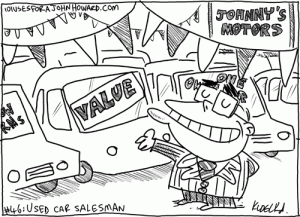
    usedcarsalesman– Advertising becomes useless. It doesn’t matter how much money you spend on ads as people won’t believe you anymore.You can’t hype up a product launch or an event that you’ve oversold forever. When you don’t deliver you are just reminding customers how much you betrayed them.

    – Your word becomes useless. When you break promise after promise, soon people won’t trust that your on their side. They will see that you only want their money and you don’t care about them.

    – Your product becomes a joke. I was in a meeting yesterday about search engines and someone used the word Yahooeveryone laughed. Yahoo has become a dinosaur of a search engine. The only thing memorable about Yahoo is that stupid song, Yaaahhoooooo. You can’t advertise and promise a web service, you can only deliver. This is the #1 reason you can’t trust Bing.com to be any good. If it was so good why are they spending $100,000,000 to advertise it?

    Shifting gears: The evangelical church has become a classic example of the over-promise. Part of the church becoming more about programs and business models is that it has fallen into the trap of needing marketing and advertising like the business models they copies. The result is a lot of over-promising. “Come to the marriage retreat, it’ll fundamentally change your marriage.” or “Sign up for our next church production, it’ll be awesome.” or “Bring your friends to the revival and they will get saved.” In a world where the awesome is so readily available churches do nothing but give away trust when they advertise promises they can’t deliver. I’ve seen church events marketed like they were going to be on par with Disney or Broadway or Oprah and deliver like a trip to the town carnival, a middle school play, or a cable access show. At the end of the day the church spent more effort marketing the event, production, or program than they did making the program awesome. It is a sick cycle that is killing thousands of churches.

    The better way: Wouldn’t it be refreshing if churches just delivered? Wouldn’t it be amazing if they didn’t sell themselves but just helped people? What if they invested in training their volunteers and staff so much that the church didn’t need to make promises, that their programs and ministries truly worked to change lives? You wouldn’t need to advertise a life-changing marriage retreat… because results would advertise themselves. You wouldn’t need to hold a revival because every church service, small group, and youth group meeting would see people come to know Jesus. You wouldn’t need to hire a killer band and create a worship experience because people were authentically worship Jesus. The best advertising a church could ever invest in is a changed life.

    If you are a church leader I want to challenge you to think about your programs. Think about how you talk about them. Think about how you market them. And remember:

    Don’t promise, deliver.

    Don’t hype, deliver.

    Don’t sell, deliver.

    Don’t measure, deliver.

    Don’t sub-contract, deliver.

    Don’t advertise, deliver.

    In a low trust, high expectation world the best way to succeed is to undersell and deliver.

  • Signs of Health

    workinprogressmalletI’ve been open about my struggles to find a healthy work pace. I’m not sure why but I have an innate tendency to want to be plugged into work 24/7. This isn’t new… I’ve been this way since high school. I remember stopping in on the little restaurant I worked at on my nights off just to see how things were going. That habit has pretty much continued up through today! I always want to know how things are going.


    Full time ministry just made it worse. After all, checking email or making a phone call to a student on your day off is ministry and how can that be bad? Jesus wouldn’t want them to have to wait… would he? With all due respect, the staff at the church just loved the fact that Adam was always available, always game, always willing to answer the call. My work in churches took some horrible tendencies and labeled them as reliable.

    When I started at YS a year ago I dealt with a bit of culture shock. I would send e-mails on Friday night that wouldn’t get read until Monday. I would stay late and have co-workers tell me to go home. I’d respond to emails at 10 or 11 PM and get made fun of. It was actually frustrating at first. It took me some time to recognize that I wasn’t seeing a lack of dedication… I was encountering healthy work habits.

    It’s taken me a long time to begin to break some of these habits. It’s taken this long to wake up to the reality that it was me who needed to change my habits. In the past few months I’ve thought a ton about the idea of sustainability and pace. Reality is that I have a natural tendency to want to increase the pace at the cost of my personal health and the relationships with my family. The pace at which I desire to work simply isn’t sustainable. In the past few months I’ve constantly been telling myself, “Slow down.”

    The last two weekends have been great signs of health.

    – Never checked work email.

    – No responding to Facebook messages that were work related.

    – Didn’t check up on all of the websites, stats, numbers… OK, I did that once or twice. (Dangit!)

    – Spent excessive amounts of time with family and friends.

    – Said “no” to things that were outside of my goals/responsibilities right now.

    – Was not the first one to arrive nor the last one to leave the office at all last week.

    I still have a long, long way to go in establishing healthy and sustainable habits. But these are signs of health. It’s like after you start working out… it takes a few weeks until you start to feel the difference. And I hope the people in my life who are most important are starting to feel the difference.

    What about you? What are some boundaries you have established that help you have a sustainable work pace?

  • Top 5 iPhone Apps I Use

    As they say, my dock is full. Kristen and I have been iPhone users for a couple of months now. So far we love it! One unintended consequence of using iPhone is that our monthly cell phone bill actually went down. Never expected that.

    Like most users, I actually use the phone part of the iPhone very little. That said, I use the iPod and wireless device parts all day. As of right now, here are the 5 apps I use the most.

    tweetieTweetie. I should clarify. Up until last night my most used app was Twitterfon. But Twitterfon was stupid and decided to drop a bunch of ads on their latest upgrade. I hate silent upgrades that dump in ads. I mean, I get it that they need revenue and all, but don’t ruin an app to do it! Anyway, Tweetie is a great Twitter app. It allows me to manage all my various accounts.

    yelp-icon100x100Yelp. I already use Yelp to post quick reviews of stuff as well as read up on places I want to visit. Now when I’m on the go I can use Yelp’s community driven review sites to chose places to eat… and even find addresses to places that are hard to find. (I like stuff that’s way off the beaten path!)

    mint-iphone-iconMint. Kristen and I use Mint to track all of our finances. So having a Mint iPhone app is a total bonus. This allows me to keep an eye on our accounts, spending, budget, and investments anywhere I am. If you are a an iPhone user but don’t use Mint… you should really think about checking it out. It is pretty powerful.

    google-reader-iphoneGoogle Reader. Technically, I don’t think this is an app. But if you bookmark it in Safari it becomes this sweet little app on your dock. I use Google Reader all day, everyday for my job. So being able to scan through endless vanity searches, twitter searches, and of course blog posts is essential. I love being able to read, share, and comment on stuff no matter where I am. As a few friends have pointed out… they can tell when I’m on the trolley because I’m sharing a lot!

    facebook-iconFacebook. What social media person wouldn’t love to have a mobile Facebook that is, in some ways, better than the web version? I love posting pictures and changing my status with my iPhone. So much less clutter.

    A few people have asked me to put together a list of apps for youth ministry. Give me a few weeks and I’ll definitely be posting about that.