• How is The Youth Cartel doing?

    I’m loving this season of life. In 2005, I did a start-up but it was different. The scale was much smaller and I had a full-time job. So in some ways this season feels familiar and in other ways it’s all new.

    If you’ve read the blog for long you know how much I value transparency. In fact, transparency is a value Marko and I have carried into the very DNA of The Youth Cartel. In order to stir things to change– transparency is required, right?

    Here are some updates on how things are going, in a few categories.

    Cartel Stuff

    • The weekly newsletters we started are doing really well! Youth workers are especially resonating with YouTube You Can Use. The growth of those, numerically, speaks to their usefulness. Both of those are kind of our flagship stuff right now.
    • This weekend Marko is in Michigan hosting our first official event, the Middle School Ministry Campference. The lead-up for that has been very successful and we can’t wait to see how it goes.
    • Our next event is the Extended Adolescence Symposium on November 21st. The planning for that is going great. We could really use your help in getting people there, though. If you live in the Atlanta area send me an email because I have a favor to ask. (adam@theyouthcartel.com)
    • I’ve been kicking around the idea of starting a ministry innovators coaching group. I kicked it around last Winter and didn’t make it happen. Thinking about it more seriously now.
    • We are dreaming of our next events, which is super fun.
    • We have a couple other initiatives coming along which I’m really excited about. But I’m quickly learning that “talking about” doesn’t always pan out!

    Client Stuff

    • I’ve been very busy on the website side of things. This could be an entire division of our company… building, maintaining, and growing organizations/individuals web presence. (Which is good, because it kind of is a division of our company!)
    • The Concierge Service is finally taking off! (Flat rate WordPress design, a great 2nd step for bloggers and small organizations.) We have the capacity to handle 2-3 of these per week and are really getting it down.
    • I’m about 2 weeks away from completely rebooting the website for a youth ministry organization. That’s been a great project and I think we’re set up for a nice long-term relationship.
    • We have a really cool project we’re unveiling at NYWC. This project deeply resonates with me and is the kind of thing every youth worker is going to want to look at.
    • I’m on the lookout for 2012 projects. Individuals, churches, organizations, start-ups, yada yada yada.

    Personal Stuff

    • Health insurance: Super excited that we can get that through Kristen’s work. A huge relief there!
    • Work time: The home office is great and I’m loving going to a co-working place 2 days per week. There are actually a group of us now looking for a real office to share… fingers crossed!
    • Speaking of balance: As I mentioned a few times already, the summer was nuts. But I’ve been able to shake those 16 work days for the most part. I’m way more available (and present) on nights & weekends than I have been in a long time. Loving that.
    • Cash flow: As someone who has had a paycheck every 2 weeks for the last 17 years this is the scariest part. So far, so good though. It’s fun to see the connection between what I do and what I bring home so concretely.
    • Joy factor: This whole thing is a blast. It’s a good kind of scary.
  • Free their minds…

    Free their minds… and their hearts will follow. (Sorry En Vogure, I changed it.)

    Is the primary task of my ministry to cram as much of what I know into their heads or is it to teach them how to think? Rhetorical, right?

    Wrong. My actions say the former while my brain says the latter.

    Think about the typical day of your students as it relates to adults.

    • Early morning: An adult tells them to get out of bed and get ready for school. (Either by word or edict)
    • Morning: A parent tells them to get in the car, get out of the car, to have a good day, etc. If they ride the bus they might make a couple words of small talk.
    • School: Adults are largely in charge of the classroom and do most of the talking.
    • Between class time: Students cram a few minutes of conversation with friends as they dash from place to place. (Adults dictate the parameters of this.)
    • After school: Coaches instruct, students listen and obey.
    • Home:Have you done you homework? Your chores? How was your day? Tell me about….

    To overgeneralize, most interaction students have with adults is either structured or adults talk at students. They are almost always put in a position of learner or otherwise lack power.

    We would all say that they have power to own their faith. But are our interactions with our students validating that or putting them in a powerless position?

    It’s relatively rare that a student would have a conversation with an adult.

    It’s even more rare that a student would have a conversation with an adult where the adult does the majority of the listening and the student does most of the talking. (The adult in the lesser role while the student is in the power role.)

    Shaddup Already!

    As this Fall has ramped up and I’m starting to get to know my small group of guys my inner dialogue is, “You don’t need to talk at, just listen. Listen. LISTEN.

    The best thing I can pass along isn’t what I know. It’s how I think. I don’t care that the guys in my small group know what I know or have answers for everything we’re talking about. But I desperately want them to know how to find stuff out for themselves, to compare and contrast what people are saying, to not just grab wisdom for the sake of acquiring knowledge but actually discovering the source of wisdom.

    Sure, I want them to know what God’s Word says about this and that. But I really want them to know how to wrestle with things in a way that moves/changes them.

    Curate vs. Dictate

    I can’t do that if I do all the talking. I’m not helping them learn how to think critically if I tell them what I know. They will only grasp hold of their faith, truly own it, if they can articulate it for themselves. That means I am not in their lives to tell them the answers. I am there to teach them how to find the answers themselves. 

    My theory is that I need to talk less and less for them to think more and more. That means my job is less to provide answer and more to create questions. Which is good. Because I have lots of questions. And I’m really good at creating doubt.

  • 5 Ways to Be Good News in Your Neighborhood on Halloween

    5 Ways to Be Good News in Your Neighborhood on Halloween

    Christians have a weird history with celebrating Halloween. Not growing up in the church I was appalled when I heard church people refer to it as “Devil’s night” and say things like, “Of course we don’t celebrate Halloween.” It’s as if we’re talking about two different holidays. There’s the one that actually happens and the one that you’re afraid is happening. Like all things– fear is irrational. 

    The whole anti-Halloween concept is built on a theology of fear. Be reminded that in Ephesians 5 Paul instructs Christians to be light in dark places!

    Many churches offer alternatives such as harvest parties, hell houses, or trunk-or-treating. Those things aren’t bad, but they aren’t good news in your neighborhood

    Here’s my suggestion: Skip the Christian alternatives altogether and embrace Halloween for what it is. It’s a night when hundreds of families will wander around your neighborhood, smiling and enjoying one another, and giving candy to children.

    Think strategically: For those who are anti-Halloween I have this challenge. One night a year one hundred families want to come to your door and say hello. Are you going to greet them? Or are you going to turn off your light and pretend they don’t exist?

    Don’t be “that guy” on your block. Embrace Halloween as an opportunity to be good news in your neighborhood.

    5 Ways You Can Be Good News in Your Neighborhood on Halloween

    1. Sit on the front porch. One of my favorite things to do is to sit on the front porch all night and talk to people as they come by. Resist the temptation to go inside between visitors. Trust me on this. You’ll like what happens. You’ll make great small talk with parents AND every time I’ve done it my neighbors see me and do the same. We have great little conversations porch-to-porch conversations between visitors.
    2. Make it a game. Set up a simple game in your front yard to give trick-or-treaters the opportunity to win the big candy bar. It could be as simple as a bean bag toss or throwing a football to knock something down. Make it simple, kids want to hit every house on your block, but this will make a great impression.
    3. Host a warming station on your block. We’ve done this one bunches of times– it’s ALWAYS a blast. We had close to 1000 trick-or-treaters at our house in Michigan and doing this cost me, maybe, $75. Set up a little tent in your driveway or front yard and serve coffee, hot cocoa, and apple cider. It’s a great break to the routine and easy to invite your small group or someone who doesn’t have trick-or-treaters to help with. Do it 2-3 years in a row and you’ll get known as the house that does that tent thing. Really want to make some friends? Offer parents a little Kahula or Bailey’s for their hot drink!
    4. Do something fun and not-so-scary. There are people in our neighborhood who go all out. They build tunnels over the sidewalk and scare the tar out of children. You can have fun like that and just make it fun. Rent a bounce house and play some music. Be weird and decorate your house for Christmas. Dress up like the easter bunny and have an easter egg hunt every 15 minutes. Just because you don’t want to get into the whole devil/ghosts/zombie thing doesn’t mean you can’t be creative to have some fun with the hundreds of kids who will come up your walk.
    5. Cover every house. I live on a block that has some elderly folks. Consequently, we have kind of a bummer block because many of them aren’t mobile enough to hand out candy. It would be great to rally a few people and make sure every porch light is on and there is candy at every house. Warning: You may need to actually talk to your neighbors to pull this one off. (Which is more scary than Halloween itself, right?)

    What are other ways you can embrace Halloween as a way to be Good News in your neighborhood?

  • 4 Tips for YouTube You Can Use

    YouTube You Can Use

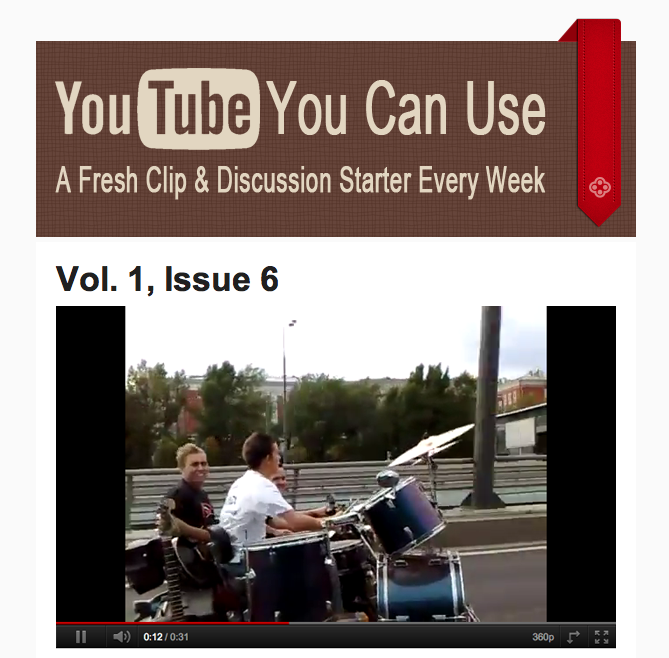
    YouTube You Can Use is a free weekly youth ministry resource I publish every Monday at The Youth Cartel.

    It includes a link to a YouTube video as well as a discussion starter, some related Bible verses, 3 ice breaker questions, and a thought question I call wrestle with this.

    To give you some behind the scenes insight, here are my goals as I put it together:

    • The video can’t be cheesy or predictable or boring.
    • The video has to be 90 seconds or less.
    • The tie-in has to lead students back to Scripture or an attribute of God.
    • It has to be age-appropriate.
    • It has to be something I’d use… because we use it in our ministry.

    Here are 4 tips for using this free resource:

    1. Play it as an intro in your Sunday morning or midweek youth ministry time. Just play the video and then have a slide with the 3 questions. Done.
    2. Post it on your Facebook page. Just straight up snatch the video and the discussion guide and put it up there for your students to wrestle with. You’re probably not using that page enough, this is a weekly excuse. Takes 30 seconds.
    3. Send it to parents as something they can use to talk to their kids. Copy/paste the content, drop in a link to the video, and now you have an excuse to send a weekly newsletter to parents. Drop your announcements for the week above there and I just made you look like a rock star.
    4. Table talk with your own kids or small group. Just pull the video up on your smartphone, hand it to them, and then have a discussion based on the email. No prep time needed, just open the email and you’re done.

    Are you getting this? How do you use it? 

    Want to subscribe? (It’s free!) Click here.

  • Sticky Faith Book Club, Chapter 1

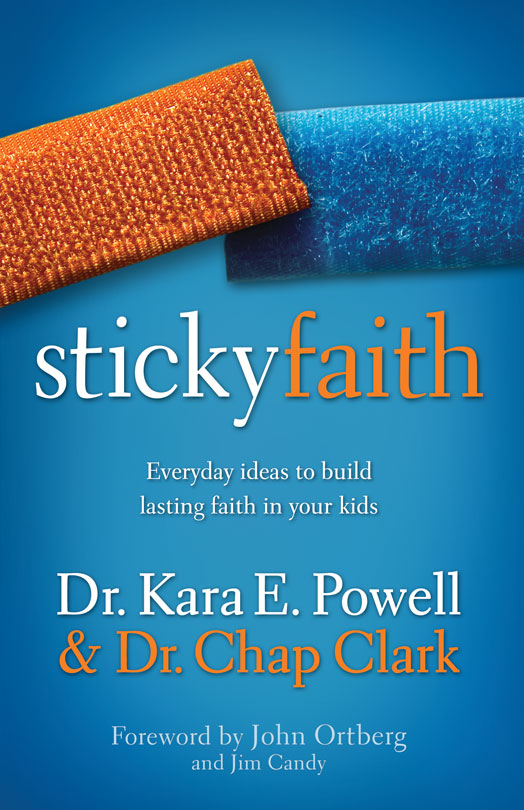
    This is part 1 in an 8 part series on Sticky Faith. Join our book club by signing up here

    A horrible reality

    For Kristen and I, the journey towards Sticky Faith for our own kids began in 2008. The first seven years of parenting went by in a blur of Sunday school lessons, small groups, Wednesday night youth group, and retreats. From 2000 – 2008 seemingly all of our energy went towards our ministry. We went into ministry as a couple to serve the church together. But as time went on in reality it became that I was in full-time ministry while Kristen was a full-time parent. Our marriage was functional but periodically miserable because life wasn’t panning out the way we’d hoped. Surely, a life in full-time ministry and having a family wasn’t supposed to be like this?

    We were losing them. Their child-like faith was evaporating before our eyes. We could observe it. But then Megan (then 7 years old) actually said it.

    Daddy, the reason I hate church is because that’s where you love other kids but ignore us.

    That was a double dagger. First, she said she hated church. Second, she hated church because of our vocation. Before she said that we knew things needed to change. But those words took the conversation from “We know we need to make adjustments” to “Holy crap, we have to change things NOW!

    A commitment to change

    As I read the first chapter of Sticky Faith my heart soared with the reality that it’s not too late. Maybe we lost some of the early battles but we haven’t lost the war… yet. In that regard statistics matter and don’t matter. I have three kids. It’s impossible for me to look at the 50% rate of Sticky Faith and pick 1.5 of them to make it. I can’t hold Jackson in my arms or send Paul and Megan to school hoping that one or two of them stick with Jesus into adulthood.

    Kristen’s reflections:

    In 1 Samuel 1:27-28, Hannah delivers her son Samuel to Eli the priest saying, “I prayed for this child, and the Lord has granted me what I asked of him. So now I give him to the Lord. For his whole life he will be given over to the Lord.” It’s hard to imagine physically giving back a child I desperately prayed for. In reality, I know that my children already belong to the Lord. Faith development is the “giving them over to the Lord” part of my parental responsibilities. It requires action and intentionality. Gut check time. Am I intentional in building faith in my kids? Truthfully I fail (often).

    Adam and I have three children – Megan (10), Paul (8) and Jackson “JT” (7 months). In case you missed it, we are far from being model parents. The statement made on page 24 gives me hope, “Hear this good news: because faith development is a lifelong process for all of us, it is never too late to be more intentional in your parenting and the faith you model and discuss with your kids.” Adam and I are still learning and developing as parents. With JT’s arrival and with Megan inching her way toward middle school, we have a new determination to make faith development a priority.

    The book asks, “What do you wish you had done differently?” For me, I wish I were more intentional about developing the discipline of prayer. (Confession time, my prayer life is active but mostly private.) What about you?

    Questions for parents in ministry

    1. There’s a reason you joined this book club, right? What problems are you hoping to address by reading this book and processing it’s learnings with fellow ministers?
    2. How would you define Sticky Faith for your kids?
    3. As a minister, how does it make you feel to think that you are the most important influence on your child’s faith?
    4. As you think about how you have parented thus far, what are ways that your ministry is getting in the way of your parenting?
  • California Dreaming

    The American dream was affirmed yesterday– at least for some California residents. For tens of thousands of children, brought here illegally as children by their parents, Jerry Brown’s signing of  the California Dream Act, was a symbol of hope that their state cares about them.

    Qualifying students, regardless of their immigration status, can now apply for state financial aid. This was part B of a two-part law, part A passed earlier this year which allowed students to apply for private loans & financial aid regardless of status.

    This is great, but it isn’t enough

    While I’m thrilled with this new state law it isn’t the Dream Act we need at the federal level.

    • Qualifying students still cannot apply for federal financial aid because they lack legal immigration status.
    • Republicans continue to block measures which would provide a pathway to citizenship or even permanent resident status for children brought here by their parents.
    • Since the majority of financial aid for college comes from the federal level, this is more support but not a level playing field.

    Why this matters to youth workers and the church

    • It’s a matter of justice: It’s an injustice that a person raised in this country, who goes to school right next to your children, does not have the same opportunities to succeed that your child does. For many of these students, they had no say in whether or not their parents brought them here. But they have gone through our educational system, learned the language, competed with native-speaking peers, and this is their country in every way… except the one that truly matters, full legal status/rights.
    • It’s a matter of fairness: You want to pay $.99 for a pound of tomatoes or $1.29 for ground beef? Do you really think that $7 t-shirt you are making for your retreat was made by workers making minimum wage? Of course not. We both know it. Your standard of living is subsidized off of the back’s of cheap labor. To block those workers children access to post-secondary education & a pathway to legal status is embracing a system of oppression.
    • It’s a matter of numbers: Whether your church recognizes it or not we are still a melting pot country. The Latino population (whom the Dream Act primarily benefits) is exploding! Some predictions show that nearly 30% of the US population will be of Latino origon by  2050. On top of that, the census bureau is predicting a massive shift towards youth in the coming years. Currently, there are 59 children per 100 people in the US. By 2025 this will be 72. So our country is getting younger and more Latino… quickly.
    • It’s a matter of strategy: Let’s talk turkey. Let’s say you could care less about the first 3 things I listed. (Justice, fairness, and numbers) Let’s say you’re so hung up on the fact that their parents brought these children here illegally that you don’t want to give them anything like legal status, equal protection under our laws, or equal access to the same education your children have. (e.g. Arizona & Alabama lawmakers) With the population quickly shifting to give numerical power to legal people of Latino origin… do you really want to have your church as one of the agencies who held them back? Do you think that’s a good long term strategy for your church?

    For my youth worker friends: Let’s be reminded that our role in our community isn’t just to work at our churches. We are in our communities to advocate for all teenagers in Jesus’ name. God isn’t interested in the immigration status of students in your ministry. He’s interested in their status with Himself.

    The King will reply, ‘Truly I tell you, whatever you did for one of the least of these brothers and sisters of mine, you did for me.’
    Matthew 25:40

  • SDSU vs. Texas Christian University video

    First, a patriotic start.

    SDSU vs TCU pregame

    Then we honored Marshall Faulk as the team took the field

    Then, the game started and SDSU laid an egg

    • TCU marched down and got a field goal.
    • SDSU got the ball back and due to a penalty drove it to the red zone, before botching a field goal attempt.
    • They woke up from their slumber in the 3rd quarter and brought the game to 20-14 at the beginning of the 4th quarter.
    • Then… Ryan Lindley showed why he will be playing in Canada next season and not the NFL. He telegraphed a couple of passes directly to TCU players, pretty much securing a loss.
    • TCU dominated our defense for most of the game on 3rd down. I think they had 11 third down conversions in a row.
    • Mix that stat with 4 turnovers and you get a loss every time.

    That said, Megan and I had a good time. The stadium felt great with 44,000+ fans. I’m sure that will drop for the next game vs. Wyoming though. We shall see.

  • 4 Things Talent Can’t Overcome

    Let me say this first– talent is overrated.

    I’ll take someone driven, or visionary, or hard-working over just talented any day. I actually think we falsely label hard-workers or fast-learners or fail-fasters as talented all the time as a way to make ourselves feel better about our inadequacies.

    That said, talent isn’t everything. In fact talent can lead to nothing quite easily!

    Here are 4 things talent can’t overcome

    1. Laziness – It doesn’t matter how good you are at something, if you’re lazy and you don’t deliver on time or do the right things… you’ll fail every time.
    2. Bad timing –  This would be a horrible time to develop a talent on the accordion. Or get really good at writing code for the Palm Pilot. Success in the present age is about timing. It’s not good enough to be talented. You have to be talented at the things that people are looking for.
    3. Immaturity – Maturity brings the wisdom to know what to do with talent.
    4. Character flaws – No one cares how talented you are when you’re a jerk or a liar or if you step on kittens tails.

    The other side of this coin is pretty fantastic. We all have something which could be labeled a talent. That’s the very nature of a free market society. I have skills/talents in one thing and you have talent/skills in another. So we trade goods. Or I trade your good for cash.

    If we all had equal aptitude life would be pretty boring.

  • Extended adolescence & you

    Adolescence cannot last from 11 years old to 29 years old. Our society will crumble economically & socially under the pressure. 

    I think most people understand that intuitively. They reflect on their teenage years and their early twenties as a time of coming of age.

    But times have changed. Most sociologists believe adolescence stretches from the onset of puberty (11-12 years old) until the late 20s. In other words, the adolescence you and I knew is now 8-10 years LONGER than when we went through it just 20 years ago.

    When I think of people in their 20s I think of two distinct subsets.

    1. Those who move out and declare independence.
    2. Those who don’t.

    1. Declaration of Independence

    For some, moving out and declaring personal independence happens after high school when they join the military. Even though I’ve heard NCOs refer to their platoons as “their kids” certainly they are not dependent on their parents any more. They are earning their own way in the world, they provide their own housing, and they are trained in complex adults tasks. A 20 year old Army Specialist repairing a Blackhawk helicopter on a base in Germany is an adult role.

    For others, they go to college and pay their own way and handle all of the responsibilities of being a college student on their own. They reject the childish party life and are serious about their education from day 1. The young woman who watched our kids this summer was this way. She worked multiple jobs all summer to bridge the gap between student loans, grants, and her need. And she takes her studies seriously because she needs this degree to take her and her family a step closer to the American dream.

    Still others, high school ends with a thud and they enter young adulthood when their parents either kick them out or they move out. They discover adult responsibilities when they realize that they have to work or starve. Or they have to work or become homeless.

    2. Declaration of Co-Dependency

    I’m no psychologist. But over the past 10 years I’ve encountered dozens of parents whom exhibit co-dependent tendencies on their adult-aged children. They track their progress at school. They call them daily. They financially support so their college students don’t work. They either directly or indirectly tell their adult-aged children that they can always live at home, they will never have to support themselves. So they don’t. They lightly attend college and learn almost nothing. They party like Paris Hilton. They don’t even do their own laundry.

    Essentially, they are pets. They know it. And love it. They know their parents are co-dependent on them and they take full advantage.

    Most of these co-dependent parents have one thing in common: Disposable income. Their adult-aged children hang around with nearly no responsibility… because their parents can afford for them to do so. 

    Questions:

    • What role does responsibility play in extended adolescence?
    • If you serve in ministry, how do you help parents who exhibit co-dependent tendencies?
    • Do you agree with my premise that extended adolescence is tied to household economics?
    Want to learn more about this topic? Want to wrestle with this and what it has to do with adolescent faith formation? Join me at the Extended Adolescence Symposium on November 21st in Atlanta, Georgia.


  • A Fall to Grace

    One day morning will dawn, your eyes will open, and you will awaken with the literal reality that the dream you had for yourself is over and it’s time to move on.

    I can think to specific days in 2000, 2003, 2008, and most recently in summer 2011 when I rolled out of bed with the knowledge that I’d just crossed a line. The dreams I knew were gone. And I had to find new dreams.

    In each case, those mornings felt like I’d just fallen from a place of positional power, security, and recognition. Even in going from one role to another– even if that new role was “better” than the one I’d left, it still felt like a fall.

    Perhaps it is a guy thing? But much of who you are and how you think of yourself on a day-to-day basis is wrapped up in what you do, who you work with, and the people you do stuff with. When that’s gone– whether by choice or not– you experience this unmooring free fall feeling.

    While other leaders have experienced ugly falls from grace I have never experienced that. Instead, in times where the things I knew are suddenly gone because I’ve moved on to something else… I’ve experienced something I can only describe as a fall to grace.

    The free fall feeling of change always lands in the loving arms of a God who has nurtured and cared for me from the beginning. And those strong palms support my back as I try to get my bearings. God’s grace supports me, lifts me up, and the warmth of that palm reminds me that I’ll be fine.

    To know Hope you must know Despair

    Despair is not the enemy of hope. Frustration and anxiety may not be your friends but they are repeatedly wrestled on your way to hope. Over the years, plenty of people have called me overly hopeful– almost stupid hopeful. From my eyes I only know summits of hope because I have been in great depths of despair. In the darkness of that valley I’ve cried out to God, “What am I doing here! I can’t do this anymore. I hate every last step of this! AAAAHHHH!!!!” The echoes of those moments haunt me.

    But when you’ve been there– when you’ve screamed in that valley and heard those cries echoed back empty? Then you discover that any step above that is a step towards hope.

    But knowing hope, truly living a hope-filled, is a reflex against despair.

    To know Faith you must know Doubt

    It perplexes me that some have made doubt the enemy of faith. I would argue that you can’t know what faith is until you know what doubt is. Both are invisible. Both are real. And both are internal, silent motivators of our daily actions.

    In putting both feet on either side of the faith/doubt teeter totter I desire balance while one always wins over the other. I’m either standing on faith or standing on doubt.

    Falling into the arms of grace isn’t an action of doubt or faith. But the resolve that comes through pushing against doubts gravity to take action is a step of faith. That is what reassures me that grace truly will catch me.

    To know Grace you must know Failure

    One of my mentors, at each of these moments over the past decade, has asked me… “What are the things you are running away from by doing this and what are the things you are running to?” Even in roles where everyone has labeled me a success I know there were failures. I know there were expectations unmet. I know I expressed attitudes I shouldn’t have. There were many times when I worked on what I wanted to work on to the neglect of what others thought I should be working on.

    Even on the road to success there are many failures you have to deal with. Being honest about that with myself and with others helps me discover what grace really means in my life.

    Because of my failures I don’t deserve anything good. But good keeps coming my way. That’s not a reflection of my character or timing or anything else. But it is a reflection of the character of God.

    Friends- I have no idea what is going on in your life. But I do know that we will all encounter times where we experience free fall. My encouragement? Fall into the receiving hands of grace.