We must dare, and dare again, and go on daring. ~ Georges Jacques Danton
photo HT to Likecool
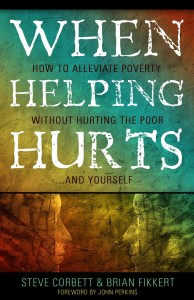
It’s taken me nearly a year to work through the book, “When Helping Hurts.” The content and concepts weigh heavy on my heart.
In my neighborhood the poor are easy to find. While not in the open, once you have eyes for it, you see poverty everywhere.
We have people who squat in abandoned houses nearby. Another man lives in old RV in someone’s driveway. There are several people who live in their cars at the park. And the truly down-and-out sleep in bushes next to a fence of an abandoned shopping center. And that’s just the homeless.
Poverty is big and real and within 100 yards of my house. And I wrestle with even the first step of a response to the point of paralysis.
It’s true. Your body is literally composed of all the stuff you eat. Don’t think about that too much, because it’s gross.
It’s amazing that people want to have a relationship with their pastor, their doctor, the person who cuts their hair, or even the person who delivers our mail. But the person who grows the fruits, vegetables, dairy, or meats our families consume?
We don’t want to know them. We wouldn’t even like to meet the people who deliver food from the distributor to our grocery store. We are completely relationally disassociated and disconnected with one of the most intimate things about us… our food.
If you are what you eat and you don’t know the people where your food comes from– You probably need to take 4-5 hours and watch some of the amazing documentaries that have come out in the past decade about our food system. You’ll see they at the molecular level most of what you eat is genetically modified corn filler, pesticides, herbicides, antibiotics, and other chemicals designed to kill pests on the farm. It’s scary.
Kristen and I decided 2 years ago that we wanted to know where our food came from. Starting in 2010, we made a commitment that 25% of our food budget would go to food we have a relationship with. So we planted a garden. Next, we joined a Community Supported Agriculture (CSA) program. Finally, we committed to going to a local farmers market bi-weekly. (Not only to look, smell, and sample– But to buy and support!)
That’s when we met the Rodriguez family of Escindido and their farm, JR Organics. Joe, Jr. and his wife Joan E are fourth generation farmers in Southern California. Their 80 acre farm in north San Diego county employs their family and about 10 others. We know this because we’ve taken the time to get to know them.
Yesterday, our family went to our second farm tour on their property. It’s one thing to go and get our box full of fruits and veggies but it’s entirely another thing to go to their farm and see how things get into those boxes. Who are the people who do the work? What makes something organic? What is the science involved? What techniques are they innovating?
The day at the farm is amazing. It’s fun to meet people who, like you, are members of the CSA. And it’s fun that they have a tour just for kids and to see them running around the paths between fields in ways children have played for millennia. And, of course, the monster feast they put on is a wonderful reward. It’s one of those days we put on our calendar and circle three times: We wouldn’t miss it.
Now that we’ve known the Rodriguez family for two years and done business with them, here are two things that strike me:
First, their values and hearts are in the right place. They absolutely want (and need to) make money at farming. But their values also shine through in how they make money, how they treat their employees, and especially how they care for their farm. Values and heart pour from everything they do. That’s evident when we pick up our box, eat the food they produce, and it’s on display when we visit their farm.
Second, Joe is off the charts intelligent. Listening to Joe, Jr. give the tour yesterday was an absolute clinic in soft innovation. While Joe doesn’t have a PhD in agricultural science he has a PhD in his land and how to work it and that’s far more valuable to him. Joe knows that how he farms directly impacts his bottom line. (And that how he farms becomes the marketing for his farm.) But he also has to deal with market conditions, the weather, bugs and other pests, and the ever-changing standards of remaining an organic farm. As families listened to his presentation and walked his property yesterday they had no idea how much work, discovery, and science went behind each of the things they nodded their heads to.
Here’s my encouragement– get to know where your food comes from. The net results in our family have been astounding. Sure, we are all eating more healthy. But we are also more aware of the people who produce our food and see how our relationship directly impacts them.
Notes:
For those who don’t know what drifting is… here’s a video.
For those who have ever watched a kid go adrift in his life– You know the parents typically just sit there with the camera running rather than doing anything.
As a kid, my parents weren’t that involved in church. There was a time when half of my family had some friends in church and did some stuff around the church. But by and large I was the church-e-est of the bunch from about 5th grade until now.
I think my reality as a high school student has peppered my entire career in youth ministry.
It’s not truly an either or situation. It isn’t that you need to make a choice to only serve Christian families or only serve non-Christian families.
Yet it is that you need to bear in mind that your youth ministry can’t assume that every family is like your “best” Christian families. My parents were actually very supportive of my church-life. They drove me to stuff. They paid for stuff. And even though they were only passively interested in the Christian life for themselves, they were highly appreciative that men and women were investing in my faith development.
Ultimately, Christian families aren’t your primary target audience. God is holding them responsible for their faith development of their children. Research shows that the biggest influence on the faith development of a child growing up in a Christian home is the parent… not the church. (No matter how cool the youth pastor is.)
How can we expect students who aren’t from Christian homes to bridge that gap and be a part of a ministry with constant parental involvement demands? That’s just not realistic.
Questions:
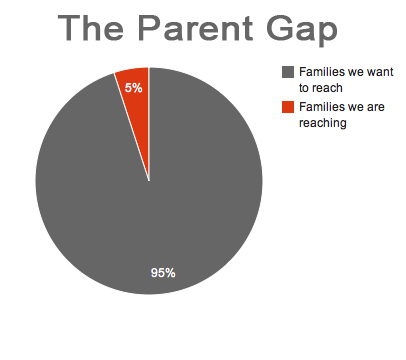
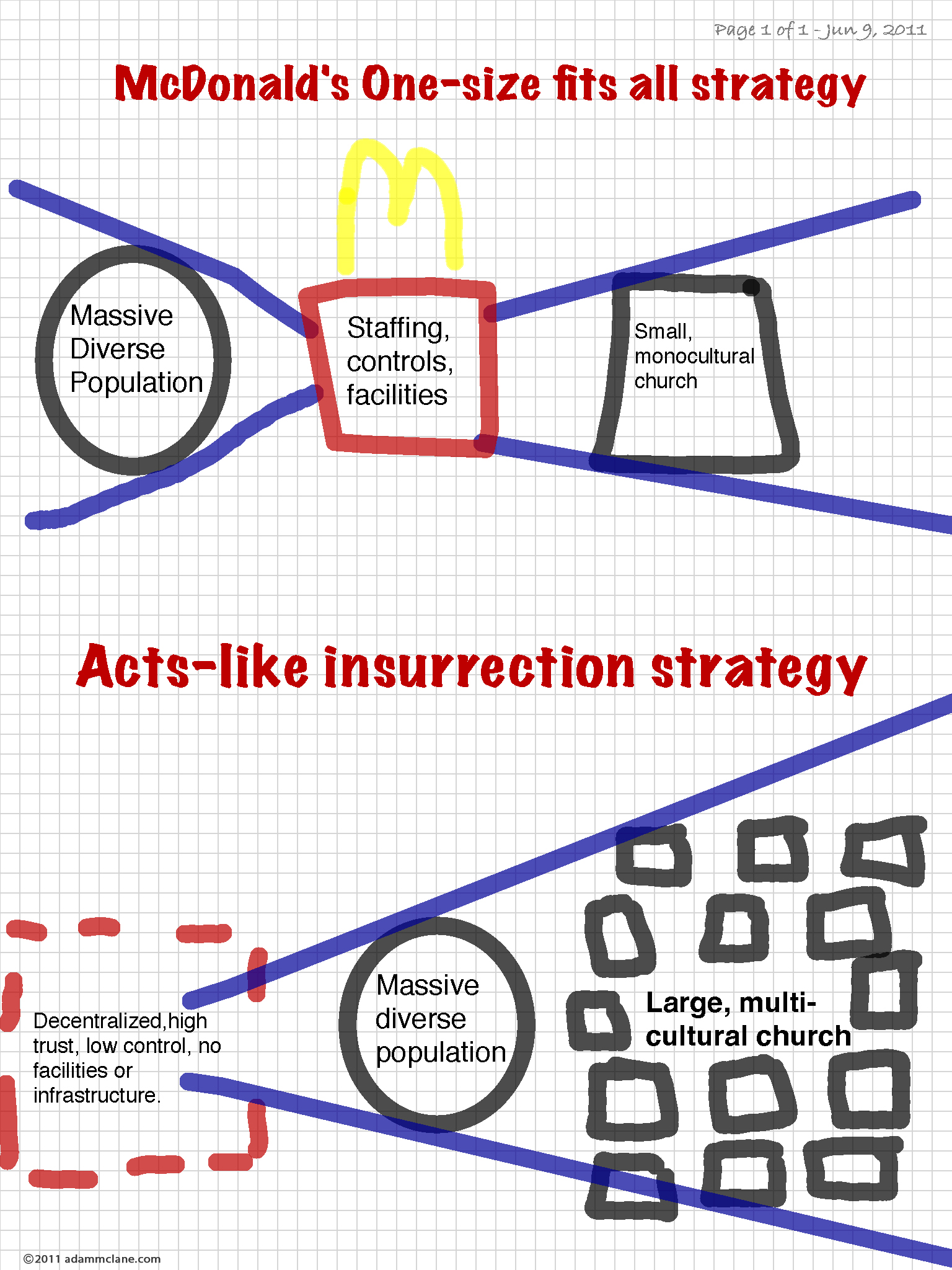
We are faced with a tiny percentage of the population actively involved in the local church. (>10%) Yet, I’m continually perplexed to see no one looking hard at the big, obvious problems of bottlenecks & gatekeepers which keep churches small with a strategy that lost its effectiveness 25 years ago.
Most churches have the same exact strategy. It’s the manifestations of that strategy which differ.
Faced with impossible statistical opposition first Century church leaders in Acts rejected the culturally accepted strategy of building a religion. Instead, they decentralized power, they empowered the powerless and served the cast-offs, and they didn’t get tied down to buildings, staffing, and overhead. As a direct result within 200 years this ragtag insurrection and their Gospel message essentially overthrew the government of Rome. Statistically speaking, when they got away from that and started to act like a religion with firm control, structure, and facilities… the churches growth slowed.
Here’s the press release.
FACT: When I added the press release category to the design of the YS site I never thought we’d actually use it. But that area has gotten a workout!
Right before I went into full-time youth ministry one of my mentors shared this truth with me over coffee.
Sometimes people are going to come to you and complain about the stupidest stuff you can imagine. Understand that when that happens, it isn’t you, it’s them. They likely have an area of their life that is completely out of control. And because they have no control over such an important area of their life they are going to try to take complete control of something they think they can control. It’s classic transference. Stop and pray with them. If they stomp off, pray for them.
That advice helped me a ton. (And for you, maybe the light just went off!)
In truth, a life of a leader also often spins out of control. Agendas are in play way above their understanding. Parent demands don’t make any sense. The level of leadership they need in their church is often outside of their experience level.
They are just grasping for anything they CAN control in a life of ministry full of things they can’t control.
As I interact with people sometimes their anger level reveals a great amount of hurt. The more they hurt they more angry they become with me about nothing. Seriously, I’ve had people yell at me because they can’t figure out how to reset a password. Or because their credit card was declined. (Because they put in the wrong address.)
All that to say– a life in ministry is full of things you can’t control.

Can you imagine what was running through Moses’ head as he stood there on the bank of the Nile waiting for Pharoah to arrive? (Exodus 7)
Standing there. On the banks of the Nile. Pharaoh shows up and Moses only has plan A. If this doesn’t work he’s a dead man.
Has there ever been a time in your life where you’ve stood on the river banks yelling and demanding something so big and so important that you were willing to stake everything for it?
These are questions I’m asking myself as I start this week…
When does my theology get in the way of my faith? Are there things I believe God can’t do? Are there problems I’ve been told are unsolveable? Am I afraid to seek the miraculous? Am I afraid what might happen if I am dumb enough to obey God’s command, wake up in the morning, take my brother and my staff and just wait on the banks of the river and say the exact words He gave me to say?
The Bible is full of stories of men and women dumb enough to believe in the impossible. Today we look at them as heroes. But they defied logic, they felt dumb, and their friends/family probably told them they were dumb. (Until they pulled it off.)
They pushed aside Plan B, C, and D and just obeyed the Lord’s commands. They stood on river banks yelling at Pharaoh. They lit soaking rocks on fire. They gave birth to children in their nineties. They looked at blind men and told them to see. They got out of the boat and walked on water.
My prayer for the week: God, lead us to your river bank. Make us a people stupid enough to obey you. Bring miracles which explode our theology. Allow us to put your commands above our plans. We are desperate for you to be God and for us to be Your people. Amen.