• Unleash Your Fingers

    Really cool video. The whole time I kept thinking… he’s going to pick his nose. I just know it. Pick it!

    ht to Likecool

  • The Sky is (not) Falling!

    I don’t know about you. But I’ve just about had it with people telling me that youth ministry is over.

    It’s not over.

    But it is changing.

    A brief look back at the history of youth ministry

    Examining youth ministry with a historical lens will allow you to see more clearly where we are and where things seem to be headed. For those who didn’t read Marko’s Youth Ministry 3.0, this is covered there pretty well.

    Era 0: Early ministries (1870s – 1940s) Before we really had adolescence we had ministries working with children and young adults. They have a legitimate claim to saying they started youth ministry. But their practices were dramatically different than we commonly see today. Some of these organizations still exist today… Christian Endeavor, Boy Scouts, Boys Brigade, YMCA, to name a few.

    Era 1: Parachurch dominance (1940s – 1960s) Younglife, Youth for Christ, and a few other ministries essentially invented the youth ministry practices we use today. The 3-fold youth group night of worship, games, and teaching came out of this. It’s important to point out that the catalyst for these ministries was first that adolescence as we know it today was born. And second that the church was horrible at responding to the needs of this emerging subculture.

    Era 2: Church dominance (1960s-2000s) The success of the parachurches eventually trickled into the church. In the mid-to-late 1960s churches began to hire Younglife/YFC staff to serve at the church and basically copycat what they were doing for the church without actually integrating with the church in a wholesale way. But as time has gone on youth ministry has trickled into the adult church. (Casual worship music, teaching styles, skits, media use… these are all inventions of church-based youth ministry that graduated into “big church.”) In fact, it’s the “big church” vs. youth group mentality that created the tension we are in now. Some places describe church-based youth group as an organizational island while others coined the phrase, the One-Eared Mickey Mouse. Either way… that tone and some recent research has lead to a lot of church-based youth workers in vocational trouble.

    Era 3: Missional dominance (2000s – ???) As I wrote about in January 2011, we are continuing to see a trend that big churches are getting bigger, little churches are getting missional, and medium-sized churches are feeling the pinch in the middle. But if you think about it all three are just getting missional and being more true to who they are. As churches (and parachurches) realize that the One-Eared Mickey Mouse isn’t helping young adults make the transition from adolescent faith to adult faith they are wrestling to discover how to best minister to the adolescents in their communities. This is leading to big churches getting better at what they do and growing numerically. Smaller ministries have realized that they can’t copy the methods of the big churches and have started to adapt adolescent faith development and evangelism into new ministries which meet the needs of the communities students.

    The sky isn’t falling on youth ministry

    I don’t want to minimize what many people are going through. It certainly feels like their sky is falling. One result of this transition is that a huge amount of long-term professional youth ministry staff people are losing their jobs.

    As the church dominance era is coming to an end there are lots and lots of people who vocationally left in the cold. So the sky feels like it is falling on them as churches (and parachurches) wrestle through the reality that they might need to do youth ministry differently. Unfortunately, when many church boards look at their one-eared Mickey Mouse, they see old Pastor Adam and his youth ministry department and decide that in order to shake things up… they are going to need new leadership.

    But you need to know that there is no less interest in youth ministry. In fact– there is much, much more church-wide.

    The exciting flip side of all of the tension/drama/pain is that we are in an incredible period of innovation, invention, soul-searching, research, and discovery in youth ministry as we all try to figure out, “What’s next?

  • The Prince’s Posture

    He came to that which was his own, but his own did not receive him. Yet to all who did receive him, to those who believed in his name, he gave the right to become children of God— children born not of natural descent, nor of human decision or a husband’s will, but born of God.

    John 1:11-13

    The Spirit himself testifies with our spirit that we are God’s children. Now if we are children, then we are heirs—heirs of God and co-heirs with Christ, if indeed we share in his sufferings in order that we may also share in his glory.

    Romans 8:16-17

    Do you have a Prince’s Posture?

    Christians believe that Jesus’ work gave us access to the King of Kings. Not only do we have access through Christ– We are adopted as children of God.

    Adopted children of the King with unlimited access to God. That’s status.

    And yet, as I interact with Christians in leadership at their church, and especially as I interact with Christians in the public arena I’m appauled how many of us take a posture of weakness, irrelevancy, and… other postures unworthy of respect or the high calling we have on our lives.

    We genuflect to the kings, demigods, and pseudo-powers of our society instead of carrying a prescence and posture of a prince.

    A prince would never need to genuflect to a local lord. Nor would he entertain, beyond amusement, the solutions of those who didn’t have access to the knowledge he had.

    But that’s the posture many people take in society.

    The only thing worse than an arrogant prince is a weak, defeated one

    A prince isn’t cocky, he is confident. A prince isn’t intimidated by challenges, he uses his resources to overcome. A prince isn’t lead by fools, he is entertained by them. He isn’t overcome by his insecurities in the public arena, as he knows his King owns the public arena and His Father has the power over the people. Ultimately, the prince isn’t worried worried what people think, because he understands that any power in the room belongs to his Father.

    A Prince’s Posture

    • Self-assured
    • Confident
    • Clear-minded
    • Generous
    • Polite
    • Educated
    • Connected
    • A doer of his Father’s business, not a debater of what his Father might want

    As we begin a new week, my encouragement for my fellow princes and princesses is to put on the Prince’s posture and put away the insecurities.

  • Committee Meetings – A Cartoon

    Click image to see full-sized version

  • Fat Adam is Weak

    There’s little joy in kicking fat Adam to the curb. It’s not as simple as dragging him to the curb and waiting for the truck to haul him away. Fat Adam is old, crabby, and full of bad habits. He’s punchy. And he puts up a good fight for a fat guy.

    My weapons of choice

    Skinny Adam is making progress. Here’s how.

    3 times per week I’m running 1.5 – 2 miles… easing up to 3.2 miles. At least 4 times per week I’m commuting to work for an additional 6 miles of bike riding. I gave up soda (pop) for lent and haven’t gone back to it. I’ve tried to replace it with water as much as possible while cutting down on easy calories like getting regular coffee instead of my favorite blended drink at Starbucks.

    My drugs of choice

    Fat Adam is holding on to some bad habits. Here’s what I mean.

    My eating habits suck. It really isn’t how much I eat on a given day so much as when and how I’m eating it and what I snack on. I tend to skip breakfast. (Or eat something carb/sugar heavy. Like a bagel. Or a donut. Or a bagel and a donut followed by granola.) Since I skip a proper breakfast and snack all morning, I tend to not feel hungry at lunch. Which means I eat a late lunch, or eat a full lunch when I’m not really hungry, and then eat a regular dinner too.

    Unless I eat lunch so late that I skip dinner and eat dinner really late. Which is super bad.

    The result? I’m feeling much, much better but I know I could be doing a lot better. Muscles are noticeably stronger. My lungs and heart feel much stronger. And I don’t fatigue on my runs nearly as soon or as bad as when I first started.

    But my eating habits are holding me back. I can feel it when I’m out pounding the sidewalk.

    While this whole thing isn’t just about weight, I’d feel a lot better if I could drop some of the weight. I’ve lost weight. My clothes all feel more loose. Which is awesome!

    The plan for July. I’m not a fan of diets. But there’s a connection between what I eat and how much progress I can make and I need to make that sacrifice. My fancy plan? I will eat breakfast. Not just a cup of tea. (Which is what I like!) I’ll eat– at least an orange or banana… something that isn’t a bagel.

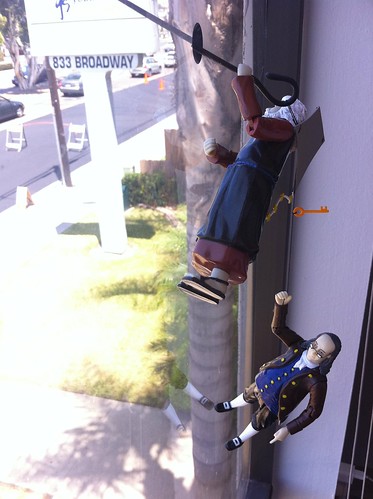
  • Office Adventures: Moses saves Ben’s life, part 1

    This is the opening shot to a film. Write the first scene.

    Go!

  • If Prayer is a Verb…

    If prayer is a verb…

    • You’ll knock on the door of your enemy to say you’re sorry, even if they wronged you.
    • You’ll nail the interview because you studied up.
    • You’ll check your friend into rehab.
    • You’ll get an A on the test because you got a tutor.
    • You’ll confront your boss about the things he says to you.
    • You’ll wait for your neighbors car to pull in; you’ll walk over and talk to them about Jesus.
    • You’ll go back and find that homeless woman and learn more than just her name.

    God can do anything. He’s huge and good and loves it when we seek Him. But sometimes He doesn’t answer prayer because He has already provided an active solution to your prayer request.

    Never forget. Prayer is a verb. Prayer isn’t passive, it’s active.

    What are you praying with your feet today?

  • Place your bet

    Photo by @ Alex via Flickr (Creative Commons)

    A few months ago I went to Las Vegas with my father-in-law for 24 hours. There are at least 4 things hilarious with that statement, right?

    He was running a marathon and needed someone to drive with him from San Diego to Las Vegas and back. I went since it’d be nice to catch-up along the way as well as have lunch with my mom, who lives a mile from the Strip.

    Since my mom lives there… I have been to Vegas at least 10 times. Normally, I like to people watch late at night. The joke has always been that I’m down $11 in slots lifetime and I’m mad about it. I’ve never really been into the games.

    What I learned from 6 hours on the Strip

    Unlike my normal late-night-people-watching, this trip had me up very early, checked out of my hotel, and walking the Strip by breakfast. With more than 6 hours to kill I wandered through a few casinos filled with old people playing slots and a bunch of dealers standing at empty tables.

    Along the way I stopped at a Starbucks. As I sipped my mocha I entertained myself by watching a few scattered games here and there. In truth, like a lot of Christians, I feel really out of place on a casino floor. More because I don’t know what to do than that I don’t feel like I could enjoy it.

    At one casino there was a small crowd around the crap table. It was a morning clinic explaining how the game worked. Perfect… I could kill an hour, learn something, and its free.

    Here’s an observation from that clinic: There is a time to place bets. But once the time has passed it is too late for placing bets. You are either in the game or you are out. The shooter rolls 7 or 11 on his first roll, everyone with a bet on the line instantly doubles their money. If you think about it, every form of gambling has that same timeline. A time to place bets. A time when betting is closed. And a moment when a winner is declared. Cards, slots, horses, lottery, etc.

    When you are playing in the game you have a claim at the table. You can win or you can lose. Your heart beats faster and adreneline pumps. The dealers chatter with you. And the cocktail waitress is happy to bring you a bottle of water or whatever you’d like on the house.

    When you aren’t in the game you have no claim to the table. You can’t lose but you can’t win either. You’re on the sidelines as an observer. No pitter-patter of your heart. The dealers might not acknowledge you. And fat chance in getting a free drink from the waitress if you aren’t in the game. You’re just another tourist.

    Gambling in Vegas is a lot like life outside of Vegas

    It feels like people are so afraid of losing that they just refuse to place a bet at all.

    • College – Where do I want to go? What do I want to study?
    • Marriage and family– Is this the right person? What if it’s the wrong person? Should we have kids? If so, when?
    • Vocation – What do I want to do when I grow up? What if I don’t like it?
    • Location – Where do I want to live?

    People aren’t shy about their shock with Kristen and I because we placed bets on all four of those categories early in life and have continued to “improve our hand” over the years.

    The flip side, experience has taught: In order to win you have to place a bet in the game. And the window for placing a bet is limited. When the time comes to place a bet I already know I want to be in the game because sitting on the sidelines is too boring for me. There are risks and rewards… but I always know I want to be in the game.

    Life’s winners and losers are in the game. But those who hold on, never placing a bet, will never know what winning feels like because they are too afraid to accept the risk of losing. And that, my friends, is losing every time.

  • What if there is no box?

    Photo by Marcus S. via Flickr (Creative Commons)

    I think outside the box.

    I’m told that a lot. And I guess it’s true. I mean, if people tell me it’s true at some point it is true.

    Adam McLane is a man who thinks outside of the box.

    When I hear that I think outside of the box I’m always thinking…

    • What if we’re working on the wrong box?
    • What if I’m in the wrong box?
    • What if our box is too small, too big, or too made of cardboard?
    • Why does the box have to be shaped like a box? I mean, is there a person who decided that boxes have to be cube-like? Can’t we build a box around who we are and not start with a box-shaped box?
    • How did we get in this box in the first place and why are we all just here wanting to get out of it in this meeting? Why don’t we just open the box and leave?
    • When did all of this crap get in the box? I think someone is using the box as a recycle bin.
    • Will lunch be served in the box? Because I’m getting hungry.

    What if there is no box?

    What if the box is just a metaphor for feeling trapped by our problems?

    Literally, there is no box. It’s a metaphor. The box isn’t real. You don’t need to think outside of it because the box doesn’t really exist.

    The box is your problem.

    Having your company, brand, ministry, organization “in the box” is the end of creativity, joy, and freedom. When faced with your next dilemna you don’t just need to think outside of the box. You need to get outside of the box. Why?

    Because the box is suffocating you.

    • It’s stealing the creativity you had as a 6 year old with a box of chalk, an empty sidewalk, and an endless summer.
    • It’s stealing the joy you had when you first started at this company.
    • It’s stealing the freedom you experienced as a kid who was just getting started, the one who wanted to conquer the world, and change things.

    Haven’t you seen Toy Story 3? The whole point of the movie is don’t get put in the box.

  • 14 Years of Mutual Submission in Marriage

    On June 21st, 1997 Kristen walked down the aisle escorted by her dad then her uncle Fred led us in an exchange of vows.

    Here we are, 14 years later, still standing next together on life’s amazing journey. This past 12 months have been especially dear to us as we experienced two of life’s great (and unexpected) joys together. First, in July 2010 we ministered side-by-side in Haiti for a week. Second, we walked together through the anticipation, birth, and first 4 months of having Jackson.

    In 14 years Kristen and I have largely not experienced the bumps and bruises so many of our friends have. We’ve had it pretty easy by comparison. We are thankful as we recognize that without an over-abundance of God’s grace it wouldn’t be possible.

    We are far from perfect people. And my flaws must grate on Kristen much more than hers grate on me.

    The secret to success for us

    Mutual love for, respect for, and submission to one another.

    That’s right my fellow conservative friends. I said it. Our marriage is built on an equal footing of love, respect, and submission to one another, as to the Lord.

    Many times in the last 14 years I have submitted to my wife out of respect and love for her. (And, by proxy, Jesus.) In 14 years of marriage I can’t think of a time when I stood in front of her and said, “I don’t care what you think, we are doing it this way. You must submit to me because I’m your husband.

    And I hope our relationship never breaks down, at its core, to the point where I’d think it was OK to do that.

    In the lead-up to our engagement Kristen and I challenged one another to memorize chapters of the New Testament. I know its cheesy, but for us it was fun, competitive, and become meaningful. (Plus, an easy way to be together alone and keep our hands off of one another!)

    One of the chapters we memorized was Ephesians 5.

    It kind of started as a joke. After all, we were Bible College students surrounded by people who loved to use this section of Paul’s letter to Ephesian Christians as a weapon. And it was totally stereotypical that a madly in love couple would memorize a passage of Scripture about marriage. At least it wasn’t Song of Solomon, right?

    Like many ancient things misunderstood throughout time, as we got to know this passage of Scripture we realized that while at the surface level it felt antiquated and entrenched with man-power-dogma, as we embedded the words on our heart we came to realize the passage is much the opposite. It really has become the basis of our marriage.

    Read Ephesians 5 for yourself. Actually, take 10 minutes and read it 3 different times in 3 different translations.

    You don’t need a commentary to understand what Paul was saying.

    As you get familiar with Paul’s language and read it in context you will see that this isn’t a repressive thing at all. As Kristen and I memorized this passage we fell in love with it.

    Most importantly, we learned that it had nothing at all to do with blind submission for a woman to a man. Why? Because that’s not how Jesus expects us to submit to Him. Like a loving groom, He asks us to offer our hand to Him willfully. And willfully, lovingly, he gave Himself to His bride wholly and completely, even unto death. It’s a beautiful mystery.

    The kicker for the whole passage, and why we crack up that people get hung up on it, is that in verse 32 Paul says, I’m not even really talking about marriage here people– this whole passage is an illustration for the church’s relationship to Jesus! And in verse 33 he adds, “Oh yeah, but a man should love his wife and a woman should respect her husband.

    Back to the practicality of mutual submission

    In our every day life does Kristen submit to my authority over her as her husband? Only to the extent that I submit to hers. The point of that passage wasn’t blind submission for a wife to her husband. It was mutual, willful, and willing submission to Christ for all of God’s people. We get along because we chose to get along as brother and sister in Christ.

    Blind submission is not an act of love as it is an act of obedience. I expect my kids to submit to my authority and to do what we ask them to do because we are their parents and we actually do know what is best for them. But I also know that to lean into the Shema I must win their hearts… which requires more than a relationship built on obedience, right?

    To expect that of Kristen would be disrespectful to her, our relationship, and her relationship with the Lord.

    Instead, we walk together in mutual, eyes-wide-open submission, love, and respect to one another as we submit arms-wide-open to Jesus.

    We’ve agreed with our very lives to put our relationship as #2 with Jesus at our only #1. As we submit to His will for our lives, we act in concert with one another out of love & respect for one another. And, not to sound trite, we’ve found our relationship with one another pretty simple because we’ve kept one another in the proper place all of these years.

    What do we think about people who take the perspective that the man is the head and everyone else submits to his authority?
    We think they are wrong. And we have 14 years of proof that our way works just fine.