I don’t have time for could, woulda, or shoulda. I only have time for results.
I know the stats. I know the strategies. I know what it takes to get it done… it’s time to get it done.
[Insert whatever analogy you need to fire yourself up]
I’m a youth worker. It’s in my blood. It is who I’m called to be and it is who I am. And all youth workers are hard-wired to plan stuff out in August. August is our January. We plan vacations, mission trips, concerts, retreats, camps, and everything else. If it is going to happen in 2010-2011… now is when we lay it out.
In August, we lay out our dreams for the school year in August.
So that is what I’m doing this August. I’m laying down my dreams. I’m laying down my hopes. And I’m putting aside my excuses.
I’m tired of waiting for next year.
I don’t have time to build another year.
I am getting too old to sit around and wait for something good to happen. Or the right kid to show up. Or the wrong kid to “get it.”
I don’t want to just hang out with kids anymore without a purpose. We’ve played enough video games, eaten enough pizza, and I’ve been to enough high school games.
This. is. it.
This year.
This day.
This moment.
Now is the only time that matters.
I’ve got no patience for coulda, woulda, or shoulda.
This is our cat, Lovely. There is some disagreement on how we keep cats. We allow our cats to be both indoors and outdoors.
Lovely is about 3.5 years old. We got her back in 2007 from an ad in the paper. Her brother got lost along the way, sadly.
Here in California she has thrived. She hunts birds of all varieties, lizards, snakes, mice, rats, and lots and lots of bugs.
She’s also very active in the neighborhood cat community. Some of the cats play together and some just spend countless hours defending their territory. Lovely does a little bit of both.
I’m not a huge cat person. But I do love her function in our family. She is cuddly and nice to Megan and eats all the critters I’m afraid of.
Yada. Yada. Yada. There are those who think that soccer is an amazing game for watching on television. But for the other 95.7% of Americans I have five ideas for making it more palatable to the American market.
Make goals worth 7 points. We get that. A game that ends in 1-0 seems pointless. But a game that is 7-0 seems like a defensive battle. But not nearly as good as a 42-35 throw down.
Every time a team scores a goal, they lose a player. With fewer players on the better teams that gives the poorer teams the chance to score more often. That means that the more goals that are scored, the fewer players on the field, and more opportunities to score. Another alternative would be to substitute a small child for a player each time a team scores a goal. About 6 years old seems right.
Add a little hill near the middle line and get rid of the offsides rule. Make the hill reasonable… but it’s important that there is a sightline issue so that a hidden forward can lay low enough to cherry pick for an easy shot on goal.
If a game goes to overtime add an additional ball every five minutes. I don’t mind the idea of playing an extra period. I just don’t want to watch a bunch of tired guys pass it around and wait for a shootout. If it’s still tied inside of 5 minutes in overtime, both managers get to play too.
Eliminate the red card and substitute in a penalty box. All of the weenie flopping is hard to stomach. If there’s a hard foul, give the offender a 5 minute timeout. Americans love the aggressiveness of hockey. But the acting on display at the World Cup reminded us of a soap opera.
These are my ideas for making soccer more interesting.
Jeffrey and Joel were visiting with the people of a tent city in the town of Carrefour, Haiti when they heard periodic banging. Used to the sound of big diesel engines and definitely used to the sound of kids laughing and playing games, metal on metal banging was distinctive pang and piqued their curiosity.
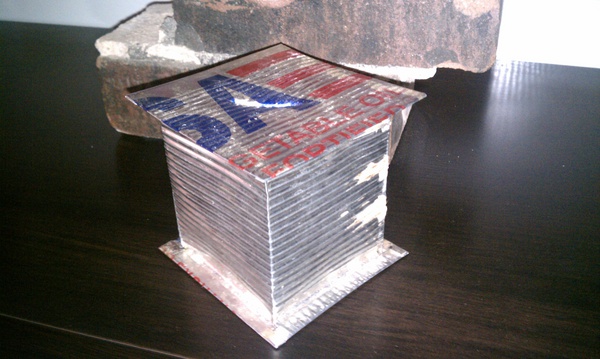
Under a tree, away from the main tent area, they met Daniel. Daniel is a mason by trade. But right now there are way more masons than opportunities to do masonry so he began to improvise. With all of the aid flowing into the tent camp there was plenty of garbage generated. One thing that seemed like it was useful for something was all of the one gallon aluminum cans which brought foods like beans.
After some messing around and possibly scouting out what was selling in the city, Daniel started cutting open the cans and making flat sheets of aluminum. Then, using only a large square chunk of steel and a smaller, shorter chunk of steel, he began shaping the aluminum into little boxes and punching a hole in them.
Bam. Instant piggy bank made from recycled cans.
Next, he began selling them to street vendors to sell up the hill in Carrefour. He sold them at 3 for 25 gouds. (3 for about 75 cents in US dollars) Each one took him about 2 minutes to make. So, in theory, Daniel could earn about 75 cents per hour. Remember, the average Haitian family earns less than $1 per day.
Jeffrey and Daniel bought about 6 piggy banks. (They paid him a little more than he was asking.)
Later that night as our team debriefed the day Joel brought up this story. And as the conversation morphed our team decided that we wanted to buy as many piggy banks as Daniel could make. Maybe, if we could get enough, we could use them to raise money for something like the Sons of God Orphanage?
The next day we went back to the tent city and found Daniel under his tree, banging away. We told him our plan and he liked it.
We will buy as many banks as you can make by noon tomorrow.
He thought he could make about 50. We said, no matter how many he makes… we’ll buy them all.
The next day, we were all a little apprehensive and hopeful. We had a feeling he’d have the 50 piggy banks. But we joked that we’d also walk into the camp and see tons of little kids with band-aids on their fingers from making these things all night long!
Daniel looked like a smart businessman. Maybe he’d hired the whole neighborhood to turn garbage into cash? Wouldn’t that be hilarious? I’d hoped we had enough money.
When we found Daniel under his tree it was clear that he was exhausted. He hadn’t slept. The interpreter tried to nice it up by saying that he thought Daniel had a fever. But it was OK, he had worked all night and we had come to buy what he had. His hard work was a good sign that he cared for his family.
He had 44 piggy banks. We counted them. We examined them. We made a big deal over how cool they were and well they were constructed. And then we talked about price.
You could tell he was nervous about that part. I don’t speak Creole but I could read his body language. Were the Americans going to try to offer him a bad price? And what would he do if we did?
The same price came up… 3 for 25 gouds. We told him no. We told him that he had worked all night and that we had rushed him. We told him that we didn’t feel right about paying him so little. We asked him if he thought it was fair if we paid him 25 gouds each. (It took a couple rounds of interpreting to get what we were saying.) He looked kind of confused by our proposition. I doubt anyone had ever told him they should pay him MORE because he had worked hard.
So, we counted them up and paid him just over 1000 gouds. (About $25 US) We shook hands, gave him the money, and walked away.
I don’t know what justice looks like. I can define justice. I can talk about it. But I don’t have a clue what it actually looks like.
I honestly don’t know if that was justice in action or just some silly Americans buying souvenirs thing. I just don’t know because I live in a world where basic justices are a given. But I do know business. I know that on that day, under that tree, that act of business felt like an act of justice.
I pray that more Daniel’s find more ways to recycle things. Turning garbage into money is good in any longitude or latitude.
Photo by bitsnpixels via Flickr (Creative Commons)
Perhaps this recession really has taught us some things?
I’ve noticed some trends softly changing in the past 2-3 years that are enlightening a cultural shift in our work-home-success life quotient. And they are encouraging.
Here’s a few things I would label under “the new corner office.” (Things that todays worker use to label that “they’ve made it.”)
No fear of self-employment. You’d think that a serious downturn in the economy, a tightening of credit, and exploding health insurance costs would scare the bejeezers out of people starting their own business? That’s just not happening in my circle of friends. And these new businesses, self-ventures, and new careers are all doing pretty well.
Working from home, working remotely, and location independence.Within the workforce, I think these are becoming status symbols. Kristen works from home as much as she likes. I like to work remotely about one day per week. And I know plenty of people who don’t even live in the same state as their company but work remotely permanently and just come in when needed. The net result for the company is that employees are actually more productive and the company needs less/different work space. The way technology is now… there’s a whole breed of worker growing less and less dependent on the traditional work environment. It’s a win-win.
Choosing “right job” over “big pay” jobs. [Note: I’m not talking about unemployed/unemployable recent college grads holding out for dream jobs that don’t exist at their level.] Plenty of people in my world have left jobs they pursued for years for something that was better suited for their personality/gift match. In many cases, that means they are pursuing a new career that pays less but feels right over a job that pays more but sucks the life out of them. That’s awesome for everyone.
Hard work is now and will always be the grease that makes the machine of success work for 99.9% of workers. At the same time, these new trends seem to show a desire for a simpler life. The new mantra seems to be, “I don’t mind working hard for the right things.“
Photo by fengschwing via Flickr (Creative Commons)
Am I the only one who notices that adults seem to obsessed about teenage lives? More to the point, we seem obsessed with pointing out how we need to intervene before they destroy themselves and the human race.
Our culture takes a very negative view of people between the ages of 13-18. If you work with them, you are used to folks turning up their noses when you tell them you love working with that age group.
Here are some recent headlines to illustrate the point:
Another angle that demonstrates this is our wonderment over a teenager who does something good. Sail around the world? Shocking! Raise money for a worthy cause? News at 11! Start a successful business? Give her an award!
It seems that those news stories are of interest, in part, because we expect teenagers to only do negative/self-destructive things and when they do something amazing it must be newsworthy.
Three observations I want to point out on this topic
Jesus is their savior, you aren’t.
Have you ever wondered why sports are so popular with adolescents? Maybe it’s the easiest place for them to achieve and/or exceed expectations.
Teenagers have about the same grades, sleep about the same, have the same amount of sex, and commit the same amount of crimes that they always have. Our obsessing over it only reveals something twisted in our lives and not theirs.