Search results for: “good news”

  • Should churches have open meetings?

    Should churches have open meetings?

    Long-time youth worker Titus Benson has gotten himself entangled in a mess. There were sexual misconduct allegations in the congregation, the church leaders allegedly tried to deal with it privately, and from what I can tell… the more Titus tried to step in and help the more trouble he found himself in.

    This post isn’t about that particular incident. But it is about the larger questions the church is facing.

    Yesterday, Titus wrote a post about how a lack of transparency can often lead to church-based misconduct from going public. He wrote:

    One thing bothers me almost as much as the abuse itself. The whole dramatic undoing of most of these faith leaders I’ve cited could’ve been avoided with greater transparency on the church’s part. Don’t misunderstand me — there would still be criminals and victims and a life of recovery for those who are harmed. But fewer victims would exist and more healing could happen if churches handled things with more Gospel-centered honesty and less deceitful self-protection.

    A Problem of Polity

    In my opinion, the lack of transparency starts with how churches govern themselves.

    Let me unpack that statement a bit… 

    A lot of the larger non-denominational churches have ties to “Baptist-y” backgrounds. That might not be Southern Baptist necessarily. But if you start tracing back the history of where the founders got their education or grew up, you’ll likely see a rather Baptist lineage.

    Now, the traditional Baptist polity (how the church is governed) is “Pastor lead, Congregational rule.” So the pastor operates under the authority of the congregations vote, but on most day-to-day matters the pastor is trusted to lead. There might be a number of committees that provide oversight and recommend direction or budget to specific areas of the ministry, but ultimately the churches members vote to decide at quarterly or annual meetings.

    In healthy contexts this works out pretty well. Congregational rule served “baptist-y” looking churches just fine for generations. This system provides many checks and balances and gets A LOT of people involved in leadership roles. So if so form of misconduct were occurring “the whole church would be in an uproar.

    It’s unhealthy contexts that warranted the form of government so popular today.

    In smaller congregations, especially in rural areas, the pastor wields the ultimate political trump card– If he’s unhappy he can leave.

    If the pastor doesn’t get what he wants he can merely threaten to leave and that’d get him what he wants.

    As a result these unhealthy congregations fostered a lot of wanna-be Napoleon rulers. I remember interviewing at a few of these types of churches… Pastor had his fingers in every decision… everything seemed to be vetted through a filter of “Is this what Pastor would want?” From the songs sung in worship to the color on the walls of the nursery, the operative word for these organizations was “control.” You second guessed Pastor? You got fired. You asked a question in a deacon meeting that seemed inappropriate? Gone.

    Checks and balances are replaced by threats and manipulation.

    Mix in the fact that the Pastor is generally the one slicing and dicing Scripture and this mix of religious leader and political leader– for some congregations– is toxic.

    I believe this is the birth place of some of the problems Titus writes about.

    Why? 

    Because a lot of founders of the church plants that became larger non-denominational churches [which are then idolized and lifted up as examples by today’s church planters] were born from associate staff working in a church job where they had no power, organizationally. [Cough, many of them got fired.]

    They looked at the pastor-lead, congregational rule system as broken and unhealthy. And so they fostered a new polity: Staff lead, elder rule. 

    Basically, how this form of government works is that the pastoral staff (or leadership team) have all of the power for day-to-day activities with general oversight by a ruling elder board. (They are the experts, even if they lack a credential to be an expert.) The congregation has absolutely no effectual power, short of leaving the church or cessation of giving. A lot of these organizations have no voting membership. They don’t vote or approve anything, there aren’t many committees or places where people have a voice, the congregation is often consulted about things… but that’s it.

    The intent is to remove power from the congregation and it does just that.

    In healthy contexts, the staff-lead model works great. Congregants don’t really need power as the self-governing staff serves the church well. When these congregations run into a problem they are quick to seek outside help, they are transparent about what’s going on, etc.

    But in unhealthy contexts, this form of government is really no different than the Pastor-lead model in a small, rural context… the pastor wields unlimited control by controlling who sits on the elder board, who is hired, etc. (I’m using male language here because, let’s face it, most of the players are indeed men.)

    What’s important to point out is that this staff-lead form of government is– without a doubt– viewed as the “only” way to lead a larger church. All other forms of government are devalued (to put it politely) and the mantra among “church growth experts” is that you cannot grow a church unless you are staff-lead. Staff are experts, congregants are sheep, end of story.

    When you cut through the Biblical language applied to these forms of government, really it comes down to this: Who is ultimately in charge of the church? The staff or the congregation?

    Lack of Transparency

    Back to the abuse. Whether it’s sexual misconduct or misappropriating funds or unlawfully firing staff… a lot of problems come out of forms of governance within these organizations which offer no transparency.

    • A staff person is accused of sexual misconduct… what was done about it? In most cases the congregation will never know because it was never informed, the police were not called, there are no written notes/recordings of meetings, etc. Even if you do get information it will not be raw, it’ll be vetted or “cleaned up so you can understand.” As we’ve learned from current scandals the church is much more likely to call a lawyer than they are to inform the congregation.
    • Church funds are misappropriated… what was done about it? When this happens, and it happens more often than anyone would care to admit, how is it handled? If money is stolen is it reported to police? Was anyone held responsible? Did anyone even notice? Similarly— That work that was done on the church… what was the bidding process like? Was it fair? Did we get a good price? Is there a warranty on the work? Did the church get proper inspections and permits? Was the work approved by the correct government agency?
    • A staff person is terminated… was it handled properly? Was there sufficient cause? Was the person properly compensated? Was the person properly classified to begin with? What training was offered? Has the supervisor been re-trained? Is the supervisor an adequate supervisor of staff? Are employees evaluated? What are their goals?

    In a staff-lead congregation you’ll probably never know the answers to any of these types of questions because they are mostly treated as private matters for the staff to deal with.

    But here comes the rebuttal…

    Titus writes, ““It is not advantageous for churches to have conflict in the public eye,” church leaders sometimes argue. We hurt the Kingdom when we argue about church stuff on Facebook, for instance. That’s just not the place for that kind of expression, some insist.” (source)

    That cuts to the heart of the matter, doesn’t it? Protect the good name of the church at all cost… even if that cost is a person’s life or livelihood.

    When something goes wrong, horribly wrong, the congregation might never be properly informed. Instead, the church staff is left to tell a story about what happened without anyone getting access to what actually happened.

    My problem with “staff lead” forms of government is two-fold.

    1. As a congregant it’s like going out to eat, being handed the bill, but you can’t see the details of what’s on the bill. You wouldn’t pick up that tab at Chili’s but you’re giving to the local church is treated like that.
    2. As a staff member, you’re left without due process.

    Embrace Open Meeting Rules

    Here’s the thought that Titus’ post elicited, that lead to this post in the first place:

    What if all 501 3c entities, churches & non-profits alike, had to abide by the same open meeting laws that public entities did?

    Though it’d never pass, I wonder if we changed the laws– Want to keep your tax status? Abide by open meeting laws.

    Don’t want that tax status? Find another business entity for your organization. (Sole prop, LLC, Corporation, etc.)

    See, here’s the kicker that I think 99% of church leaders are in denial of– Your largest donor is likely the government.

    • Why don’t you pay property tax? Because you are seen as benefitting the public. Just like the city doesn’t tax it’s own parks, they don’t tax you. Even though your church uses the same roads and public utilities, etc… the rest of the community pays the bill on that, they are financing your church. 
    • Why don’t you pay the same employment tax other organizations your size do? Because the government subsidizes it by making other business owners pay fractionally more… the rest of the community bears that because you’re seen as good for everyone.

    Whether you admit it or not every church is partially funded by your local, state, and federal government.

    So why not make it so that every one of your meetings as open to the public as theirs are? Why not make your 501 3c records available to FOIA requests? (Just like other publicly funded entities.) Why not post meeting notes?

    You can have closed sessions about personnel or legal matters– just like government entities— but the local church needs greater record keeping and transparency to restore lost trust.

    I will say this until the cows come home… the local church should be the best employer in town, it should be the safest place in town, and it should be the one place where every person, from any walk of life, regardless of personal history… should find life.

    You will not get their hiding behind closed doors. You will get there when you embrace the transparency our untrusting culture demands.

    In a post-Christian world people have to experience good news from you before they will experience the Good News of Jesus in their lives. 

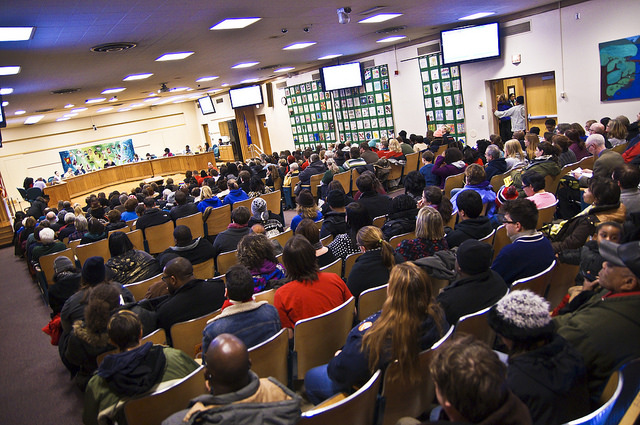
    Photo credit: School Board Meeting is Packed by Light Brigading via Flickr (Creative Commons)
  • The Most Difficult Place for The Gospel in America

    The Most Difficult Place for The Gospel in America

    The Bible Belt.

    The None Zone.

    Those liberal tree huggers in California.

    It’s hard to reach people in the Northeast.

    Or was it the Pacific Northwest?

    Over the past couple of years I’ve grown increasingly weary of hearing about how one area is especially hard or easy to be a minister of the Gospel.

    One group will point to a set of statistics and say how it’s nearly impossible to do ministry– it’s so much harder than ____.

    Another group will lay claim that they, of course, live in the hardest to reach region of the country.

    It kind of makes my head spin. On the one hand I don’t want to discourage anyone. If pointing to a statistic is somehow motivation for someone to keep going or be more creative or adapt the Gospel to their local context better than that’s great. But on the other hand I think a lot of people miss the bigger, more important point.

    The Most Difficult Place for The Gospel in America is…

    Dinner is The Most Difficult Place for The Gospel in America

    But really? What’s the most difficult place for the Gospel in America? 

    None of those statistics mean anything to the two groups of people you’re actually responsible for reaching with the Good News… and the most difficult.

    1. Your family, the people living in your house…
    2. Your neighbors, the people’s whose house touches your house…

    You can’t make the Gospel big in your community until you make the Gospel small in your life.

    For most, you live on the most difficult block in America to reach. It’s the challenge of a lifetime and one we too often ignore for the sake of trying to reach people we aren’t commanded to reach at all.

    Reach your own family. Then reach out to your neighbors.

  • 3 Keys to a Healthy Ecosystem for Growth

    3 Keys to a Healthy Ecosystem for Growth

    I spent a lot of time in Freshbooks last week. This revealed three important things to me. First, it’s clear that Marko and I have no training in accounting or bookkeeping. We try really hard and we are learning a ton. But it’s way harder than I’d like to admit. Second, while living in the daily grind of our little business makes it hard to see it… there’s no denying the exponential growth of everything we’re doing. Third, there’s a huge need for the position we’re hiring for to help us administratively so that our growth doesn’t stall. I’m actually starting to think of our next couple hires after that.

    So what’s the secret to the Cartel’s growth? I think the biggest secret is that we cultivate a healthy ecosystem where growth is a natural byproduct of the health– instead of worrying about creating a home run product. Since it’s opening day in Major League Baseball… I describe what we do at the Cartel as “small ball.

    2100738_o


    We do a lot of little things right and success is the outcome. And when we do things wrong… we fail fast and small.

    3 Keys to a Healthy Ecosystem for Growth

    We don’t always get these things right. But when we’re at our best, this is what we’re striving for.

    Consistency


    It’s easy to overdo it on consistency. Like, worrying about something being done at a specific time as opposed to being done well. But consistency is a sign that things are going well, that we’re on a good pace, and that things are sustainable. People are naturally drawn to consistency in quality of what you’re doing or consistency about timing on an event or even consistency of how long it takes to follow-up on something.

    For instance, we don’t change the size of our books or the paper quality or even the thickness of our covers… ever. It’s not that we can’t do that. It’s that by being consistent people know what to expect from our books. And while we’re still perfecting our editorial process, the process of how a book becomes a book is pretty consistent. Why? Consistency leads to health.

    Playfulness

    Core to who we are, from the onset, is cultivate playfulness. There’s a fine line between playfulness and corniness… and we make sure we stay firmly on the playful side. This isn’t just something we do on the outside in what we do, it’s kind of who we are as an organization. I won’t extrapolate how that actually plays out on a daily basis, I’ll just leave that to the imagination. 

    I find that as we’re playful it spreads to people we work with and into the stuff that we do. Last year, at The Summit I had a joke with the woman at our host hotel about wanting a really, really big gift basket because we completely sold out the hotel. Well, we we checked in to our rather modest little hotel room there it was… a candy gram with a hand written note.

    It wasn’t over the top ridiculous but she was being as playful as her very serious job would allow.

    Desperation


    Nothing good comes out of a research & development department.

    That’s something I’ve learned over the years.

    • IBM had all the money in the world and missed on the home computer.
    • Apple had all the money in the world and missed on Dropbox.
    • Google had all the money in the world and missed on Facebook.

    Fat and happy never leads to innovation… only iteration.

    Innovation is directly linked to desperation. One of the key things we do at the Cartel is always keep things a little desperate. We make things work because we have to make them work in order to keep going. Take that away and we get really, really safe.

    Desperation is to innovation as safety is to iteration. 

    Start Composting

    DIY Composting Bin - http://www.instructables.com/id/compost-bin/
    DIY Composting Bin – http://www.instructables.com/id/compost-bin/

    So what do I do with these 3 things? Start composting.

    Literally, you cannot buy health. You can’t hire health. You can only cultivate a healthy environment and patiently mix these things in over time. The bad news is that you can’t do this overnight. The good news is that once you’ve got it going it’s relatively easy to keep it going… just like a good compost in your garden.

  • Keep Youth Ministry Weird

    Keep Youth Ministry Weird

    Youth ministry is weird. 

    When planning a worship service for adults you’d never think, “We need a big group game to get people laughing.” Or, “Let’s have a sleep over right here in the church.

    A little too weird for most adults. But awesome for 8th graders.

    It’s pretty rare that adults will show up an hour before church just to skateboard in the parking lot or hang out with their friends. I’ve been in some fun adult small groups, but we’ve never gone to a trampoline park together. Teenagers don’t donate old couches for adults to sit in on a Sunday morning. And, as sorry as I am to say it’s true, it’s pretty tough to get 25 adults to show up to help clean up the neighborhood.

    Silly games, fun nights, mission trips, service projects, t-shirts, bad pizza, over-the-top songs, all-nighters, pointless road trips, winter retreats, just-cos-movie nights, helping at VBS, camp flings… all of these are staples of youth ministry.

    Youth ministry is weird because weird is what works with teenagers.

    If you aren’t a little bit weird you’re a lot-a-bit creepy.

    Tune Out the Tamers

    To me, one of the scariest things going on in youth ministry right now is the desire to tame it. People are so worried about youth ministry being a one-eared Mickey Mouse (not fitting organizationally) that they put a saddle on their youth group and break it.

    • People start to see youth ministry as a great way to market to families instead of a great way to reach teenagers who need Jesus.
    • People worry so much about integrating with kids ministry and young adult ministry that there aren’t really any non-church kids to even worry about integrating… we’re integrating people who were going to integrate anyways. 
    • People preach the Gospel of safety and political correctness more than they preach the Gospel of the Good News of Jesus Christ.

    If you tame it you’ll lose it. If it’s boring the only people who will come are the students whose parents make them come.

    If you finish a night of youth ministry and you didn’t have at least one point of the night where you weren’t sure if it was going to work or if you were going to lose control… you need to tune out some tamers in your life.

    Youth ministry, at it’s best, is weird. 

    Deal with the phone calls.

    Explain it in staff meeting.

    Get your volunteer team to back you up.

    And keep your youth ministry weird, baby. 

    Photo credit: Zorbs by Ian Southwell via Flickr (Creative Commons)
  • Come build partners in Haiti with me

    Come build partners in Haiti with me

    Today’s Throwback Thursday reaches all the way back to April 2014. And it comes with an invitation to join me on a trip in April 2015. 

    Backstory of this picture

    The gentleman in this photo is the pastor of the church located in the mountains above the city of Jacmel in southern Haiti.

    He and his family live in a small house about 20 yards to the left of this photo.

    Here’s what isn’t in the photo…

    Earlier in the morning we took this picture we drove up to a school about two miles up the steep mountain road above this church. There we met with the head teacher of the local school, a young man in his mid-20s, who despite not getting a salary has dedicated his life to investing in the education of the communities children. When we arrived, it was a school holiday, so no one was there. But within 15 minutes dozens and dozens of kids came from all over the mountain to see us. This is one of those rural communities that doesn’t get a lot of Haitian visitors, much less Americans. We played games and blew bubbles with them for about an hour. Then we gathered together, sang some songs, and told a Bible story.

    We left but the kids didn’t leave us. They followed… chased… us down the hill to the church. What a scene!

    So what isn’t in the picture is the kids– probably 20 of them– hiding behind the door and window in the picture. If you look closely you can see a few of them peaking. See them?

    Also not in the picture is this pastor’s vision for his church. Sure, people in his community have spiritual needs. But this area has physical needs that he is intent on helping end the devastating effects of the cycle of poverty, being Good News in the Neighborhood for him means developing a way for local farmers to bring their product to market. See, people have the ability and skills to grow more than their family needs. But getting their product to market has some barriers… physical ones but also practical ones. One vision this pastor has is to provide a low-cost mill for local farmers to prepare their product for market because the one that’s available to them in town is so expensive that it eats up all of their profits.

    Lastly, what isn’t in this picture is the generosity of this pastor. See, in the rush to get this photo, I forgot my camera bag in the church with all the kids. I took this photo, shook his hand, and then jumped into the truck to drive off to our next stop. In doing so I left a bag with about $6000 in lenses and gear sitting on a pew. When I realized this a couple hours later we were able to call him, he found the bag, and he generously brought my bag to town… about 45 minutes on the back of a motorbike each way.

    Your Invitation

    I’m headed back to Haiti in April. And, if you’re a church leader willing to explore a partnership with a church like the one in this picture, I’d like for you to join me for a few days together. You can learn more here.

    And if you’d like to chat about the trip, fill out the form below.

    [gravityform id=”12″ name=”Vision Trip 2015″ ajax=”true”]

  • Spectacle: Making things go boom in youth group

    Spectacle: Making things go boom in youth group

    At last month’s Summit, Chanon Ross (Director of the Institute for Youth Ministry at Princeton Seminary) talked about the concept of spectacle as it relates to adolescent culture, literature, and ultimately faith development.

    Spectacle isn’t something I’d really thought about before Chanon’s talk. I won’t steal his thunder, you can watch it for yourself.

    Of course, I had heard the word “spectacle.” And when he used the example of the power of spectacle in Roman culture I was very familiar with the concept from my latin classes back in high school. (Yeah, I was that kind of nerd in high school.) But I’d never really thought about the value of spectacle in our culture, specifically it’s importance to adolescence. But really… now I’m seeing it all over. 

    “OMG. Did you see _____?”

    When I think about the things that have really exploded in the past few years I see spectacle. Remember KONY 2012? That was kind of ridiculous. It had an unbelievable “Did you see ____?” factor. But even on a smaller scale, spend any time on a middle or high school campus and you’ll hear the latest spectacle. “Did you see what ___ did? Check it out… here’s the video.

    Popular YouTube videos, something on TV, a concert everyone has to go to, a fight after school, Homecoming, break ups, the new video game, on and on. It never really ends.

    Youth Group as Spectacle

    When I think about the times in my youth ministry where things exploded there was spectacle.

    • Some of our best “gotta be there” times came when we went through our gross out phase. I think we had a high school student puke 5-6 weeks in a row playing a stage game. I’m not really saying that I’d do that again– long live the 1990s– but dang, you had to be there to see it.
    • At multiple points the “gotta be there” factor was through the roof because one student came to faith and absolutely lit their campus on fire with the Good News, literally telling anyone who would listen.
    • One thing Brian does really well at Encounter is fostering a little spectacle on his retreats. I mean, they basically sent a water heater to space this year in the desert. Of course high school guys want to go next year… you can always make something go boom a little bigger.

    I’m not saying you’ve got to get kids to puke on stage to get them to show up or blow things up in the desert or preach your face off until someone important on campus gets on fire for Jesus. If I’m completely honest, so many of those times where things just EXPLODED, and we had amazing responses to something we did… they were spectacle… but we didn’t really know what we were doing. It was kind of accidentally spectacular. (You know, the Holy Spirit, and all.)

    But what I’m saying is that there’s something to spectacle in youth group. If things are flat, if there’s no “gotta be there” factor, then– quite frankly– I’m not so sure students are going to show up and they definitely aren’t going to be quick to drag their friends.

    The counterpoint: If you heard my talk at The Summit I pointed out that entertainment has a depreciating return over the long haul. And it’s totally true. The problem of spectacle is that you have to ramp it up. Just like Rome had to go from one gladiator fight per day to one per week to… within a few decades… needing HUNDREDS of gladiators to draw a crowd… spectacle is a short-term motivator.

    It’s not the answer. But sometimes a little spectacle goes a long, long way. 

  • Looking for Help in the Wrong Direction

    Looking for Help in the Wrong Direction

    Pastors have an infatuation with the business world.

    I’m not exactly sure where it comes from but it is unhealthy. Perhaps it’s because church hierarchies tend to favor business people on boards and committees and eventually they give in to the way business people think? Or perhaps it’s kind of an Oedipus or Freudian thing with pastors looking longingly towards the business world, pinning for the type of money and success they think they deserve?

    The irony is that successful businesses create community and benefit their employees in a way churches only wish they could. So, in a lot of people’s lives… they go to church and see a poorly run business but go to work and experience the church.

    Business Books are Taking Us the Wrong Direction

    When I hang out with a pastor I’m always intrigued by what they are reading or who is influencing the way they pastor. And frankly, there’s a lot of influence tracing back to two particular books: Jim Collins Good to Great and Seth Godin’s Permission Marketing. (With Godin, many pastors are impacted by derivative works of Godin. Most of his new books simply flow from or expand on the lessons taught in his first major book though.)

    Both are pretty old. 2001 and 1999 respectively. And they were pretty good books with some impact on the business community. But within churches? Their influence is huge. They are getting booked to speak at church leadership events but not with very many business leadership conferences anymore. See, when I hang out with start-up leaders and business folks… Collins and Godin are in the rear view mirror, artifacts. In an age of big data do you really think “Permission Marketing” is influential? If you are trying to get acqui-hired do you really give two craps about building a great company structure?

    Where are the books on farming?

    So here’s my point.

    Do you really think people are coming to your church to experience a business? Have we devalued the churches sacramental, innately desired place in people’s lives to leftover department store management mantras and outdated marketing techniques? Is that all that’s left of the Good News? 

    There’s bunches… MULTITUDES… of “church leadership” books which are built on business and marketing principles that were popular 15 years ago. But there is very little written about or learning experiences created for pastors to learn from the metaphors Jesus actually used relative to leading a church.

    • Shepherding a flock
    • Managing a field, pruning a vineyard
    • Casting nets to catch fish

    These aren’t things you learn in the city. These aren’t things you learn in a classroom. You learn these things by getting dirty, long hours doing menial tasks, being patient, and learning skills from a master shepherd/farmer/fisher who learned from another master.

    But formal ministry preparation looks almost exclusively to the city and never to the farm. The very act of getting ministry preparation usually means coming to the city and learning from city people.

    Yet when I read the Gospels I see Jesus rolling his eyes and walking away from the rabbis and formally trained religious people in the city to go and invest in the regular people who understand some things only regular people can understand.

    Friends, the Gospel isn’t elite. It’s not about sales and marketing. It isn’t reserved for those with the resources.

    The Gospel is about bringing Good News to those who are hungry for it, the regular Joes.

    Get your nose out of business books and start planting a garden, raising chickens, cast a line, going on a hunt…

    Jesus said, “The food that keeps me going is that I do the will of the One who sent me, finishing the work he started. As you look around right now, wouldn’t you say that in about four months it will be time to harvest? Well, I’m telling you to open your eyes and take a good look at what’s right in front of you. These Samaritan fields are ripe. It’s harvest time!

    John 4:34-35, The Message

  • Haiti Vision Trip 2015

    Haiti Vision Trip 2015

    I made my first trip to Haiti in February 2010, shortly after the earthquake that devastated much of Port-au-prince and it’s sister city Carrefour. In that first trip, amidst all of the devastation and loss of life, my life was forever changed by the undeniable sense that God was at work in Haiti’s darkest hour.

    Over and over again the people I met with had a simple message: Do not forget about us. 

    On the long journey back to Santo Domingo and flight home to San Diego I made a very simple promise to God: I won’t forget.

    Over the past 5 years I’ve been back to Haiti several times. As I wrote about last spring, the work in Haiti has shifted from the immediate relief efforts and rebuilding to forming long-term, healthy partnerships to support the movement of God that was unleashed with the earthquake. (see all of my posts on Haiti)

    Over the past 3 years we (The Youth Cartel) have been proud to partner with Praying Pelican Missions as we’ve sought to activate churches, young adults, families, and youth groups to come and partner with the local church on the mission field.  There’s a lot of chatter about the problems of short-term missions. And, quite frankly, there are a lot of unhealthy short-term mission trip opportunities out there.

    That’s why Marko and I have taken so much time and gone so slowly, examining and re-examining PPM’s philosophy and on-the-ground actions. We’re sensitive to the reality that many mission trips do indeed “pimp the poor” or turn mission trips into “poverty tourism.” And, while it’s impossible to always be perfect, we’ve found PPM’s way of doing short-term missions to be great for North American participants while actually helping further the ministry of the local church in places they serve. (see When Helping Helps)

    For me, the health that I’ve seen in PPMs work in Haiti is marked by their development and investment in local leaders. As you’d expect, when they first started working in Haiti they partnered with some people but trips were largely run and overseen by Americans. But as time has gone on it’s been awesome to see that leadership transfer over to Haitians. Local church leaders are hosting and leading teams, they are developing new partnerships with more and more churches, and they are behind the scenes doing everything from accounting to overseeing the various teams operationally. I think this symbolizes the health and vision of PPMs work there. They don’t just want to bring down North Americans for the sake of the North American experience. They also want to see their work more holistically, so it’s not just Good News for your team… but Good News for everything PPM touches. (From the bus drivers to the cooks to the part-time summer staff to the full-time staff to the pastors that they partner with.)

    Your Invitation

    I’m headed back to Haiti this April 11-14th and I’d like you to consider going with me. Together we’ll have the opportunity to visit with a whole bunch of PPMs church partners all around the Port-au-Prince area. (And as last years vision trip team learned… maybe even to a church partner on the other side of the island!)

    Specifically, I am inviting you to come on the vision trip if…

    • You are considering a short-term trip to Haiti with PPM
    • You have a heart for Haiti and are interested in what it might look like to bring a team
    • You’ve heard about Praying Pelican and you’d like to check them out for yourself
    • You’re a ministry leader and you’ve had a bad international short-term missions experience and you need to cleanse your palette
    • You’ve felt called to minister in Haiti but are not sure where to start

    Here’s how it works

    We’ll arrive in Port-au-Prince on April 11th. You’ll book and pay for your own flight, but we’ll pick you up. (The new airport in Port-au-Prince is really nice!) We’ll get you oriented to Haiti, we’ll meet our hosts, and we’ll probably meet with 1-2 pastors. Sunday we’ll experience church in Haiti and then spend some time meeting other partners. All day Monday we’ll continue meeting with ministry partners and seeing the work PPM is doing. And Tuesday we’ll fly home.

    What’s the cost? Basically, you pay for getting to Port-au-Prince and we’ll take care of everything else. (Housing, food, transportation) When you register you’ll pay a small deposit ($100-$150) that will be refunded when you arrive. We do this just to make sure you show up!

    Where will we sleep, eat, etc? Most likely, we’ll stay at a church and eat most of our meals there. The “worst case” scenario is that we’ll stay at a hotel. In all seriousness, staying at a local church is really a highlight for me and I prefer it over a hotel. It’ll be pretty basic. But you’ll have a comfortable place to sleep, showers, and great food. (That’s one thing about PPM… you are guaranteed to eat very well!)

    Safety, etc? Yup, all of that is taken care of. We’ll go over those details with the team before we leave. Needless to say, we’ll keep you safe and the PPM team knows what to do if something goes wrong.

    Interested?

    Fill out the form below and we’ll follow-up with you.

    [gravityform id=”12″ name=”Vision Trip 2015″ title=”false” description=”false”]

  • Get a Life! How much is too much church?

    Get a Life! How much is too much church?

    Several weeks back, Jason Raitz posted this on his Facebook wall:

    So, I’m curious and need your help. Quite a few people have asked me this question in the past 2 weeks. ‘Is attending church consistently really all that important’? What do you think? I’ve been writing a blog post on this for awhile now, but would love your help!

    Read the post & comments here

    My very first thought when seeing this question was this, “Is that a rhetorical question?” It’s impossible to imagine that he’d really think that anyone would post on his wall and say no to him. I mean… dude is a pastor of a church plant. His Facebook wall is 99% mentions of his church. His Facebook profile picture is the logo to his church. I know Jason, he’s a great guy, and he’s 120% about his church.

    So obviously, Jason thinks everyone on the planet should be consistent about church attendance.

    He and I agree on that point, 100%. I believe consistent church attendance is part of walking with Jesus. But when I see a church leader say stuff like that I have to read between the lines because I’m willing to bet that his definition of “consistently” is different than mine.

    Here’s what I replied:

    I guess I’ll be the voice of decent. (Shocker, I know) I used to think it was a big deal… when I worked at a church. And now we make church a priority, we go a lot, but more like 35-40 weeks a year instead of 50-52 when I worked at a church. But I would say that nothing happens there that is magical and makes me OK with Jesus any more than not going. Plenty of times I go to church and leave completely unsure of why we went. So is going to church consistently “really all that important?” I think there are a lot of other things more important. The flip side question is also really important, “Is there such a thing as going to church too often?”

    The Right Question

    Ultimately, I think Jason’s heart was, “What level of church involvement is healthy and good for a believer?

    And, as a dude who used to work at a church but is now trying to figure out life in ministry without being on staff at a church, it’s one I think about.

    I used to be Jason. My life used to revolve wholly around the life of my church. And I remember dealing with the frustration of seemingly never having enough volunteers or money or consistency from people who were part of my church. I was wondering “how do I get the most out of people” and it ripped my heart out to have people pull me aside and ask, “What’s the minimum level of involvement I can have here and be OK in your eyes?

    But I’m not in Jason’s seat anymore. My life has changed. Things are different and as much as I empathize with it and understand it, I long for Jason (and people like him) to really see things from the perspective of people in the community.

    On the one hand I want to be part of my church, I want to find community there, and I love investing in the guys in my high school small group. On the other, I almost see getting involved at church as a trap: Attending ANYTHING includes ovations and invitations to attend more stuff at church. (We’ve been part of 2 churches in San Diego since making this transition, while they are both wildly different in size, this one aspect is exactly the same. Being a part of one thing almost always includes invitations to more things.)

    Addressing the Elephant in the Room

    “The thief comes only to steal and kill and destroy; I have come that they may have life, and have it to the full.”

    Jesus in John 10:10

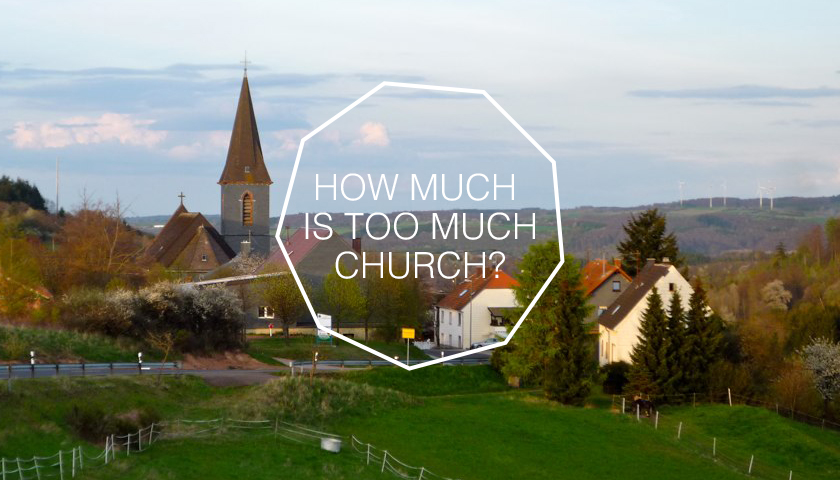
    When you drive around in many places in Europe you’ll begin to notice that the church is the tallest building in town. Quite literally, the church in many Europeans was designed to be the central focal point of a community.

    In America, churches are rarely the high point of a city. Instead, churches try to make themselves the high point of congregants lives.

    And in the same way you or I would drive into a small Bavarian town and laughingly think… “Did they really think that if they made the church the biggest building in town it’d become the most important thing in people’s lives?” The same is true when we wrap our whole lives around the day-to-day activities of being a part of a church.

    It works and doesn’t work at the same time.

    I think wrapping every free minute and thought up in the life of our church misses the point of John 10:10. It’s not living life to the full. It’s living life full-of-something-less.

    I have many friends who work in churches and I think, “Do they have a life outside of their jobs?” Because addiction to a church job is just as unsexy and unhealthy as addiction to teaching or being a CPA or any other job. Being a workaholic as a church leader is incredibly dangerous (it impacts EVERYONE in your life) but also somehow seen as incredibly normative. (Which is why so many people don’t want to be involved in churches, they see it as unhealthy!) I find myself lovingly telling friends, “You need hobbies, you need a life, you need adult friends.” But at the same time you’d think a pastor wouldn’t need to be told that. You’d think they’d be modeling health to me instead of the other way around?

    Newsflash: There are not “non-church-y people” walking around your neighborhood right now thinking, “Know what I need? I need to get involved in something that keeps me really, really busy!

    We, as a society, are busy enough. We need rest. We need less. We need Sabbath.

    Desperate for Good News

    Think about it like this. I believe humans are hardwired to inately seek out good news. (Both the Good News of Jesus and good news, more generally. General revelation means all things that are good come from God, right?)

    Is how you live, as a church leader, good news in your neighborhood? Do you have a life? Do you have hobbies? Do you practice Sabbath? Are you present with your children? Do you date your spouse? Do you manage your house? Are your weeds pulled?

    Because that’s the stuff your neighbors notice about you. Do they look at your life and go… “Dang, I want that!” Or are they looking at your life and going, “I don’t know what that dude does… but I don’t want to be like that.

    If the answer to that question is… “Um, crap. Probably not” and you want your community to hear the Good News of Jesus you’re going to have to figure out how to live a life that’s good news. You are going to have to make some changes.

    No one walks into a church building thinking “How can I get more busy?”

    If you could preach to me, the sermon I long to hear, the good news I need in my life– is for someone to stand up and help me discover less church life and more life of being the light of Jesus in my community. Someone, anyone, please tell me what’s enough church involvement instead of inviting me to more. If you can do that it’d be the best news I’ve heard all year.

    A fully devoted life to Jesus simply cannot be a fully devoted life to church life.

    I’d love to hear thoughts, comments, call for my head below in the comments. People who work in churches… does what I just said make any sense at all? People who go to churches… does what I said resonate with you? Why or why not?

    Photo credit: German Village Steeple by a_peabody via Flickr (Creative Commons)
  • Immigration and Youth Ministry

    Immigration and Youth Ministry

    The Problem

    U.S. Customs and Border Protection estimates that since October 2013, 66,000 children and teenagers have crossed the U.S. border without their parents, most of them from Honduras, El Salvador and Guatemala. They’re escaping gangs, street violence, and extreme poverty in their countries and usually coming to meet family members who live here.

    source

    A Reasonable Response

    Mark Lane told KGTV that he was moved to help a family fleeing violence in Guatemala after his 5-year-old son asked why residents in Murrieta were blocking buses of refugees from entering their town.

    “He asked me why the people were mad at the buses and I was like, it’s 2014 … why do I have to explain to my 5-year-old why people are mad at the buses when really they’re mad at the people inside of the buses ’cause they’re brown,” Lane explained.

    Through Border Angels, Lane found a mother, teenage sons, and a 23-year-old daughter who fled violence in Guatemala when gangs threatened to kill one of the sons for not joining.

    source

    The Question

    How is it that youth ministry is not engaged with what’s going on around issues of immigration impacting teenagers in their community?

    An owner of a fish market is engaged… but youth pastors aren’t.

    Let that sink in.

    It’s not a San Diego thing.

    It’s not a big city thing.

    It’s a people thing.

    It’s an everywhere thing. 

    The greatest growth opportunity for youth ministry right now is for youth workers to become advocates for teenagers in their community– regardless of social status, legal status, church affiliation, gender preference, political affiliation.

    Want to impact your community? Want the Gospel to flow through your church body and into the veins of your neighborhood?

    In a post-Christian society people need to experience good news before they can hear the Good News of Jesus.

    I long for the day when it’s normative for youth ministries to meet the relevant needs of teenagers in their community. I long to see youth ministry truly become Good News in the Neighborhood.

    I don’t think youth ministries struggle to engage teenagers because Jesus is irrelevant or some other cultural excuse. I think youth ministries struggle when they aren’t good news to teenagers in their midst.

    Good news is electric. It’s magnetic. It’s viral.

    Good news is unstoppable.