Category: social media

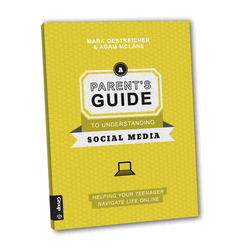
  • Book reviews for A Parent’s Guide to Understanding Social Media

    I’ve enjoyed reading reviews of the new book posted to Amazon.

    Here’s a sample of 5:

    A Great Resource for Parents

    This short book is crammed full of information on social media that every person should know! The chapter on Internet privacy was especially informative. It’s well worth the read!

    I like it. A short book gets a short review.

    Excellent Resource for all parents and teachers/youth workers

    I am a parent of an 8yr old who very much wants to own an iPod touch so she can text me and play Words with Friends with her parents. And take pictures and videos that she can send to grandma, grandpa, and friends. My 5 yr old will be there soon enough, as well. This book gives me hope rather than fear and practical guidance for the conversations to come with my children about online responsibility. I appreciate that Adam and Marko refer to online gaming and cell phones as social media outlets, and they address national laws concerning age limits and such.

    As a youth minister who daily connects with teens, parents, grandparents, and colleagues via Facebook, Twiiter, Instagram, and LinkedIn… This is a gold mine of information to have in my back pocket (or rather on my Kindle app!). I have already begun referring parents having teens & tech struggles.

    This book is and was SO needed. Thank you for combining your wisdom and experiences in this easy to read book! Congrats on a job well done.

    Thanks Leena. We were definitely hoping to alleviate fear by giving information and principles. Glad they work with all ages!

    Great Guide for Lost Parents!

    I would recommend this book to any parent. The younger your child is the better as we look at preparing for the world of Social Media. If your child is a preteen (4th-6th Grade) then you NEED to read it now. If your child is in Jr. High then you need to read it yesterday. Remember with all of this that prayer and God are your number one resource in raising children. Great book! Definitely 5 stars.

    Bingo. The content of the book was guided by a parenting seminar I do. It’s not aimed at high-level professional social media types… we worked really hard to keep it approachable while pointing to the data, plus offering our best advice.

    A Great Resource

    I have to admit that I was not expecting to get too much from reading this book as I am already fairly in the know when it comes to technology. I was however pleasantly surprised and found myself recommending the book to a friend with a child in the pre-teen years shortly after finishing it. It is a quick read, but is actually a handy resource on what is happening on the internet and how to handle it with our kids. As a parent of kids just entering those years, I am sure I will refer back to this book as a resource from time to time.

    Really humbled by this. I’m glad our experience is helping you and your friend.

    A great guide for the experienced and the newbie

    As a parent and a youth leader, I am very impressed with this book. It is short enough to not feel overwhelming; informative enough feel like I’m actually learning something; and practical enough for me to know I’m going to refer back to this book time and time again.

    I feel like the intention of this book is to help parents who don’t know anything at all about social media. But I can say as an avid user of social media myself (very important in helping me connect with a lot of the teenagers I work with!), this was still a very helpful book! I can’t impose boundaries on kids that aren’t my own, but I can make suggestions, and help parents who need ideas. I can apply some of these very good guidelines to my own children when they become teenagers (which will be much sooner than I am ready for, I’m sure), knowing that by being involved in what they do, I am showing that I do care about them as a parent.

    One of my favorite parts of the book seems to sum up the whole: “As parents of teenagers, we are trying to raise adults. We’re more interested in wisdom than compliance, more interested in responsibility than high walls of protection, and more interested in healthy parent/teen communication than maintaining a veneer of good appearances.” Amen and amen. Well done, Adam and Marko. I highly recommend to all parents of teenagers (and preteens).

    That’s great feedback. I think I’ve learned that most adults, even avid users, are using social media… are even pretty savvy. But they haven’t taken the step back to think about their use… the UI of everything is so intuitive, it comes naturally. I’m glad the book helped frame some of that for you.

    Wanna read it?

    Available at Amazon in soft cover or Kindle. Also available at The Youth Cartel & Simply Youth MinistryOr learn how to get it for free.

  • Social Media Rule #1 – Everything posted online is public

    Social Media Rule #1: Everything posted online is public
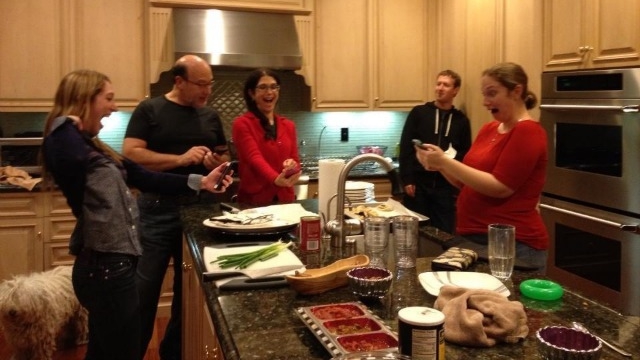
    This Christmas picture shared on Facebook went viral, much to the embarrassment of the Zuckerberg family. (You know, that guy Mark who founded Facebook…)

    Social Media Rule #1: Everything posted online is public

    It seems that even Mark Zuckerberg’s older sister, Randi, has become a victim of Facebook’s totalitarian privacy settings. Forbes “30 under 30? media honoree Callie Schweitzer tweeted the above photo of the Zuckerberg family, writing “@randizuckerberg demonstrates her family’s response to Poke #GAH.”

    Zuckerberg responded, saying, “Not sure where you got this photo. I posted it only to friends on FB. You reposting it on Twitter is way uncool.”

    Quote from Salon.com, December 26th 2012

    I enjoyed the irony that the man who created Facebook got bit by Facebook on Christmas day.

    (more…)

  • Jim Burns endorsement of A Parent’s Guide to Understanding Social Media

    I’m thankful for Jim Burns endorsement of the book I co-authored with Marko. Jim is a youth ministry legend. His decades long ministry has impacted the lives of countless students, youth workers, and parents. I was humbled that he not only read the book and offered this endorsement, he also had me on his radio program. We recorded 2 segments last week that’ll air in January.

    Is there a parent anywhere who hasn’t asked, “How do we create a media safe home for our kids?”  Adam McLane and Mark Oestreicher are two of America’s leading experts on teen culture and this book is a must read for parents who want to grasp just how the ever changing world of  social media is influencing their kids. This is my new “go to” book on the subject. 

    Jim Burns, PhD

    President, HomeWord

    I’ll be on the HomeWord radio broadcast January 9th and 10th. Make sure to tune in.

    Don’t forget, order 10 or more copies of the book before December 15th and get free shipping at the Cartel store.

    This book started as a parent seminar. If you’re interested in having me teach at your church, please let me know.

  • A secret deal on my book

    My new book, co-authored with Marko, comes out next week.

    I’m very excited about it for two specific reasons.

    1. Parents of teenagers really need this book. The days of fighting or banning or trying to wall off kids from social media is over. Parents need to know how to help their child live a life that will increasingly be lived online. This book does that really well. It’s short, easy to understand, and very practical.
    2. I’m proud of how this turned out. Marko and I worked really hard on making a book that’ll last a few years. We focused on helping parents understand social media while avoiding all of the pitfalls of your typical Christian book about media– there’s nothing here that is alarmist. We aren’t trying to scare parents, we are providing tested principles that have worked for years, work today, and will work for years to come. Trust me, that wasn’t easy.

    Here’s the Official Description

    With each passing day, teenagers’ lives become increasingly intertwined with social media. How can you as a parent stay informed and involved in healthy ways? How can you help your son or daughter make wise decisions and remain safe online?

    A Parent’s Guide to Understanding Social Media will equip you to have meaningful conversations with your teenager about the best, wisest ways to get connected while staying safe.

    Your guides for this journey are Mark Oestreicher and Adam McLane, who draw from their own wells of experience as parents and youth workers. They’ll help you chart a course toward discovering and practicing wise family online activity.

    My Secret Deal

    I would love for you to get this book in the hands of all the parents in your ministry. Like the other books in this series, this would be great to use as the content of a parent meeting. In fact, the book is based on a short seminar I’ve done for parents of teenagers in a bunch of churches.

    You can pre-order it on our site right now for $6.99.

    If you buy 10 or more copies, you’ll automatically get free shipping on your entire order. (media mail, US addresses only) Check this out. Add whatever else you want to that same order, as long as you order 10 or more copies of the book, you’re getting free shipping.

    If you buy 20 or more copies, I’ll still pick up the tab for shipping on your order, and I’ll start tossing goodies in the box.

    This secret deal expires on December 15th.

    p.s. If you don’t automatically get free shipping, apply coupon code SECRET62

  • 12 Gift Ideas for the Geek in Your Life

    I’m a geek. You know a geek. Geeks are sexy these days.

    We have a lot in common. 

    So what does the geek in your life want for Christmas? This year we want gadget accessories, classy art, and stuff ironically associated with internet memes. If you can’t find anything else, we’ll take an iPad mini.

    Here’s 12 ideas for the geek in your life

    The Glif ($20)

    It’s a stand and tripod mount for an iPhone. I’ve got one of these, it’s totally handy on planes, when making Skype calls, or when you are trying to take nice photos.

    From Photojojo

    The Glif - excellent geek toy

    (more…)

  • Notifications are of the Devil

    The Internet Loop

    Do you catch yourself in a compulsive loop sometimes? For me? Right now it starts with email. Then I go to Twitter, then Facebook, then Instagram, then ESPN.com. If things are particularly interesting I’ll go around the loop 2 or 3 times in a row.

    This is what psychologist John Grohol calls FOMO Addiction. (Fear of missing out.)

    Like the old-school Crackberry addict, we’re now all in the grip of “FOMO addiction” * — the fear of missing out on something or someone more interesting, exciting or better than what we’re currently doing.

    Link

    Web developers depend on exploiting this phenomenon. Since most social media sites are fueled by ad revenue– in turn depending upon millions and millions of pageviews where they can display millions and millions of ads per day, engineers use lots of psychology to get you to add their web application to your loop. Each time you go from site-to-site on your addictive loop you see new ads on your Gmail, Facebook timeline, sponsored tweets, etc.

    For the engineers, getting into your loop is like offering free crack to a crackhead unlimited, all day and all night.

    They have you.

    But they want more.

    Notifications Supersede the Loop

    Texting gave rise to a disturbing trend for these same engineers. While desktop users have continued, even increasing their addictions; smartphones delivered a brand new way to fuel the loop even more.

    At the same they noticed that texting guaranteed an interruption of the loop. Receiving a text, unlike receiving a phone call, would cause a person to almost immediately type a response. Various studies show that something like 98% of text messages are read by the recipient within 15 minutes and the response rate for texting, particularly amongst teenagers– the most influential demographic for spending, is nearly 100%. (related source)

    Compare that to an email marketing message, where 20% open rate and 5% response rate are considered excellent, and you can see why web engineers knew they needed to build their own loop interrupters to supersede your loop with their content.

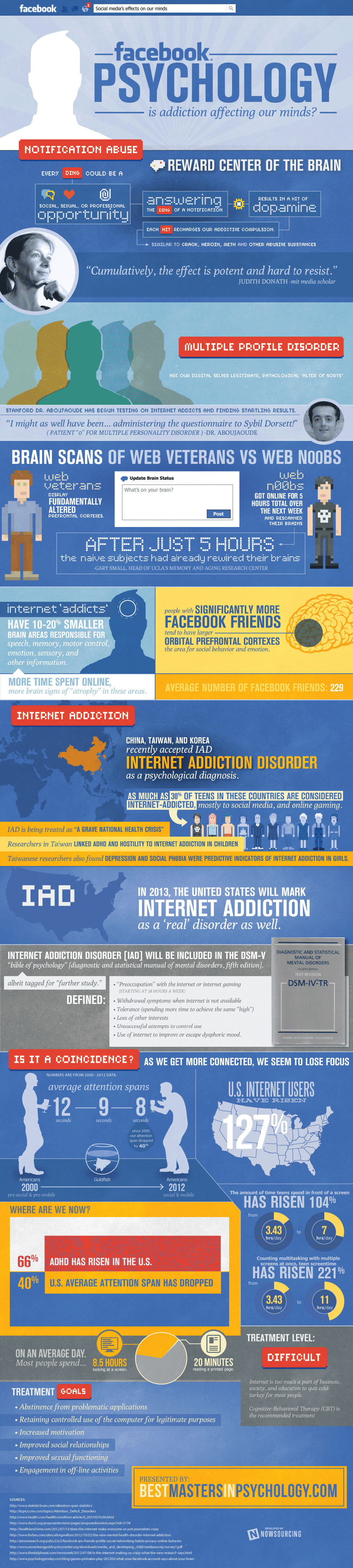
    click to view full-sized version

    That’s how the notification was born. If your phone beeps or buzzes in your pocket you are almost guaranteed to check it. Likewise, if something pops up on your screen or even if a number in your peripheral vision ticks up from 22 to 23, you will check it.

    Your wife could be in labor. Your house could be on fire. You might be driving through white knuckling snow with your kids in the back seat. You might be having sex. If you get a notification the neurology of that moment is against you. You will check it. 

    Why? Dopamine. Recent studies show that the same neurotransmitter that fuels many other chemical addictions also is released when you get a notification from a text, Facebook, Twitter, Instagram, email, etc.

    A notification causes you a tiny bit of pleasure… and the drive for that impulsive pleasure will augment your loop and interrupt whatever you are doing.

    In my new book, A Parent’s Guide to Understanding Social Media, we explore the this more and its impact on teenagers.

    But, for now, let’s talk about what you need to do.

    Notifications are of the Devil

    When I say that notifications are of the devil I’m only kidding a little bit. If you think about it, web engineers are exploiting a very similar neurological response to many other life-endangering addictions.

    Doing drugs gives you a big hit of “dope.” Meanwhile checking hundreds of notifications per day is lots and lots of tiny hits of “dope.” You decide if that’s the devils handiwork. I tend to think it is.

    Notifications may be ruining your quality of life (and perhaps your safety). 

    So turn them off. All of them. Notifications on your phone, your laptop, your tablet, your email… turn them all off. (Here’s a Google search to get you started) You don’t need any of them.

    Next, make it so your phone never vibrates. Think about it, if you are having lunch with a co-worker or are in a meeting, or are watching a movie. Do you really need to check that text message? Nope. And if you turn off all visual, audio, and vibrating notifications you can simply ignore all of that.

    Web developers, in an attempt to get you to view the next ad, are driving you crazy. Literally, they are fueling an addiction that is stressing the relationships in your life simply so they can make more money.

    So make the choice.

    Reclaim your life.

    Turn off all notifications.

    Do it now.

    P.S. Like this post? Want to be a better parent of a teenager in a social media infused world? Pre-order my book, A Parent’s Guide to Understanding Social Media.

  • How to talk to parents about parenting

    Over the past year or so I’ve had the opportunity to lead an hour-long seminars for parents. In fact, earlier this year partnered with Simply Youth Ministry & Marko to turn the content of my seminar into a book that comes out in a few weeks, A Parent’s Guide to Understanding Social Media.

    For me, this has meant going to churches and presenting content without knowing a thing about the context of the church. Sure, I can figure out some things just by driving around or overhearing small talk in the foyer.

    (more…)

  • Power in a Social World

    Spontaneous tweeting is the “antithesis” of political conventions, says Dan Schnur, who was communications director for John McCain’s 2000 presidential campaign. “Conventions are about singing from the same hymnbook. Twitter means everybody has their own song.”

    Twitter rewrites the script for political contentions, Martha T. Moore, USA Today – August 22nd, 2012

    The quote above shows just how much the man quoted doesn’t understand what has happened in the world in the past 5-6 years. 

    It used to be that you could script a political convention, large scale event like the Olympics, or even a news event and control the message relatively simply. We used to talk about how politicians were able to spin stories with press conferences or package their candidate with ads. Michael J. Fox starred in a show called Spin City, the very premise of which feels dated now. Jon Stewart and Stephen Colbert make millions of dollars pointing out the inaccuracies of news items that have been spun from the truth.

    Today, power has shifted away from those traditional mediums. Today, power truly belongs to the people. Position and influence are really two different things in this new, flat world.

    Don’t believe me? Remember the Arab Spring? Yeah, Twitter was the catalyst for those revolutions which lead to regime change in several countries.

    Here’s a news flash for those “in power.” More often than not the person with the microphone is in the least powerful position in the room(Traditionally, they had the most power.) While they are speaking there is an entirely different conversation going on via Twitter about the speakers credibility, the veracity of their talk, and whether or not their words even matter. While they are the ones saying the words they have zero control over how its received.

    Someone can walk off the platform thinking they’ve nailed it only to learn that they made a mistake that costs them big time. Or they can feel like it’s a dud and see it take off on YouTube. In either case, the person in a traditional position of power (the speaker) is now the least powerful person in the room because the platform is vulnerable. A guy like me, watching on TV, can make snide remark that gets retweeted and refashioned 10,000 times before he steps off the platform. That’s just the way it goes now. 

    What does this have to do with me as a local leader?

    Social media has changed a lot for big, national leaders. But I don’t think it’s dramatically altered things at the local level. There just isn’t the same volume so the impact of social media on your leadership is way smaller.

    If anything, just know that the text, twitter, Facebook conversation that happens about you and your leadership is completely beyond your control. It’s a whole new level of vulnerability that can be overcome by simply being authentically you.

  • Social Media is Linked to Depression

    Researchers at Missouri University of Science and Technology have linked depressive symptoms in college students to their internet usage. It’s a small study, only 216 participants over 1 month, but the correlation quantifies what other researches have hypothesized. This is the first of its kind that overlaid subjects actual internet usage and diagnostic testing. Participants were college students on a closed network. So once they agreed to participate the researchers gained access to their real time usage via the schools network.

    In short, the more time subjects spent checking social media sites like Facebook, chatting online, and shopping– especially late at night, the more depressive symptoms were measured.

    In this paper, we report our findings on a month long experiment conducted at Missouri University of Science and Technology on associating depressive symptoms among college students with their Internet usage using real Internet data collected in an unobtrusive and privacy preserving manner over the campus network. In our study, 216 undergraduates were surveyed for depressive symptoms using the CES-D scale. We then collected their on-campus Internet usage characterized via Cisco NetFlow data. Subsequent analysis revealed that several Internet usage features like average packets per flow, peer-to-peer (octets, packets and duration), chat octets, mail (packets and duration), ftp duration, and remote file octets exhibit a statistically significant correlation with depressive symptoms. Additionally, Mann-Whitney U-tests revealed that average packets per flow, remote file octets, chat (octets, packets and duration) and flow duration entropy have a statistically significant difference in the mean values across groups with and without depressive symptoms. 

    Source

    This fits into the advice I share in my seminar, (and forthcoming book co-authored with Marko) A Parent’s Guide to Understanding Social Media, that parents need to focus less on WHAT their kids are looking at and more on WHERE and WHEN they are using the internet.

    ht to Mashable and Huffington Post UK

    Photo credit: Ars Electronica via Flickr (Creative Commons)
  • How I Made Facebook Lovely Again

    Oh Facebook.

    You temptress. You instigator. You heartbreaker. You are so freaking addicting and maddening all at the same time. You define paradox for me. 

    Here’s what we all know: You either control Facebook or Facebook will control you.

    With more than 1600 virtual friends… let me be the first to admit that Facebook was starting to drive me nuts. Literally, I felt as if I teeter tottered on sanity. It was just too much.

    But in the past 3-4 months I’ve been able to do a couple simple things that made Facebook much more enjoyable.

    Here’s how I made Facebook lovely again

    1. Manage your subscriptions – I accept friend requests from just about anyone. But here’s a little secret. If I don’t actually know you I don’t want to see every one of your status updates. So I mark you as “Only Important” on my subscription settings. So when I see someone pop up on my timeline and I don’t really know them, they get marked as “Only Important.” Over time this makes a massive difference! Conversely, if someone is in my family I mark their updates as “All Updates.” But most of my actual, in-real-life friends are marked as “Most updates” and that works just fine.
    2. Manage requests – Oh baby, event notifications and game requests will drive you batty. So I kill them all. I’ve never played a single game on Facebook and I block ’em all. I also found that all the game requests were coming from a very small minority of my friends. So not only do I block that specific game, but if you request I play a game I also mark you as “block game requests from this person.” Oh, sweet sanity!
    3. Hide updates from Yahoo, USAToday, and any other site that shares my friends browsing activity – This is your next sanity finder. All you have to do is click the little dropdown on that block of links and mark the “hide” button. That makes it all go away and I never see it again. (I couldn’t take a screenshot to show you because it’s all gone!)
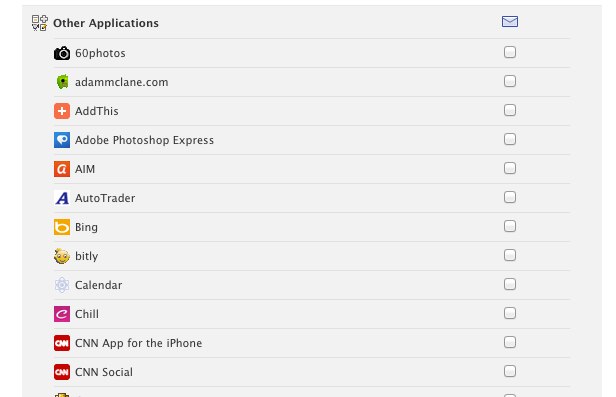
    4. Turn off all notifications – If I want Facebook I go to Facebook. Head over to Notification Settings and turn them all off. I never want to get an email from Facebook. No direct message notifications, no friend requests, no tag notifications, nothing. Also, scroll down to Other Applications and turn all of those off.
    5. Close the tab – I know it’s tempting to keep Facebook open all day. That way when a notification pops up you are able to get right there and see who liked your image or who commented on your status update. Close the tab. The coolest thing will happen! You’ll get your life back and enjoy Facebook even more when you want to. In other words, I don’t let other people’s use of Facebook interrupt my life.

    Taking these measures of control and getting the settings just right has truly made my use of Facebook lovely again. And that’s a sweet sane victory!