Tag: blogging

  • Rules for Blog Comments

    Quick synopsis:

    1. I reserve the right to edit your comments if they contain foul language.
    2. I welcome all comments and all types of comments.
    3. You may use a pseudo-name so your “real name” isn’t publicly visible.
    4. But you must use your real email address so I can follow-up with you.
    5. You are welcome to use my contact form to send me comments that will not be published on my blog.
    6. Anonymous comments with invalid email addresses will be deleted.
  • The state of youth ministry blogs

    It’s been a couple of months since I published my list of Top 20 Youth Ministry Blogs at the YS Blog.

    And for the most part the list did what I was hoping it would do. People took notice that YS had taken notice of blogs enough to rank them. And the net effect has been that many who had stopped taking the genre seriously are now take it seriously again.

    It’s hard to explain and its impossible to pin it on just the rankings. But it was clear that youth ministry blogs were on the decline. Now they are noticeably getting stronger.

    Am I taking credit for that? All I’m saying is that publishing the rankings didn’t hurt the genre.

    Here’s a few observations: (In no particular order)

    • The quality, quantity, and effort put into youth ministry blogs has increased in the past two months since the rankings went public.
    • There are lots of new youth ministry blogs to index– awesome!
    • The method used to calculate the top 50 will continue to refine.
    • It looks like I only missed a few sites that could have hit the top 50. (This was my big fear!) I did ask those who voted on the top 50 to tell me who was missing, that group brought up only 2 blogs that weren’t indexed. For a first public shot… that’s not bad.
    • For 2011, I’m glad that I’m just the math guy and I get to turn over the influence ranking part (33% of the overall ranking) to the 2010 top 20 bloggers.
    • Basically, everyone from #11-20 wants to be in the top 10. Which is fantastic because it forces EVERYONE to grow and get better just to stay in the top 20. I’d be impressed if anyone can crack the top 5… there is a big statistical hurdle between a top 5 blog and the rest.
    • I’ve noticed a lot of folks in last years top 50 are making changes. They are getting right with Technorati and Google. They are making sure their RSS feed works. They are probably doing some SEO stuff. In other words, the whole class of youth ministry blog is getting better not just from a content side… but from a set-up side.
    • I think I’m going to exclude from index if they haven’t updated in 30 days. It’s tough because it takes me a couple of weeks to get through the data. So I might just index everyone and scrub the data right before I send the top 50 for influence ranking to the top 20.
    • Those of us on the list have had some weird effects. I know I’ve heard more bizarre product pitches in the last two months than I’d ever heard before. And marketers have definitely taken notice. Crazy town.
    • Yes, I think it is possible for a new blog to make a first year appearance in the top 20. Because some of the indexes that go into the composite score take time to build… I sincerely doubt anyone could amass the traffic to go from launch to the top 10 though. But I’m sure its possible.
    • I’ve had to laugh at the humility thing of those on the list. Lots of people on the list don’t know how to react. Christians try to act humble when they are proud. I think it’s OK that they are OK being on the list. It’s not like they politicked to get on the list… no one knew it was coming!
    • Speaking of politics, unlike other rankings in our world, the YM blog ranking is open. If anyone thinks their blog has a legit shot at getting into the top 20, let me know so I can start indexing it. Last year, I indexed more than 100 blogs. I have a feeling I’ll be indexing 200+ in 2011.
    • A lot of people have asked me about adding Twitter/Facebook numbers into the mix. I’m resisting that urge for a number of reasons. I actually think blog indexing and social media indexing are two different things. Truth is, size of a social media circle is completely meaningless.
  • 5 Types of Engagement With Each Blog Post

    I’m an engagement preacher. No other stat matters in social media quite as much as engagement. Likes, Retweets, Trackbacks, Comments. These are the things that show that your content isn’t just getting read– it’s getting shared.

    Here are five ways each of my blog posts is engaged with.

    1. Comments (On the blog itself, on Facebook, and on Twitter)
    2. Facebook like and shares (I have a limited reach. But through my reach I have unlimited viral capabilities.)
    3. Twitter links and retweets (Did someone like you post enough to post on their Twitter account? Did anyone retweet the link?)
    4. Private discussion (I get a lot of e-mails, Twitter direct messages, and Facebook messages with each blog post. I even tally the number of times people see me in person and mention something I’ve written. That’s all engagement.)
    5. Blog excerpts (Getting a paragraph pulled from a post and having it create content for another blogger/online magazine is awesome engagement. It’s like an annotated recommendation.)

    What are ways you engage with your audience?

  • Measuring Success in Social Media

    I laugh when I see the term, “social media expert. Let’s be honest. It’s an emerging field and the only thing that makes someone an expert is that they have labeled themselves as such and they read Mashable and Seth Godin.

    With that in mind, I’ll just point out that for the last two years I’ve gotten paid to handle social media. I don’t know if that makes me an expert in the field, but it does mean that I’m employed in the field. (And I read Mashable and Seth Godin just for good measure.)

    So, how do I measure success?

    False positives

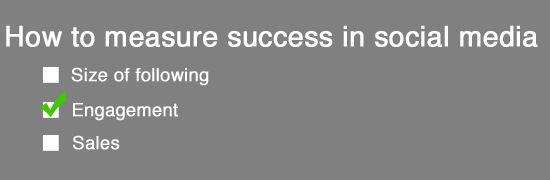
    • Size of following. Having 25,000 followers on Twitter or 10,000 fans of your Facebook page doesn’t mean jack.
    • Contest excitement. I love hosting contests as much as the next guy, but hosting a big contest doesn’t mean jack.
    • Being active. Utilizing the tools of social media is important, but just showing up doesn’t mean jack.
    • Atta boys. [Or atta girls] When you first get started everyone in your organization will be excited, but that doesn’t mean jack.
    • Sales or lead generation. This may make the boss happy, but in most cases it doesn’t mean jack.

    True positives

    • Engagement. Are your followers, fans, subscribers listening to the stuff you send out in a measurable way? Do they click on links you recommend? Do they comment on stuff you post? Do they open the emails you send? Having a large following is only as valuable as your ability to engage those people. Otherwise, your just another message they are ignoring. I’d rather have 100 engaged Twitter followers than 25,000 who ignore me. What to measure: comments, likes, open rates, click rates, number of clicks, mentions on fan/followers feeds.
    • Users who contribute. Is your effort a two-way conversation? Traditional marketing is about pushing a message. Social media is about pulling a response. It’s shocking to me how many organizations have large followings but only push. And they wonder why they think their social media efforts are a waste of money? They are! What to measure: Submissions, Facebook messages, Twitter direct messages, unsolicited or solicited ideas.
    • Repeaters. This post is the perfect example. When I press publish on this blog post, my own network will draw a couple hundred visitors. But this post will be read several thousand times in just 7 days. How did that happen? Repeaters. What to measure: Facebook shares, Twitter retweets, add-to-this analytics, trackbacks, blog posts about your content/product/service.
  • My blogging process

    Photo by m-c via Flickr (Creative Commons)

    Posting something almost daily at adammclane.com is a challenge. So I thought it’d be fun to write about that process. Perhaps this will provide an insight into my daily life or maybe it’ll even help someone figure out a new process for them?

    Three main sources of my daily post

    1. I wake up and have something on my mind to write about.
    2. Pre-planned posts.
    3. Rants.

    Typically, I write in the morning. I leave for work at 8:00 AM and I often start writing at about 6:30 AM. Most days I am literally pressing the publish button, hopping in the shower, and dashing off to work!

    1. For stuff I write in the morning.
    These are my journal posts. They tend to ramble more. These are also posts that I mostly write because I have to or the thought will take over my day. It’s hard to explain that, but I think I’ve disciplined myself to wake up thinking about something. There’s definitely a spiritual discipline side to it as well. I’m going on 6 years of daily public blogging… so it’s probably as much a habit as a discipline. But I really dig getting up early to write. And the pressure of having to finish by a certain time helps. (Donald Miller has a great post about using a timer to blog)

    2. For stuff I pre-plan.
    I’m a doodler. And if you’ve spent time with me you’ve probably seen me listen to something, or finish a conversation, and pull out my iPhone to take notes. (I also carry a notebook for this and use Post-its for the same purpose.) I use Evernote to organize that mess into a list. I have one ever-edited note called “blog posts” which is simply a list of things I want to blog about at some point. Some of those items on the list have partial posts that match… these are things I doodle while in meetings, sitting in church, on the trolley, or in a plane. Some of them are just main ideas, some of them are fully edited posts, and some are pictures of things I’ve doodled in my notebook.

    Sidenote: Almost every morning I look at that list and decide do I want to write about something on the list or something on my mind? If I chose to write something on my list instead of what is on my mind, I always make sure to capture a couple sentences of that thing have on my mind for a later post.

    3. Rants
    Rants are a healthy part of the blogger diet. The part of ranting that I’ve tried to eliminate from my blogging diet is the immediate rant. (That’s blogger junk food!) I used to allow something to fire me up and then I’d write a scathing response. Bam, done. My new self-imposed rule is that I don’t publish a rant right away. Instead, I prefer to allow it to sit in Evernote for a while and add it to my list of things to blog about. Then, when I’ve had some time to reflect, I can decide when to publish the rant as well as how I want to edit it. Some of my most popular posts of all time started as rants, fermented, and got re-edited to something else. But a good rant is fun and I let ’em fly on occasion.

    Other types of posts

    There are a couple of genres of blog posts I didn’t include here. These are my more spontaneous posts. Book reviews, family updates, and video posts. There’s not much pre-planning or  deep thought that goes into them. Which is why I typically publish them on weekends or when I’m on the road. And the truth about those posts is that they are more meaningful to me than they are to the reader.

  • Facebook Morphs Blogging Again

    adam-head-09-100px-squareBlogging, by very nature, is a fluid art. Just a few years ago I thought I was pretty slick because I could journal on my computer using Microsoft Word. Flash forward a few years, to around 2000, and I learned that I could take those Word documents and convert them to webpages. It was cumbersome and I didn’t do it very often… but it was awesome. Then Blogger.com took “the web log” out of the hands of the HTML king and made blogging accessible to just about anyone willing to give it a shot. I was fasinated that I could link to friends blogs and that we could leave comments for one anothers posts. A few years later, 2005-2006 and Typepad and WordPress suddenly made it possible for blogs to live on their own domain easily.

    In 2007-2008, blogging became all about search and syndication. I started seeing my stats level off while I could tell my reach greatly extended. RSS (really simple syndication) made my content portable and SEO (search engine optimization) got my blog noticed high in Google search results.

    facebook2009 has seen blogging morph again. Facebook’s power in the adult demographic has brought blog syndication to a whole new level. Now my posts appear on my Facebook friend’s timeline, so a whole new audience of people has been added to the pool of people who read my blog. When they comment that ends up on their friends timeline, which greatly expands the pool of people reading and commenting on my stuff. (Though there isn’t yet a matrix for this so that’s a bit frustrating.) In the past few months I’ve run into tons of people who read my blog and I have no idea who they are or how they got here… but it’s awesome!

    More noticeably, in the past few months I’ve noticed a steep uptick in folks who read my blog posts exclusively on Facebook and comment there as well. Often times, I’m left with a post which generates two separate conversations. Which is really cool! On top of that, Twitter has further expanded my blogs discussion and reach. While there is some overlap, Twitter is mostly a different audience for my content.

    Wagon_WheelGoing forward, adammclane.com is now and will continue to be the hub of my online presence. It feeds RSS, search results, Facebook, and Twitter. I think of the personal blog as the engine that powers everything else. That said, my recommendation for beginners has begun to morph. You can certainly do the same thing with a WordPress.com blog (free) or even a Facebook account.

    And since I know about 75% of the people who are reading this post will never make it to adammclane.com, here are some ways we can connect. We can be Facebook friends. You can follow me on Twitter. We can pool links on delicious. You can be a contact on Flickr. You can subscribe to my blog via RSS. But you can’t be my Myspace friend. That’s so 2005.

  • Adam’s Rules for Twitter

    twitter-rules

    You’ve seen my rules for blogging. With many people using the social media 360—  blogging, Facebook, and Twitter simultaneously– I thought it would be helpful to share my Twitter rules. These guide my use of the site and I think would act as a good primer for those getting into it.

    Rule #1: Don’t forget the question. The primary use of Twitter is to tell people what you are doing. It’s easy to get lost in conversation and treat Twitter like a chat room. With that in mind I try not to @reply the same person back and forth in conversation. I am quick to take the conversation to a phone call, email, or direct message. The power of Twitter is seeing that all of our lives are fascinatingly mundane. Focus on that and you’ll be fine.

    Rule #2: It’s not about the numbers. There’s a lot of locker room-styled comparisons going on with who has the biggest following. Just like in real life, it’s not size that’s important. (See rule #1) If you are interesting to people you will attract a larger following. Joining a website that promises 10,000 followers or endlessly participating in #followfriday in hopes that you’ll add just 3 more followers is only going to make your use of Twitter less enjoyable and you more annoying to follow. I allow anyone to follow me. But for my personal account I only follow back who I want to follow back. I read every profile when someone follows me… and I follow back just those whom look interesting. For business accounts I follow everyone back who follows those accounts.

    Rule #3: Don’t follow then unfollow just to build a following. Follow only who you want to follow. It is rude to follow someone so they will follow you back only to then go and unfollow them. That’s rude. I can’t tell you how many people do that to me. And they probably think I’m rude because I don’t play along.

    Rule #4: Retweet, @reply, and compliment often. It’s good form to reply to every @reply. On my personal account, I do my best to @reply to everyone who @replies to me. Remember, Twitter can be a fun place for networking, idea sharing, and community. Be aware that @replies help your followers meet and get to know one another.

    Rule #5: Pimp your content, but pimp it lightly. In the early days of Twitter there was backlash when you’d post links to your blog or other content. I don’t think it’s a big deal to Tweet links to your content, just do it lightly. (Mention it once, then move on.) Then again, if all you use Twitter for is posting links to your content… that won’t be interesting enough to draw a following.

    Rule #6: Keep private stuff private. Avoid the social fax paux of over-sharing on Twitter. No one wants to know that you are taking a dump, getting drunk with friends, or just made out with your girlfriend. Sharing where you are eating, who you are out with, or TwitPic’s of your best friend passed out while taking a dump… perfectly fine though. That’s for the public interest.

    Rule #7: It’s OK to have multiple accounts. I know people who have public accounts and private accounts. I have personal accounts, work accounts, and special interest accounts. All of this is fine. It helps people follow only the stuff that they actually want.

    Rule #8: Hashtags are for tracking stuff. It’s OK to use them just for fun or sarcasm. I do it all the time. But if you aren’t at an event or a concert and you use their hashtag just because everyone else is, you look stupid. Even if you are at the event make sure you only tag tweets that are relevant to the event.

    Rule #9: Don’t be a whore. I teach people how to tactfully self-promote themselves. I think that is fine. But don’t sell your account for marketing tweets and don’t use twitter to enter marketing promotions. Since Twitter won’t do anything about this and has allowed bots to create squatting accounts, this is why I think Twitter is the next Myspace.

  • Are blogs a voice to extremism?

    For all the good social media, blogging, and other technology does for us this is a good reminder that some are out of control. Seriously, if you blog, twitter, post notes to Facebook, write on Myspace, whatever: Make sure you have some friends who can check you. If you need some guidelines, here are my rules.

    Random sidenote: I think this is the first time I’ve watched something from Fox News in more than a year. I get my news from the internets.

    HT to Mark Riddle

  • You have to be blunt

    stop watchThis morning I was reading an appeal from a ministry. The crazy thing about this appeal was that it wasn’t clear what it was asking me to do. Will you join us? Will you help us?

    I thought to myself… How can I join you when I live so far away? What is it that you’re asking me to help with?

    In today’s culture you have to be blunt. The internet moves a million miles a second and we all get dozens of emails, read tons of well-written blog posts, check out news stories, and basically see thousands of messages a day. Studies show that you have 0.7 seconds to catch a readers attention or they will simply move on.

    If you want to catch my attention you have to be blunt and you have to be quick about it. Make it quick, make it count, and make it visual.

    Otherwise, you’re just another blog, another email, another news story, or something else I will quickly move past.

    What was that ministry asking me for? I have no idea. It never said.

  • The YMX blog

    For a few weeks now (eternity in my library of ideas) Patti and I have talked about having a YMX blog so that our blogs weren’t quite so clogged up with stuff about the company and/or youth ministry stuff for others.

    It’s not that we don’t love youth ministry or youth workers coming to our site, it’s that beyond our friends people aren’t getting a central location for all of our youth ministry stuff. Also, we need to feature bloggers from YMX more regularly and we really didn’t have a place to do this on YMX outside of the forums. (Right now, only half our traffic goes to the forums so that was out.)

    So, the YMX blog was born last week. It’s got a fancy look that I love and we’ve got a growing list of writers to go along with all the collaboration we do all around the sites.

    Three quick things about the YMX blog:
    1. It’s all original content. We’re not recycling stuff we’ve already posted on our personal blogs or stuff that is making the rounds of blogs.
    2. It’s all about youth ministry. No personal musings allowed.
    3. It’s informal. We’ve got standard on the main site for polished content… we’re relaxing that on the blog.