Tag: change

  • Two views of the local church

    church-views

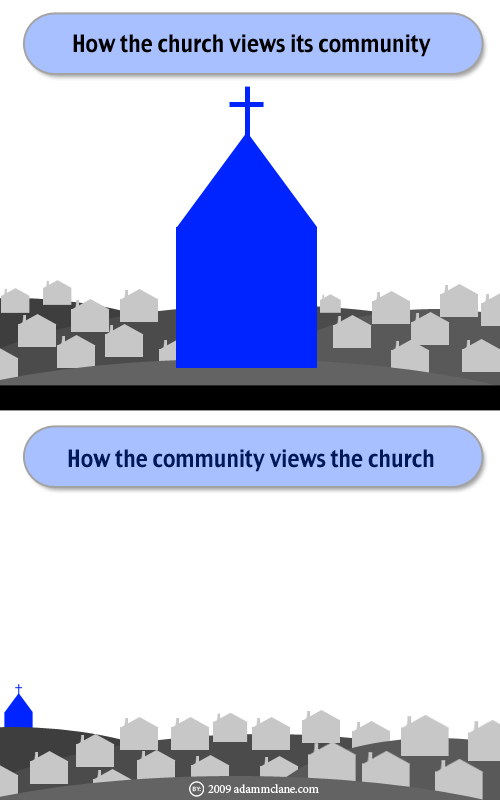
    There are two sides to every coin, aren’t there? I’ve had this post stuck in my head for several weeks– and I think the illustration says it all.

    Church leaders: Complacency sneaks in. We surround ourselves with people who go to church. We spend a lot of our time at the church. Our perspective becomes that the community revolves around activities at the church. Pretty soon we become ambivelent about the neighborhood we live in. Our schedule is defined on what’s convenient to those who come to church. Our agenda becomes to serve them.

    We perceive our ministry as a “city on a hill” when in fact the people living in our neighborhood are completely unaware of our existence. Before we know it, we are so comfortable with our programs, budgets, staff, and people who come to church we forget reality.

    The reality is that in most communities about 5% of the population attends a church. And yet we are comforable with that. Go ahead do the math yourself. Spend 30 minutes calling every church in your community and get actual attendence numbers. Next, simply divide that number by the population of your community. In most places that number is 5% or less of people who attend church on any given weekend. And we all know that just because someone attends church on Sunday doesn’t mean they are Christians, right?

    Why not take some time to get to know how 95% of the population views your church? Think of it like this. Count the next 20 cars that drive past your house. Only the 20th car will attend a church this weekend. In the illustration above there are 18 houses in view of that church. And none of them will attend that church this weekend. If your theology is like mine, you recognize that Jesus died for all 20 of the people in those cars and all 18 of the people who live in those houses. But who is our ministry serving? The 5% who show up. Most of our money and time is spent serving Jesus from the perspective of the 5% and not the 95%.

    That perspective should change things. 1 in 20 people will attend church this weekend. Any church. Even that church that is so bad you won’t even meet with the pastor to pray.

    I’m speaking to you out of deep gratitude for all that God has given me, and especially as I have responsibilities in relation to you. Living then, as every one of you does, in pure grace, it’s important that you not misinterpret yourselves as people who are bringing this goodness to God. No, God brings it all to you. The only accurate way to understand ourselves is by what God is and by what he does for us, not by what we are and what we do for him. Romans 12:3, The Message

    And yet church leaders reassure themselves that numbers don’t matter! This is the state of the church and people say we don’t need to fundamentally change how we do ministry. We worry about offending the 5%. We worry about changing too much too fast while our sworn enemy puts up victory statues all over. We follow leaders who look at this reality, shrug their shoulders, and move on with their lives. We go to denominiational meetings which agree to spend more money on organizations which are smaller every year. In short, we invest all of our time and energy in a broken model.

    And then when someone really breaks through. And that community reaches 6% of the population so we flock to hear how they did it? Got a book? Teach a seminar? Our perspective is jacked up, isn’t it?

    New leaders are needed. I dream of church leaders coming to the forefront who are drastically interested in the 95%. I long to surround myself with leaders who keep the 5% in perspective. We celebrate those lives changed! But I want to be with men and women who think differently. Where are the leaders who look at those 5% as just the beginning? Where are the people who recognize that a model cannot be built around an individuals talents? Where are the leaders who know they need to start a swarming movement?

    Point me to those people. I am tired of those who are satisfied with the failure of 5%.

  • The Blue Sweater

    the-blue-sweaterOver the past month or so I’ve been working my way through The Blue Sweater by Acumen Fund CEO Jacqueline Novogratz. I think this is a book worth reading for a number of reasons. Here are some high points.

    – Novogratz carries a general principle with her that makes a ton of sense: To change a families life you have to work with women. I wouldn’t label her a hardcore feminist, but her point is very valid. Traditionally in charity and community development the money goes to the men. The thing is that very little of that money ends up trickling back to the family. A much higher percentage of the income you invest in women goes towards educating, feeding, and investing in the home.

    – Novogratz sees her role in changing the world as a blend of charity and for-profit business. The old adage that “If you give a man a fish, he eats for a day. If you teach a man to fish he’ll feed his family forever” is an interesting sentiment but isn’t truly solving the problem. This book talks a lot about helping people set up businesses that are sustainable, run by locals on their terms, and yet holds them accountable for their actions. Those are qualities of an ecosystem worth chewing on.

    – Justice is beyond charity. There is a huge movement going on about mosquito nets. When Ashton Kutcher gave $100,000 to buy 100,000 mosquito nets this was both good and bad. While it is fantastic that $1 buys a mosquito net, it’d be way better if some of that $1 went to helping build a company that could produce and innovate those nets without the need for more charity. Charity is great… but it doesn’t go far enough to fix problems.

    – Dignity is more important than charity. For a lot of us who think about building systems upon which others can build their livelihood, it’s important to remeber that our role is to provide the system and get out of the way. A truly good system is a platform on which others can invest and trust.  The platform should take a backseat to the products developed for the platform.

    – For-profit is not evil. There is a sentiment of those who work for charitible organizations that anything for-profit is ignoble. I love how she shows for-profit being as important as non-profit and not-for-profit.

    Interwoven in these threads of thought, Jacqueline Novogratz shares stories from the rich tapestry of her life. Each story helps to form a patchwork quilt from various places in the developing world. From her first experience as a young co-ed where she discovers that a blue sweater she donated in America worn by a child in Africa to running a small bakery in Rawonda, to eventually creating The Acumen Fund, Jacqueline shows that she is crazy enough to change the world.

    For world changers and those longing to see the world a better place, The Blue Sweater is a great read.

  • The World Doesn’t Change Itself

    change-depends-on-you

    This weekend the family hosted my friend Andrew Marin. I suppose most people know Andy as a controversial speaker and author who is trying to help the church build bridges with the gay community. I know Andy more as a friend. We met last summer in preparing for National Youth Workers Convention where he was a general session speaker. In exchanging some Facebook messages  for a guest post I knew Andy was the real deal. There was something about him I instantly liked. Humble, yet bold. Courageous, with a healthy measure of fear. I could tell he had been biten by a few sheep as well. Then when we met in Sacramento he joined Cathy and I for a trio of fun that carried us all through the convention season.

    The point of this post isn’t my friendship with Andy.

    The point of this post isn’t that sheep bite.

    This post is about you and I bringing change to the world.

    The reason for change goes back to two core things which shape the world. First is the fall of man, which leads man towards a life in pursuit of sin, expressing enmity towards God and entropy in all systems of people. (Governments, local organizations, Christian organizations, etc.) Second is the redemption of mankind through the person and work of Jesus Christ. Jesus didn’t come to the world merely to provide a way to salvation and for us to patiently wait for the world to go to pot until His return. [Honestly, this is the view of the Evangelical church in the last 30 years.]

    No! The Gospel cannot be limited to a singular, man-focused individualistic message! He came, first and foremost to be the Savior of mankind… but He also charged the church to be His witnesses in Jerusalem, Judea, and the rest of the earth. He set us up to be agents of His. As Ephesians 2 points out… we (both individually as believers and as the church) were called by Him to do good works. We are meant to effect change. Our role as believers to to make life better. Our job in a life with Jesus is to change the world and make it a better place for others. Our desire must always be to fight systemic entropy. Our focus as belivers must be to continually force Jesus’ redemption into systems of church, government, charity, and friendship.

    The world will not right itself. The world will never wake up by itself and say… “You know what, we should stop this injustice. We should stop oppressing people. We should stop trapping them into slavery. We should stop corruption. We should stop stealing.”

    The world needs us to be agents of change. The world needs people who are absolutely driven, like Andy Marin. He is brave enough to look eye-to-eye with the most powerful men and women in Evangelicalism and say, “How you treat gay people is wrong. Let me help your church apply some principles that build bridges instead of walls.

    One of my favorite songs right now is John Mayer’s “Waiting on the World to Change.” I listen to it every Monday morning on my walk to work. It fires me up, it reminds me that I am not meant to wait for the world to change. I am meant to change the world. If you know Jesus as your Savior, you are meant to lean into the insane call of changing the world.

    Me and all my friends
    We’re all misunderstood
    They say we stand for nothing and
    There’s no way we ever could

    Now we see everything that’s going wrong
    With the world and those who lead it
    We just feel like we don’t have the means
    To rise above and beat it

    So we keep waiting
    Waiting on the world to change
    We keep on waiting
    Waiting on the world to change

    What are you waiting for?

  • Rethink Church

    HT to Sara who left this as a comment for the post, Church of the world and not of the church. I think Mr. Wesley would be proud.

  • How do we get to Youth Ministry 3.0?

    t_9780310668664I’ve been wrestling with the concepts of Marko’s book, Youth Ministry 3.0 for a long time. Actually, before I worked a YS I had been going through a prolonged set of discussions at Romeo saying in a thousand different ways… What I’m doing isn’t working anymore.

    The problem was simple. I was trained and experienced at how to do youth ministry a certain way. The entire ministry was built around a youth group night of games, worship, small groups, and a talk. I had seen it work and do incredible things! Even in Romeo we had seen this ministry model draw 40+ students to a church of 120. Lives were changed, kids were discipled, volunteers loved it, on and on. We ran that thing and worked that model like a well-oiled machine. I was well-versed in all the terminology of all the other well-oiled youth ministry systems and had written tons comparing and contrasting the strength of one model over the other. But in the last few years the model tanked. Kids stopped coming. The whole thing became kind of toxic. Instead of re-arranging their schedule to make in on Wednesday night all of a sudden kids were trying to find things to do on  Wednesday night so they could politely bow out. Frustration mounted and I kept saying, “What I’m doing isn’t working anymore.

    The crazy thing was my reaction to a YM 2.0 model. My response was always, even to the last day, “I know this works, something is just missing, that’s all.” I would tweak things here, re-emphasize this or that. It was never that the concept was broken. The problem was always either the kids not getting the vision of the model or my model not having the funding/support it needed to succeed. It never really dawned on me that my solution to fixing things was to kill the model and search for a better way to minister to students. My reaction was always to just work harder and to keep trying.

    Pray more, blame the parents. Pray more, blame the money. Pray more, blame myself. Pray more, blame the kids busyness. In the end I was royally frustrated and a little angry at God that He had me in a place where I couldn’t fix things.

    But as Marko’s book shows, there is a massive shift from what he calls “Youth Ministry 2.0” built around programs and models, towards “Youth Ministry 3.0” where the programmatic approach is, probably though not necessarily, foregone for a draw towards ministries built around affinity. (A super over-simplified analysis, right there!)

    My wrestling point right now is pretty simple… how do I help ministries kill what has worked for a generation and open their eyes to a way to reach this generation. My experience in YM 2.0 environments is that they’d be happy running an un-attended YM 2.0 model if that means they don’t have to change things. Youth workers may not like the sacred cows of big church but they have certainly built some sacred cows themselves. (Remember the fury over my articles, “I Kissed Retreats Goodbye?“)

    From a national perspective I’m seeing one trend that is scaring me and I don’t want it to be the solution: Killing youth ministry budgets, staffs, and programs. Please tell me that we’re not going to throw the baby out with the bath water? Simply because a model isn’t working doesn’t mean that we shouldn’t minister to adolescents!

    What is a more productive outcome than that?

  • Loop Artist

    Not only is it cool how this artist creates his craft, I think his message matches the theme of this blog.

    It is possible…

  • The Danger of Changes

    change-o-holicWhether it’s a business, a school, or a youth ministry or even a blog there is both fun and danger in change. Some would say that half of the fun of change is the danger.

    Good Catalyst
    Almost all of the change I deal with is neccesitated by the existing way not meeting expectations and/or goals. Somewhere in a meeting the team will decide that a radical change is needed because the existing “thing” just isn’t going to cut it anymore. It’s always a pure thought. It’s always a change for the better. And it’s always a change with the best of intentions.

    The Dark Side of Change

    There are some people lost in every change. For some recipients of the change, your customers or students or youth group kids or blog readers, the change becomes an opportunity to check out.

    In Romeo, a format change to the youth group meant that several students never came back. It wasn’t a judgment of the quality of the program… in the end, our changes just gave them an excuse to not come back.

    At adammclane.com I’ve never recovered all of the RSS subscribers I had when I was on Typepad. I went from 100+ to about 30 and have never gotten back to 100 RSS subscribers.

    Just today a blogger I follow announced he was moving from Blogger to WordPress and I decided this was a good time to stop following him. It’s not that I don’t care for him, it’s simply that I don’t care enough about his blog to both unsubscribe to his content and then go to his new site and re-subscribe.

    On and on this principle continues. A change is made and we accept a certain fallout percentage.

    So here’s the big question: Are those changes worth it?

    In hind site I would have rather kept those 70 subscribers to my blog and those 3-4 families in the youth group than embrace what was changed. Sure, in the process of changing I’ve gained new subscribers and now youth group has several fresh faces… but I’m left wondering if we could have had both if the old way was tweaked and not overhauled.

    No matter what you lead or have the power to change you have to weigh is the change I’m making for the potential of growing exponentially worth the loss of some people who won’t make the transition?

    I can think of many times when the answer to that is a resounding YES. But I can think of a couple where the answer is NO.

    So, fellow change-o-holics: Is change worth it or are there times the biggest risk we can take is to stay the same?

  • Paris Hilton is Totally Ready to Lead

    Looks like we’ve got another candidate to check out. And she claims she is hot. Is that with one “t” or two?

    See more Paris Hilton videos at Funny or Die

    True confession. I forgot to vote in the local primaries yesterday. Oops. I guess since I don’t plan on voting here in November it is probably better that way. Here are the results.