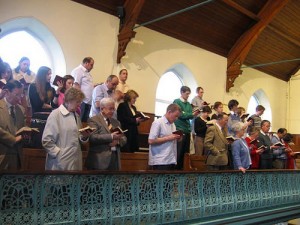
At least he's driving a Toyota – Photo by Tony Alter via Flicrk (Creative Commons)
When I was new in ministry I struggled with the idea that people were paying me to tell them what I thought. (About God, about how to live as a believer, and about a lot of other things.)
It took me a while to realize this simple fact: They don’t really care what I think. I’m just their pastor.
Knowing your role
Vanity is a constant temptation when you serve on church staff. Why? All of a sudden you recognize that people are learning about God based on how you are teaching them. They are worshipping God corporately in a way you are leading them. The way you structure things is how people begin to experience various attributes of God.
Based on your own observations– You are vitally important to how people know & worship God. You are the leader and they are following you. And that feels really, really good.
And that is really cool. And it feels really good. But, it’s also just a little, itsy bitsy baby step in your heart to slide from thinking, “This is how God has lead us to do things” to “This is how I lead others to God.”
If you fall into that temptation you begin to create an ivory tower for yourself. You begin, ever-so-Christian-slyly, to put yourself on a pedestal. And you really start to believe that people care what you think, that you deserve a special place of honor, that you’ve earned a parking spot in the parking lot with your name on it.
A service goes good and you go home thinking, “I AM THE MAN!” Someone takes a big step in their walk with Jesus and you Tweet, “Joe just gave his heart to Jesus over a cup of coffee. Thank you God, I make the most of EVERY opportunity.”
Vanity creeps in and its ugly.
It all crashes down when you leave. That’s the irony of the whole thing. You feel like you are really important some place until you leave your role. And then the next Sunday the alarm goes off and you wake up to realize– those people who were so loyal to me, they are going to go to church and worship God and learn from His Word without you there. [Insert tears, wailing, and gnashing of teeth sound.]
It doesn’t matter how good you are. They will replace you. And within a few weeks you’ll just be a memory. Two months later and people won’t hardly remember how things were when you are there. People just move on.
That’s when you discover that you weren’t nearly as important as the role you filled in their lives.
Resting in your role
Photo by Henry Burrows via Flickr (Creative Commons)
You are just filling a role in people’s lives.
That’s where I find tremendous comfort. I am just filling a role. Nothing more. It’s a good role. But it’s also just a role. And when I leave? Someone else will fill my role.
Ultimately, no one cares what I think… so I don’t have to think too hard about their questions. Instead, when people ask me what I think, I just tell them the truth. “No one cares what I think, I have no authority, let’s look at what the Bible says. It is God’s love letter to you and I. There’s truth there that will help you long after I’m gone.”
Whether you are a megachurch pastor of 25,000 people or a rookie with 4 kids in your youth group, there’s rest found in knowledge of your role. Your job is to point people to the person of Christ.
You are merely the servant who points people to them to the King and Lord of all.
On Evolution, Biology Teachers Stray From Lesson Plan
Researchers found that only 28 percent of biology teachers consistently follow the recommendations of the National Research Council to describe straightforwardly the evidence for evolution and explain the ways in which it is a unifying theme in all of biology. At the other extreme, 13 percent explicitly advocate creationism, and spend at least an hour of class time presenting it in a positive light.
That leaves what the authors call “the cautious 60 percent,” who avoid controversy by endorsing neither evolution nor its unscientific alternatives. In various ways, they compromise.
Here’s the kicker to the article: (read carefully)
But Dr. Moore is doubtful that more education is the answer. “These courses aren’t reaching the creationists,” he said. “They already know what evolution is. They were biology majors, or former biology students. They just reject what we told them.
No doubt this article will make a lot of Christians chuckle. As a whole we aren’t big fans of evolution, nor are we fans of the compulsory indoctrination of children to the theory.
In truth– we should cringe at what this reveals about our condition in youth ministry. We do the same thing.
Just like schools can’t get biology teachers to teach evolution the way the government requires, we often refuse to change the ways we minister to students. Just like America’s biology teachers, we can read study after study or attend seminar after seminar… but we are ultimately going to teach the way we want to teach using methods we want to use. To quote the article, “They just reject what we told them.”
If it was good enough to reach us, it must be good enough to reach today’s teenagers. Right? Wrong.
Truth + human behavior = no change
I could overwhelm you with evidence that your communication methods are ineffective. And you wouldn’t change.
I could show you longitudinal research proving that your programs don’t deepen a students walk with Jesus. And you wouldn’t change.
I could prove, from your own experience, that other methods of teaching Biblical truth could deeply impact your students. And you would not change.
I could show you study after study that shows that the way you do youth ministry reaches a decreasing percentage of students in your population. And you wouldn’t change.
I could point you to studies which show how certain types of strategies affect long-term change while others seem like they affect long-term change but ultimately don’t. And you wouldn’t change.
That’s not how change works. You and I don’t change for rational reasons. We say we do. But we don’t.
You can’t expect change from people who won’t acknowledge their failure.
Some of you will read that list above and say… “But if you showed me that evidence, I’d change.” No– you probably wouldn’t. You might say you will. But if I come back to you in six months you’d fill my time with excuses.
This is a big organization, it takes time to turn the Titanic. (True, but it sank in just a few hours.)
I couldn’t convince leadership to make any of those changes. (Um, and they call you a leader?)
We already had a plan when we learned those things, but we are planning on implementing them this summer. (Really? I bet if the internet broke in your building you’d get it fixed today.)
I want to do things differently but we run this ministry as a team. (Consensus is the way to go. Just ask the federal government how that’s working for them.)
Change is intrinsic. That’s why extrinsic evidence is often a waste of brain cells.
You won’t change who you minister to until something changes in your heart. You won’t change how your programs work until something changes inside of you. Your behavior won’t change until you take the time to internalize who you are, what you believe, why you do this, and count the cost of change.
Each of us in youth ministry is faced with the same challenge. We are called by God to help adults form meaningful connections with adolescents. And we are called to go and reach students with the Good News of Jesus Christ.
Will we continue to do things the way we have always done them and watch the church reach 8% of the population. 7%, 5%, 2%… 1%. Or will we snap out of our trance, look in the mirror, and make the changes in ourselves needed to reverse that trend?
“Wake up, sleeper,
rise from the dead,
and Christ will shine on you.”
That’s the goal of our high school ministries Winter retreat.
I’m not talking about a cash neutral event to the youth budget. I’m talking about… we’ve got no money so we need to do this retreat for free. We don’t have budget money and our students literally have no cash to offset expenses.
Here’s what we’re trying to do:
Create a memorable, kinetic, outside-of-our-neighborhood, experience with our high school group. We need this retreat. It’ll be good for the students and it’ll be good for the group.
Here’s how we’re going to do it
Beg: I’m not too proud to beg. Especially when it comes to the faith development of the students in our ministry. Fortunately, when it came to location, I didn’t even have to beg. I just asked a Kingdom-minded friend if we could crash his youth building for 30 hours. When I visited Danny Long earlier this fall and saw his facilities (about 30 minutes from City Heights, but far enough into East County to feel completely separate from the urban environment.) I asked if it might be a possibility to use his building for a retreat. Without flinching he was happy to do it.
Next up, Kathy (our youth pastor) asked her cousin to lead worship. Done. Teaching? I’m pretty sure we’ll split those duties. Now we’re out begging for folks to pick up the tab on our Costco run for food for the retreat.
All that’s left is to beg off some programming elements. One of the tricks I learned from retreat-guru Lars Rood [author of an upcoming YS book on doing ministry for cost-neutral or free] was to not skimp on experience. So we are officially on the lookout to bring something to this retreat that our students from City Heights completely unexpected. (Horseback riding, sledding, paintball, or something along those lines.)
Borrow: We’re going to borrow ideas. Darn near all of them. Why spend all the time thinking up stuff when we can take things people are already offering for free and tweak them to work in our ministry/ From activity ideas to theme to kitchen appliances.
Steal: OK, we’re not going to steal anything. But we are stealing victory from the enemy by doing something we can’t afford for free. We might not be a resource rich ministry, but we are a resourceful group who aren’t ashamed to rely on the Kingdom.
Have you ever done a ministry event like this? If so, leave a comment and share your idea. [So I can steal it.]
Right out of college, Kristen and I were full of ideals about where we wanted to serve in a local church.
We had a list of things we were looking for: Having been in the midwest for eight years we were ready for a geographical change. We wanted to see mountains and take a break from winter weather. We wanted a ministry in a small town that reached out to kids from broken homes, loving the unloveable. And we wanted to leave the big church world for the medium-sized church world where I could be involved in more than just one program.
When we found the right place in Northern California. We looked past the rough parts of the job (Which would lead to us staying only a year) to tried to see the diamond in the rough. The ministry was in the foothills of the Sierra Nevada mountains. It boasted the highest teen pregnancy and teen drug abuse rates in California. It was a strong, medium-sized church, and I’d have responsibilities in a bunch of areas.
In truth, being my first experience in looking for a full-time ministry I asked all the right questions but didn’t listen for the right nuances to the answers. It was perfect and wrong at the same time.
Worse yet, when it came down to talking about my salary package I based our salary off of what I hoped we could live on instead of what things were really going to cost. Visiting this small town with a big city mindset I just couldn’t have seen some of the hidden costs of living in the middle of nowhere.
About 60 days into our new life in rural California I came to a painful realization. I had misunderstood what my utilities were going to cost in making my budgets and we were in trouble every month. (Water and electric were about 400% more than our place in Chicago. Combined, they totaled what I was paying in rent.) I had flat out negotiated for the wrong salary.
I sweated out a couple of months hoping that it was just a fluke and we’d settle into a more affordable reality.
It didn’t happen.
Every month we had too much expense and not enough income. Kristen and I cut back and cut back. We cut back to the point where we were spending less but we just didn’t have enough for groceries. (About $100/month was all that was left over after fixed expenses.) A hundred dollars was basically covering formula and the basics. In truth, the only way we were making it was by accepting every offer for a meal that came our way! (After church every Sunday, every party people from the church had, stuff like that.) Another trick to hide our meal shortage was that I started taking tons of high school students out to talk so I could take them out so I could buy a meal and put it on the church credit card. (Taking home the leftovers was part of the deal.)
But, as financial pressures tend to go, this was really stressing us out and stealing our joy.
With my tail between my legs I took our budget to the elders. It was humbling to look at these older men and admit that I was going broke and needed help. I’ll never forget opening up my laptop and showing them the numbers on Microsoft Money. It was humiliating.
Since the church was doing well financially I had hoped they would just increase my salary by a few hundred dollars per month to alleviate the pressure.
I couldn’t have been more wrong.
They chuckled. No, they laughed at me. They gave me the small town vs. city slicker grin I had long ago tired of. And they came back with two possible solutions. (Three if you count the sarcastic “you can live in a tent in my backyard” comments.)
Apply for WIC and/or welfare.
Allow the people of the church to offer you welfare.
I chose the latter. And the elders quietly began to let it be known that those city slicker McLane’s needed food.
From humiliation to humbled
You know, as a pastor, you know in your head that your salary comes through the offering plate and that you, in turn, have enough to pay your bills because people give. You feel it but you don’t really see it as the process is rather sterile.
But when you hear someone pull into your gravel driveway and get out of the car with a paper bag full of vegetables from their garden or a hen they’ve raised from a chick– it changes your perception of an offering.
Our little family literally ate people’s first fruits of our churches labor.
And it changed us forever.
What had once robbed our joy became one of the few sources of joy in a ministry experience of sorrow.
[The crowd raises to its feet and cheers as the band begins to play…]
These are guaranteed anthems to bring a church to its feet.
But I’m left wondering if our ecclesiology is a little too big?
“It looks like your eyes were bigger than your stomach.” That’s what my mom used to say when I put too much food on my plate at dinner.
And I think that’s the strategic error of many churches.
I know it’s the strategic error of most believers.
Most churches mission statements tell the people the goal is to reach the world… and when we aim at that we get nearly nothing because it’s too big.
Isn’t our job to love our neighbors as ourselves and put God first? (Mark 12:28-31)
Isn’t my job, then, to love my neighbors? Like the ones who live next door? Or down the block? Or maybe as far as around the corner? Isn’t that why God, in His infinite wisdom, placed me in my neighborhood?
Yes, it is. That is the business God has clearly called you to. He has called you to be good news to your neighborhood.
Every other type of ministry you do is secondary to that. To take it a step further… every other ministry you have which gets in the way of what Jesus calls the second most important command, is unnecessary. Until you can love your neighbors as yourself you have no business doing anything else. (Yeah, including those who work in churches. I’m looking at you.)
Step 1: Get to know your neighbors
Loving your neighbors isn’t hard. You were created in Christ Jesus to do it. It takes no training. And it takes no special skills. This is what you need to do.
Get to know your neighbors names. If your yard touches theirs get to know their names. If they are across the street they are your neighbors, too. Each neighborhood is a bit different. But just start with the people immediately around your residence.
When you see them… stop and say hello. Talk to your neighbors. These are people God foreknew you to know. You don’t need an agenda, just be friendly.
Keep your eyes open and your ears open. When you can see they need help, do what you can.
When you need help, ask your neighbors. Sometimes exhibiting some dependency is the perfect open door to getting to know someone.
Over time, learn to depend on one another. Maybe your neighbor is a little older and you have a snow blower. Start shoveling the walk. When you go out of town, ask them to pick up the mail.
As you do this process, the Holy Spirit will begin to reveal to you next steps. Maybe it’ll be to host a neighborhood BBQ? Or maybe it’ll be to help find a lost dog? It could be any number of things… but it probably isn’t to invite them to church or to give them a flyer. God didn’t ask you to bring people to hear the Gospel at your church. He empowered you to bring the Gospel to your neighbors through your love for them.
What are you waiting for? The power of the Gospel will prevail when you set out to be Good News in your neighborhood.
A few weeks back I wrote about something I call, the Pastor Man Up Movement. (PMUM) There’s something about PMUM that annoys me and I’ve been trying to figure out exactly what it is.
Is it that its mostly men and I have a strong desire to see women lead? Maybe a little.
Is it that its mostly racially homogenous? Maybe a little, but I’m a white male too. So what do I know?
While both of those things annoy me a tad about PMUM speakers/writes I can’t say that its contributing to the distaste I get when I hear one of these people talk about leadership.
I’ve been trying to search myself so I can articulate it. (And I want to be careful that I use words like “annoy” and “distaste” so people aren’t thinking I’m just some bizarre hater of well-known PMUM leaders.)
But here is one thing that I know doesn’t resonate with me when I listen to them talk about leadership:
Leadership isn’t about celebrating yourself.
Leadership is about moving people to do something or go somewhere they couldn’t go on their own.
Ultimately, one thing that bothers me so much is the celebration of self. You hear introductions that laud how much they’ve accomplished. How much money they raised. Where they went to school. How many people go to their church. That they are the founder of their congregation which is larger than yours. How often they meet other famous leaders. And why you should believe that every word flowing from their mouth is like little leftovers that the Holy Spirit forgot to include in the canon saved especially for you, as if it were milk and honey saved just for you… this one time.
Want to know who I want to admire? I want to admire a person who leaks transparency. I want to hear from a person who doesn’t want the microphone. I want to admire a person who doesn’t know how many books he’s sold or how many people go to his church or how many staff members he has.
I want to hear a speaker who stands up and tells the audience as her into, “Want to know why people follow me? Me too. I haven’t got a clue. God is doing it through me. I’m just a knucklehead. Know that I’m a sinner and it’s by grace that I’m standing here today. My husband and I argued about me making this appearance, but I guess we just need the money. And the message I’m about to deliver this morning– don’t get hung up on it. I have a staff who helped me and I have delivered it for 14 times. I call this my $22,000 sermon. After today, it’s my $22,500 sermon. Don’t be impressed with me today, be impressed with how God is using me to minister to you today.”
I know that isn’t exactly inspiring to most. But its the kind of leader I like to follow. (And its the kind of leader I aspire to be.) I don’t know if people would spend $100 to listen to a series of speakers talk like that. But I do know it’s worth $100, for me at least, to hear the truth over and over again.
Just hit me with the hammer God has gifted you to hit me with.
Honesty preachers to me.
Transparency preaches to me.
Humility preaches to me.
Checking what I assume against what is clear in Scripture preaches to me.
I know people in youth ministry from the “biggest and best churches” in America. And I know people in youth ministry in the tiniest churches in America.
And both people have the same complaints and struggles– ministry life sucks for family life.
My response to that?
So what? Cope and deal. Do the best you can.
Ministry people aren’t alone in struggling to put family first. Any and every profession has the same struggle. Our desire to make full-time ministry this heroic effort and sacrifice to our family is humiliating to the people who make the same sacrifices to finance our vision. Not to mention– nearly half the people we are trying to reach are single parents who have to put work first in order to just keep their family afloat.
The reality is that “family first” is a marketing line that has been repeated to the point where we think it is some sort of biblical by-law. It’s hardly a biblical mandate. I seem to remember Jesus’ call to his disciples being to leave family and put him first. Offering yourself as a living sacrifice (Romans 12:1) doesn’t have an out clause for parents of young children. On and on… there simply aren’t calls to a a life in ministry, biblically, that are “family first.”
It is something we believe to be true which just isn’t in the Bible.
Sorry.
Even in an agrarian society, which you hear family-first people constantly refer to, it’s not like dad has a stay-at-home job. Have you ever visited a farm? Family-friendly workplace is not a description I’d use to describe a dairy farm. Or a family growing corn. Or even our local organic farm that supplies our CSA.
Family-first people also reference pre-Industrial Colonial times as this idealistic time of parenting where mom and dad patiently did homework or taught a skill to their sons and daughters. What history books are these people smoking? I could point to any biography of an early American success story and their life was hardly “family-friendly.” It’s funny how revisionism is a two-way street, isn’t it?
The Secret Ingredient of Success
Success, by any definition, has not changed in its core ingredient, since the stone ages.
You’ve got to want it.
Or you’ve got to steal it.
Let’s assume that you the type of person who prefers the former over the latter.
You’ve got to want it more than the person next to you.
You’ve got to outwork, out-hustle, out-whatever everyone you know.
You’ve got to wake up wanting it.
You’ve got to lay your head down in knowledge that you didn’t want it enough.
You’ve got to throw balance out the window.
You’ve got to Cats in the Cradle it.
The bottom line is that if you are driven by some ideal of success, however you define it… it’ll own you more than you own it.
And the reality is that once most people figure out that the dreams they had as children involved all of that– they redefine happiness around a new kind of success.
That’s why “family first” is a different mantra of success.
That’s why successful people get on Oprah or Barbara Walters and tell the camera that they chased success and they lost their family and now they have regrets. But they aren’t giving success back. They aren’t returning the awards or the money. They are spending their time on easy street trying to make up for lost time.
Can I be in full-time ministry and put my family first?
Call me a heretic. But I don’t think that’s what Jesus called me to. I think in the New Testament example Jesus called us to put family second.
Fortunately for me, I’m married to a woman radical and crazy like me. Together, we get it.
Does your skill level match the level of difficulty in your ministry?
I’ll admit it.I’m a recovering video game junky. Up until Madden 2005 I used to incessantly play anything football EA Sports produced.
One of the fun things about the Madden games is that you can adjust the level of difficulty to match your skill level in the game. So, if you were new, you could set it to easy and still have a good time. Then, theoretically, as your skills improved you could turn the game up so that it remained challenging.
One of the great injustices in the ministry world is that there is often a disconnect between the skill level of a staff member and the level of difficulty in a ministry setting.
In general, those who have a low skill level (new to ministry) are only able to get jobs in ministry locations labeled difficult or expert. Meanwhile, veteran church workers tend to flow towards jobs on larger teams in healthier ministries where the level of difficulty is significantly better matched to their skill level. (Not easy, per se. But ministries which match their skill level.)
In the past few years I’ve had countless conversations with pastors in way, way over their head. They’ve been in ministry a short amount of time and are in situations with no support, politics leaning hard against them, and socially isolated from people who think like them. They slump their shoulders as we sit down for breakfast, “Adam, am I crazy? Why does serving Jesus hurt this bad?”
Why are these people hurting?
Because they are in ministry settings where the level of difficulty is a miss-match.
The Way it Works
We have a Darwinian approach to ministry jobs. Our church culture dictates that the newest, greenest, and least capable among us serve at the gnarliest of ministry sites. A youth pastor takes her first time job, replacing a youth pastor fired for sleeping with a student. A worship pastor hired from a larger church to lead a ministry from traditional worship to contemporary. A senior pastor right out of seminary replaces a long-tenured wise owl who retired after 40 years of successful ministry. A children’s worker will accept a calling to a church plant where they have to go out and raise their support while somehow trying to create a children’s program from scratch.
All expert level ministry jobs performed by newbie staff members. They don’t stand a chance.
A large majority of these newbies will get washed out of their first jobs in the first 2-3 years. Battered and bruised, about half will lick their wounds and find non-ministry vocations before they’ve even paid off their seminary loans.
Yet, a small minority will learn their lessons from these impossible ministry situations and move to more healthy levels of difficulty. Eventually, through survival of the fittest, a small minority manage to work their way into roles that are matched with their skill level… or maybe a little mismatched so that they are in jobs significantly easy compared to their skill level. (You know who you are.)
In other words, those of us with high levels of expertise gravitate to the easier jobs while our success in roles made to look easy encourages countless others into the flames of despair at the hard jobs.
The Way it Ought to Work
Ministry experts should flow to the expert level jobs. Jobs in healthy ministries should hire more newbies for shorter periods of time in order to increase their skill level and help match them with jobs that best suit their long-term skill level and interest.
This would perpetrate a mantra of healthy churches helping unhealthy ones instead of visa versa.
I have a fervent belief that if we want to reach a post-Christian society, we have to be Good News before someone will listen to Good News.
I asked some teachers, “How could a local church be Good News to your public school?” Here are 10 of their ideas.
Create a team that participates at every school board meeting. Your presence at meetings, without bringing forward issues, will communicate to the decision makers that your church cares.
Sponsor a community-wide clean-up day during the Fall and Spring semester. If you lead the charge, other churches and community organizations will join forces.
Ask teachers to post individual classroom needs on Donors Choose, and then ask church members to help fund things that will go directly to the classroom.
Set-up a tutoring program that meets in your building after school. (Example) You don’t have to be a certified teacher to help kids with math, science, and reading homework.
Ask your congregation to strategically send their children to public schools. Resist the temptation to home school or send children to a private school. Instead, ask the congregation to invest that time and money into their children’s individual classrooms.
Schools are often lacking volunteers for events. Meet with the principal early in the Fall and find out which events need help.
Have the church cover any expenses for background checks or medical tests related to volunteering in schools. Sometimes the smallest obstacle becomes the biggest excuse!
Once a month, provide treats to the school staff. Every school has a teachers lounge and every employee of the school will appreciate if you provide a bagels or a healthy lunch snack. (Don’t just bless the teachers, bring enough for everyone!) Trust me, this will make even the most hardcore staff smile.
Many districts have cut spending on arts and music. Have your worship leader work with local administrators to set-up workshops, after school, or any opportunity for children to get exposure to art and music.
Find out what projects are important at a school and help provide the supplies. If they have a garden, make sure they have tools. If they are allowing children to paint murals, make sure they have the paint they want.
Want to get started? Pick one and let me know how it goes!
These are my ideas. What are yours?
Many of these ideas came from classroom teachers. Special thanks to Erin, Annie, and Paul for speaking into this post.
A youth worker in Minnesota asked me to share my definition of worship with her as part of a lesson she’s preparing for her youth group. I thought it’d be fun to post my response to her (with her permission) for a couple of reasons.
I hadn’t thought about it like this before.
I like it when people call me a heretic.
What is worship?
I think the English word for worship is limiting versus what God asks of us. So I break up the act of worship into a bunch different categories. (Not limited to this list)
We come together to worship God in community.
We spend time in prayer, fasting, song, reading of Scripture individually.
Our work is worship.
Our attitude is worship.
When I give my talents and treasure to God, that is an act of worship.
When I journal, that is worship.
When I am alone with my wife, that is worship.
Everything I do… I can do as worship of God.
Now, how do I define worship? Worship is any intentional human actions which bring glory and honor to God.
What do you think? Is the intention what makes an act worship? Or have I overstated what worship can be?