After three amazing years of working at Youth Specialties, it’s with a crazy concoction of sadness and excitement, that I’m sharing today that I’m leaving Youth Specialties to start a new venture. It’s impossible to put into words the emotions I felt just now as I wrote, then again as I rewrote, and over the past weeks as I’ve meditated on having to write those words. Truly, few jobs could have shaped, challenged, encouraged, and forced me to grow more than these past three years at YS.
My hope is that I’ve received the gift which my time at YS was and it’ll act as a springboard for my next season in life.
At the same time, from a different place of emotion, I am bouncing up and down with excitement for the opportunity I have to partner with my friend Marko (Mark Oestreicher) in launching The Youth Cartel.
I told you it was a crazy concoction of emotions!
My last day as an official YS staff person will be August 31st and I’ll start my new role with The Youth Cartel on September 1st. I’m still coming to both NYWC in San Diego & Atlanta as a seminar speaker, fish bowl moderator, and presenter in the multimedia area. So I hope to see you at convention! Likewise, with my new role, I’ll have more free time at convention to chat with fellow attendees instead of racing from thing to thing.
First — A Look Inside My Head
The last several months have been incredible. The Spirit has been at work in our house, shaking things up and reassuring us at the same time. He has used many people to speak bold unmistakeable truth to us. We’ve had deep, long conversations with trusted friends, and even remarks from others such as, “Maybe your just doing what you’re doing to learn?” Or “I feel like God wants you to dream bigger.” Or even, “We’re wondering just how serious you are about San Diego. Do you want to be here for a long time?”
Into those messages have come some close friends, acting as a discernment group, helping Kristen and I weave together what we needed to do vs. what our heart might have been telling us. In the last several weeks, as we really dug into this thing, that group of men helped me (specifically) see past my own expectations and limitations and get a plain view of what God was calling me to do. (I’ll have to write about the wisdom of plurality in decisions another day.)
More important than even those outside voices has been the voice of Kristen. At every turn she’s been bold in telling me the truth. And when I said, “What do you think about this thing with Marko? A start-up is crazy.” She just looked at me and said, “It sounds crazy enough to be a lot of fun.” Yesterday I wrote a post about being bold and courageous. She lives that out better than anyone I know.
Housekeeping, literally house-keeping. Unlike a lot of ministry moves this life-change means we are staying put in San Diego and have no intention of moving any time soon. I’ve re-upped my San Diego State football tickets and added men’s basketball, as well. I mean… what’s not to love about San Diego?
Second — A Look Ahead
Stoked isn’t quite the right word for what I feel about The Youth Cartel. Marko and I have continued to grow closer as friends over the past three years. Originally, I thought maybe God was asking me to start my own youth ministry organization. But as Marko and I shared our hopes and dreams for youth ministry it became abundantly clear we needed to work together. Our byline is “Instigating a Youth Ministry Revolution.” If you’ve ever been with me for more than 20 minutes you know that’s what I’m all about. This venture is all about finding and elevating new ideas, new voices, and a new era of youth ministry. It’s that “sharedness” that drew Marko and I together to do this. As I shared in the video, we have some cool stuff in the works. And I can’t wait to give my full attention to this in September.
A fun sidenote: This is my second youth ministry start-up. My first, Youth Ministry Exchange, Marko led the way in buying from me in 2008.
Third — A Look at the Big Picture
What’s crazier than one start-up? Simultaneously running two start-ups. I’ll be sharing my time between The Youth Cartel and McLane Creative. To some degree, both organizations operate in very similar ways so it’s a natural compliment. I’ll continue growing McLane Creative with innovative design, marketing services, and coaching with my non-church clients. And all of my church/youth ministry related stuff will be part of The Youth Cartel. My hope, long-term, is that I can stay involved with both as they grow, with eventually handing over the day-to-day operations of the design firm to a protege`. (Or even one of my kids!)
That’s my news. If you have questions, leave me a comment (public) or even use my contact page. (private)
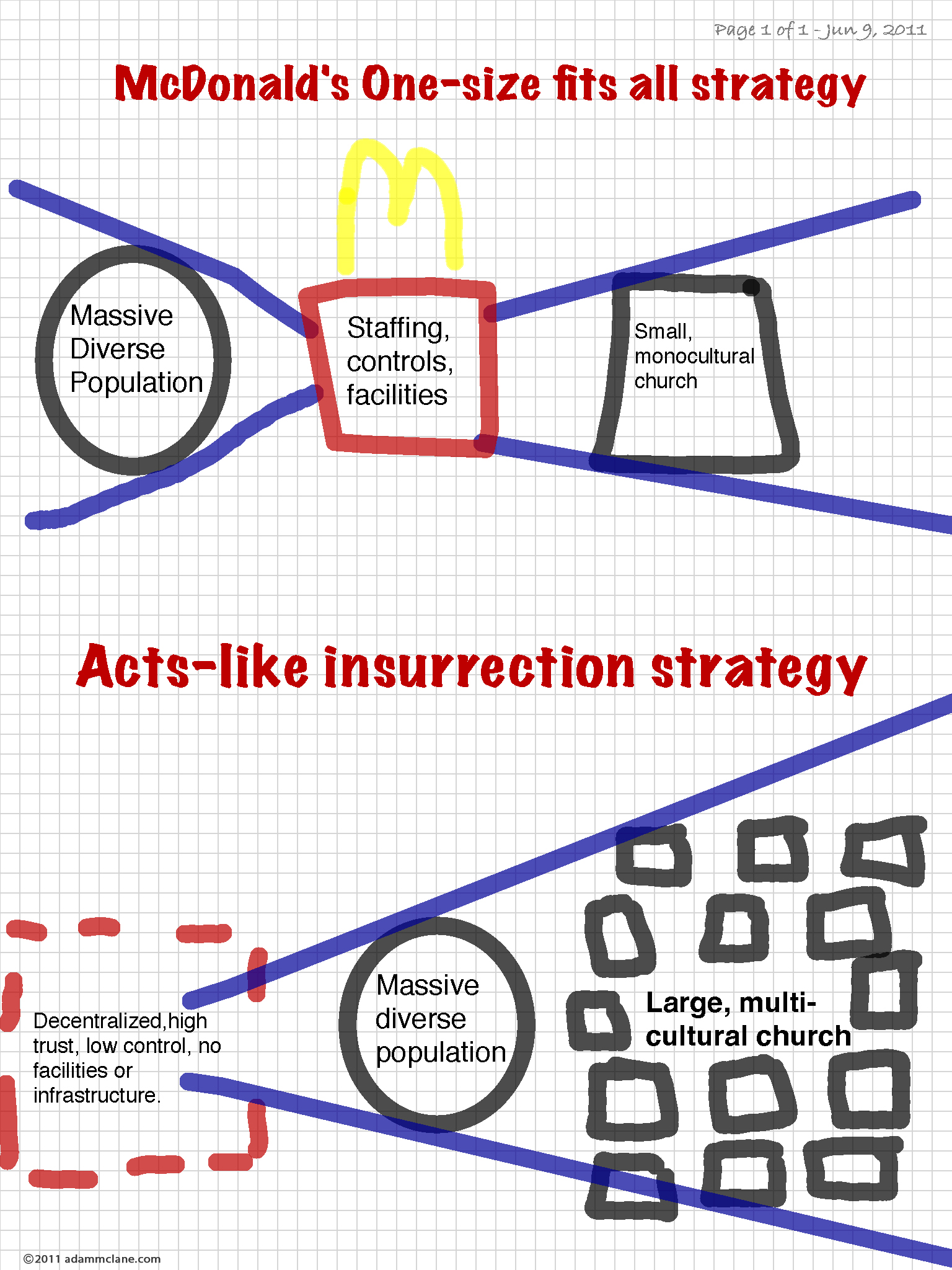
The problem with one-size fits all is… One-size doesn’t fit all.
We are faced with a tiny percentage of the population actively involved in the local church. (>10%) Yet, I’m continually perplexed to see no one looking hard at the big, obvious problems of bottlenecks & gatekeepers which keep churches small with a strategy that lost its effectiveness 25 years ago.
Most churches have the same exact strategy. It’s the manifestations of that strategy which differ.
Faced with impossible statistical opposition first Century church leaders in Acts rejected the culturally accepted strategy of building a religion. Instead, they decentralized power, they empowered the powerless and served the cast-offs, and they didn’t get tied down to buildings, staffing, and overhead. As a direct result within 200 years this ragtag insurrection and their Gospel message essentially overthrew the government of Rome. Statistically speaking, when they got away from that and started to act like a religion with firm control, structure, and facilities… the churches growth slowed.
Simply put. The reason we are reaching >10% of the population is that we have replaced a rebellion for nice.
To reach more people you don’t need a new program.
“You are crazy enough to think you can change the world.”
This was the negative criticism of my ministry nearly 10 years ago by an elder. I took it as a compliment.
When I read Revelation 2-3 I see that Jesus will not judge individual churches or communities of faith. That’s not what John saw. (Revelation 1:19) Instead,
I see Jesus judging entire towns based on both what they’ve done and where their hearts are collectively.
As we look forward to that future judgment, we as church leaders in each community cannot be satisfied with reaching 5%-10% of the population. A logical conclusion would be that how we are doing things will only result in reaching 5%-10% of the population going forward. Simply put, f we want to reach exponentially more we, collectively, must change.
Most people realize that. But they don’t actually know how to make change happen.
Here are 5 ways I make change happen:
Present the facts, repeat them often, write them on the walls. Do your homework, get behind the evidence.
Persistence. Be a bulldog. Don’t let the issue die. No isn’t an answer, it’s an opportunity to try a different approach.
Stop the presses. If something is really important you need to stop everything else, at all cost. We can’t go on like this.
Tell a great story. Remember, a well-told story is your most powerful weapon.
Outwork everyone else. Know why everyone says hard work pays off? Because it does. You can’t ignore hard work.
Last year, Kristen and I made a commitment to grow organically or buy organically 25% of our families food. For us, that has meant starting and maintaing a garden.
A native suburbanite, I’ve discovered many revelations about my perceptions of a healthy church shattered by the realities of staying in tune with more agrarian things in my backyard.
The title of pastor is agrarian by etymology. To manage a flock is different than managing a business. Jesus could have chose to describe church leaders as business owners or organizational leaders… but instead Jesus chose an agrarian term, pastor.
Here are 5 things that gardens teach us about healthy churches:
Healthy organisms replicate. The hallmark of a good plant is its fruit. And the reason a plant creates fruit is simple: To replicate. Conversely, the mission of a church isn’t to grow infinitely, it’s to replicate and make impact on the community it serves. If it isn’t replicating (producing fruit) than it’s just wasting space. (Matthew 3:12)
In order to grow strong you must water & feed regularly. I need to make sure my plants have sun, water, fertilizer, (organic, of course) and good soil. In order for the church to be healthy, you need to do the hard work of making sure you have healthy conditions for your church to grow. Are you teaching good stuff? Are you grounded in your mission? Is your staff team feeding from God’s Word? Are you leading people to be dependent on you… or are you teaching them to feed themselves?
In order to produce good fruit you must weed & prune. Last year, I got enamored with a tomato plant which grew to more than 20 feet tall. It was exciting to see how big that plant would get. But the bad thing was that it choked out the growth of all the plants around it. That taught me a valuable lesson about pruning. The goal isn’t just to have one healthy plant in the garden, to have a healthy garden all of the plants need to be healthy. Which means I need to keep up with weeding and pruning. Likewise, a good pastor weeds & prunes his church regularly. He doesn’t wait for big problems to arise before acting. He nips things in the bud. (A pruning pun for you.)
Everything tastes better when its home grown. We love our CSA. Every two weeks we pick up a great big box of locally grown fresh fruits and vegetables. But, in all honesty, that stuff is no where near as tasty as the stuff we grow in our backyard. And stuff we buy from the supermarket… that’s like ordering a salisbury steak when you can have prime rib. Too many churches go to the supermarket instead of looking at their garden for talent and ideas. There’s nothing wrong with going to the supermarket. But growing your own talent and implementing your own ideas is so much more sweet.
Healthy gardens are a habitat to many species, not just the plants. At any given time I have 5-10 different types of things I’m growing in my garden. But at the same time my garden has a whole ecosystem of other plants, animals, bugs, and crawly things which survive and thrive off of our garden. There are bugs that hang out by our compost heap. There are different little plants supported by the back spillage of our drip watering system. There are good bugs who eat bad bugs. There are bees who pollenate. And there are birds who live in our yard who live off of the bugs. The same is true in a church. When you let go of control and instead chose to create a healthy environment, an entire ecosystem of impact unfolds.
Our title of pastor is describing something agrarian. For most of us, like myself, we grew up completely separated from all things farming. Perhaps more of us need to spend more time in the garden or in the fields tending to flocks to understand the simplicity and complexity of our roles?
What do you think? Should seminaries and conferences offer tracks which send you to the farm?
A living exhibit of current apps being sold. Photo HT to Sachin Agarwal
More than 1 billion apps have been downloaded from the iTunes app store. Believe it or not, there are lots of people who still don’t think of it as a serious marketplace. A billion is 1,000 million folks. That’s pretty serious.
Here are 5 things that the app store has taught me
Free is a legitimate business plan.
Financial success isn’t so much about profit margins, it’s about price point.
Traditional high margin businesses with complicated business plans can’t compete.
The one hit wonder is just as powerful today as it was yesterday.
Big business will always manipulate a free market system.
Some brief explanations to unpack the list above.
Free is a legitimate business plan
Would you have an account on Facebook, Twitter, or Gmail if it cost you $2.99 each to belong? Of course not. But how did Google, Twitter, and Facebook get to become some of the most powerful companies in the world without charging you a dime? TV has been doing it for years.
Financial success isn’t so much about profit margins, it’s about price point
When I developed my first apps for YS, the content was valued based on the retail price of the book. Consequently, they never took off. People aren’t going to pay the same $7.99 for an app version of a book that they’d pay for a hard copy because the perceived value is different. The question app buyers are asking is, “Will I get the free version or will I pay $.99?” Remember… all of Facebook, Google, and Twitter are 100% FREE! So your buyer wants to know why your app, compared to what they know is already free, has more value to them than that. To pay more than $.99 for an app you have to demonstrate ridiculous value. Consequently, if you lower your price point or eliminate the cost, you will access millions more customers and potentially make infinitely more money as a result.
Traditional businesses with complicated business plans can’t compete
Traditional media and brick/mortar retailers are struggling to figure out how to take advantage of apps. Look for yourself. Retailers apps aren’t really necessary but are just attempts to have “something” in the app store. An online catalog is pointless because of Google. A store finder is pointless because of Google Maps. Most traditional brands apps aren’t adding value– they are marketing. And people are extraordinarily good at sniffing out marketing thanks to the popularity of bloggers like Seth Godin. Companies with simple business plans are beating them in the app store because simple business plans have lower overhead, can take more brand risk, are more nimble, and will rely less on expensive “experts.” (If an app maker is an “expert” than why would they sell your company something for thousands when “experts” are becoming millionaires? Additionally, the counter-intuitive business strategy of free is nearly impossible for traditional business leaders to comprehend.
The one hit wonder is just as powerful today as it was yesterday
Angry Birds is to the app store what Don McLean is to the record business. Except we live in an age when a company that has a one-hit wonder in the app business will get a royalty checks from Apple for millions of dollars per month. Not bad for some college students from Finland, eh? Take that– Mattel or EA or any of the other major players in the game industry! Each of the original creators of Angry Birds will not only make a lot of money off of Angry Birds… they are now solid gold for life.
Big business will always manipulate a free market system
The editors at Apple have always claimed a certain level of editorial control of the app market. In other words the stuff at the top of the pile is at the top of the pile mostly because it is the best in the marketplace. But, in truth, they have allowed that to be manipulated by some levels of marketing of new stuff. Go to the app store today on your iPod, iPhone, or iPad and you will see ads for featured items. That wasn’t free and it is almost always big, publicly traded companies, who have bought that influence. Consequently, some of the biggest selling apps are not, indeed, the best apps in a totally free marketplace. There has been some manipulation.
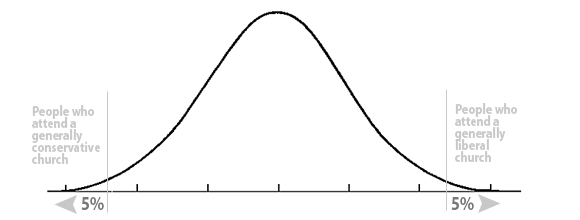
As I think about the church and the 5%-10% of people we reach in the community I wonder where we fall on the bell curve.
Something tells me that it looks a little like this.
I wonder if the positions we take attracts, appeals to, and connects a certain type of people? And I wonder if church leaders are going for the sucker pin of thinking of going more conservative (politically/socially/by American cultural definitions) or more liberal is going to lead to growth in their congregation? However, this is counter to what we know about behavior from the bell curve. This just means that to attract more people “like us” we need to have a wider reach and draw people from a larger and larger geographic area.
Sidebar: Now, immediately I have some people who will read this upset because they don’t really like my labels. And they especially don’t like that I’ve lumped nearly all churches into two categories. And some are going to be quick to point out ways that their church is neither liberal nor conservative. That’s OK. This is just some generalization and hyperbole to make a point.
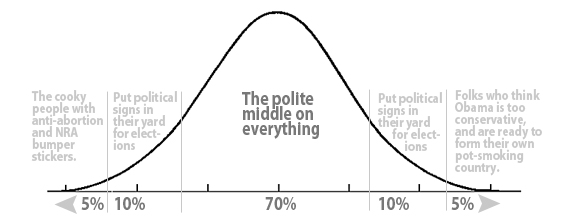
Here’s my neighborhood on the bell curve. Again, full of hyperbole and generality.
Our neighborhood is not unlike any other urban or suburban neighborhood I’ve lived in. We have our cooky people on the fringes, we have our people who are just a little bit political, but who will quickly drop it for the sake of community… and we have the vast majority of people who probably have some personal opinions but just want the neighborhood to be a nice place to live, are willing to politely disagree on some stuff, and otherwise would rather be defined by their neighborliness than their political leanings.
Think strategically church leader!
Instead of trying to out-conservative or out-liberal ourselves, where we will find decreasing populations and have to incur the expense of widening our reach, the reality is that reaching the majority of the population will come as we lay aside our ideals and move towards the middle.
As Stephen Phelan, my pastor, put it yesterday– The two extremes will come together when we focus on a common mission. For instance, if we focus on feeding and housing the poor, both extremes agree that we should do it for their own ideologies, and people in the middle are just happy to participate in something cool. The happy middle will agree to be a part of it because everyone knows it’s good to take care of the poor in your community.
For example. I’m an egalitarian. I would love to see more women in the pulpit. And I’ve turned down positions on boards that were all male with the exception that I’d join the board if they moved towards 50% board membership by females. But I go, love, and support a church in my neighborhood that is PCA. (Which doesn’t allow women to preach or hold pastoral roles.) How do I deal with that contradiction between what I believe the Bible teaches about women and the church I attend? It’s easy… I’m in love with the mission of our church! Just like we overlook the flaws of our spouse because of our love, so I overlook this disagreement because of my love for the church. While I disagree with that one position, I am in full agreement with their strategy to reach our community and I love the staff as brothers and sisters in Christ. That over-powers my personal preferences.
How to reach more people
If you want to grow, from a population standpoint, you need to better represent your zip code and move to the middle. To do this, you’ll need to take a sober judgement of your congregation. Walk around the place with centrist eyes. Ask yourself, “What is in this building that could be offensive to the general population? What would make people feel uncomfortable? What would make them feel like they didn’t fit in?”
Over the past few months people have approached me and said that I present both radical and simple ideas… that their church would never go for. The reality is this: Move to the middle to find growth and those naysayer voices will be overcome by the reality of your strategy. Focus on what we all know to be true… Jesus called the church to be good news to the neighborhood. It’s a centrist position that only feels extreme to people on the extremes scared to be pulled towards the middle!
To move towards the middle you may need to realize that your leadership might just be on the leading edge one way or the other. That doesn’t mean that they can’t hold those positions. But it might mean that they can’t represent those personal convictions on behalf of the church.
Wanted: Christians willing to love neighbors. Pay: None. Experience required: None. Training: None. Location: Work from home. Starting date: Immediately.
A parent affirming a youth pastor by saying, “My kids aren’t your target audience. Reach the lost.”
What would happen if parents stepped into their role and discipled their teenage children, and at the same time affirmed the church’s youth pastor by saying, “My kids aren’t your target audience. Reach the lost.”
Game changer.
G-A-M-E-C-H-A-N-G-E-R
The reason so many youth workers feel like babysitters or cruise directors is that they are regarded as such by many people in the pews. (And sadly, by their bosses and governing boards who see them as a way to attract or keep parents of teenagers.) The attitude is… “Well, we give money to the church which funds this persons salary and the program they run so we should allow the expert to pour into my kid and I’ll just step back, get the most for my money.”
This makes some logical sense because its visible. But it is missing the point, missiologically and ecclesiologically.
Modern church youth ministry, as a movement, sprung out of parachurch ministries like Young Life and Youth for Christ in the 1950s-1960s who stepped up to answer the call the church would not… reach lost teenagers. It was primarily a method of evangelism. And it operated well outside of the walls of a church because the methods often used to get students interested in the Gospel freaked churchgoing adults out.
In the 1960s and 1970s churches woke up a bit and started hiring youth workers of their own. (Lots were former YFC and Young Life staff) And all of a sudden the vocation of youth pastor started to shift from something that looked like a missionary to something that looked like a pastor.
As things have morphed over the years many youth ministries focus has shifted from non-church teenagers to almost entirely church kids. Youth ministry has gone from being mostly about evangelism to mostly being about discipling church kids with an evangelism strategy which boils down to, “Bring a friend.”
That’s a bad thing! And as I’ve said over and over again… we’re reaching a decreasing amount of the population with this strategy. Some try to dismiss me by claiming I’m just deconstructing. I’m not deconstructing, I’m calling the church to recognize her strategic failure and change!
Personal Example
I’ve always known this to be true. (That my churches job wasn’t to reach my kids, but to reach the lost.) But I suppose economic realities and race make it obvious enough for my dense mind to notice now that we go to a mission-styled church.
I don’t want my church reaching my kids. If I sit in on my churches kids ministry program and it is targeted at my kids I know something is wrong. Why? We’re a mission church in a neighborhood where 75% of the people don’t speak English in their home and even more are not from the U.S.A..
My kids aren’t the reason my staff raises support! I know this and I celebrate it. I’m pleased that my tithe doesn’t help create a ministry paradigm designed to disciple my kids. Why? That’s my job!
Their job is to reach the neighborhood!
Why is acknowledging this important?
It changes my attitude from entitlement to supporting the mission of the church.
It clarifies expectations.
Your Role as Parents
If you are like me, a Christian parent, your role is vital. Deuteronomy 6 is abundantly clear. A life with Jesus isn’t reserved for the temple. You’re to talk about God in all that you do, everywhere you go, and in your own home. You are to impress on your children that your faith is real. If you want your kids to believe in God it is up to you. If you leave it to your church to do you have failed as a parent. (If your church is telling you it is their job tell them they are wrong, they need to hear it.)
Your tithe is an offering to God not a ticket to entitlement to church programs. While it is our role to oversee and make sure that the church is not misappropriating funds– It is hardly an offering to God if it has strings attached to it which stipulate that the church will create programs to entertain and disciple your children.
Imagine
Imagine the freedom it would create to your church staff if you uttered this simple phrase, “My kids aren’t your target audience. Reach the lost.”
We have a tendency to think in extremes. There’s something in our cultural make-up which makes it difficult to think about minor corrections as we default to massive swings.
It’s “either or” thinking… and it drives me mad.
It’s been going on for a while. In fact, it is engrained in Western thinking.
An Example
Nearly a decade ago, I worked at an Evangelical Free Church in Northern California. Part of the job offer was that I would pursue ordination within the denomination. As I began the steps in that process I was assigned to read a series of books about the denominations history. I was shocked to discover that deeply engrained in the history of the denomination was a protest mentality from the fringes of the protestant reformation. The very word “free” in the denominations name was a protest against Scandinavian Lutheranism. They were free from Lutheranism! The Lutherans had a hierarchical structure, churches were interdependent and structured into synods. In response, the E-Free world had a lack of hierarchy. The Evangelical Free Church of America won’t even call themselves a denomination. They are a group of autonomous bodies tied together by historical culture and common beliefs. (Er, that’s what a denomination is, isn’t it?) Lutherans had ornate churches so E-Free churches tried to make their buildings stark white and plain in protest. Lutheran churches had a problem with pastoral abuses so E-Free pastors have virtually no power in their congregations. On and on... so much of what made the Evangelical Free Church distinct was actually pendulum swings from their past life in Scandinavia. I’d set those books down and think, “Only by God’s grace could such a rebellious attitude reach lost people.”
More Examples
A church replaces a highly relational pastor with one who prefers books to people.
A company used to sell gas guzzlers, but now they just sell hybrids.
A country goes from electing a very conservative president to a very liberal one.
A person retires, having lived in Cleveland their whole life, and moves to Costa Rica, sight unseen, for retirement.
A family hates pets their whole life and on a whim they buy 3 dogs.
Pendulum thinking is interesting, isn’t it? It assumes that the only way to change is to go from one extreme to another! We don’t live in a culture of nuanced differentiation– we live in one filled with extremes.
In all likelihood the change you are looking for, the growth in your organization, the new product that will balance your budget, the educational principle that will revolutionize your classroom, and even the happiness you seek is not going to be found in the extremes.
One pendulum swing just leads to another.
What you are probably looking for is just a little bit to the left or the right.