
Each week I produce a free resource called, YouTube You Can Use. The concept is simple. I take a viral video from YouTube and write a small discussion starter and/or devotional based on the content.
Currently, more than 1100 people around the world receive it each Monday. They use in their youth groups, in small groups, and as sermon illustrations. I’ve even heard from a number of parents who use it as a family devotional.
You can subscribe to the email list here and get it in your inbox each Monday. Also, the full archives, currently 56 of them, are available on our website. (free registration required)
Below is the latest edition.
Category: youth ministry
-
How to talk to parents about parenting
 Over the past year or so I’ve had the opportunity to lead an hour-long seminars for parents. In fact, earlier this year partnered with Simply Youth Ministry & Marko to turn the content of my seminar into a book that comes out in a few weeks, A Parent’s Guide to Understanding Social Media.
For me, this has meant going to churches and presenting content without knowing a thing about the context of the church. Sure, I can figure out some things just by driving around or overhearing small talk in the foyer.
-
We need less resources, not more
Last week I shared a graphic about decentralizing youth ministry. I thought it’d be fair to unpack that a little more and challenge you to think about where that leads us.
Inverse Relationships
A direct relationship is more like cause and effect. The more I invest in my 401k before I turn 40, the more I should expect to withdrawal in retirement. Or in our bodies, a direct relationship is that if I drink too much water I’ll have to pee more.
An inverse relationship is when doing more of something results in an negative, often unintended consequence. It’s when you think you are doing something good but in effect you are doing something to your detriment. For example, brushing your teeth once or twice per day is good for your teeth. But thinking that if some if good than more will be better is false… you’ll scrape the enamel right off your teeth.
-
The role of father’s in adolescent sexual education

Existing research preliminarily suggests fathers influence the sexual behavior of their adolescent children; however, more rigorous research examining diverse facets of paternal influence on adolescent sexual behavior is needed. We provide recommendations for primary care providers and public health practitioners to better incorporate fathers into interventions designed to reduce adolescent sexual risk behavior.
“Our research suggests that fathers matter when it comes to their adolescent children’s sexual behavior,” Guilamo-Ramos said. “Moving forward, more attention to the role of fathers in shaping adolescent health and wellbeing is needed. Fathers represent a critical missed opportunity to support the sexual and reproductive health of adolescents and represent an additional mechanism to influence teenage sexual behavior.”
I’m intrigued about where this research can end up.
What do you think? Obviously, dads have impact on their adolescent children. But what are ways that you’ve seen dad’s attitudes towards adolescent sex positively or negatively impact his children?
-
Infographic: Why Youth Ministry Must Decentralize
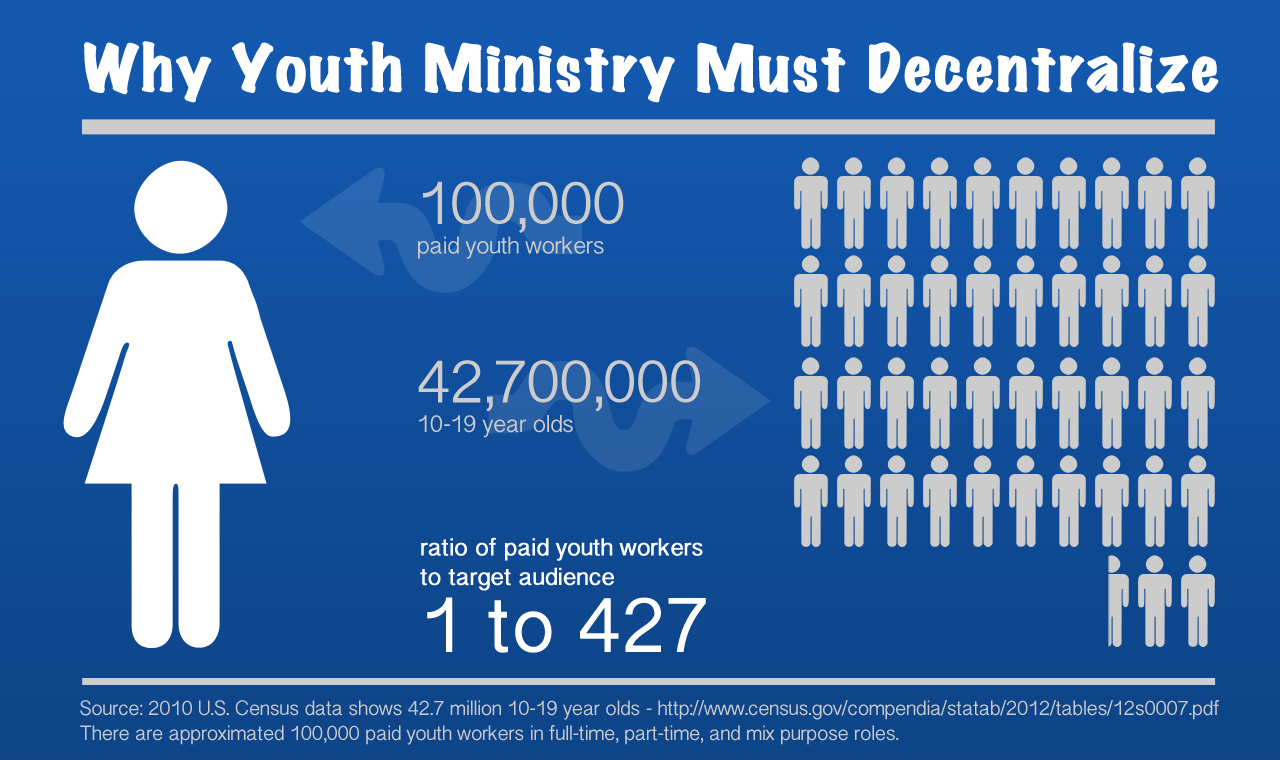
Click here to view or download full-sized version
Source: U.S. Census Data
Challenge
You cannot reach 427 10-19 year olds with 1 paid youth worker. We have 40 years of data which tells us this is impossible. The way we currently do things is part of the solution but we must think differently to engage more of our societies 10-19 year olds.
We must decentralize our role, invite more adults who minister to teenagers already to the table, and multiply our effectiveness.
The cause of Christ is too important to continue on with another 40 years like this.
My invitation to you is simple: Join us. Help us innovate contextual means for decentralizing our role and impacting more 10-19 year olds. I am not alone, there are thousands who think like me. Together we can write a new story of youth ministry.
Ready to dream about your ministry, again? (Instead of just surviving.) Join us next week at The Summit.
-
Cementing Faith Steps with Action
As I mentioned on Friday, I went on our high school ministries Men’s Retreat. 70 dudes went out to the desert of Imperial County to share life, eat meat, blow things up, and connect with God.
Brian Berry makes this trip look easy. It’s not. Merely surviving in rustic conditions like that is tough enough. (This year we had gusty winds, sometimes exceeding 40 miles per hour.)
But Danny Bowers & Brian also add components to the weekend so the participants can engage with God. This is truly a gift I am thankful to witness.
The things they add in intentionally takes what has happened in participants heads and hearts and cements it with a physical memory.
Obviously, not much of this trip is transferrable to any culture. As I mentioned on Friday, this thing is an exhibition of cultural exegesis, it works because young men raised in East County San Diego go to the desert with their dad’s and friends. But there are elements which make this not just a fun experience but a faith building memory making machine.
Some of these “types of things” are very transferrable into just about any ministry context. So yes, adapt these and add them into your next retreat!
 Our first activity involved making a survivor bracelet, this was a great way to introduce the general concept of the weekend theme that’d be repeated over and over again… knots.
 Sunday morning the students were asked to go find a place to be alone and listen to God. I love this picture because it’s taken on top of the ridge where you can see 7 young men scattered along the ridge, each in their own space overlooking the camp.
 Saturday morning the young men broke into groups to hear from 6 “sages.” Each sage shared wisdom they’ve learned and gave each a dog tag. Later, the dog tags became prayer prompts.
 Sunday afternoon we closed our time with a time of communion. Arm in arm men, young and old, shared a common cup and remembered Christ’s sacrifice for us to live a life of freedom from sin.
 We built a rope bridge during the weekend across a small gorge. On Sunday afternoon we asked students making decisions (for a variety of things) to cement their decision by taking a walk of faith across the gorge on the rope bridge while their peers cheered them along and prayed for them on both sides.
 -
The desert & cultural exegesis
Later this afternoon I’ll join 70 high school students and 20 other adults for the Encounter Men’s Retreat.
This is my second year doing the retreat so this year I have a better idea of what to expect.
- Intense, respectful content that asks young men to lean into practical realities of walking with Jesus.
- A large scale, rustic communal experience. No running water, no bathrooms, no cell service, no tents.
- Moving and setting up a completely self-contained 3 day retreat– built with lots of muscle power and big boy toys.
- Massive, burning man-style bonfires. (Last year U.S. Border Patrol stopped by– big.)
- Guns, lots of them. (Used in a very safe, secure, proper way)
- Explosions, lots of them. Fireworks, explosives, and pretty much anything else that will blow up.
- Seemingly unlimited paintball, bouldering, and combinations of bouldering & paintball.
- Lots and lots of meat, potatoes, etc. No crepes or powdered sugar or quiche.
- An extremely memorable weekend for all the guys who go.
No doubt there are parts of that list which absolutely resonate with you and other parts that make your skin crawl. Trust me, I’m totally with you.
If you know me very well at all you know my convictions on gun control. I’m not just a little anti-gun, I actually think it’s morally wrong for Christians to have guns for self-protection. So the idea of taking a bunch of guys to the desert and shooting off a bunch of ammo is really, really hard for me to swallow.
Cultural Exegesis
So, why do I go? If I’m not a big fan of putting a 12 gauge in the hands of 14 year old… why not just bow out? Why support and give 3 days of your life to something that might feel wonky?
Because the men’s desert trip works. It’s an example of looking at the culture you are called to reach, reading it properly, and connecting the dots between something that happens in culture and impacting people’s lives.
And while it I’m not comfortable with parts of it I’m fully aware of these three facts.
- East County San Diego dudes go to the desert, blow stuff up, shoot guns, and eat meat. It’s something east county people do for fun.
- God does significant things in people’s lives in the desert. Do a word study on that… there’s a correlation in the Bible between time in the desert and movements of God.
- Reaching young men for Christ is sacred. My opinion, comfort level, and personal preferences are not sacred.
What are things that you’re doing at the intersection of your culture & ministering to adolescents? -
5 tips for engaging students on a Sunday morning

Newsflash. It can sometimes be difficult to connect with a teenager at church.
Our culture does a lot to communicate to us that teenagers and adults shouldn’t engage with one another. As adults we think, “What could I have in common with a 14 year old?” And teenagers assume that adults don’t really want to be with them. So when thinking about engaging with a teenager at church or youth group you have to start with the understanding that there is naturally a gap or divide to be crossed. You’re going to have to fight past some stuff to really get there.
And frankly, I need to know that the 2-3 hours per week I volunteer with the youth group make a difference. If that time isn’t going to be valuable than I’d much rather invest that time at home than at church.
Getting past “Hi” and the craptastic world of small talk involves some skill. Here’s 5 tips for getting past small talk and helping you really engage with the teenagers at your church.
- Take the first step. In my life I’m used to people taking the first step to begin a conversation. But most teenagers, even the most outgoing ones, assume that you don’t really want to talk with them, so you’ll have to take the first step. So push past the awkwardness of initiating a conversation and just go for it. An easy in is always, “Tell me about your week.” Then make sure you listen, not just for an in to talk about your week, but really listen.
- Don’t play 20 questions. When taking the initiative to start a conversation it feels easy to play 20 questions. My rule of thumb is that I don’t want to ever get one-word answers so I tend to kick off a conversation with something open-ended. You’re looking for paragraph responses, you want to know what they think, and you want to make sure they know you are someone who really wants to talk to them.
- Don’t beat around the bush. About 10 years ago I had a volunteer in my ministry who taught me just to skip small talk altogether. He had this warm, strong way of putting his arm around a guy and saying, “Talk to me about your devos this week, whatcha reading?” I promise you, the reason half the guys in our group read the Bible was because they knew that question was coming and that Jeff really cared about the answer. So skip the small talk about sports, the weather, and TV shows and just get to the point. You want to make a difference and they want you to make a difference— small talk is a sell out.
- Go for the heart, share your heart. When we’re engaging with God’s kids at church we need to remember that God cares more about our heart than our feet. We are all going to make mistakes and part of being an adolescent involves trying to figure out who you are. Don’t make the mistake of talking to students about merely what they do. Make sure to drill into who they are when they are doing stuff. And share your heart. You don’t have to relate everything to when you were a teenager, relate what they are saying to your daily life. It’s OK to share your heart… they want to see that you are real and really can relate to them.
- Level the playing field. Some of this is body language and some of it is how we position ourselves in conversation. I always want to be at eye level with students. If they are sitting, I sit. If they are sitting on the pavement eating pizza, I pop a squat next to them. The same is true in conversation. They know that in society you are more powerful than they are… culture tells them that. It’s your job to communicate in word and deed that you seem them through God’s eyes… we are all human, we all have the same needs for Jesus, we all have things we are working through and big questions. I’ve found when I level the playing field I go deep, but when I fall into hierarchical habits all of my relationships with students default back to small talk.
What are tips you use for engaging with the teenagers at your church? Share your ideas in the comments.
-
If in doubt, teach the Bible
 Two or three times per week I hear from a youth worker asking me for a resource recommendation.
When I’m asked that I’m torn. On the one hand I know (and sell!) a lot of great resources. On the other, I know that too many people are just going from resource to resource to resource.
Over Resourced, Under Adapted
In fact, one reason their ministry may be struggling is their inability to teach because they are merely communicating content. (Sidebar question: How do you know the difference between teaching & communicating?) They’ve never done ethnography for the students they are trying to reach (Instead just kind of know the students who come to their ministry already) so they would have no idea how to actually adapt a curriculum from its published form to the way it should be taught in their ministry.
I’d never recommend buying a curriculum and teaching it in its published form. Even the person who wrote it had to adopt it in ways during the publishing process that they wouldn’t teach it the way it is in the book.
By Default, Just Teach the Bible
Personally, I tend to swing the pendulum too far the other way. While I like an occasionally topical series to break things up, its my preference to just teach books of the Bible. All of the times when I’ve seen my small group or youth group grow the most it’s correlated with time spent, communally, in the Bible.
For instance, a great small group discussion happens in James. Read the first chapter out loud together, then ask the journalism questions… “Who was this written to? What do I have in common with those people? What was the author saying to those people? What might be transferable to me? Why did the Holy Spirit inspire James to say that? How can you apply this to your life?”
The Bible is the Ultimate Resource
With a huge, blossoming marketplace of resources, it’s good to remember that the best resource is always the Bible. Maybe what I like to do is too far for you? My advice would be to spend at least 50% of your time doing just this… working your way through books of the Bible in unfancy ways. If we really want to get trendy we’ll bounce from an old testament book to a new testament one or visa versa. But seriously, God’s Word is in there so it should be your default, go-to resource.
-
Seattleness Weekend




I’m up in Seattle this weekend hosting the first ever Open event.
Please join me in praying for a great day. There’s a lot of people traveling from all over the country (specifically the Pacific Northwest) to get here. I am praying that its a wonderful weekend of refreshment.
If you’d like to follow the action, the hashtag for the weekend is #openseattle


