Category: youth ministry

  • Too big to fail

    Too big to fail” is a colloquial term in describing certain financial institutions which are so large and so interconnected that their failure will be disastrous to the economy, and which therefore must be supported by government when they face difficulty. ~ Wikipedia

    Since the mid-1980’s the federal government has mandated that some banks are so important to the operations of our country that they, literally, will not be allowed to go out of business.

    No matter how bad it gets. No matter much much money they lose. If you stick your ATM into the machine or swipe your card at checkout, it should work. Those companies can be bought and sold, they can be taken over by the government, and their business practices can morph over time.

    But these banks are too important to the livelihood of our country to be allowed to go away. 

    Youth ministry is too big to fail

    Youth ministry is too important to the Kingdom to be allowed to fail. (As I wrote in this article, we do need to address our actual failure though.)

    It’s too important to be folded in as an extension of children’s ministry or simplified into a church-facing, sterilized family ministry. (I love potent, community facing family ministry!)

    It’s too important to be tamed by lawyers and protected from actually doing ministry by safety policies. And all-too-often true youth ministry can’t be measured by business goals or contained to mission statements, it’s bigger and more important than those things created for Main Street.

    We need to remember what youth ministry has always been… A little bit wild, a little bit dangerous, and recklessly chasing all of God’s kids.

    Organizations like Youth for Christ and YoungLife were created, not as nice extensions of the church, but as a response rebellion to the churches failure to reach teenagers for Christ.

    Sometimes, youth ministry isn’t nice. I know too many friends who were nice about getting fired for reaching “the wrong kids.” I know too many people who are silent as a board embraces stupidity to the default of its most important ministry. I know too many people now tamed by jobs they hate to hold onto a sliver of hope that one day things will get better.

    We’re too nice. We need to embrace rebellion again. We need to drag this thing back to the drawing  board and innovate like we used to.

    We need to re-embrace our 1-eared Mickey-Mouseness when it means reaching “the wrong kids.” We need to be willing to get fired for the sake of bringing “the wrong kids” into the church. We need to yawn at staff meetings. We need to forsake office hours. We need to be more willing to please our Father than please the board.

    We need to adapt to a climate that is less likely to fund youth ministry endeavors, becoming empowered by unleashing our creativity instead of held back by a lack of resourcing.

    We need to get really engrossed in ethnography while restlessly becoming disinterested in chasing the latest craze.

    Precisely because youth ministry is too big to fail we need to step back, take a deep breath, and allow ourselves to dream again!


  • Right person, wrong program

    I had coffee with a ministry friend yesterday. His church plant is about 5 years old so they aren’t completely tiny but they aren’t so big that they’ve become a thing.

    He said something pretty radical. Allow me to paraphrase.

    “About a year ago my youth ministry guy started a youth group. I think he thought it was the right thing to do. But it was really unnatural for us as a church, cost him a lot of energy, and took him away from being on campus– the thing thing he’s best at and gives him the most life. So we just agreed to kill youth group so he can go back to what he was made for.” 

    Sssssccccreeeee-aaaacccchhhhh!

    Say what? You mean the church launched something. Then they realized it wasn’t going to work so decided to kill a program instead of fire an employee? Yup, that’s what they did. They didn’t double-down on youth group. They folded and placed a new bet on a different form of youth ministry.

    Bend your mind around that for a second. 

    Building a ministry around the gifts, dreams, and strengths of a minister instead of asking them to conform to a culturally created expectation for what a youth worker does– imagine the possibilities. I’m not trying to sound sarcastic but you have to know that this is a radical concept!

    All-too-often I meet youth workers who feel the program they run, mid-week youth group / small groups and a Sunday morning thing, drains the life out of them. Meetings and planning suck joy from their soul.

    And what they really live for that brings them life? The thing that keeps them in it? It’s something they do on the sideThey coach their kids soccer team. They go to conferences to see friends. They volunteer at the high school.

    It makes me wonder if we’re all doing it backwards?

    What if churches hired the right people and asked them to build a ministry around what brought them joy? What if they built their ministry around what they are good at, what they are passionate about, what their spiritual gifts lead them to, and chasing the unique dreams God has called them to.

    Is that even possible? 

  • You know you’re onto something when…

    • the powers that be (doing nothing for years) are nervous about you.
    • people from the church start leaving tracts and books on your desk anonymously.
    • an old lady cusses at you and about you.
    • country club members decide to worship elsewhere.
    • tattoos and pick-up trucks outnumber lattes and minivans in the parking lot.
    • you get sued.
    • your building gets tagged.
    • you get a “performance improvement plan” and are assigned to take the Strength Finders test.
    • a week later the Senior Pastor confesses that he’s jealous of your ministry.
    • the janitor starts covering for you.
    • a ministry magazine and an investigative reporter want an interview on the same day.
    • you schedule volunteer meetings and everyone shows up.
    • your budget gets slashed.
    • you can’t remember whose graduation party or wedding reception you’re at anymore.
    • the fellowship hall you booked for a fundraiser is suddenly being used for a knitting conference.
    • you get called a heretic.
    • you can’t sleep at night.
    • the discouragement is unbearable.
    • the walls of the church seem paper thin.
    • you are exhausted, weary, blurry eyed, but can’t imagine yourself doing anything else.

    Remember: Discouragement does not come from the Lord. When you’re onto something our enemy attacks. The closer you get, the more you can expect to be attacked.

  • What happens at camp doesn’t stay at camp

    Earlier this Spring I posted an infographic about the Power of Camp. I think this video from YouthDynamics illustrates the power of camp quite well. Personal challenges and personal encounters with Christ. That’s what it’s all about!

    The video captures my own experience as a youth pastor in getting teenagers out of their context. For them, it’s a big adventure which helps conquer fears and expose them to stuff they wouldn’t get at home. But it’s also an unparralled way for God to grab hold of students lives in new ways.

    While trips impact teenagers in different ways, each time I’ve taken students somewhere each of them is challenged in big, unique ways.

    Of course, I think it’d be great if you helped YD crush their modest fundraising goal of $5000, they are at $3500 and need just a little bit more by July 4th. I love that they’ve set it up so that even $20 makes a difference. Wouldn’t it be cool to help them raise $50,000? 

    Not familiar with YD? One thing I love about them is that they intentionally open ministry centers in small communities, underserved by local church youth ministry programs– they go places others won’t which displays their Kingdom heart.

    My bigger point is this: Build experiences that put your students outside of their native context. For YD it’s taking them into the wilderness. But for you it might mean taking small town teenager to a soup kitchen in a big city or comfortable suburban kids into the worker camps of Tijuana.

    Want to widen your impact? Widen your students world view to bigger things. 

  • Until you get fired…

    … you won’t change. 

    … the pain of doing something outside the box outweighs the ease of trying to make the box you’re in prettier.

    … those sacred cows are worth feeding, watering, and printing new t-shirts for. 

    … it’s about the depth of your relationships and not numbers. 

    … you think you don’t have the power to do anything within your system.

    I get accused of stuff or labeled as stuff all the time. “Oh Adam, why do you keep saying stuff isn’t working?

    Because it isn’t. Look at the numbers, gang. Youth ministries who are making a measurable difference regularly go back to the drawing board and are doing something deeply rooted in ethnographic study/research/innovation. Youth ministries who have been statistically flat for long periods of time typically only do minor tweaks year-to-year.

    But let me tell you this simple truth that I hear over-and-over-and-over again from people: It all changes as soon as you get fired. 

    I mean, “asked to resign.”

    It’s amazing how much clarity getting canned is for so many people. All of a sudden they get it. “I should have been doing things very differently.” Well, no duh. All of a sudden planning that mission trip for 14 students doesn’t seem like it was worth 300 hours of your time in research, preparation, fundraising, and travel, does it? All of a sudden, in the swirl of emotional fallout comes the realization that you could have, should have, and now have to live with the regret that you DIDN’T do a lot you could have done.

    Make today different. Don’t wait until you get fired to act. Today. Today. TODAY. 

    • Begin a process of smart, measurable, statistical analysis of your ministry. Get outside help if needed.
    • Begin a process where you do more than read blogs about culture, but do ethnography for yourself.
    • Begin a mindset that looks for solutions instead of a solution.
    • Begin a mindset that allows ministry to adolescents to go beyond things that you can directly oversee and participate in.
    • Allow yourself to re-think resource assessment to the assets of your community, not just stuff you have keys to in your pocket.

    There is unlimited talk in our world about the future of youth ministry. Let’s be reminded that in order for each of us to find that future in youth ministry we need to act now.

    Make today the day. Don’t get canned.  

  • My Sanctuary

    Ugh. Another parking ticket. I think I already had about 10 of them. While I never intended to pay them I was still embarrassed to get ticket after ticket for parking in the women’s basketball coaches spot. She never seemed to use it anyway and the walk from the visitors lot was long. Plus, tickets were for rich kids.

    I dropped the ticket on the ground and got back into my 1978 Ford LTD Station Wagon to begin the drive home.

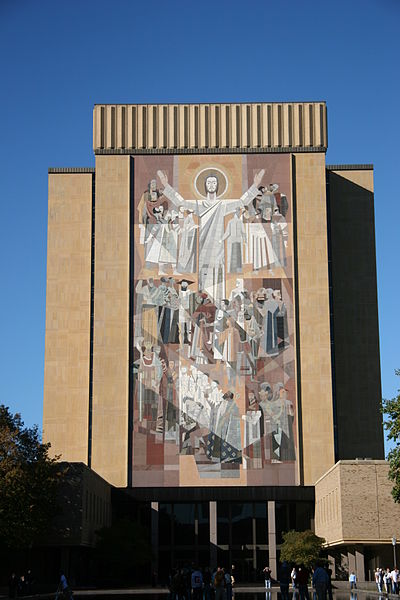
    It was the Winter of 1994 and I was spending a lot of time in Notre Dame’s Hesburgh Library. You might know the building as Touchdown Jesus but I know the building as my sanctuary.

    My senior year of high school was complicated.

    While I did my best to maintain a front that everything was OK, everything wasn’t OK.

    After spending my junior year in Germany with my mom I moved in with my dad for my senior year.

    My hope was to move home and resume my life. My reality was that I’d exchanged one chaotic situation with my mom for an even more chaotic situation with my dad. While his marriage to my stepmom wouldn’t end for a couple more years the volcano of their relationship erupted over and over again. It was pretty rough. I moved in, then we moved out, then we moved back in– on and on this went. I think I moved in and out of that house 7 times in 10 months.

    When we were home I tried to avoid being there as much as possible. And when we lived with grandma I tried to stay out until after she went to bed. I spent as much time as I could at school. But eventually the janitors would ask me to leave and I’d have to go somewhere else.

    Hesburgh Library was on my way home from school. It was both a logical and welcoming place for me to hang out. While I wasn’t a student no one ever asked me if I belonged. As long as I was quiet, doing homework, and didn’t break rules I knew no one would complain. I was good at blending in, knew enough about Notre Dame to fake it if I got into a conversation, and knew they weren’t going to put me in Leprechaun Jail if I got caught.

    So I’d disappear for hours into the stacks to read, research, dream, nap, and explore.

    To graduate I needed to pass gym. So I had little homework. But that didn’t mean I wasn’t learning. I’d grab a novel off the shelf or dig into an autobiography of someone I’d never heard of. They’d refer to a piece of history I wasn’t familiar with so I’d head over to the microfilm and read the New York Times from those days to find out what the author was referring to. Anything to pass the time.

    As the weeks went by I got lost in reading newspapers from the Great Depression. Over time I got pretty good at finding stuff and operating the microfilm… and then I started helping the librarian show students how to find what they were looking for. And that lead to even more time in the library “studying.” (This was a great way to meet female students, by the way.)

    At a time in my life when I didn’t feel welcome at home– or really even have a home to feel welcome in– I felt welcome in the library. More than a place I trespassed at or occasionally got a parking ticket for squatting on the women’s basketball coaches parking spot, it was a sanctuary of comfort and predictability that I desperately needed.

    Do you work with teenagers? Help them find their place of sanctuary. Don’t ever assume that because they look OK or aren’t saying they aren’t OK that everything is fine. Sometimes the best thing you can do isn’t talk… it’s help them find a place where they can just be.

  • Belonginger

    This is the role of the youth worker. 

    Adolescence is full of isolation. Many teenagers struggle to see the world from anyone’s perspective other than their own. While in adulthood we have learned to “look at things from the other persons perspective” many early to middle adolescents just haven’t fine tuned that skill.

    That’s why when something relatively minor happens, say they get a pimple on the end of their nose or they trip on a curb and fall in front of their friends, can be so devastating. Since they only see things from their perspective they don’t notice that their friends also have pimply noses so it must be no big deal or that everyone falls sometimes and it’s just because their body is growing so fast.

    The net result is that many students struggle to find a place where they fit in, that is safe, and where they can stop worrying about being accepted and rest knowing they are.

    A great youth worker is great at making everyone around them feel like they belong. When I think back to my first exposure to youth group in 1992 I left after 1 night feeling like I belonged. I had been around church for 5+ years and never felt as welcome as that place made me feel in 2 hours.

    Here are 3 Rules of a Great Belonginger

    1. Create space that is emotionally and physically safe. I’ve visited youth groups that were like vipers pits. Cutting remarks went unchecked, body language communicates unwelcomeness, and adults more focused on their task than their ministry. But create an emotionally and physically safe place for teenagers? You do that and you’ll be a magnet.
    2. Create a place where everyone is heard and has a voice. Think about a students interaction with typical adults. It rarely involves actual conversation. And it very rarely gets past hearing to listening. Do that and you’ve helped students realize they can be a part of something bigger than themselves.
    3. Creates a vibe where everyone is in on the joke. Great friendships are full of inside jokes and have a relational ecosystem all their own. The task here is to create simple, fast ways where visitors feel like insiders instantly.
  • 5 Nights of Youth Group

    Lately, I’ve been thinking a lot about youth ministry strategy. About two weeks ago I published an article on Asbury’s Seedbed which caused a lot of spin off conversation because I had the audacity to state the obvious:

    The current bi-modality of youth ministry, one mode built around church kids and the other built around outreach, has failed to deliver numerical results over the past 20 years and which is forcing church leadership to invest resources elsewhere. 

    If you want to see my thoughts about the reasons for this failure, check out the article.

    But I’ve been locked on this concept for a while: Every youth ministry is basically built around the same one-model structure.

    They do one thing (either youth group/small groups plus occasional outward facing events to bring new people in) pretty well, but it’s impact is known and finite. It is going to reach a certain circle of people in a community and no matter how much harder you try or how much you refine it, you’re never going to really “pop” and see hundreds/thousands of students impacted.

    And no one in youth ministry is satisfied with the numerical result. I know it’s hard to quantify the value of impact. And I know that relationships are priceless. But people want to get paid and to get paid you better have some numbers. (Your paycheck is a number, by the way.) All I’m saying is that 5%-10% youth engagement in a community isn’t enough. We can and must do better to see community transformation.

    So, to recap.

    • On one hand we can agree that the current modes we do are going to reach a limited number of teenagers in a community. Only a certain number of people will be interested in the mode  your youth ministry is built upon.
    • On the other hand, we’ve been training people to “do youth group” or small groups for 30+ years. It might not be perfect, and it might not be reaching a statistically huge amount of people in a community, but it’s what we know how to do and it is functionally working. (It’s not broken, it doesn’t suck, it’s just fixed in its numerical  impact.)

    Last night, all of that lead to this simple thought: Why don’t we just do what we’re good at… just more of it? 

    • What if youth group happened 5 nights per week, same program flavored 5 different ways?
    • To give you some for instances by inserting some flavors… What if Monday was for band/choir people? What if Tuesday were for people into R&B/rap? What if Wednesday night was in Spanish? What if Thursday night were for all the sports teams? What if Friday night were for the church kids? 5 nights, same content, different flavor.
    • What if volunteers served 2 nights in a row. Let’s say Monday was the night they helped with band/choir people, but Tuesday night they did follow-up… like, not at the church?
    • What if we stopped trying to make every student fit into one youth group and just gave them flavors they already sub-divide in?
    • What if we stopped asking youth ministry staff to hold business hours and just had them come to work 1-9 PM so they could prep and do what they do best without all the pretending to be office rats?

    OK, so that’s my off-the-wall idea for a Tuesday.

    I think there’s a lot of people asking the question, “What’s the future of youth ministry?” And I think it’s time we embraces the reality that there are probably a lot of futures of youth ministry. Looking for a single, silver bullet solution, will only lead you to angst. Instead, let’s encourage one another to drink deeply from the well of ethnography and create ministries & programs which serve  the needs of our students. (No more felt needs!)

    Photo credit: Open 24 hours by Eric Auchard via Flickr (Creative Commons)
  • Love God. Love Neighbor. Simple. Right?

    Want to teach the students and young adults in your life HOW to do this? Pick up my 6-week curriculum, Good News in the Neighborhood.

    ht to Steve Knight for the link. Shouts FTE.

  • 3 Things Teenagers Wonder About the Adults in Their Lives

    Teenagers are good at asking questions. But I’ve found they often have a hard time coming to you about things they wonder about.

    More specifically, what are the things they are wondering about as it relates to the adults running their youth group that they have which they can’t quite put words to?

    Here’s the three things I wrote down which could all start with the phrase… So, I’ve been wondering…:

    1. If I can’t think/process/apply what you are teaching me right now, how can I grow?
    2. If you won’t listen to me– really taking the time to get to know me– how can you help me?
    3. If I can’t be as involved as you want me to be, do I still matter to you?

    How are you answering these questions with your actions?

    What are things students in your life are wondering about the adults in their lives?