Category: youth ministry

  • You’ll never know

    Clearly nervous, her voice wavered to say hello as she gave me an awkward side hug and handed me a gift. She’d driven a hundred miles or so “just to swing by and say hello.” No one drives that far just to eat greasy food and say hello.

    After some niceties the reason she drove all the way to our house became clear. She wanted to say thank you.

    She hadn’t been particularly faithful to youth group. She was always kind of one foot in and one foot out. In truth, I never really knew why she came. She was always too cool for it. I figured she just came because her friends were there and she felt comfortable.

    Since high school graduation she’d gone down some dark roads. But she drove to our house to tell us thank you… and she was back.

    I’ve done this a long time. And most students don’t come back to say thanks. You wish them well on the next stage of their life and they ride off into the sunset.

    That’s the thing about youth ministry. You’ll never know.

    You’ll never know, in the moment, what is sinking in and what isn’t. You’ll never know if the lessons you work so hard to prepare are making a difference. You’ll never know if your ministry introduced them to a lifelong walk with Jesus or if they just kind of held Jesus’ hand through high school. You’ll never know who is going to walk away, who isn’t coming back, and who will come back. You’ll never know if your ministry helped a person become a better parent or soldier or engineer.

    Your impact will always surprise you a little bit. The Prodigal will always take your breath away upon their return.

    Think about the worlds or moments in your life which had the deepest impact— that truly put you on the right course. Chances are good that person who impacted you will never know their impact on you.

    You might not ever get a chance to say thanks. That’s just how life works. 

    It’s the same thing in youth ministry– You just keep scattering the seed.

    Your job is to keep planting seeds of hope, love, and joy found in Christ. Youth ministry can never be judged solely by today’s harvest… It’s just too short of a time with an individual… It has to be judged in the amount of seed spread.

    Friends, just keep reaching into the bag and scattering seed.

    Because you’ll never know.

  • 5 Common Misreads on Teenagers in Youth Group

    One of the things you learn as you go in youth ministry is that teenagers are experts at sending off false signals that can be difficult to pick-up on.

    Here are five common ones I see newbies miss all the time.

    • “I’m just hanging out” or “I just thought I’d drop by because I was bored.” If you have a student that stays late or is just hanging around or lingers longer than usual or drops by the office for no real reason– it isn’t an accident. There is always a reason. They want to talk and are waiting for you to take the initiative. And sometimes when they do this you’re going to have to build a little repoire before they share what’s really going on.
    • That student in the back isn’t paying attention. This is a frustration that comes out of youth workers all the time. Stop it. It doesn’t mean what you think it means at all! It’s easy to think that a student who is sitting in the back, looking at the wall, or just looks like they aren’t paying attention isn’t paying attention or is being disrespectful. My experience is that they are usually paying attention and soaking in more than the kids who being compliant, smiling, responsive teenagers in the front row. If they weren’t there for an encounter with God they wouldn’t be there. Period.
    • The student who wants to be a up front is a leader. Nope. Up front skills and spiritual leadership are two different things. When I was in youth group I was up front, leading games, and even leading a small group before I even gave my life to Jesus. Some people are born leaders and lead wherever they go. Students who like to be part of your leadership teams might be just as lost and trying to figure it out as the dude in the back who stares at his iPod the whole time.
    • Spiritual maturity and physical maturity are two different things. This is really hard for adults to grasp. But if you do youth ministry for any length of time you will meet students who are just as spiritually mature, or who are MORE mature, than most of the adults in your church. You don’t have to be 50 and have kids in college to be mature in Christ. How do you judge spiritual maturity? Fruit. Stop looking down on students because they are young. Bottom line on that one.
    • They aren’t ready for theology. Ugh. Any time a youth worker says this I want to punch them in the face. I actually had a methodist youth worker say this recently via a Facebook message. My response: “How old were the founders of Methodism when they got started? Look it up.” Yeah, don’t underestimate what the teenage brain can handle. You can’t tell me that an 11th grader who just wrote a 5 page paper on Whitman’s use of symbolism isn’t ready for some theology. Just because you’d rather play video games than study doesn’t mean that every student is like you. A big reason they eventually bail is because they are bored and the faith that you are exhibiting is boring compared to what they read in the Bible.

    These are the misreads I see all of the time. What am I missing? 

  • How to Keep Your Youth Ministry Job

    How to Keep Your Youth Ministry Job

    Spring firing season has begun.

    The end of the school year is a dangerous time to be in youth ministry. With the program year winding down it is prime time for church leadership to make a decision on whether to keep their youth worker for another school year.

    Hint: If you get invited to an unscheduled meeting with the elders in the next few weeks, you’re getting fired. I’m sorry. (Er “forced to resign” which is the same thing but makes the elders feel better about it.)

    I have several friends who are going through this right now. And it really sucks. 

    Here’s two things you need to nail to keep your youth ministry job

    1. Measurables. Oh sure, we talk about the importance of relational ministry. But don’t kid yourself… it’s about numbers. If you want to get paid to do youth ministry (a pay check is a number, by the way) than you better deliver something everyone agrees is measurable and communicate that measurable well. This might be your career, but to a church leader the youth ministry program is just another mouth to feed. (It’s an expenditure.) They want to look at the financial investment they are making and see the results. You’d be wise to start the ministry year communicating clearly defined desired outcomes with  measurables and then preparing a presentation in February/March to show what you’ve done to meet those desired outcomes as well as the measurable impact. Flow charts, graphs, and case studies. If you think I’m being ridiculous… go talk to someone who works at a non-church charity, they have staff people whose sole job is to keep the funding coming by creating desired outcomes and presenting measurables to donors. At the end of the day the only way leadership will continue funding your ministry is to constantly prove it’s working.
    2. Donor relations. Earlier this week I wrote a post called Skin in the Game. As a church staff person you need to know that those who attend the church, especially those for 10+ years, have a lot more skin in the game than you do. Don’t buy the lie that the staff have the most skin in the game at a church… it’s just not true. You are an employee hired to do #1, you are not an owner. I could point you to dozens of friends who have learned this the hard way. They thought being friendly with all the leaders or doing really important, hard work meant that they were safe. Or they thought that if they simply cared a lot and gave everything they had to it that their career would be fine. And then they got invited to a meeting and asked to resign. Spiritually, the owners might be “under your authority” but that doesn’t mean they won’t fire you. I don’t care if you’re the best youth pastor in America. If you don’t deliver on #1 above you’re in big trouble. In professional sports terms, they are the owners and you are the coaches. You job is to win and attract “fans” aka potential owners. If you’re aren’t delivering results than your job is hanging purely by your ability to manage donor relations. Manage those relationships well and you can probably hang on until you deliver on #1. But mismanaging those relationships makes a board decision to fire you a whole lot easier. (Hint: It’s not always the board who are the people you need on your side. Make sure you’re managing the right relationships.)

    When I talk to friends in youth ministry who have just been let go, those are the two things it always comes down to. Measurables and donor relations. (aka “politics.”) You might disagree with me on that, and you can probably point to a case where that wasn’t true. But let me reassure you… nail those two things and you are eliminating 90% of the reasons my friends have gotten fired.

    Maybe this post is too matter of fact for you? Trust me. I’m only sharing to prevent your pain. I know that I’ve taken something so personal, so much a part of you, and so much a part of your faith and narrowed it down to two bullet points for how you can keep going. I know it seems simpleton and I don’t really get your context. But you just need to know the truth. Don’t be naive. We are all capable of getting fired. Manage these two things well and all the other things you love about your job can continue. Mismanage them and you’re in for a world of hurt. It might not be this Spring, but your Spring is coming.

    UPDATE: Brian Berry has a continuation of this post on his blog. Go check it out.

    Tip: Get canned? Check out our free job board over at The Youth Cartel.

  • Don’t apologize…

    Don’t apologize….
    • For being 39 and loving to hang with teenagers.
    • For giving a student a hug, it might be the only hug they get all day.
    • For pursing a career in something your parents think is a stepping stone.
    • For giving up another career for something most adults don’t get.
    • For loving a job that your boss might look down on.
    • For being bored during the diving part of a swim meet.
    • For going to a soccer game simply to say hi and show your support for someone who isn’t your kid.
    • For liking how bad a freshmen jazz band sounds.
    • For texting info about tomorrows Bible study during staff meeting.
    • For being more comfortable driving a church van than your minivan.
    • For asking for more budget to cover the rental of sumo costumes
    • Or for losing the receipt for the sumo costumes.
    • For knowing exactly how much cash and time it takes to get 15 pizzas delivered.
    • For knowing that one large pizza feeds about 5 teenagers.
    • For practicing games on the XBox during office hours.
    • For bringing your kids on the camping trip for free.
    • For reusing a killer illustration over and over and over again.
    • For feeling weird when the senior pastor rips off your killer illustration in his sermon.
    • For being there when all hell breaks loose.
    • For being a little thankful that hell has broken loose because you know God will use it.
    • For asking hard questions to discover harder truths.
    • For challenging boys to become men.
    • For challenging moms and dads to let go of their dreams for their kids so their kids can have dreams of their own.
    • For representing Christ in places no one wants him represented.
    • For challenging other leaders to think differently about teenagers.
    • For challenging teenagers to think differently about themselves.
    • For asking students to skip band camp for Bible camp.
    • For keeping the door open when a member of the opposite sex is in your office.
    • For asking the secretary to skip her lunch so you aren’t in the church alone with a student.
    • For trying things that are new.
    • For giving up on things that don’t work.
    • For always believing that people can change.
    • For reaching the wrong kids.
    • For reaching kids like me.

    Never apologize for being a youth worker. We need you too much. 

    You don’t hear it enough. Thanks for serving today’s students. Thanks for investing your life in people the church all-too-often misses. Thanks for reaching kids like me. And thanks for putting up with the stuff you put up with just to keep going.


  • A better place to live

    A few weeks ago I spoke at the BOOST Conference. BOOST is a resource for out-of-school time workers. (After schol programs, assemblies, stuff like that.) In other words, these are people who work with children and teenagers.

    If you think about it, youth ministry people are out-of-school time workers, too. The major difference is that we work for religious organizations which are typically privately funded and folks at BOOST work for publicly funded organizations. But we love the same people, just work on opposites sides of the wall separating church and state.

    The first thing to come up in my presentation was a question about the separation of church and state. I was ready for it. 

    “Separation Schmeparation”

    No. Seriously. 

    Issues of separation of church / state are legitimate. But it often feels like a real, physical wall of separation when in fact it is a cultural barrier based more on fear than anything else.

    We spent 10 minutes listing out some of the fears….

    • There’s fear of litigation if a public entity and private religious group work  together.
    • There’s fear of what the board might say.
    • There’s fear that a parent might get all funky and go to the board or threaten to sue.
    • There’s fear that bringing a religious group on campus or a private group using religious space might lead to cross-pollination, even by inference. Christians worry about “watering things down” and public groups worry about “proselytizing.”

    The list of fears actually never ends.

    When both sides are afraid of one another there are typically at least two factors present.

    1. They don’t know one another.
    2. They don’t have the same language.

    And that’s precisely the case when it comes to youth workers and out-of-school workers. We have common goals, common love for the same students, and here’s the kicker… ARE LITERALLY OFTEN THE SAME PEOPLE! At one point in my seminar we went around the room and introduced ourselves. Nearly half of the people attending my seminar were either part-time church staff or their spouse worked at a church.

    Huh. 

    So what’s the point? 

    At the end of the day we can build relationships on shared goals. Every youth worker and every out-of-school worker wants to help build a better community.

    And that’s a building block towards working together.

    Let’s stop building walls around what we disagree on and instead build bonds on things we can agree on. 

  • A rant on discipleship

    A few week’s back Joel Mayward asked if I’d participate in his blog series on discipleship. He asked some great questions and really got my mind churning, plus I was in one of those pre-lunch moods. Here’s a taste of what ended up being a holy rant on the topic.

    What is discipleship? 
    I’d like to start off with two push backs on your question itself.

    First off, discipleship is a made up word. Let’s acknowledge that for what it is. Every time I type it in Microsoft Word or on my blog it always pops up as a misspelled word. Because it isn’t a word. More to the point, it’s a made up word because we don’t really even have a word to describe what discipleship is.We are trying to smash the relationship that Jesus had with his disciples into a modern construct of a ministry model. The very problem of a lack of discipleship comes from trying to make it a quantifiable process that is replicable so that we can point to a person as church leadership and say, “This is how I know people are growing in their relationship with Jesus.” It’s a McDonald’s-style phrase that just falls flat in the face of what Jesus and the early church actually did, as documented in the New Testament. So I want to start off by pushing back on the very word, discipleship. Jesus told us to make disciples, (Matthew 28:19) not create a process whereby all people can follow 6 easy steps or run the bases or complete a wheel of discipleship. Those are modern simplifications which have proven to have horrible impact on the life of our churches.

    What is the greatest barrier to this in youth ministry?
    2. As I opened this with, we are living in a day where we’ve tried to create a process called discipleship as a replacement for how Jesus and the early church actually did it. So when we talk about making disciples we think of programs when Jesus never had that in mind. The disciple-making process is a lifestyle, not a program. So a major roadblock we hit as leaders is that our adult volunteers think they’ve been “discipled!” Moreover, we have a culture which is so “easy” focused that very few have the stomach to get involved. Decades of crappy “discipleship models” have created undiscipled, undisciplinable followishers of Jesus.
    And these are just two excerpts! You can read the rest on Joel’s blog.
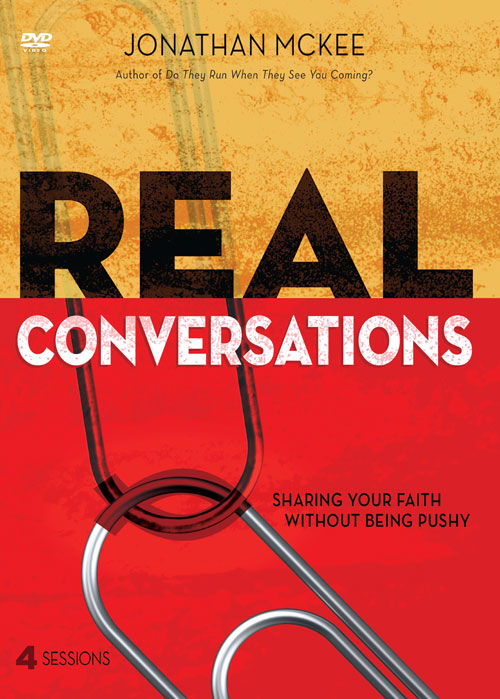
  • GIVEAWAY: Real Conversations by Jonathan McKee

    What it is…

    Jonathan McKee (The Source for Youth Ministry) just released a 4-week video based curriculum that’s all about how to have real conversations about sharing your faith. (Which is cool considering it’s called, Real Conversations.) As a youth leader, this is one of those plug-n-play options that would be cool to have on your bookshelf. Each week there’s a 12-14 minute video and a participants guide to help drive it home. For instance, let’s say most of your team is going to take August off and you’re solo teaching? Bam, press play and let Jonathan do the work. It isn’t quite that simple but the videos and the guides make it pretty simple.

    Who is Jonathan…

    If you know Jonathan and you know me you might not see the connection. He’s more conservative on some things than I am, approaches life a little differently than I do, and he’s from NorCal while I rock the fish tacos down in SoCal. But,while we often have a different approach Jonathan and I have one important thing in common: We long to see the church get better at reaching people right where they are… and we are putting our necks on the line to try to make a dent of a difference. I think that’s one reason we get along so well… we care first about people.

    Another reason, and this shares something I don’t talk about a lot, is that I connect well to people who hustle. Jonathan works hard. Yes, he’s talented. But his stuff does so well not  just because he’s talented, but also because he flat out works harder than a lot of other people in our world. He and I worked on a project earlier this year and he was RELENTLESS! He wanted to not just get it done and on time… he wanted it to be great and put in the work to make it great.

    Why I like it…

    I dig Real Conversations for a number of reasons. I think that there are a lot of youth groups looking for this type of training. It’s consistently choses to stay practical when a lot of similar curriculums get lost in theory and apologetics. I like that its Gospel-oriented without limiting the Gospel to a message. I like that it’s funny, really… I LOL’d a couple times. And I like that it was shot and edited real pretty. (The crew at Zondervan did a real nice job.)

    In the end, I see a lot of similarities between Real Conversations and Good News in the Neighborhood. They are two-sides to the same coin. As I’ve tried to figure out and live into the realities of becoming Good News on my block I’ve had several instances where someone, completely out of the blue, has asked me… “So, I know you believe in Jesus and there’s something about how you’re living that makes me want to know more. What is that Jesus thing all about and how do I get me some of that?

    So you can think of it like this. The Good News curriculum might teach you how to live for Jesus on your block. But Real Conversations will actually help you answer the natural questions that will come up as a result of partnering with Christ to become good news to your neighbors.

    How you can get it…

    Two ways you can get this.

    1. BUY IT. The more direct way is to head over to Jonathan’s website and pick it up. (It’s $10 off, awesome.)
    2. WIN IT. Zondervan was nice enough to send me a copy of the DVD & Participants guide to review. The simple reality is that I watched the DVD and flipped through the book, but I’d rather give it away to someone who might actually teach it than stick it on my bookshelf to collect dust. It’s brand new! So, leave a comment on this post on 5/1/2012. And I’ll pick a random winner to get my copy. To enter… just leave a comment of any kind. I’ll announce the winner on 5/2/2012.

    WINNER: Jeffrey Dyson – send your mailing address to mclanea@gmail.com

    Let’s do this again next week! I’ll be giving away a DVD/participants guide for Love is an Orientation next Tuesday.

  • Youth workers in the news

    Exhibit A

    Tell me this guy has never played chubby bunny or lit a fart at 3 AM with a room full of 7th grade guys… 

    Exhibit B

    This is why youth workers bring their teams to conferences. Because if we just hang out together without people from our church, this happens…

    Exhibit C

    A man does not stay  that calm while tricking another man unless he has played several hundred hours of Honey if you love me won’t you please, please smile at summer camp. 

    OK, so I don’t know if any of those guys were youth workers. But… maybe! 

  • Is your strategy as big as your vision?

    Our vision is to provide high quality, age-appropriate experiences which invite every student in our community to experience the Good News of Jesus Christ.

    This could be the vision statement of any youth ministry team in the country. Like you, I’ve seen vision statements like this in youth ministry literature, on youth group websites, and even painted on the walls of youth rooms for years.

    The problem is that they have a vision (mandate) to reach 4,000 students in their community but a strategy which scales to reach a lot less. The result of this strategy vs. vision mismatch is frustration-induced angst. No one strategy can reach 4,000 teenagers in a community!

    We all know youth workers who have quit or been fired. And one of the reasons? They failed to focus on something they could actually succeed at. A lack of measurable results makes it easy to quit any job. (Or get fired!)

    You could work 32 hours per day 8 days per week and not make a serious dent in that vision– it’s too big. Simply put, the vision is not right-sized for the strategy. (Most youth ministries employ a single strategy system– a youth group model.)

    Compare that vision to the vision of the local public school system– which likely reaches 90%+ of teenagers in your community. They might have a similarly large vision/mandate. But it takes hundreds of full-time, professionally licensed employees and anywhere from $6000 to $9000 per student to enact a strategy that reaches nearly 90%+ of the students in your community.

    There’s no youth ministry in America that employs enough people to reach 4,000 students built on the youth group model. It simply falls apart at a certain size.

    Youth workers rightly have a burden to help students walk with Jesus and introduce others to Jesus for the first time. But we need to shrink our vision to something we can actually handle strategically instead of aiming at everything and hitting nearly nothing. 

    To get more effective you need to shrink your vision to a realistic size that your strategy can actually accomplish. Then, if you start to nail that, you can expand your vision a little bit bigger. (Better yet, discover new strategies altogether to reach different types of students.)

    Sometimes to grow you’ve got to shrink. 

    Photo credit: Gary Jungling via Flickr (Creative Commons)
  • The cup is 95% empty

    “Adam, why are you always assuming that the cup is half empty?” 

    Youth workers say this to me over coffee. Their lives are run wild with activities, planning, teaching, and meetings. Their ministries are full and something I’ve said has called that busyness into question.

    My response, not trying to be trite, is “Oh no, I’m not saying the cup is half empty, I’m saying the cup is 95% empty.

    Again and again I’ve challenged folks to do the math for themselves. Most people can do it in their head. You don’t need a scientist to measure impact if you know basic facts about your community.

    • How many students are in middle & high school in your community? How many students attend a youth ministry in your community? Divide. Probably less than 10% of the eligible population. (If you factor in students who attend youth group by choice… this number dramatically falls, doesn’t it?) 
    • How many years has the current model of youth ministry been impacting your community? 20, 30, 40 years? How much have churches grown as a result? At best, church attendance has flatlined over the past 20 years, likely declined compared to 30 or 40 years ago. 
    • You might be able to point to a couple of exceptional examples. (Communities of great impact or individuals greatly impacted) But for the amount of effort, amount of investment, in most communities the impact is pretty small.

    My point is not to tear youth ministry down down. It’s to rebuild. We can’t think about the future until we can make a sober assessment of what our tribe has accomplished.

    It’s not that the wrong people are in youth ministry, it’s not that they are uneducated, don’t care, are lazy, or even under-resourced. I actually think the frustration, the quitting, angst, and the burnout we see in youth ministry is because we have the RIGHT people working 24/7 [largely] on WRONG strategies. [More fairly, their current strategy is OK, just limited in impact.]

    That’s not tearing down at all, is it?

    My point is that the strategies we’ve used to date have a finite impact. We can look at 40 years of history and say “youth group” will impact less than 10% of any given student population. (How much more evidence do you need to see that this is true? 50 years? 100 years?)

    The challenge to anyone who will listen is to think about the 95% of un-impacted adolescents in their community and ask themselves, “What are other strategies that might impact these students lives for the sake of the Gospel prevailing?

    That’s not being negative. It’s missiology 101.

    Photo credit: Mykl Roventine via Flickr (Creative Commons)