
Category: Christian Living

  • Myth: God opens and closes doors

    I’ve heard this phrase to the point where I think people actually believe this is somehow a biblical concept.

    God has opened the door for me to ____.

    I was pursuing something I really felt called to, but God closed the door.

    That’s not in the Bible folks. It is a non-biblical, non-Christian philosophy called fatalism.

    I believe this little phrase, God opens and closes doors, has lead to people falsely blaming God for missed opportunities. We put this philosophy of open and closed doors above biblical concepts like perseverance, patience, and long-suffering.

    Instead, many have bought into a mentality that it’s meant to be, God will open doors. If it isn’t meant to be, God will close doors.

    Again, that’s fatalism. That isn’t how God works. Nor is it how God’s people are asked to look at the world.

    This is what God says about opening doors:

    Here I am! I stand at the door and knock. If anyone hears my voice and opens the door, I will come in and eat with him, and he with me. Revelation 3:20

    • Did David tell his friends, “Yeah, I was anointed as the next king, I don’t know though. Clearly, Saul doesn’t like me so I think God is closing that door?
    • I don’t think God cared too much about Jonah’s “closing the door” on going to Ninevah.
    • I don’t remember Jesus telling Paul the whole blinding thing was an open door to a life in ministry.
    • And a ship-wreck was clearly a “closed door” if I’ve ever seen one. But did that stop him?
    • Persecutions of the first apostles weren’t seen as God closing doors. The only door that ended their ministry typically involved lions.
    • Pharaoh refusing to release the Jews for the first 9 plagues wasn’t God closing a door.
    • Shadrach, Meshach, and Abednego had an open door to a fiery furnace. But that didn’t stop them, did it?
    • Seems like the doors were closed around old Jericho, weren’t they? Did that stop God’s people from taking action?

    On and on we see that Scripture is not fatalistic about vocation, doing good, doing right, or fulfilling our call!

    But God does work in us and through us when we persevere, when we are patient in affliction, when we long-suffer for doing right.

    God rewards the righteous. God smiles on those who seek justice. God hears and answers prayer. God wants us to seek wise-council. God’s calling is true. God can move literal and figurative mountains for the faithful.

    God calls us and asks us to depend on Him and Him alone.

    He could care less about our education. (Paul) He could care less about our abilities. (Moses) He could care less about our lack of faith. (Jonah) He could care less about our past failures. (David)

    When God asks us to do something open and closed doors are meaningless.

    If He is asking you to do something He will make a way.

    Rather than worrying about if the door is open or closed we are asked to open the door. We may have to kick it in. And we may need to buy a sledge-hammer to make a way where there is no way.

    But waiting for doors to open or doors to close is meaningly, dangerous, and destructive. The only door you should be closing is on fatalism. The only door you should be opening is to Jesus, “Here I am, use me how you want. I am yours. You are my Savior and Lord.

    Do not conform any longer to the pattern of this world, but be transformed by the renewing of your mind. Then you will be able to test and approve what God’s will is—his good, pleasing and perfect will. Romans 12:2
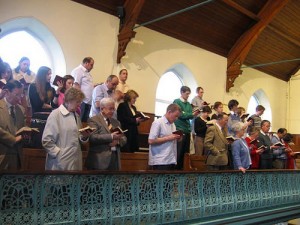

  • What is worship?

    Photo by Bill Lollar via Flick (Creative Commons)

    A youth worker in Minnesota asked me to share my definition of worship with her as part of a lesson she’s preparing for her youth group. I thought it’d be fun to post my response to her (with her permission) for a couple of reasons.

    1. I hadn’t thought about it like this before.
    2. I like it when people call me a heretic.

    What is worship?

    I think the English word for worship is limiting versus what God asks of us. So I break up the act of worship into a bunch different categories. (Not limited to this list)

    • We come together to worship God in community.
    • We spend time in prayer, fasting, song, reading of Scripture individually.
    • Our work is worship.
    • Our attitude is worship.
    • When I give my talents and treasure to God, that is an act of worship.
    • When I journal, that is worship.
    • When I am alone with my wife, that is worship.
    • Everything I do… I can do as worship of God.

    Now, how do I define worship? Worship is any intentional human actions which bring glory and honor to God.

    What do you think? Is the intention what makes an act worship? Or have I overstated what worship can be?

  • Change my heart, first

    I’m a pain in the neck to be around.

    When I’m “on” I have the ability to poke holes in everything. I always see things from another point of view. I can find fault in any system, organization, strategy, person, nation… darn near anything.

    My personality is a double-edged sword. Sometimes I see things so clearly and I think, “If things are going to change I need to change THAT.” That’s the positive side of my personality. The negative side is that I am slow to look at myself and say, “Before I can point out the speck in that persons eye, I need to deal with the plank in my own.Matthew 7:3

    So that’s my prayer. When I am anxious for change I need to pause and ask God, “Change my heart, first.

  • A or B thinking

    Wipeout is a metephor for life

    The thing that I really love about Wipeout is that I can see myself being on the show. There is something about the story of the show that makes me want to insert myself into the narrative. I don’t know about you, but when I watch the show I’m constantly thinking about how I would react to a situation or how I would have done it differently.

    Watching other people fall, fail, and probably get hurt is attractive to me.

    There is something so train wreck about Wipeout that makes it interesting and intruiging.

    I want it. But what is “it?”

    Why can’t I stop watching?!?

    3rd person perspective

    I like it because I am not in it. The reason it is so funny on television is because the people on the ground are in the first person and they are forced to think linear about Wipeout while at home we are in the third person and can see everything.

    They only get to see what is in front of them. They don’t know how other players have completed the obstacle. They don’t have the view we have at home. We are above the action while they are in it.

    They are trying to problem solve the maze of each apparatus in real time first person.

    We are the humans watching the mouse work its way through a complicated maze. When you have a third person perspective, the game is easy and the mouse looks stupid.

    Person after person makes the same mistake and you are left to just scream at the television… “Don’t do it that way! You’re going to fa… Oh, did you see him fall? Ouch!

    The Wipeout mousetrap forces the participant into A vs. B thinking while the third person perspective clearly shows the answer is either A or B.

    Sometimes the answer is C

    My life is sometimes an episode of Wipeout. Life often feels squished into a maze of A & B choices.

    But I’m learning more and more that the answer in A & B circumstances is actually C.

    • C: None of the above
    • C: All of the above
    • C: Another idea

    This is why life isn’t Wipeout.

    Life feels like a series of A or B choices. And if you get them right, you’ll succeed in life.

    But that’s incorrect. Life is full of choices that look like A vs. B. But C is often the only right answer.

    Stuck?

    I know a lot of people who feel stuck right now.

    They don’t feel like life affords them a lot of options.

    Do I continue down this path or do I start something new?

    I hate my job but the economy sucks and I don’t want to be unemployed right now.

    The trick is not settling for A or B when the answer might be C.

    The answer is– adjust your perspective.

  • Ebenezer

    Photo by cmiked via Flickr (Creative Commons)

    This is it.

    Today is the day.

    I don’t have time for could, woulda, or shoulda. I only have time for results.

    I know the stats. I know the strategies. I know what it takes to get it done… it’s time to get it done.

    [Insert whatever analogy you need to fire yourself up]

    I’m a youth worker. It’s in my blood. It is who I’m called to be and it is who I am. And all youth workers are hard-wired to plan stuff out in August. August is our January. We plan vacations, mission trips, concerts, retreats, camps, and everything else. If it is going to happen in 2010-2011… now is when we lay it out.

    In August, we lay out our dreams for the school year in August.

    August is our ebenezer.

    So that is what I’m doing this August. I’m laying down my dreams. I’m laying down my hopes. And I’m putting aside my excuses.

    I’m tired of waiting for next year.

    I don’t have time to build another year.

    I am getting too old to sit around and wait for something good to happen. Or the right kid to show up. Or the wrong kid to “get it.

    I don’t want to just hang out with kids anymore without a purpose. We’ve played enough video games, eaten enough pizza, and I’ve been to enough high school games.

    This. is. it.

    This year.

    This day.

    This moment.

    Now is the only time that matters.

    I’ve got no patience for coulda, woulda, or shoulda.

    This is my ebenezer.

  • The new corner office

    Photo by bitsnpixels via Flickr (Creative Commons)

    Perhaps this recession really has taught us some things?

    I’ve noticed some trends softly changing in the past 2-3 years that are enlightening a cultural shift in our work-home-success life quotient. And they are encouraging.

    Here’s a few things I would label under “the new corner office.(Things that todays worker use to label that “they’ve made it.”)

    • No fear of self-employment. You’d think that a serious downturn in the economy, a tightening of credit, and exploding health insurance costs would scare the bejeezers out of people starting their own business? That’s just not happening in my circle of friends. And these new businesses, self-ventures, and new careers are all doing pretty well.
    • Working from home, working remotely, and location independence. Within the workforce, I think these are becoming status symbols. Kristen works from home as much as she likes. I like to work remotely about one day per week. And I know plenty of people who don’t even live in the same state as their company but work remotely permanently and just come in when needed. The net result for the company is that employees are actually more productive and the company needs less/different work space. The way technology is now… there’s a whole breed of worker growing less and less dependent on the traditional work environment. It’s a win-win.
    • Choosing “right job” over “big pay” jobs. [Note: I’m not talking about unemployed/unemployable recent college grads holding out for dream jobs that don’t exist at their level.] Plenty of people in my world have left jobs they pursued for years for something that was better suited for their personality/gift match. In many cases, that means they are pursuing a new career that pays less but feels right over a job that pays more but sucks the life out of them. That’s awesome for everyone.

    Hard work is now and will always be the grease that makes the machine of success work for 99.9% of workers. At the same time, these new trends seem to show a desire for a simpler life. The new mantra seems to be, “I don’t mind working hard for the right things.

  • Seeking Euphoria

    Have you ever wondered what people are looking for?

    Every day I read about my friends who are:

    • Climbing mountains
    • Taking kids to camp/retreats
    • Going on mission trips (guilty, as charged)
    • Going to the desert to be alone
    • Moving from one church to another
    • Changing careers
    • Reading books or writing books
    • Going to concerts
    • On and on…

    And I wonder what it is that they are looking for? I look at their stories and think about Pilgrims Progress. “Where are you headed, Christian?” They are going on these trips, seeking something, some find it while others don’t. It’s a mysterious phenomenon that has been going on forever, I suppose. But this spiritual seeking is now on full display thanks to Facebook status updates and Twitter posts.

    We are all seekers of something. But why?

    I often wonder what I’m looking for. Right in the middle of one of these experiences I’ll have an annoying moment of clarity when I ask myself, “Adam, what the heck are you doing this for?

    Humans are hard-wired to seek religious euphoria

    We aren’t usually able to articulate it. But we spend countless energy trying to find it or repeat it.

    The first time is mystical… almost magical. For many people, we were going about our daily life and one day an experience got us. (See the list above) Maybe we were sitting around a campfire at a retreat when it happened. Or maybe we were at a Christian concert? Or maybe we were at home, sitting in front of our laptop, writing a blog post, when it happened?

    We have a euphoric experience. Something so powerful that we almost can’t explain what it was or what happened that made it so amazing.

    It just was.

    Some people remember just weeping and they don’t know why. Others remember a tremendous warm feeling overcoming them. Still others talk about an intense peace that washes over them.

    The intensity of these experiences defies description. It may have only lasted 5 minutes but those five minutes felt like hours. And we spend weeks on a slow decent back to normal life.

    Then, when we come down off of that high moment– we spend the rest of our lives sub-consciously seeking it again.

    So we try to go back to the place it happened before.

    And we’re a little disappointed when we can’t replicate it. So we try again. And again.

    And again. Some find it again while others don’t.

    And, in moments of clarity, we are left to wonder: What is it that I’m truly looking for?

    Two articles on this experience that speak to the science of it, it literally is a high:

  • 5 Ways to Encourage Your Church Staff

    One thing I learned when I was on church staff rarely does a person really want what they are presenting what they want.

    In other words, when a parent wants to come in and talk with you about some ideas for the summer youth group schedule, that’s only the presenting issue. I know that with enough time and a couple “How are things going?” and “How can I pray for you?” type of questions you can usually get to the real reason they drove 20 minutes to come to my office.

    I’m finding the same is true with church staff.

    Satan has a very active and special ministry with church staff.

    We have an enemy. Not a metaphorical one. Not one who wears a red cape and pulls some cameos around Halloween. No, Satan is real and he is active and he is effective.

    And he knows when, who, and where to tempt your church staff. He is sneaky and he thrives on discouraging them. Satan loves a sucker punch so he gets them when they are really, really high and really, really low.

    As a youth pastor, I hated the end of our youth group time on Wednesday nights because I knew what was coming. I called the hours between the end of youth group and when I finally fell asleep, “The dark night of the soul.” I went home and questioned everything. I relived every moment. I wondered why I was a youth pastor since I clearly sucked at it. My heart criticized everything I said. I’d often stay up late and re-write everything.

    Logically, I knew that Jesus wasn’t the author of that. But emotionally, I just couldn’t flee it.

    And I’m not alone. The staff of your church likely experience the same things.

    5 constant temptations for all church staff

    • Evaluate the wrong things.
    • Make brash decisions and abuse power.
    • Do it your their way with their own talents.
    • Comparing to other ministries.
    • Leading more and serving less.

    5 ways to encourage your church staff

    • Translate evaluation questions into affirmation of calling. They are asking, “Am I doing the right things?” And you need to tell them, “You are the person God is calling. You are in the right spot.
    • Communicate to your staff that you love them by praying for them.If you won’t pray for the staff and their families find a new church.” A long time ago I went to a membership class lead by Ray Pritchard. He said that and it kind of shocked me. I thought he was being arrogant. But its true. If you don’t love the staff God has placed in your church enough to pray for them than you better take that up with Jesus. He’s way smarter than you are. Get over yourself.
    • Only say nice things on Sunday’s. I know that sounds fake. (Maybe you need to be more fake and less mean?) But your staff has laid their hearts on the altar in ways you will never see. Right after they have finished their ministry time they are most open to Satan’s attacks. They will pick up on the slightest slight and amplify the words you say. Just save it. Sleep on it. Put it in your pocket. Instead, look your staff in the eye and tell them thank you, that you are praying for them, and you think they are doing a great job.
    • Act as a shepherd and guardian for their family. Not the cute, cuddly shepherd who leads sheep to still waters. No, the defensive one with the rod. Smack people in the forehead when they attack your church team. In case you didn’t know, your church staff isn’t paid all that well. Help them take care of their relationship with their spouse by offering free childcare so they can go on dates! Grab a gift card at the grocery store “just because.” When you hear people pick at or about the pastors spouse or kids, get angry and defend them. When you hear a staff member squirm with embarrassment at their kids behavior, grab their arm and say, “Stop it. They are kids. It’s OK for them to be kids.
    • Think about their schedule and send notes at the right times. Find out when your pastor is preparing the sermon. Or when the worship band practices. Or when the youth pastor writes the talk. Or when the kids worker is photocopying curriculum. That’s when you want to drop them a text, Facebook message, or email. That’s when you want to leave a voicemail just to let them know that you are praying for them, that you love how they are ministering to them, and that you are thankful to God for bringing them to your church. 8:00 AM on Sunday morning, that’s not the right time. Friday afternoon or Saturday morning… bam.
  • Jobs and Millennials

    Scott Nicholson needs a job. Or so reports the New York Times in a recent article. The problem isn’t that Scott can’t get a job. It’s that Scott can’t get a job he wants. Here’s one situation that lead to a job offer he turned down.

    It was in pursuit of a solid job that Scott applied to Hanover International’s management training program. Turned down for that, he was called back to interview for the lesser position in the claims department.

    “I’m sitting with the manager, and he asked me how I had gotten interested in insurance. I mentioned Dave’s job [his older brother who makes $75k, this job offer was for $40k] in reinsurance, and the manager’s response was, ‘Oh, that is about 15 steps above the position you are interviewing for,’ ” Scott said, his eyes widening and his voice emotional.

    The article documents the lamentations of a self-described “hard worker” as he searches for his first real job, post-undergraduate education. It seems two realities are hitting him hard while avoiding the third.

    1. His expensive undergrad degree and good grades didn’t earn him squat.
    2. Even though his parents are connected, there’s no high paying job waiting for him post-graduation.
    3. He has no debt, his grandparents paid his way through school, and his parents are footing his kennel fees indefinitely. This is a blessing and a curse.

    What I find interesting is this desire to hold out for the right job. Scott would rather not work than work a job he doesn’t like.

    It’s not just Scott who does it. It’s kind of an upper-middle class phenomenon in America. College graduates hold out for a dream job that doesn’t really exist. Meanwhile, hungrier and harder working students trying to climb the socio-economic ladder continue to take more advantage of a system that rewards hard work… thereby disadvantaging lazier, idealistic, rich kids who are looking for a fast-forward.

    It’s a cultural disadvantage facing the suburbs right now. Somewhere, somehow, they have bought into a lie that pursuing the American Dream is easy. And a good job is their birthright.

    A trip into American history only reveals the opposite to actually be true.

    I wrote last May that there was bad news coming for the suburbs and Scott’s story only adds an illustration to the point. The problem isn’t that there aren’t jobs. It’s that there aren’t jobs that recent graduates are willing to do.

    That’s two separate problems.

    Don’t be a moron

    1. Life is not a made for TV movie. We’ve never lived in a country that grants recent college graduates wishes for easy street. If you want the American Dream you have to do it just like the next guy… you take it.
    2. You are not Mark Zuckerberg, Bill Gates, or one of these 20 year old billionaires. See, they didn’t just wake up billionaires. They worked their butt off and earned billions of dollars with their good ideas. But it also took time, they got lucky, and they are smarter than you.
    3. Starting at the bottom is not humiliating. It’s the only strategy that works. See, the economy depends on people starting at the bottom and working their way up. Likewise, how else will you learn? It’s not like college prepares you for the real world.
    4. There’s nothing wrong with chasing dreams. Heck, I’m still chasing the same dream I started pursuing as an 18 year old! I’ve come pretty far– but I’ve still got a ways to go! But understand that the chasing of dreams can take a lifetime of steps in the right direction while avoiding many pitfalls. If your life were a novel, it’d suck if you reached your goal in chapter 1.
    5. Desperation is the key ingredient to success. I can’t tell you how many times I’ve told parents… the best thing you can do to your post-college graduate is to stop feeding them, stop paying their bills, and make them either pay a real rent or kick them out. The smelling salt of items 1-4 above will never be accepted until a person wakes up to the reality that they are the ones who have to make something happen. If they don’t hustle, they don’t eat.
  • Have you declared independence?

    Photo by Creativity+ Timothy K Hamilton via Flickr (Creative Commons)

    There is something in our DNA as Americans which is completely antithetical to the life Jesus calls us to live. It is our staunch, stubborn, streak for independence.

    There’s absolutely nothing wrong with taking the time to celebrate our nations independence from England. But let’s not get too caught up in it.

    As followers of Christ, Jesus asks us to be dependent on him. He is our provider and protector. He has proven himself over and again… And yet, our nature draws us to seek greater and greater independence from him.

    Seth Barnes has a great reflection on this:

    We are self-sufficient by nature; we have to be taught how to depend on and consult with our Lord. This is why the “American Dream” is so at odds with the life of God. The American Dream is about security and comfort. The two cars, the house, the nice job, the insurance policies, can all release us from the need to depend on God. None are wrong in and of themselves, they are just twigs in a nest.

    Jesus told his disciples to pray for their daily bread. When you need God to this degree, it gives you the opportunity to see His goodness as He provides, which in turn enables you to trust Him.

    I am one of many American Christians who struggle with this issue of trusting God (in the radical way that He wants to be trusted). Why? Because we don’t really have to trust Him. And many of us don’t fundamentally know if He is trustworthy.

    Self-sufficiency is an insidious trap that can sideline us for life from God’s Kingdom purposes. Which is why it is so important to practice the life of abandon as an exercise of our will before our nests become so comfortable that leaving them seems impossible.

    Happy Independence Day everyone – may God grant you a measure of dependence on Him as well. Read the rest

    Preach it Seth.