• Investing in Long-Term Relationships

    Investing in Long-Term Relationships

    At the chewy center of Praying Pelican Missions is the local church pastor.

    Organizationally, they have a heartfelt desire to put the pastor’s vision for the church first and the needs of the visiting missionaries under that. So, whenever possible, short-term mission team stay with the pastor in his church or even at his house.

    But who are these pastors? What are they like?

    Over the past six years that I’ve been coming to Haiti I’ve had the glorious opportunity to meet with and hear from dozens of pastors.

    Before you can understand the pastors you need to understand a little bit about the role of the church in Haitian culture.

    Unlike in the United States, the government does not provide a safety net for the poor.

    Some people, myself included, would like to see American churches more involved in the social welfare of our communities. But the reality is that programs like WIC and welfare make sure people don’t starve. All children under 18 years old have access to free public education. And in most states the poor have access to Medicaid, housing assistance, and other things which look people who need help.

    In Haiti, this work largely falls to the local church. It’s not something they “should” do. It’s an expectation that the local church helps the poor in very practical ways. I’ve met pastors and church leaders who offer feeding programs, operate schools, run medical clinics, build and maintain sanitation systems, and last week a team spent time working on a local library. One of my favorite pastors, Pastor Jean Obed Delcy, I lovingly refer to as “the mayor” of his town.

    So, when you meet with local pastors in Haiti, you automatically need to know they are heavily invested in both the ministry of their church as well as meeting the practical needs of their community.

    Haitian pastors are mostly male, almost always fun-loving and full of smiles, warm and quick to welcome you with a hug, universally tired from long days, no-nonsense and ready to get down to business, well-trained– seminary is just the beginning of their training, and infinitely patient. Oh, I almost forgot, most of them are paid very little or unpaid altogether. So they do all of this for their church but often times have another business or job!

    So who are these pastors? They are passionate men of God who work serve in harsh conditions all of their lives. What are they like? They are an inspiration. You can’t help but admire these men.

    Last week, I had the opportunity to speak with two pastors about their lives in ministry– specifically life in ministry with their spouses.

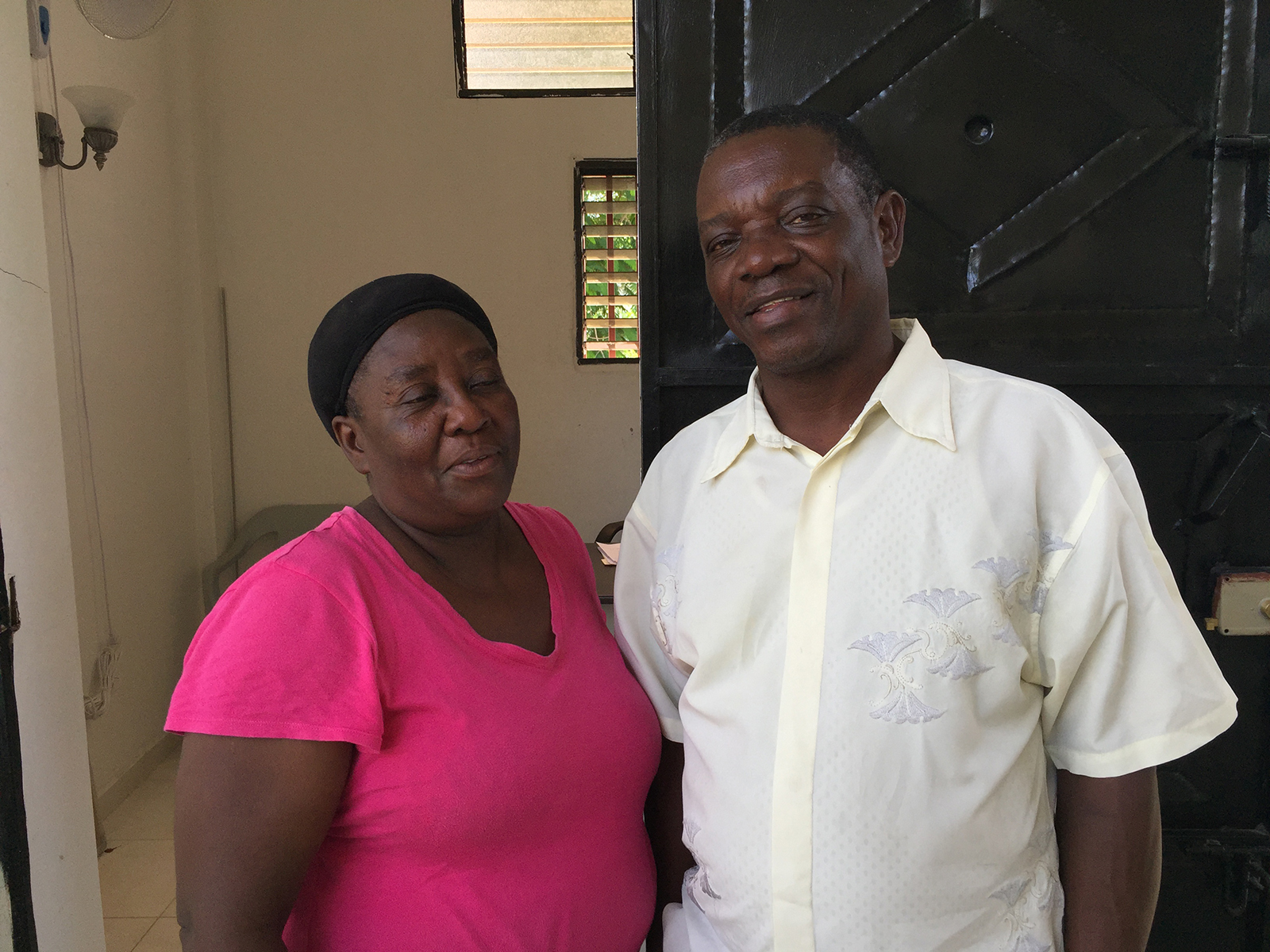
    Meet Pastor Docteur and His Wife Jacqueline

    A: Have you always lived in Hinche? Were you born here?

    Pastor: We are mostly from the north part of the country. I was born in a small town. We now live in the central part but I’m from the north part. So my wife was from the same area. We went to primary school together. We used to go to the same church, a missionary church. So we grew up together. We used to share spiritual activities because we went to the same church, prayer groups, choirs, and things like this.

    A: Tell me about your church. How did you get started in Hinche?

    Pastor: This church was started in a small room, close to this building, (pointing to the building next door of a small radio station) and it was in 1983 that we started here. I got to study for your years at the Bible college but they gave us money for supplies. So when I got back in December 1986.

    We started with the church in 1983, working with children. Now after a year the room was pretty full. So we bought the house down the road from the church and after some years the house downtown became pretty full. Then in 2001, we started wit this building of the current church. The Lord has blessed us very much.

    A: What are some challenges that you face in Hinche? What are some difficulties?

    Pastor: Some challenges. You know Haiti is a poor country? As pastor in this country. You know how it is. You don’t have to take care of just your family. You have to provide food for people in the community. You have to provide opportunities for the children to go to school. Like when school is ready to start, you will have a lot of people coming to the pastor and asking for money to pay for school fees. How can you help me? And I can’t even provide food for them… how can I provide for their education? Maybe in the United States it it is different. In Haiti, the pastor doesn’t have to only take care of the church spiritually, but also physically. You don’t have enough for your own family, but you also have to take care of everyone else. It’s a big challenge.

    And some of the people they don’t even have a house. So this is a challenge. The church sometimes needs to provide a room for them to live. Actually, the church is trying to build a place for some of them to live. Even when some of them die you need to take care of them. It’s a lot of challenges.

    A: How do the challenges of ministry impact your marriage?

    Pastor: Sometime we are discouraged with the attitude of some of the christians from the church. You are trying to help them but they don’t understand what you are trying to do.

    A: Did Madame Docteur see herself in ministry as a little girl? Did she always see this life for herself or was that something she did because of you?

    [laughs are shared]

    Pastor: Her father was a pastor. She used to work with her father, so she had some training before they got married, during her early age, for ministry because her father was the pastor.

    A: How did you know you wanted to marry her?

    Pastor: [he giggles, HUGE smiles] It’s a big and a good question. I know I was going to marry her. The first thing I did, I prayed to God, chose for me a girl who can be my wife. I think I received revelation from God to chose her. (Celine Dion’s “To Love You More” in the background… IT’S TOO GOOD!) Because I was a Christian and she was a Christian. Everything we would like to do, we knew we would go to God first.

    To Jacqueline from Annie: How do you view your role in this ministry?

    I always knew I would marry a pastor, that God would put a pastor on my path. I give myself to the ministry.

    From my childhood, I had this heart for ministry.

    A: Specifically, does she work with women and moms?

    Pastor: She works wit the women, children, and she is involved with the men. She has a women and men’s singing group.

    A: Do you have a place that you go to rest and recuperate in the ministry? Maybe home to visit family or just something you do in your marriage?

    Pastor: That’s not happened often. Sometimes when we cannot do it when we would like to. More often what happens is that we go with friends and we can go to some place and spend some time out of the ministry, out of the house, and we can get rest.

    A: It takes someone else to tell you to do it?

    Pastor: Yes.

    Meet Pastor Valcourt and his wife

    A: I’m curious how long you have been married?

    Pastor: December 23rd I am celebrating 20 years. Since then we have two girls and one boy.

    A: How did you meet your wife?

    Pastor: [laughing] I met with my wife at that time. She was one of my neighbors friends, he knew both of us. He invited me to go and visit a church and she was there.

    She used to come visit her friend, who is my neighbor. When I went to visit her church I saw that she was very active, she had a lot of responsibilities, I saw that she had a lot of activities in the church. At that time I was also one of the leaders here in this church (Cote Plage) even though I was not yet a pastor. I saw in her someone that I can love and work together in that way.

    Through my neighbor we became friends. So when I told her that I loved her, she was surprised, she didn’t have that in mind.

    And then after that we realized that– I realized and she realized that God had made us as the perfect ones for each other.

    A: Did you both grow up in church families?

    Pastor: Yes. Her dad was the pastor. In my family, only my mother was a Christian but my dad was not. So when I got married, my mom was not a Christian, but then she became a Christian.

    A: So, Madame Valcourt knew what she was getting into because she knew what the life of a pastor’s wife was?

    Yes, she knew that. She always testified that her mom used to welcome all the missionaries who would come. So she was ready for that. Because the way we do ministry together, it’s like she was used to that in her family. You know, welcoming the missionaries and all that. I can confirm all that.

    A: What are her gifts?

    Pastor: She composes music, she leads worship, she can preach, she is a teacher for the children at the church, she used to teach kindergarten, she is a mom, she knows how cooks well, she studied culinary in school, as well she has her own school at Mariani where she teaches the youth how to cook. And she knows how to sew. She makes all the uniforms at the school. And she works in the social area and she also works in the special.

    A: Madame Valcourt is an amazing woman!

    Pastor: What are things you remember about the last pastor’s conference?

    So the thing was… it was about unity! It was a vision for unity. We had all the denominations, even the Catholic priest, and we sat together and met together. We didn’t talk about our doctrines because that was not the goal of the conference. So we sat together, to feel the unity, and PPM always shows that unity works– just like when teams move like 200 cinder blocks together– that’s a symbol for how we can all work together on the same vision. So we took that moment to share our visions for our churches together. And now we have contacts with all of the pastors so we can stay connected with one another.

    I had the honor to stand in that conference as the first beneficiary of PPM. I remember when they came in August 2010. For me, from that partnership, all the other churches can learn about how they can benefit from a relationship with PPM.

    A: Why would it be a benefit to have the pastor’s wives attend the conference?

    Pastor: After each conference, the past conferences we’ve had, I always share with my wife everything that happens, the theme and all of that. It would be a big benefit if my wife could ask questions. I don’t know if my wife will be in the same meetings as I am, but if she is at the conference she is going to benefit a lot and that would help me in my ministry.

    In the same way I hang out with the other pastors, sharing my experiences, my wife would be able to do the same.

    A: How often are you able to get away with your wife alone?

    Pastor: [A long pause… HUGE smile. Really the smile tells it all.] Because of all of our responsibilities we don’t do that often. This is something that we are working on and trying to do that more often. But, you know, when we have some days off we try to take some time off. We try to make time at night to take time and talk. And with the kids, too. There is time we do that with other people, too. So what we do every day is that we always pray for the ministry together.

    As I’m a musician and I can compose music, too. So when she has to compose music for the ladies sometimes we work together. So that’s a way we spend time together, working together to serve the church.

    Expanding the Pastors Conference

    A few weeks ago I had a conversation with Cassie Jean-Louis about my upcoming trip. She’s been praying about their upcoming Pastors Conference, where she and Almando gather together all of the PPM partner pastors for a couple days to pray and share vision for all that God is doing.

    Cassie’s heart is to expand the purpose of this Pastors Conference to include their wives. In previous year, it’s been good, but they’ve squeezed 3 guys into hotel rooms… literally strangers sharing a bed. To do this, she is hoping to raise about $6000.

    The Smile Says it All

    As we were interviewing pastors and their wives, during each interview I made sure to ask when was the last time they’d been alone together. And, universally, they’d stare at each other and smile… you know… they smiled in that way a husband and wife smile at one another.

    I’ve got a lot of friends in ministry. Chances are, if you’re reading this, you’re in ministry. And you know just how important it is to get away from the ringing phone and the people coming to the office and all of that. That’s why this Pastors Conference is so important. Yes, of course, it’s about getting PPM partner pastors away to share vision and strategy for the ministry to come. But it’s also about Almando and Cassie ministering to these pastor couples who are integral to the success of the ministry in Haiti.

    Please consider helping me make the chewy center of PPM missions in Haiti, the pastors, just a little bit more sweet.

    How to Give

    You can donate at this link.

    Make sure to add a note to indicate that the funds are for the PPM Haiti Staff Retreat. If you want more information about the cost of these events or just want more information about them, please feel free to leave a comment or contact me through my blog, Facebook, Twitter, etc.

  • Genuine Partnerships Flow Through Local Leadership

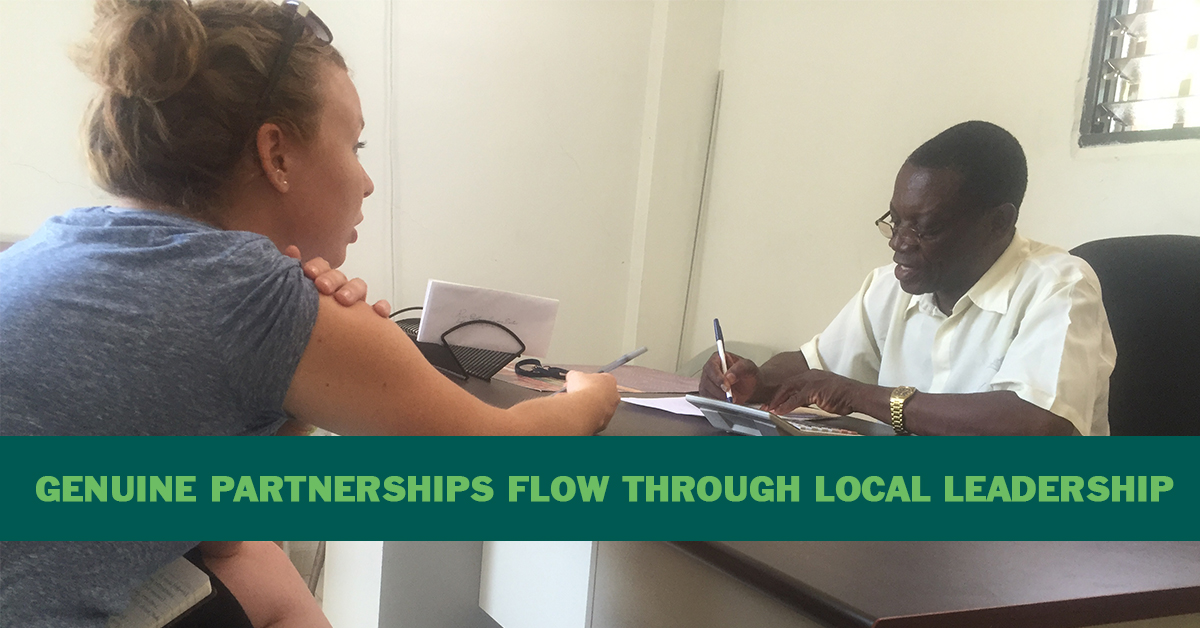
    Genuine Partnerships Flow Through Local Leadership

    Genuine partnerships. Long-term relationships. Sustainable ministry. 

    Those are the three pillars of Praying Pelican Missions. Those aren’t marketing slogans. As I’ve seen over and over again those pillars are the secret sauce of what sets PPM apart from everyone else doing short-term missions. Hearing those values pour out of the mouth’s of staff and then seeing those lived out on the field each time I’m here… this is why, I believe, they’re the best at short-term missions. It’s so simple and difficult at the same time.

    They don’t have values on a wall. They live them out every day.

    Wrapping Up a Special Summer

    I was here at about the same time last year. My trip last summer was great. But something is noticeably different in 2016.

    At this point in the summer most of the trip leaders are in their final days. They’ve been welcoming teams and shepherding them through trips week-after-week since early June. Some of them are able to get away for a few days while others run from start to finish with little more than a day off to do their laundry, handle some paperwork, and get ready to welcome the next team.

    It’d be totally understanding if they were a bit cranky. Since we’re friends I’d expect them to share daydreams with me about getting back to their daily lives. That’d be perfectly natural, right? Instead, every staffer seems to be dreading the end of the summer season.

    Sure, they’d like to catch up on sleep. Sure, they’ve each got a few wounds to heal. But everyone I’ve hung out with over the past few days is sad to see this summer end. It’s been special. When Annie, Mel, and Anuel picked Megan and I up on Wednesday morning they were sleepy, it was 7 o’clock in the morning, but they were downright cheerful about our 4 hour drive up to Hinche. Later that night, when I first saw a veteran leader and full-time PPM staffer from Ohio named Lonnie, he first told me how dead tired he was after a week of ministry. Then, with his body melting steadily into his bunk, he proceeded to talk my ear off for an hour sharing stories of all that he’s seen God do on trips all summer.

    He was ready to go home. But he was still holding onto the summer.

    Local Leadership

    This summer about 70% of the staff are Haitians. These highly skilled, highly trained, and highly motivated local leaders serve teams at every level. In some cases, the only American PPM staff serving on trips come along as assistant trip leaders, helping make sure everything translates across language and cultural barriers and posting a daily trip journal. Why? Because the national leaders have learned how to do everything. Haiti Operations Generalist Annie Schoessler shared with me, “I’ve almost worked myself out of a job and I love it.

    One of the things I love about working alongside PPM is how fair they are as an organization to their staff. If you’re excellent at your job you can earn more responsibilities and opportunities regardless of nationality.

    I want to introduce you to a couple of these amazing leaders who I had the chance to interview recently.

    Meet Nadege

    I first met Nadege in 2015. One quality that sticks out to me about her is how sensitive she is to the Holy Spirit as she works in ministry. For example, I was with her last summer as she lead a group of Americans around a community in south Haiti doing tree ministry. Tree ministry is a modification of door-to-door evangelism where teams go around the community meeting with neighbors on behalf of the church, offering to plant a tree in their yard, [deforestation is a major problem throughout Haiti] and asking community members if they’d like prayer.

    As you can imagine, tree ministry puts a lot of pressure on the Haitian staff because they are trying to keep track of their group PLUS trying to translate conversations and prayers PLUS trying to make sure that the experience is a positive one for both the trip participants and community members alike. Our group did a lot of walking, lot of talking, and a lot of tree planting. While our energy faded in the withering heat hers increased. While we felt awkward meeting new people her disarming smile and straight-forward way opened up hearts and removed suspicion. She was tender and pastoral and inspiring.

    You might think someone like that grew up in church or was a pastor’s kid. That’s not the case with Nadege. While she went to church off and on growing up she didn’t really get serious about her faith until her teenage years. When I asked her about her church life now her face lit up, she loves her church and goes year-round with some fellow PPM staff, in many ways they are her adoptive family.

    Like lots of people her age she’s enjoying ministry while also pursuing her career. During the summer and during breaks she works with PPM, but otherwise she is studying to be a nurse.

    Nadege is super positive so I had a hard time pulling out of her something that she finds hard or frustrating about her work leading trips. Finally, after some prodding, she shared how managing teams expectations is hard. Teams sometimes use language about bringing God to Haiti and it can be hard for them to wrap their minds around the fact that God is automatically active everywhere, all the time. Teams learn that they aren’t coming to bring God to Haiti but to encounter God outside of their own culture. When I asked her what she hopes teenagers will take home from their experience here, she paused for a long time to make sure she said it just right: “I hope teams go home with a vision to do what we’ve done here back home.”

    Amen.

    That’s my hope, too.

    Over and over I’ve seen people come with a heart to give, postured to pour themselves out– but they go home filled up in a new way, having been ministered to as they serve. When they try to pour themselves out their cup is filled, overflowing. Like Nadege said, my hope is that they take that experience… that new thing they learned about serving God… and do it back home. In a week you can make an impact. But in a lifetime you can make a difference.

    Meet James

    James grew up as a church kid. Except for a time in his teenage years when he wanted to learn what like would be like outside of the church, James has always gone to church with his mother, brothers and sisters– being involved in all sorts of aspects of his church.

    Today, after living for a while with his brothers on their own, one of his older brothers got married so he had to move back home with his mom. When he’s not working for PPM he’s working on his carpentry skills, there’s tons of building going on throughout Haiti and a skilled carpenter stays very busy.

    A couple of years ago his brother Rudy, another PPM staff member, asked him to get involved leading trips. It took a little convincing but after his first summer he really fell in love with it. “The best part of working with PPM I get to use all of my gifts. For example, I play guitar, I love to talk, I have some leadership skills, I speak English, I try to make people comfortable by being funny. By being in a place where you can use all of these gifts is great.”

    I asked him, “If you weren’t leading trip with PPM, what would you be doing?” With big smile he said, “Um, leading trips. I love it.”

    Jokes. James is full of jokes.

    When I asked him to describe more about what he likes in leading trips he said, “It’s getting to know new people, making new friends, and also seeing old friends come back– I love those reunions. I enjoy the challenge of getting to know people, each team is different, and them leaving at the end week wanting to come back and request me to lead their next trip. I also love working with the children in the communities.”

    Why do kids come out of the woodwork here?

    “It’s part of our culture. They enjoy people coming and meeting people. They want to try everything. They want to grab your phone and try the filters on Snapchat. They just want to have fun.”

    That’s been my experience, too. Haitians love languages and learning about different cultures. There’s an inviting innocence to that which makes it fun and easy for everyone.

    Is there something that drives you crazy about Americans?

    “To be honest, the biggest thing is assuming things. I don’t find that a lot but I do find it sometimes. People get so caught up in what they think about our country that they aren’t even really here. If you are here to experience something, you need to be fully here, you can’t be thinking about home. You need to be open to experiencing the full potential of the trip. Another other thing that is hard is when teams think they are going to bring God down here. I don’t like when people think that they are bringing God here. Think about it… “Where isn’t God?” It’s OK to come here with some expectations. But the problem is when you are trying to live into your own expectations instead of what’s really happening. People are sometimes looking for moments that they expected, like “Haiti is a dirty country.” They are looking for that and sometimes that’s not true, so it becomes a distraction as they look for it. They get to the point where they so believe in their expectations that all they are looking for is to validate what they already thought. And that’s hard.

    What are you hoping they take home?

    “First of all– God. To know that He’s everywhere, that they need to rely on Him. Second of all, you should never judge a book by it’s cover. You have to read it first. I want them to come down here to find God, or maybe find him in a different way, and know that He is everywhere. I also want them to go home knowing that we are all the same. We are real people, we have feelings, the differences that we have are just cultural. God has placed us where we need to be because He knew where you needed to be. He loves us the same.

    Investing and Celebrating Local Leaders

    These are two example of PPM’s Haitian leaders. There’s an incredible team being built here with much to be celebrated.

    But it’s not without it’s challenges. For example, at the beginning of the summer Praying Pelican Missions gathers it’s top leadership in the United States to build into the staff, to cast vision, and to share encouragement across all of the countries they work in. But because of the costs and visa situation it’s not been possible to get all of the Haitian staff who would normally be invited to those meetings.

    But, like ministry often teaches us, when something comes up as a difficulty you end up seeing it as a opportunity. Full-time missionaries Almando and Cassie Jean-Louis are hoping to gather the Haitian staff this fall, to celebrate all God has done and continue building into their team as they look forward to fall 2016 trips and the 2017 season.

    Their hope is to create a gathering of Haitian staff (and their spouses, kids) at a resort for 2 days for encouragement and celebration.

    That’s where you and I come in. To do that we need to raise about $3000. (enough for 30 people) I hope you can join me in investing in the continued development of these leaders by pitching in to help make this retreat happen. Whether you and your team have been personally impacted by this team or whether you’re just learning about the ministry of PPM in Haiti for the first time, together we can help this hard-working team finish off their summer right.

    Here’s the link to donate

    Make sure to add a note to indicate that the funds are for the PPM Haiti Staff Retreat. If you want more information about the cost of these events or just want more information about them, please feel free to leave a comment or contact me through my blog, Facebook, Twitter, etc.

  • In Haiti… For a While

    In Haiti… For a While

    IMG_8887Hi. My name is Adam McLane and I’m addicted to going to Haiti.

    How many times have you been to Haiti?” That’s a question I hear quite frequently when I meet people on trips. “A lot” is my new response. I suppose I could go back and count, but it’s easier to just say that I’ve been here a lot.

    This trip has two distinct parts and one special bonus.

    The bonus is that Megan, my 15 year old daughter, is with me. This is her first mission trip and second time out of the country. That she’d even be willing to spend 14 days with me is enough… it’s so fun for me that she gets to meet a lot of my friends in Haiti and experience a whole bunch of new stuff. It makes a dad’s heart happy to share what he loves with his kids. I’ve been looking forward to it and so far she’s doing great.

    IMG_8853The first part of the trip, from Wednesday until Monday, is being spent visiting with our missions partners in Haiti. We’ve been going around and visiting church leaders and Haitian staff, collecting stories that I’ll share here on the blog next week.

    The second part of the trip, next Monday until we leave on August 9, Megan and I will be joining the high school team from our church. There we’ll work with our sister church in Carrefour, investing in the church’s ministry to youth.

    From Then to Here

    IMG_8875As I’ve shared on previous trips… things have shifted in Haiti. We are well past emergency relief after the 2010 earthquakes. At this point so much of the work being done is building up the local church, who often act as the social net for the poorest of the poor in each community. So far this week I’ve already had the opportunity to visit with social entrepreneurial non-profits, Papillon Enterprises and Haiti Made. These types of NGO’s are exciting and new– even two years ago they weren’t thriving like they are now. These are exciting to visit, doing very well, and are totally gorgeous (and tasty!) pit stops for visitors.

    You can follow along to the more minute details of my trip on Twitter and Instagram.

  • Stop Gawking

    Stop Gawking

    Rubbernecking, gawking, eyeball, peer, rivet, glare, ogle. 

    These are synonyms for what the 24/7 news cycle wants out of you.

    The antonym? There’s only one:

    Ignore. 

    Source

    When the News is More than The News

    About 18 months ago I had the epiphany. Huffington Post and CNN weren’t showing me news. They were showing me commentary about the news that was specifically designed to get me to react. I wrote about that in the post, Reaction Porn.

    In some quite literal ways news organizations have used analytics and algorithms to shape content designed not to inform the public but with two specific goals:

    1. To keep you watching/reading.
    2. To garner a reaction. Specifically, share it on social media.

    The “why” behind that is fairly simple. To keep the ad dollars flowing they need your eyeballs on the TV and they need the page views of getting your friends to click links so they can see ads, too.

    It’s not evil. It’s not slanted. It’s not necessarily immoral. These are businesses, owned by some of the largest media empires on the planet, and they need their money.

    But it is bad for you. It’s manipulative. For me, it literally seemed to control my blood pressure. And it wasn’t making me better informed: It was making me more angry. 

    Turning Off the News

    So I quit the news cold turkey. Just flat out took it out of my loop.

    No more CNN.com. No more HuffPo. Deprogrammed Fox ages ago. I don’t go to their websites. I don’t follow them on Facebook or Twitter. I rarely watch TV anyway… but I won’t go online to their feeds or click on links to some specific sites from Facebook. Below I’ll show you how I completely block myself from seeing links to specific outlets or people who post nonsense.

    And you know what? I don’t miss it.

    When “Breaking News” happens I’ll turn on CNN long enough to get caught up with what’s going on. But as soon as they switch to the three idiots on their panel to start debating “why” something happened or “what it means” I just turn it off. (Why do I do this? See #1 above.)

    My Sources for News

    IMG_8696It’s not that I completely tune out. Not at all. I’m just turning off the commentary.

    Let me introduce you to the AP News mobile app. (Available for free on Android/iOS) I scroll through it once or twice a day, it’s not in my loop. Instead, I look through their generic feed quickly to read a couple top line news items. What I like about the AP app is that it’s the straight dope. Other agencies use AP as their source, they jump off of the basics from the AP to add commentary. But the AP app is just a boring feed with little, if any, editorializing.

    Of course, I read local news. And to get a more global look at things I enjoy reading the BBC app.

    But that’s it.

    Tuning Out the Nonsense on Facebook

    Like more than a billion other people on our planet, I really like Facebook. But I also understand that EVERYTHING I see on Facebook is filtered through Facebook’s algorithm which is designed for one thing and one thing only… getting me to spend more minutes on Facebook.  Facebook isn’t a free service. It’s a company that turns your attention span into the product they sell their advertisers. (Full disclosure: I’m a Facebook shareholder)

    I bring sanity back to my Facebook feed by using Facebook’s built-in features to eliminate biased nonsense.

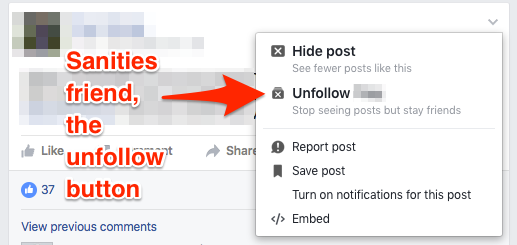
    First, I shamelessly unfollow people who post reaction porn. Best part? They’ll never know. You’re still “friends” you just no longer see their stuff.

    Unfollow Button

    Second, I block sites from my feed that are annoying…

    Once you start paying attention to websites and links that tend to raise your blood pressure you can very easily eliminate them. (Note: I’ve done this so extensively that I’m using something as an example that I wouldn’t normally block.)

    skitch-9

    You could spend 20 minutes and eliminate 95% of the reaction porn from your Facebook feed altogether.

    Engage Local Issues. Be Aware of National Ones.

    Yes, there are big national things that we should be aware about. Yes, there are breaking news items that’ll stop me cold and bring me to watch. But we all need to understand that things we’re learning about national and international news items is one tiny– often times skewed— view of what’s really going on. Until you actually engage with a story with your own eyes and put your own feet into a situation, you only know part of the story. The fact of the matter is that it’s not your responsibly to form firmly held opinions or reactions to news items that aren’t local to you. You need to understand that the reaction your feeling was created by someone with their own agenda.

    That’s not to say I don’t engage on national news items or political policies. I’m going to continue to talk about gun control, immigration reform, school reform… but the more I’ve tuned out of the daily grind of reaction porn… the better and more focused I’ve found myself on things I’m actually accountable for doing. (e.g. No one pays me for my opinion on the news item of the day.)

    The 2-Week Challenge

    Try turning off your favorite news feeds for a couple weeks and see if it helps you get a better perspective on things. Deal?

  • Pictures from Vacation

    Pictures from Vacation

    Late Monday, we came back from our annual summer 2-part vacation.

    Part one was at the Wawona Campground in Yosemite. This was our first time at that particular campground… and we certainly liked aspects of it. (Good: It’s right on the river. Bad: No views of the valley, and it’s hot.) Due to some car trouble we actually never made it into the valley. So that’s a first. We went all the way to Yosemite but barely saw what most people would call Yosemite. Ah well, it was a blast.

    Part two was at one of our little happy spots… a beach house in Cayucos. We take it from the mountains to the Central Coast. While camping is relaxing in it’s own way it’s still nice to just put your feet up and do nothing. Well, “do nothing” means we probably walked 15 miles a day on the beach! Murray liked the mountains but he LOVED the beach house.

  • Writing Again

    Writing Again

    “Only write if you’ve got something to say.” 

    That was advice that stuck. And that’s advice I’ve tried to keep. Whether it’s on the blog, in articles for magazines, contributions to books, curriculum projects, seminars, media stuff… I’ve always felt that if I expected someone to listen I had to have something interesting or new or important to say.

    When I’ve got something to say the process is easy.

    When I don’t? Writing is work. Boring at best. It feels forced and unnatural.

    Since publishing A Parents Guide to Understanding Social Media with Marko a few years back I’ve felt a subtle push [internally] to write more about social media.  Externally, it’s been an obvious ask since the first book did well.

    But, it’s not really in my DNA to put a feather in my cap. And though it’s nice to deposit money in my bank account I’m not really interested in an advance. And I’m definitely not interested in building a personal brand or mini-empire, the mission of the Cartel is so much bigger than that.

    I share all that because I’ve resisted a new book. I didn’t want to do a new book just to do it or for the money or whatever lame reason. I didn’t write again just because. See, I didn’t feel like I had something that needed to be said. Even writing for a utilitarian reason like “it’ll help people” is meh to me.

    All that to say.

    I’m working on a new project.

    I’m excited about it.

    I’m plugging away on the nuts and bolts of it over the summer, writing the bulk of it in September. I guess it’ll probably come out sometime in 2017.

    My hope is to push past helpful.

    My goal is to write something you’ll want to read.

    My aspiration is that it’ll be something you need to read.

    You see, I’ve got something to say.

  • Pokémon Go and Your Youth Ministry

    Pokémon Go and Your Youth Ministry

    There’s a new fad that’s completely wholesome, brings people to church, and is 100% free. In that sense Pokémon Go is pure youth ministry gold.

    But, like the 1849 Gold Rush, you’ll need to act fast because it won’t last long. I don’t see Pokémon Go lasting in the mainstream for very long… but it’ll be great while it lasts. (We’re talking weeks here… probably not months.)

    What You Need to Know

    Pokémon Go is a free app that takes Pokémon out of the realm of the Nintendo DS line of products, out of the trading card game, out of the holdover early-2000s geekery class, and puts the game into real life on your mobile phone. The game sends you out looking for Pokémon using augmented reality technology that’s been out several years but never truly taken off publicly in the way this game has.

    • You have to walk around to play the game, finding characters and logging kilometers so your eggs hatch.
    • You have to have the app open to play.
    • In order to collect more Pokémon you need check in at Poké Stops to get more Poké Balls, the app has chosen millions of public landmarks, including just about every church.

    Here’s a beginners guide if you want to know more about how the game works.

    Adults Are Kinda Freaking Out

    Of course, since it involves kids/teenagers/game-loving-adults and phones plus being outdoors… adults are kind of freaking out.

    For the most part people who aren’t playing it seem to fall into two camps:

    A. Genuinely amused to see people wandering around playing the game. (This is from a high school friend’s Instagram feed, language warning…)

    B. Dismissive & Issuing Warnings

    My Advice?

    Here on my blog you know I write frequently about things to look out for with social media apps. And yes, I could point out the security concerns or the semi-obvious-COPPA compliance issues.

    But you know what? Let’s just go with this one. It’s simple, it’s fun, it’s pretty harmless, it’s getting millions of people out walking around in our communities, (the absolute BEST thing you can do to make a neighborhood safe is people out walking around!) and people are enjoying it.

    Let’s set aside the concerns and just enjoy it. I mean, we let small children play with sparklers on the Fourth of July, right? It’s that kind of dangerous. Yes, somebody is going to poke an eye out or find a dead body. But most people are just going to have fun with it… so let’s have fun, too.

    [Literally, you grant so many apps with the exact same types of access to your phone’s private information, I’m a bit shocked at the backlash about privacy. I mean, you can probably trust this company more than you can trust the random free photo filter apps you’ve got that use your Google account to login.]

    Some Ideas for Youth Ministry

    I think this little cultural phenomenon is a great way for your ministry team to connect and get to know people. Think build relationships and not evangelism.

    First, if you haven’t already, go ahead and download the free app so you know what the heck everyone is talking about. Spend an hour playing it, at least get to Level 5, you might as well do this as a staff since it’s not just a kid thing… pretty much everyone is playing it. (It’s the most popular iOS app right now. It’s user base is closing in on Twitter after just 6 days on the market.)

    It’s kinda big right now.

    Second, see if your church is a Poké Stop. You’ll probably already know that because there have been cars stopping in front of your church or people walking up to your church’s sign for a week.

    Third, if you notice people are dropping by to visit your Poké Stop, grab a lawn chair and go sit outside for a while to watch and enjoy. Wave, have fun with it. You don’t have to understand it to enjoy the phenomenon. I mean, when was the last time this many people just randomly swung by the church?

    Hack the system: You can combine the first idea with the third. Sit out by the Poké Stop and play the game… if you don’t understand something, ask one of the people walking by for help. (Nerds are helpful!)

    Fourth, serve ’em.

    Here’s a few ideas off the top of my head:

    1. Put out a candy dish. Get some Poké Balls, maybe an egg, and get a free lollipop? WHAT!?!?!?! I love that church!
    2. Buy a bunch of battery chargers and lend them out. (The app uses a lot of power, a little charger is like $10. Get 5-10 of them and lend them out.) Sure, you might lose a couple. But you might be surprised.
    3. Put out bottles of water. Did you know to hatch an egg you’ve got to walk 5 KM? (3.2 miles!) Put a cooler out with free waters next to your stop, or just a jug and some cups with ice water, pretty much free and a great way to communicate you like nerds.
    4. Offer something simple like a free tour of the sanctuary. Chances are these players have never been in a church! Show them all the technology you use or show them what everything is in your sanctuary. Keep it short and sweet, but also keep in mind they need to walk 5 KM to hatch an egg, so they need to walk around. Oh, you’ve got A/C? Even better!
    5. Offer free (side) hugs. We’ve even made a t-shirt for this one.
    6. Host a Pokémon Go meet-up. You’ve got space available, right? Get all the players together and let them nerd out. (Since your whole staff plays, they might even enjoy this!)

    What other ideas do you have? Leave a comment and let’s make a list.

  • Raising Up Generalists

    In the summer of 1994 I shared a dorm room at Moody Bible Institute with a former Olympic Sprinter from Liberia. I believe his name was Samuel. I was barely 18 years old, living on my own for the first time, and he was in his 30s, a married man trying to save money to bring his wife over to the United States while he finished his schooling.

    He and I weren’t close. Sharing a room was about all we had in common. But I thought he was cool… he’d run in races around the world against Ben Johnson and Carl Lewis.

    Late in the summer the school sponsored a 5k race to raise money for a cause. And Moody’s athletic director, with a flair for promotion, invited Samuel to be a part of the race so that he could put on the flyer that an Olympic runner would be involved.

    On the day of the race I had a very interesting conversation with Samuel. He was nervous about the race. He wanted to do it because he felt it was an honor to be invited and he knew the school was counting on him. But he’d never run 5 kilometers. He was a sprinter. And he was convinced that he couldn’t run that far.

    He was right. When the race started he dropped about about a kilometer into the course. He joked, “I went as far as a sprinter should ever go.

    Raising Up Generalists

    We celebrate specialist. These are people who have taken something that lots of people could maybe fart around with and maybe be alright at… but they’ve focused all of their attention at getting really good at one thing.

    The truth is that specialists are great to work with. You know what they do, that it’ll be great, and you can count on them.

    But being a specialist is also problematic. There’s a difference between a persons specialty and their passion, those don’t automatically line up.

    The longer you are seen as a specialist in a specific field the less people assume you know anything or are interested in things outside of your field. I run into this all the time. And it drives me insane.

    Raising Up Generalists

    The reality is that while the specialist gets all the attention, the generalist gets things done. Organizations need both to thrive.

    I would recommend that we each examine ways that we can celebrate the non-specialized parts of our specialists and celebrate the generalists in your organization who get stuff done every single day.

  • Amazon Tap Review

    Amazon Tap Review

    A couple months back I was looking for a nice Bluetooth speaker for my office. Specifically, something that was better sound than my Macbook speakers and better than the built-in speakers on the TV mounted on the wall.

    I wanted it to be small, have good sound, and connect to anything. After some digging around I went with the Amazon Tap and have been pretty pleased.

    What is it?

    Here’s the official description:

    • Just tap and ask for music from Prime Music, Spotify, Pandora, iHeartRadio, and TuneIn
    • Uses the Alexa Voice Service when connected to Wi-Fi or a mobile hotspot to play music, read the news, provide weather reports, and even order a pizza
    • Streams all your music via Bluetooth from your phone or tablet
    • Delivers crisp sound powered by Dolby, with dual stereo speakers that provide 360º omni-directional audio
    • Provides up to 9 hours of playback
    • Always getting smarter and adding new features and skills
    • Includes Charging Cradle

    Adam’s description:

    It’s a portable Bluetooth speaker made by Amazon with some built-in Amazon features.

    The Good

    You might be familiar with Tap’s big brother, Amazon Echo. Echo didn’t meet my needs for my office for a couple of reasons. First, I just needed a speaker and not a personal assistant. Second, I’m not 100% sold that I want an internet-connected device listening to and recording everything it hears. Edward Snowden would tell you that’s a bad idea.

    What I like about Tap is it’s simplicity.

    • I like that it’s got a crazy long battery life… it’s listed at 8-9 hours but I regularly use it 12-14 hours between charging.
    • I like that it’s portable. I can use it in my office all day. But I can (and do) pick it up and take it with me. So when I’m out working in the yard I can still listen to music or a podcast or whatever I want. It switches pretty seamlessly from being connected to home wifi and my phone’s Bluetooth. So I’m looking forward to taking Tap on vacation or the beach or anything like that.
    • I like that it’s connected to all things Amazon. I ditched iTunes Radio when they went to a subscription service for Amazon Music, which is part of the Amazon Prime membership. I stream music all day, every day. Plus, I can add something to my Prime Now shopping list or ask when my next Amazon order will arrive.
    • I’m learning to like Alexa. I’ve been kind of slow to find a real function to Alexa (or Apple’s Siri for that matter). But I’ve been learning to use her to set timers and add things to my calendar or any other number of small tasks. I know I can connect Alexa to all sorts of home automation things, too. So I look forward to telling Alexa to turn off the lights in my office and set the AC to 75 degrees.

    Things I Don’t Like

    There are a couple of things that kind of annoy me about Tap. First, it’s really hard to turn it off manually. I know I can press the button and say, “turn the power off” and it’ll power down. But I don’t think the actual power button on the back turns the thing off… just on. Second, Alexa can sometimes fail to deliver what you want on Amazon Music. She seems to be infatuated with recommending a couple of stations I don’t particularly like. Since I use Tap for background noise while I work (like right now as I’m writing this) I like to ask Alexa to “just play some music.” Instead of playing Amazon Music stations I listen to all the time, say the U2 channel, she’ll start playing some random alternative music channel. And if I tell her “I don’t like that channel, play something else” she gets confused and says “I don’t know what you want, Adam.” That’s a little too angsty and existential for me. Just play something else!

    The Money Line

    Is this worth $129? On the face of it, as a Bluetooth speaker alone, a better value would be found in the Bose or JBL portable Bluetooth speakers. Though I didn’t do a side-by-side comparison my assumption is that both would have a higher quality sound experience. So just as a Bluetooth speaker I don’t think it’s a great value… should be more like $70.

    But when you add in the other stuff that it does… that it can connect to your home wifi to play music independent of another device, plus have all the benefits of Amazon Alexa, plus still be used as a Bluetooth speaker? I think it might creep into that category of being a good deal. Though, in all honesty, $99 would be a better price point. 

    Overall I’m pleased with it. I use it all the time.

  • Youth Ministry as an Advocate for Vulnerable Children

    Youth Ministry as an Advocate for Vulnerable Children

    Perfect.

    No really, perfect.

    With my sarcasm volume cranked up to 100% I say it again, “We had the perfect ending to a perfect school year.”

    How perfect was this school year? It was so perfect that we’re planning a bonfire at the beach this weekend where we will burn everything. And I mean that literally. We will burn everything.

    Why? Sure, the whole school year wasn’t bad. There were parts of it that were pretty good! But we need to start over– to symbolically leave the 2015-2016 school year behind us.

    I’ll spare my readers the details and just summarize it like this: One of our kids made a mistake at school and the school offered an outsized, nuclear response. It took 8 days of near round-the-clock work to finally clear it up late last week. And the ramifications of the outcome will take months to navigate.

    Something like this is an unholy mess no one can prepare themselves to deal with.

    It put us in a tailspin emotionally. Anger, disappointment, heartbreak, distrust, frustration… near madness. Round and round we went.

    And, in the end, we don’t know what the long-term ramifications will be.

    And even though it’s over we are exhausted, heartbroken, angry, and frustrated. Most of all exhausted. Thank you Jesus for our upcoming vacation… we desperately need the sanity only Yosemite seems to bring.

    Vulnerable Children Are Among Us

    I share this not looking for sympathy. I share this because you need to understand how privileged we are to have the resources available to deal with this.

    • I’ve been involved in things at school before on behalf of other people’s children, so I had some working knowledge.
    • We’ve got access to a myriad of friends who are experts in what we were dealing with.
    • We have financial resources and a budget that make funds available for when unexpected things come up.
    • We’ve got a support system to lean on as we process a course of action.
    • Our children have two parents at home full-time.
    • Our family has work/life flexibility which allowed us to dedicate the time needed without fear.

    Yes, those 8 days were hell. But we are painfully aware our  family walked through that with many advantages and privileges.

    All along the way we kept wondering about children in similar circumstances who just didn’t have access to the resources we did, who didn’t know how to navigate a system, who didn’t know they could fight back or fact check or compare actions against the law, or who– quite honestly– wouldn’t even have had the ability to show up because work wouldn’t allow them to go.

    What would have happened to them? I shudder at the thought.

    Most likely, if the same thing happened to another child anywhere in America, the outcome may have been much different.

    You see, no one stepped forward to help us. And if no one stepped forward to help us— you can be assured that this is standard operating procedure. If you get accused of something it’s up to you to defend yourself.

    Each day millions of children navigate the hallways as classmates in a public school system defined as equal. But it’s not. Schools do their very best to level the playing field. But everyone knows what is up, who has and who doesn’t. It’s no secret among students who gets free lunch, who attends before or after school care, who has a big house, who is undocumented or a refugee or whose parents are on the splits.

    Schools aspire to be a great equalizer. But they are not. Students may be afforded equal opportunities but they aren’t equal.

    We should continue to aspire to that but we also need to stop pretending. 

    Just as there are privileged children among us, there are vulnerable children, as well.

    Youth Ministry as an Advocate for Vulnerable Children

    If you know me, you know I’ve long held up the baton that youth ministry needs to see itself from a bigger lens than youth group. I think youth group is great– but there is so much more that the church could and should be doing to minister to the needs of adolescents in our communities.

    I don’t think that the church’s responsibility to minister is limited to the people who show up to a program. I believe that God has placed our churches where they are for a reason, we aren’t just a place of worship, we are a place that lives out the Gospel as people of faith in a community. Just like Jesus’ life was incarnate, we too as Christian men and women must live incarnationally. To be like Jesus, “Christ-like” we have to live among and for others.

    Friends, there are vulnerable children among us. Your kids go to school with kids who are vulnerable. Your kids are friends and classmates and buddies with them. You’ve got vulnerable children in your youth group, on your block, on and on.

    The question is: Are you prepared to advocate for them?