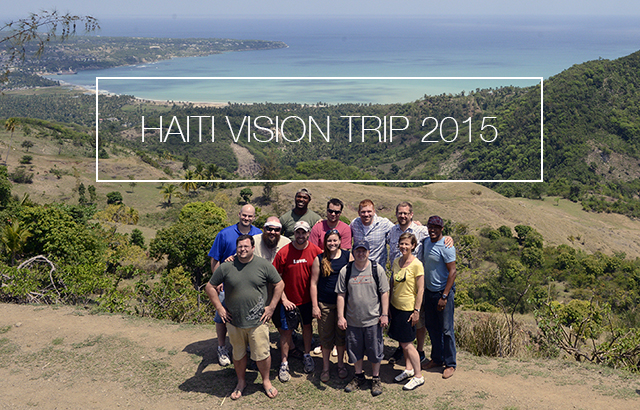
Late tomorrow night I board an overnight flight for Port-au-Prince, Haiti. Once there I’ll spend the next four days with a dozen pastors and youth pastors from across the United States who are coming to explore bringing a team to Haiti with Praying Pelican Missions.
I have a confession to make:Going to Haiti doesn’t make me nervous anymore.
My first trip in 2010 I was really, really nervous. Just a few weeks after the devastating earthquakes that brought Port-au-Prince to it’s knees I nudged against Ian Robertson at the San Diego airport and said, “What in the world are we doing going there right now?” In preparation, I’d stared at the endless devastation on CNN for hours, read and watched everything I could take in, and been warned by a travel doctor of every possible ailment I could contract.
Going to Haiti in 2010 felt death-defying and harrowing and a little ridiculous. Something you survived.
But… I’ve made six trips since then. And a lot has happened in 64 months there.
I’m not nervous about my trip at all. I’m just excited.
The Value of a Missions Experience
I do, indeed, think that one important aspect of youth ministry– one indelible opportunity for every student involved in a youth group— is a missions experience. Living in the United States is incredibly ethnocentric. And adolescence is a crucial time to shape a worldview that is bigger than the United States.
Part of our job as a youth worker is to help teenagers understand that the Kingdom of God is bigger, stronger, more connected, and better than the place that we live. Jesus followers are citizens of the Kingdom… to discover that you have to get out of your culture. You have to be in other places, worshipping with different people, eat different foods, explore different cultures, and fall in love with something outside of what you know.
Whether it’s across town, across the country, or across an ocean I believe a healthy youth ministry includes a healthy dose of missions experiences. It’s good praxis. It’s good theology. It’s good sociology and anthropology.
More than a “Missions Experience”
Jim Noreen & Sister Mona at Good Shepherd Orphanage
But I’m 38, not 15.
Frankly, I don’t need another missions experience. I love exploring and visiting new places and meeting new people as much as the next person. But I am at the point in life where I want more than a one-off experience.
I want real relationships. I want to know what I’m doing is sustainable. I want to build partnerships. I want to lift up the local church and strengthen ministries in the things that I do. And I want to make sure that what I’m do is helping and not hurting.
That’s why I’m excited and not nervous about my trip this weekend. I’m going on a vision trip with a dozen folks from around the United States and we’ll spend 4 days with people in Haiti that I know– Eric and Bethany, (get to know Bethany a bit in this post) Cassie and Almando, Rudy, Sister Mona, Pastor Valcourt are people I’ve built relationships with, and have seen how these long-term partnerships lead to sustainable ministry through the local church in Haiti.
To get the opportunity to introduce people to that kind of health? There’s no room for nerves, only excitement.
Want to learn more about PPM’s work in Haiti? Fill out the form below and we’ll talk your ear off.
Back in the old days, 2005 to be exact, I had a problem. I needed an email template to send our very first newsletter for Youth Ministry Exchange.
Email marketing was starting to become a thing and I wanted to send an HTML-based template that looked like I knew what I was doing. (Even if I didn’t.) Back then, we sent email with a little program that ran off our webserver using the PHP mail() function. It was archaic, at best, and usually shut our server down in the process. But it’s what I had and I was determined to make it look as professional as I could.
As I continued to look at templates I kept ending up at a little website, MailChimp.com. It was a paid service, I didn’t want a paid service, but they were offering free templates… for them, this was an early entry into the SEO game… and it was working by drawing me in.
I started using their templates. I’d copy/paste their code into my HTML editor, add our content, then copy/paste their template into our software, and send it out to our customers. Then our server would shut down… and people would freak out because the forums were down or the articles I was linking to weren’t visible because I’d have to call Bluehost and get them to reboot the server, again. On top of that headache I had to create and manage forms for people signing up for our newsletter as well as manually manage people opting out. It was a royal pain.
By early 2006 I’d had enough.
Even though we really didn’t have the money to pay for any service I knew that I could sell an ad on the forums that’d pay for MailChimp. But the downside of paying for something I had been doing “for free” on our webserver was easy to overcome when I could get more uptime for the forums, less complaints, and MailChimp would also offer me some basic reports, handle the opting in and opting out, all of that.
And so, MailChimp became my email marketing platform of choice. They were still kind of small at that time, they had something like 11,000 customers. (They have more than 7 million customers now)
Pretty soon I had questions. Something didn’t work right or I couldn’t figure it out, so I’d hop on live chat or send in an email to ask my question. And instead of “just fixing it” they’d often times point me to their support documents which told me how to fix my problem.
They’d roll out a new feature, I’d try it in my next message, if there was a problem I’d email them, they’d send me a link to a document and I’d fix it. This little loop would continue for the next year or so. With each message I sent I got a little better, our emails got a lot better, and we were rocking and rolling. (Open rates of like 45% were the norm!)
Then in summer 2008, Patti and I sold little YMX to another company and the next thing I knew I re-entered the dark ages as I began working for the larger company on their email marketing.
All-in-all, the emails we were sending at the new company were prettier– the copy was much more snappy. But the open rates were terrible– less than 10%, the click rates virtually non-existent– less than 1%, the lists were full of spam and duplicates, we had a very hard time showing how emails created leads/sales, and we were spending lots and lots of money sending email messages with an array of contractors and over-priced, out-dated systems.
Worse yet, when something went wrong, or we wanted to do something different… the answer was always either no,more money please, or that’s not in our contract.
In 2009, I finally convinced this new company to move to MailChimp. And you know what? Our open rates, click rates, and every other measurable skyrocketed. (Not to mention we saved boatloads of money.)
Self-Service = Power for the User
Here’s what I learned in this:
Most expensive can mean something is the best, but not necessarily.
When you empower your users to help themselves, your cost of doing business per customer drops to almost zero.
When you empower your users to help themselves, the value of your product increases in the eyes of your customer.
When you empower your users to help themselves, they become your evangelists because they make themselves better by using your product.
The Problem of Religion
It’s not just MailChimp that’s taped into this. If you think about it, the driving force behind much of the current internet/app crave is that power has shifted from CEO dictators who control every aspect of how a product is used with their greatest weapon being restricting access to CEOs who act like anthropologists and data-driven analytics monsters whose greatest weapon is granting near limitless access.
YouTube makes very few videos but their platform and reach is massive. Apple’s iPhone struggled until they publicly released the software to build apps and make the entry point for submitting apps just $199. (Android was built from the ground up on this principle.) WordPress is an open source product that runs nearly 1/4 of all the websites on the planet. Want to contribute? Anyway can help make WordPress better.
On and on, most of the most powerful technology companies today have empowered their users to build their own platforms.
This shift in power, from a small group to the masses, presents a problem for the church. Culture demands the power to create, transform, remix, reimagine, innovate.
And the Christian leadership establishment is terrified by this.
Their entire model of subsistence depends on large gatherings where a guru speaks to the masses. Power is equated by how many people listen… a church is deemed as being more powerful if the guru speaks to 10,000 people versus a church of 100.
The challenge for the Christian establishment is to quickly pivot from an organization who finds it’s power/influence in culture where everyone listens to the guru to becoming a place that empowers believers see the local church as a place to become equipped to influence their network wherever they are and with whatever they do.
Fortunately, there’s a playbook. The first century church faced nearly the same challenge as they pivoted away from a Temple-based, hierarchical priesthood to empowering every believer as a priest. The less control the leaders had, the more individual believers were empowered to live out their faith, the faster the church grew.
If you want to know what to do right now to see the local church impact a culture where old-school power doesn’t work, read the book of Acts.
I spent a lot of time in Freshbooks last week. This revealed three important things to me. First, it’s clear that Marko and I have no training in accounting or bookkeeping. We try really hard and we are learning a ton. But it’s way harder than I’d like to admit. Second, while living in the daily grind of our little business makes it hard to see it… there’s no denying the exponential growth of everything we’re doing. Third, there’s a huge need for the position we’re hiring for to help us administratively so that our growth doesn’t stall. I’m actually starting to think of our next couple hires after that.
So what’s the secret to the Cartel’s growth? I think the biggest secret is that we cultivate a healthy ecosystem where growth is a natural byproduct of the health– instead of worrying about creating a home run product. Since it’s opening day in Major League Baseball… I describe what we do at the Cartel as “small ball.”
We do a lot of little things right and success is the outcome. And when we do things wrong… we fail fast and small.
3 Keys to a Healthy Ecosystem for Growth
We don’t always get these things right. But when we’re at our best, this is what we’re striving for.
Consistency
It’s easy to overdo it on consistency. Like, worrying about something being done at a specific time as opposed to being done well. But consistency is a sign that things are going well, that we’re on a good pace, and that things are sustainable. People are naturally drawn to consistency in quality of what you’re doing or consistency about timing on an event or even consistency of how long it takes to follow-up on something.
For instance, we don’t change the size of our books or the paper quality or even the thickness of our covers… ever. It’s not that we can’t do that. It’s that by being consistent people know what to expect from our books. And while we’re still perfecting our editorial process, the process of how a book becomes a book is pretty consistent. Why? Consistency leads to health.
Playfulness
Core to who we are, from the onset, is cultivate playfulness. There’s a fine line between playfulness and corniness… and we make sure we stay firmly on the playful side. This isn’t just something we do on the outside in what we do, it’s kind of who we are as an organization. I won’t extrapolate how that actually plays out on a daily basis, I’ll just leave that to the imagination.
I find that as we’re playful it spreads to people we work with and into the stuff that we do. Last year, at The Summit I had a joke with the woman at our host hotel about wanting a really, really big gift basket because we completely sold out the hotel. Well, we we checked in to our rather modest little hotel room there it was… a candy gram with a hand written note.
It wasn’t over the top ridiculous but she was being as playful as her very serious job would allow.
Desperation
“Nothing good comes out of a research & development department.”
That’s something I’ve learned over the years.
IBM had all the money in the world and missed on the home computer.
Apple had all the money in the world and missed on Dropbox.
Google had all the money in the world and missed on Facebook.
Fat and happy never leads to innovation… only iteration.
Innovation is directly linked to desperation. One of the key things we do at the Cartel is always keep things a little desperate. We make things work because we have to make them work in order to keep going. Take that away and we get really, really safe.
Desperation is to innovation as safety is to iteration.
Start Composting
DIY Composting Bin – http://www.instructables.com/id/compost-bin/
So what do I do with these 3 things? Start composting.
Literally, you cannot buy health. You can’t hire health. You can only cultivate a healthy environment and patiently mix these things in over time. The bad news is that you can’t do this overnight. The good news is that once you’ve got it going it’s relatively easy to keep it going… just like a good compost in your garden.
Me: “It’s all the things. Quirky, weird, amazing, frustrating, growing, dying, changing, finding a rhythm… I feel like I don’t know how it’s going and I know exactly how it is going at the same time.”
Someone: “Sounds about right.”
Open, by it’s very definition, is the Wild West of Youth Ministry events.
We put together a group of local organizers who don’t necessarily know one another or have worked together. We adapt the event to the needs of the community. We host it at a college or other “neutral” location. We bring in a mix of experienced and inexperienced presenters. And no one gets paid…
Frankly, it’s a crazy cocktail. It shouldn’t work. But it totally does.
13-0
Very practically speaking we’ve run thirteen Open events over the past three seasons and not lost money on any of them.
Now, Open isn’t built to make money, we actually give most of it away. But we’re able to take the risks on Open because each person who is part of it comes together for the same reason: We want to advance the cause of ministering to adolescents.
The Road Ahead
Heading into our 4th school year this fall I’m still optimistic about Open. Yup, we’ve had some bumps and bruises. Yup, we’ve “failed fast” on a few things. But yup, the spirit of what Open is all about continues to thrive.
Here’s where we’re at for the 2015-2016 school year as of right now:
If you’re passionate about youth ministry I want to invite you to be part of an Open event. We’d love to have your organization partner with us to pull it off, we’d love to have your ideas for a presentation, we’d love it if you wanted to be part of the organizing team.
I think the one thing that separates Open from every thing else out there in the youth ministry training space: I don’t want to own it. I want to give it away.
Ultimately, Open isn’t about the Cartel. It’s about youth ministry. We don’t create and host these events as a platform for ourselves… we rarely even present! Instead, we create and host these events as a place to learn, share, and contribute to the common thing we can all agree on– we think that a teenager’s life is better with Jesus than without.
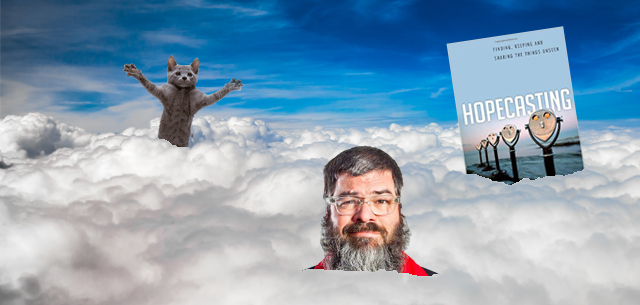
My partner in crime at the Cartel has a new book coming out. He has something like 70 titles in the youth ministry genre, been the general editor of a couple Bible projects, and is the general editor of our Cartel publishing line.
But this is Marko’s very first general audience Christian book.
So it stands out that the audience isn’t limited to people who are working in local churches with teenagers, it’s for everybody.
Here’s the truth: I haven’t read it yet. So I can’t recommend it from that perspective.
However, I can recommend it wholeheartedly as a friend who has born witness to the process of creating the book… and the life altering stuff that happened which lead to the creation of the book.
This book kicked Marko’s butt.
It made him uncomfortable. It made him work harder than he wanted to. It interrupted him. I think it drove him crazy and pushed him to places he didn’t really want to go. And, in the end, he’s really proud of it.
Here’s the description:
Why are some people full of hope, while many of us struggle to get past the snooze alarm? Hope often seems elusive—both to explain and to experience. So we find ourselves instead clinging to lesser substitutes. From self-medication to lazy clichés, we apply these balms to our pain and experience little to no comfort. But we know, in our guts, that these replacements aren’t the hope-filled lives we long for, the lives we were made for. Mark Oestreicher gets it. Through hard-wrought experience and robust-bordering-on-desperate theological reflection, he offers here a fresh perspective on Hope, that virtue that God carries to us even as God carries us. Read Hopecasting and discover a good God casting hope your way.
And here’s what Scot McKnight has to say, he’s way smarter than me:
Hopecasting takes us through the joy of holy week, into the exile of darkness and hopelessness, and to the empty tomb of hope. In this book Marko teaches each of us how he has learned to practice a life of hope through the resurrection. What a gift of God this book is. May you discover the reality of a biblical hope that reshapes life today.
Whipser, Secret, Yik Yak, Snapchat, Burnbook, et al.
These are apps low on the “get it” list for adults. We look at them and wonder… “Why would I want that?” And it goes back to a fundamental difference between why teenagers use social media and why adults use social media.
Adults use social media to network. Public benefits that effort.
Teenagers use social media to hang out with friends. Public inhibits that effort.
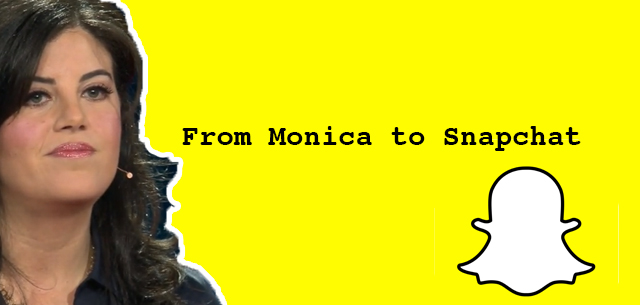
Remember Monica?
We all remember Monica Lewinsky, the butt of every late night television and shock jock radio joke for a year. But, as she points out in the video below, along the way we forgot that she was a real person. No matter what she does in life she’ll always have an asterisk next to her name.
Last week, Ms. Lewinsky had the opportunity to talk about the impact of her public shaming and offered some challenges for what needs to change in our society when it comes to public shaming people online.
Literally, she isn’t saying anything new. The reason she’s on that stage is because nothing is changing.
In 2007, I wrote a post about an emerging Economy of Hate gaining steam via ad revenue online. In January 2014, I wrote about Reaction Porn, revisiting this concept to talk about the actual economics at play.
Without the economy of hate and reaction porn you wouldn’t have things like TMZ or Buzzfeed, two entities who proclaim their worth as bastions of free speech when in fact they are merely the Larry Flint and Hugh Heffner of the shame business.
Let’s be clear:These aren’t bastions of free speech, they are purveyors of shame. They profit by dehumanizing. And your enjoyment of them, those minor indiscretions of keeping up with the latest gossip, aren’t all that different than looking at pornography. (Not sure if that’s true? Both sell dehumanizing, damaging, and false views of real life. One is about sex while the other is about gossip. Both are highly profitable forms of exploitation.)
Why Snapchat?
The “why” of ephemeral apps is simple.
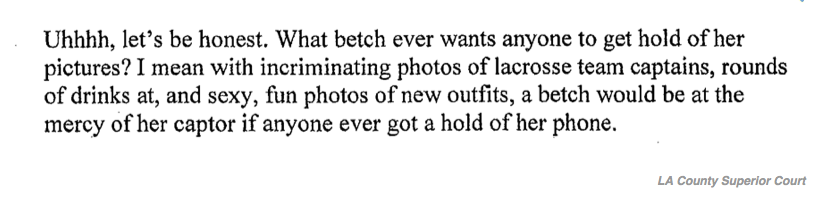
What happened to Monica on a national stage happens on a small scale at middle schools, high schools, and colleges every single day.
Here’s how: A person makes a mistake… let’s say getting drunk at a party and throwing up. Someone takes a picture of it and it gets spread around the school.
Now, all of a sudden, the only thing anyone knows about that person is that they are the drunken girl who pukes. She’s a slut, whore, idiot. She’s not a human anymore. She’s a character in a narrative. Forget the fact that 25 other people were at that party… she just got labeled. (see The Scarlet Letter from 1850. This isn’t new. Heck, it’s in the Bible, right? How did things turn out for Bathsheba?)
But what is new is that social media moves fast and lasts forever. And most apps offer so little control of privacy, that teenagers actually need methods of privacy.
Literally, to see how ephemeral apps took off watch the video below from social scientist danah boyd, author of the groundbreaking work It’s Complicated, and take note of solutions teenagers were creating pre-2011 to this problem.
So why Snapchat (and Whipser, Secret, Yik Yak, Burnbook, et al.)?
The technology followed the actions of teenagers. They needed a way to say things anonymously or have things they did (from silly to mistakes) disappear… and so these things emerged.
This is exactly the utility (function) that Snapchat’s creators were describing as they created the app, as Picaboo messenger.
“I’m so glad social media didn’t exist when I was a teenager…”
I hear that line all the time. Teachers say it, parents say it, youth workers say it.
Why do we say it?Because we did stupid stuff when we were 16 and it isn’t following us today.
But today’s teenagers do live in a world with social media and they are fully aware that stupid stuff they do, even if it’s exactly the same stuff their parents or grandparents did, will follow them.
Sitting at a table eating overpriced Chili’s chips and making small talk. Walking from gate to gate with coworkers. Starting a shift at the TSA. Sorting bags.
Each day thousands of stories check-in and checkout from the airport.
But unlike your neighborhood library all of the books on the shelves at the airport are fiction.
With Each Heartbeat
We each serve as the narrator in an unwritten best selling novel in which we’re both the protagonist and the antagonist.
Unfulfilled.
Arrogant.
Proud.
Satisfied.
Humble.
Meek.
Kind.
Cruel.
We are monsters.
We are kings.
We are champions.
We overcome.
We stumble.
We despair.
We are desperate.
We are fat.
We are an athlete.
We’re buffoons.
We are savage.
We are superhero.
We are a moment away from being a millionaire.
We are a moment away from being on the streets.
We are loved.
We are lonely.
7 Inch Novel
We live the fiction of our lives, a narrative in our heads, pursuing what we want, neglecting things in pursuit of what we want, utterly blind of dimension for the things we miss or our impact. And it all plays out in the 7 inches between our ears.
We see what we want to see.
We filter the days events to fit our storyline.
That’s the point.
It’s easy to label. It’s easy to presuppose. It’s easy to look at each person as a supporting character in your own narrative.
But to do that is to misconstrue reality to fit your own needs. To do that is monstrous.
The Human Form
Because we are all human. We are all the narrators of the greatest story ever told, our own.
I’m the main character in my story. And you are the main character in your story.
Other people are not extras.
Each is a story.
Each is the greatest fiction tale never published.
We are whole. We are unfinished. We are published. We are unpublished. We are known. We are unknown.
But we are all fully human.
We all have equal worth.
And, while we are largely unseen by one another.
We are seen.
Cover photo credit: At the airport by Andreas Schalk via Flickr (Creative Commons)
Last week, San Diego county schools went coo coo for cocoa puffs about the social media app Burnbook.
Megan, our 8th grader, missed school on Monday. When she came home on Tuesday she said the joke on campus was an assembly she missed on Monday. “No one had the app or had even heard of Burnbook. What is it?”
Yeah, this is what I mean when I say… “Don’t educate 99% of students about something 1% or less are doing.”
Face meet palm. Seriously.
I see schools do this all the time. And it’s why my social media talks are based in principles instead of a single app… let’s educate the 99% about good, healthy habits, and deal with the 1% of problematic students in the counseling office.
So what’s Burnbook?
Basically, Burnbook is Yik Yak for middle and high school students with a couple plot twists.
Plot Twist #1
You opt into a community whereas Yik Yak merely implies a community based on your geolocation.
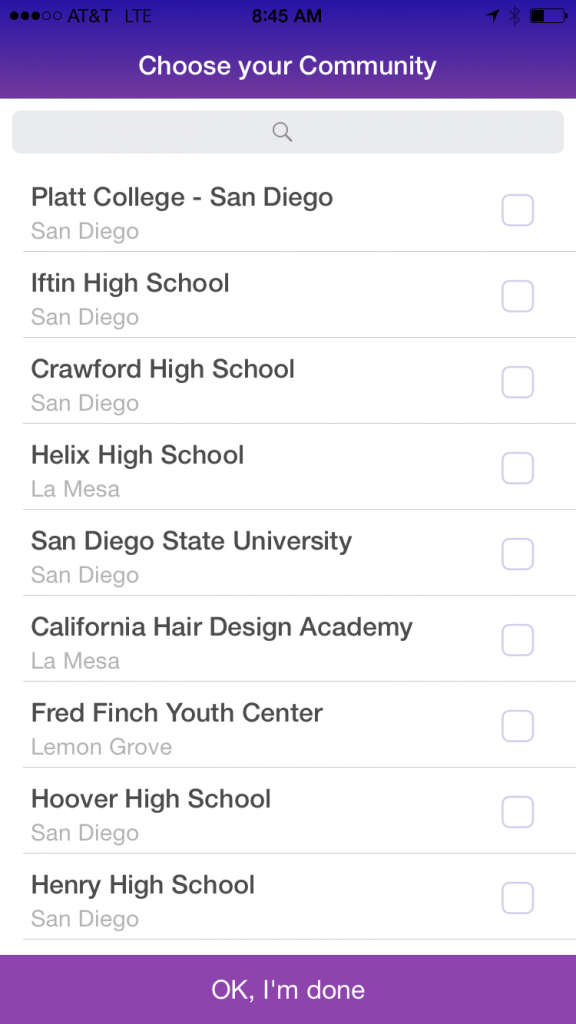
So when you open the app, you create an account and you pick your community. (Most users would pick their school)
The plot twist is that you can pick a different school…
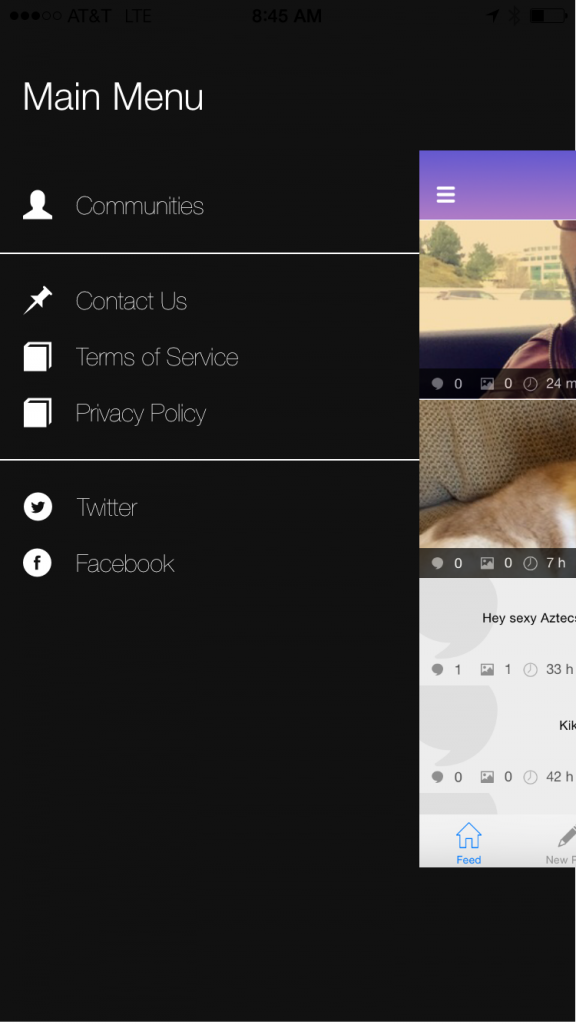
Just go to the menu, click on Communities, and you can move from one high school to another, or a college or whatever.
I think this is a problem. Particularly for high schools. You don’t even have to be part of the school to talk about it or be in that community? Moreover, you can just hop from rival school to rival school and post whatever you want?
Meh, not a fan of that. I’d rather you picked a community and the app made it hard to switch to another one. Maybe only allow you to do that weekly? Seems like the current model allows for and encourages trolling.
Plot Twist #2
App administrators are unashamed about monitoring communities.
Don’t get me wrong, every app does this to some extent. But the Burnbook crew is intentional about trying to moderate things by being visible, correcting bad behavior, highlighting the behavior they want to see on their other social channels, etc.
For an anonymous and ephemeral app… this is unique. I like that idea. It’s a little old school but in a good way.
Don’t be fooled. All of the other anonymous apps do this one way or the other. For instance, Yik Yak has paid community people on college campuses which make sure the “Yik Yak game is on point”. But Burnbook seems to have a rather old school mindset of community management from the forum days. They are around and real people. It’ll be interesting to see if this can scale up as the app takes off. But I’m sure that’s something Team Burnbook would see as a good problem to solve.
I had a brief chat with Burnbook’s creator Jonathan Lucas about his app last week. Flat out, his philosophy is that school campuses are in need of a way for people to say what’s on their mind. He feels like they can help moderate and sell the idea that this is possible… that teenagers won’t just melt down into being a community that bullies or harasses people online… but that anonymity can and will lead to something positive.
So when I asked him if he had plans to geofence schools based on pressure from school administrators… he didn’t have any interest in doing that. Instead, he said that they are doing anything they can do to work with schools/law enforcement to rat out the bad stuff in an effort to highlight the good stuff.
“The majority of people are good,” said Lucas, but you have to “design the app with the most sinister person in mind.”
To that end, Lucas has implemented several key tools for Burnbook. The first, and most effictive, is a simple down vote system wherein five down votes (perhaps 3 soon!) automatically removes a post. 2-4% of posts are destroyed this way.
He also has a “blur” option for every photo to protect people’s identities.
This launched in September 2014. It’s really small. That’s part of why it was so odd that San Diego county schools freaked out about it. I mean, compared to Snapchat it’s tiny. (And Snapchat is tiny compared to Facebook… even among teenagers who say they don’t use it.)
As of right now they are reporting 400,000 users. (.9% of teenagers in America) Snapchat is about 5.4 million teenage users according to Pew. (13% of teenagers in America) Facebook is well over 50%.
What do I need to know?
There’s a few little side stories which I think are interesting.
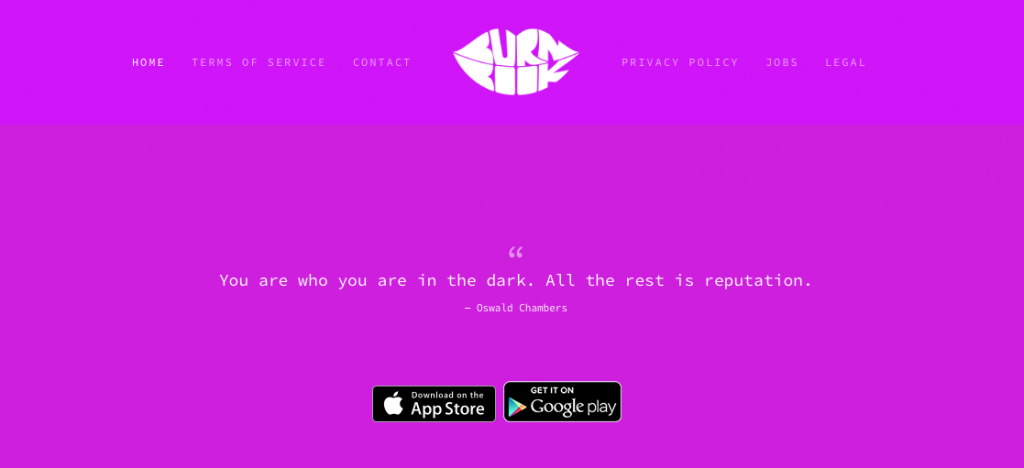
First, I got clued into Jonathan Lucas’s faith before I spoke to him… he has an Oswald Chambers quote on the homepage of his app. (see screenshot above) He grew up in a Christian home, in many ways he’s a typical student from any of our youth groups. All of that helps me view what he’s trying to do with Burnbook through a certain lens. He’s a newbie to the development world, he taught himself to code, he’s built a small but very interesting little company. All of these are endearing qualities to me. Maybe it shouldn’t– but it makes me a little less judgmental about the whole thing.
Second, Burnbook is a sapling in a forest of ephemeral, anonymous apps. I’m not saying it won’t make it but I’m not sure it should really be on anyone’s radar at this point, while gaining steam it’s also tiny. What I see in the app and the organization is still beta. But who knows? It could be the next big thing and Jonathan might be on next years Forbes list like Snapchat’s co-founder, Evan Speigel?
Acquisition seems far more likely than it becoming a big thing. (Whisper, Secret, After School, on and on) That’s a fine exit plan for a first time developer.
Third, I’m not sure the idea itself is realistic or helpful or developmentally possible. I’m on the fence about it.
The name Burn Book is a Mean Girls reference. It strikes me as weird that the app has an idea that good can come from anonymously sharing things on a school campus when the app is named after something that happened in Mean Girls.
It’s kind of an obvious clash of narratives. According to Wikipedia (the collector of all truth… ha!) the Burn Book is “a notebook filled with rumors, secrets, and gossip about the other girls and some teachers.”
Geez, I wonder why this would make administrators nervous?
What do I do?
This is the easy part.
Keep reminding the teenagers in your life that there is no such thing as anonymity, only perceived anonymity.
In the end, Burnbook is no different than all of the other ephemeral and/or anonymous apps out there. I like to tell teenagers, “The only one that thinks it’s anonymous is the users.”
Burnbook does a better-than-average job at telling students that their posting are linked back to them via their phone number and that they will absolutely cooperate with law enforcment if you do something dumb, like post a bomb threat. [You click OK to several acknowledgements when you create an account with your phone number, there are reminders… maybe too often.]
But, in the heat of the moment, it’s easy for anyone to forget that that tiny bit of gossip or bragging about an indiscretion ultimately points directly back to you.
There’s no such thing as privacy online.
There’s not such thing as anonymity online.
There’s only the perception of anonymity or privacy.
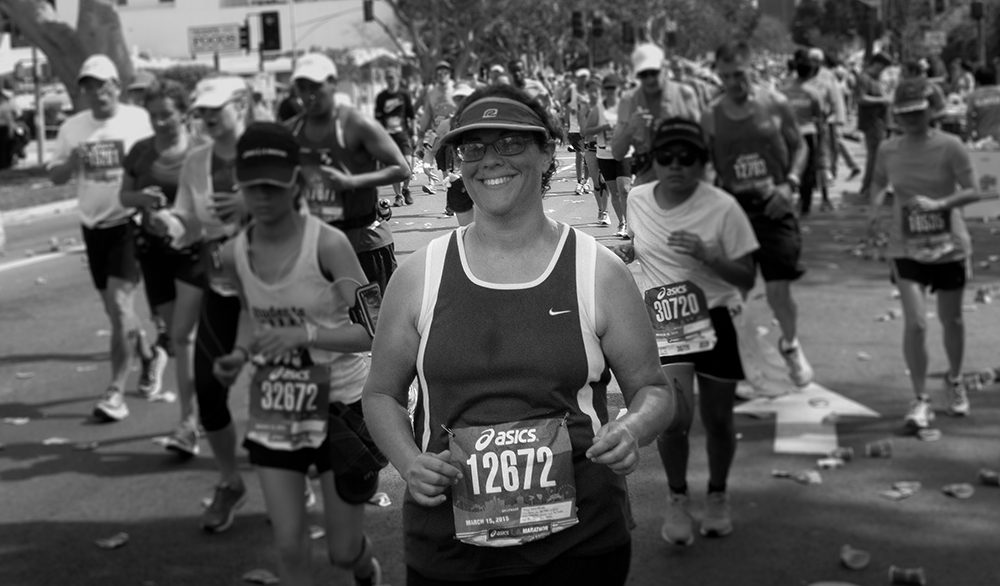
On Sunday, I had the chance to witness Kristen in run the LA Marathon.
It. was. awesome.
The Road to LA
After completing her 5th Half Marathon last spring she started thinking about LA.
A marathon is intimidating. A 5k or half had become pretty manageable for her. One builds on the next, you know what to expect, and lots of people are happy there… just improve on the last one to better your time.
She spent a month or so toying with the idea. When you consider the length of time it takes to prepare for the marathon– in her case about 6 months of training– and all the things that have to go just right– a few runs during the week, a long run on the weekend, three kids, a husband who travels for work, nutrition, injuries, illnesses, and all the normal stuff– it’s a huge undertaking just to train.
The last several weeks has been a series of longer and longer training runs. We’d wake up early on a Saturday and I’d drop her off, track her for 3-4 hours using Find My Phone, drop off water every few miles, then pick her up at the end.
One week she circumnavigated most of San Diego Bay from the Coronado Bridge all the way down to Imperial Beach then up through Chula Vista and National City to San Diego.
In the week leading up to the race all of the talk was about the heat. An early Spring heat wave pushed temperatures to the mid-90s with 15% humidity on Saturday. That kind of heat and 27,000 runners going 26 miles just don’t mix. The last 24 hours of wondering about the impact of the heat were no good. You wanted to get it out of your mind, but dang– that’s too hot to run that far.
Kristen barely slept on Saturday night. Nerves and excitement and all of that. When my alarm went off at 3:45 am, she was already up and just about ready to go.
I dropped her off at her Santa Monica shuttle at 4:30 am and went back to bed. Our friend April crashed at the beach house, too… I took her over to the same shuttle stop at a pedestrian 6:30 am before heading back to the house one more time to check on our kids. When the race started at 7, I packed up my stuff– a cooler full of frozen towels, my camera, and my phone to meet her along the way.
11 Miles In
My first stopping point was about 11 miles into the race in the business district of Hollywood. My experience in LA is so limited (Despite living just 2 hours south, we avoid LA like new moms avoid sleep.)
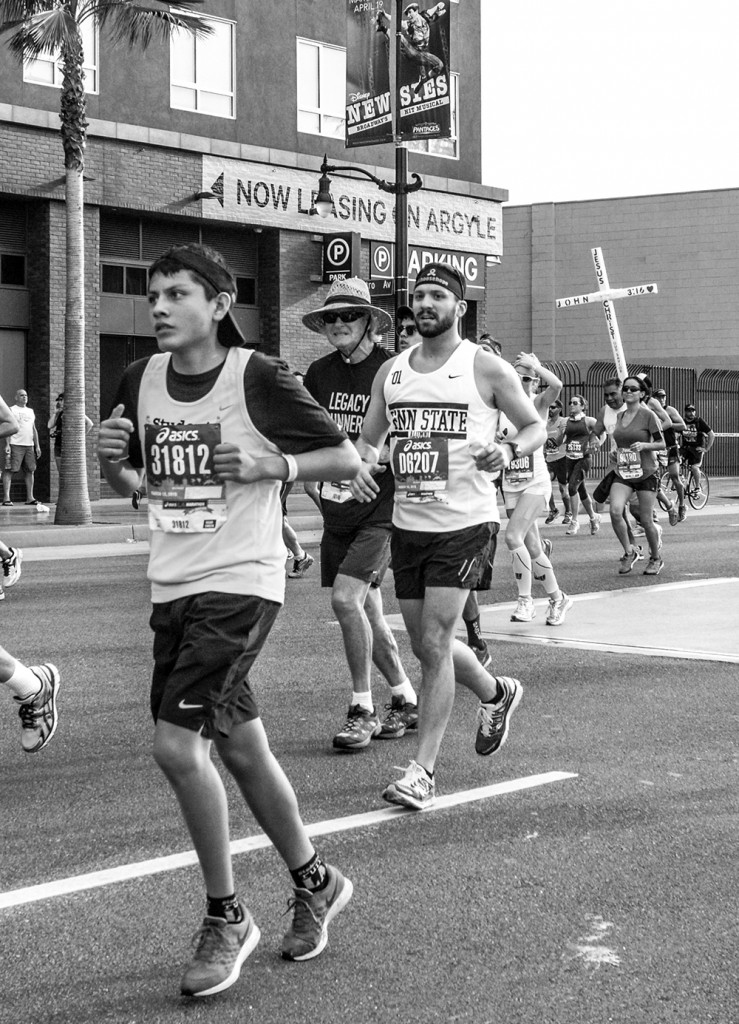
A legacy runner, someone who has competed in each of the past 30 years in the background and a high school student, part of a “Students Run LA” initiative, in the foreground. And some dude carrying a cross for 26 miles. This is the LA Marathon.
The first thing you need to know about the LA Marathon is it’s very diverse. Usually, the races Kristen has run in have been predominately 30-something year old white people. But that just wasn’t the case in LA. There were people of every walk of life, every age… middle schoolers and elderly… every ethnicity, and every cause.
But, more importantly, Kristen was in great spirits.
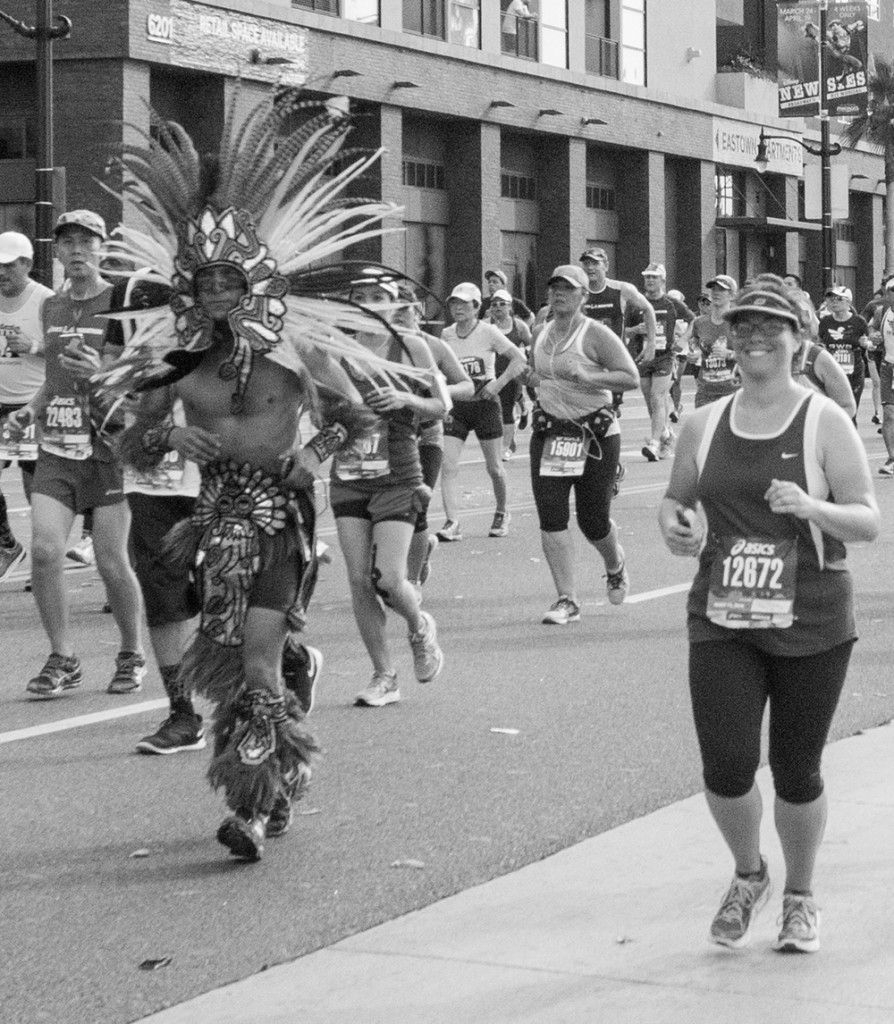
In LA, you get to run with all kinds of people… even guys who run in full Native American head dress for 26.2 miles.
From here, I made my way south from the race course to start navigating through the side streets, grabbed some coffee at Starbucks, and made my way to West Hollywood to try to see her 45 minutes to an hour later.
15 Miles
When I found the race course at exactly the 15 mile marker, Kristen was still a mile or so down the course, so I took a while to stand there, people watch, and cheer folks on.
Here’s something awesome about big races. Everyone comes out to cheer people on, even if they don’t know a single runner in the race. They show up, they cheer, they encourage, and lots of people even bring things to give to runners out of their own pockets… fruit, water bottles, and er– hot dogs and pizza slices, too.
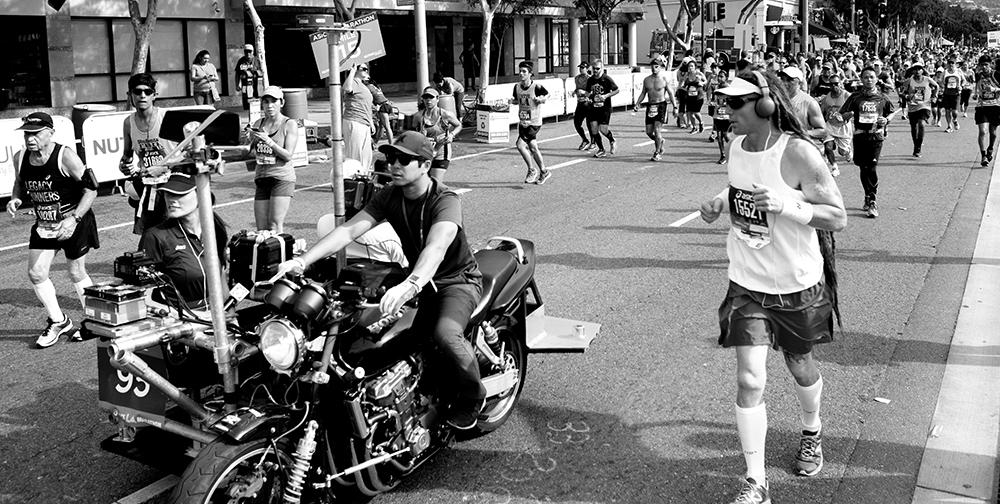
Marathons are full of interesting things… like men with hip length dreadlocks peaking at TV motorbikes.
And when I finally spotted Kristen, she was still having a blast FIFTEEN MILES into her day.
From West Hollywood, I went back to our minivan and started to work my way across town more to get to the next spot on the course, 22 miles, in Brentwood– most famous for being the home of O.J. Simpson. To get there… I had to wind my way through neighborhoods like Beverly Hills… where my minivan made me feel like I was on the cast of Beverly Hillbillies.
Driving through Beverly Hills neighborhood. Saw a lady walking a pink poodle. Is this real? #LAMarathon
From there parking was a real problem. I ended up finally finding a spot about 5 blocks from the race course. And in my rush, I forgot to take notes on where I parked… more on that later.
By this time the heat had kicked in. Racers were super fortunate that an unexpected, un-forcasted cloud base made it pretty pleasant most of the morning, high temperatures in the mid-80s. But that started to burn off late in the race. And it started to get really, really hot.
In this last set of pictures I want to point out some of the lasting impressions I had on the marathon.
The marathon is a community effort. Tons of official and unofficial volunteers make it a GIANT 26 mile long celebration. The family to my right knew a couple runners, but their endless supply of orange slices and ice made hundreds of runners smile.
And don’t forget about causes. I’d say a quarter of the runners were running to raise money for something.
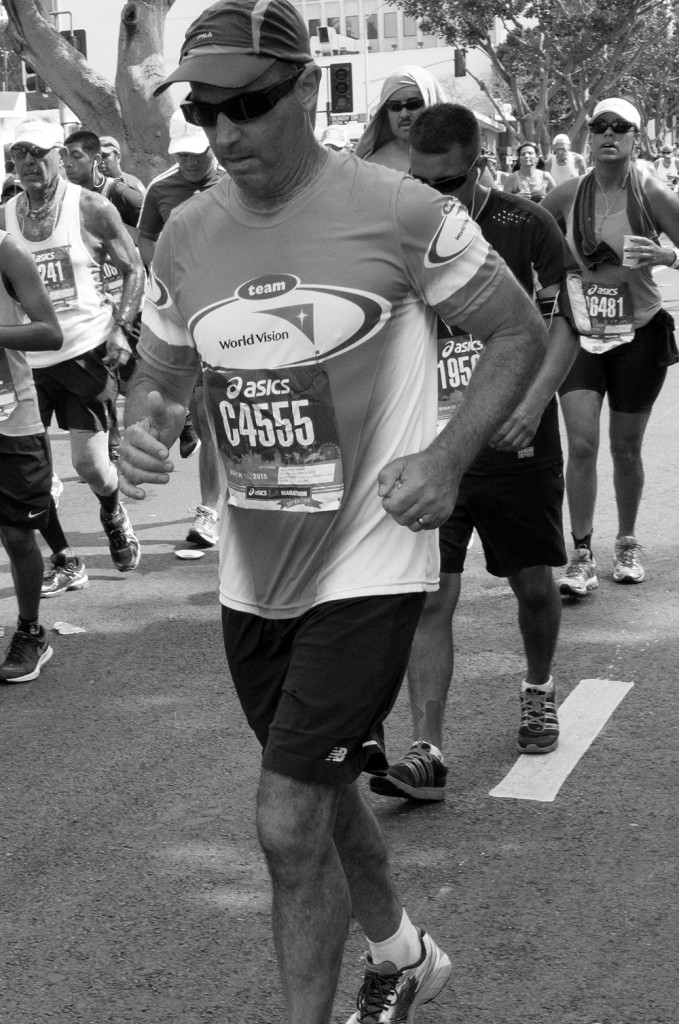
Team World Vision had more than 600 runners, raising money for clean water in Africa.
And– oh yeah– this smiling lady.
At 22 miles, Kristen had never run this far. Notice that she’s smiling and having a great time while runners around her aren’t quite looking so fabulous.
By this time, she was starting to get tired and hot, so she accepted my invitation to take 2 minutes off to cool down… bring on the frozen towels!
Having just come through a non-shady part of the race with 4 miles left in the blazing sun, 2 minutes of cooling off really seemed to help.
And at this point… it’s just a victory lap. Six months of training and it was abundantly clear she’d finish her first marathon!
26.2 Miles
After this pit stop I got a text from April, she was at the finish line and looking for a ride back to the beach house.
The problem was that I was 4 miles away… cell service was jacked up with so many people trying to post selfies… and I HAD NO IDEA WHERE I’D PARKED!!!
Seriously. I was so pumped to go see Kristen at 22 miles that I forgot where I parked. 15 minutes later I finally found my way and was back in the car.
From there, I got lucky and guessed a side street that went all the way to Santa Monica, Colorado Street. And I took that all the way to where I could see the finish line… but then got stuck in traffic. I picked up a very tired April and then we spent the next two hours trying to find Kristen and make our way back to Venice Beach.
Success!
Huge congratulations to Kristen. She made it look easy… if 26.2 miles can be easy.
And I don’t know what her next challenge will be. But I think it’ll involve a bike and swimming.



 We each serve as the narrator in an unwritten best selling novel in which we’re both the protagonist and the antagonist.
 We live the fiction of our lives, a narrative in our heads, pursuing what we want, neglecting things in pursuit of what we want, utterly blind of dimension for the things we miss or our impact. And it all plays out in the 7 inches between our ears.