• 5 things great leaders never say


    If I were preparing a talk about leadership this would be my premise and these would be my 5 points.

    5 things great leaders never say….

    1. I let others do my dirty work.
    2. I could use one more critic.
    3. I’m not hard on myself.
    4. That’s impossible for us to accomplish.
    5. I need to get better at recognizing others achievements.

    If you missed it, here’s a post on why people follow.

  • The unstoppable force of amen

    The word amen declares affirmation. I agree.

    Amen is not simple.

    It’s an ancient posture we’ve lost sight of. Amen is something we experience when we stand together in agreement. Living in amen isn’t the forebearance of ones own opinion so much as it’s setting ones own opinion in submission of the amen of community.

    We stand in agreement. Amen. We rest in amen. We dwell in amen. The Spirit manifests Himself in amen.

    You can’t actually have amen alone. It’s impossible — you cannot declare affirmation to yourself!

    To reside in amen is a state of communion with Jesus and one another. Communion isn’t merely an act of taking some bread and wine and remembering Jesus life, death, and resurrection for us. Communion invites us to live in a radical, different kind of community with one another. It sets aside ourselves in the embrace of another, en masse self. The amen.

    When our zip code is amen we are a different people, an unstoppable selfless force.

    Morning prayer

    Lord, make us a people who don’t just say amen but live amen. Amen. 

  • Checkpoints

    “Why don’t I just take off my pants? This is getting ridiculous.”

    These words rank right up there with some of the dumbest things I’ve ever said. I’d lost my cool and was about to pay the price with even more frustration.

    It was November 12th, 2001. I’d just completed a 6-day trip to Germany to speak at a retreat for high school students on an American military base. I’d spoken 11 times in those 6 days, slept on couches and in sleeping bags, fought through a flu, and was completely exhausted and ready to go home.

    What I didn’t know was that as I was checking in for my flight that morning from Frankfurt to Chicago, 260 people had just lost their lives in an accident over Rockaway, New York. Initial suspicions were that this was a terrorist act.

    “Sir, since the time you acquired this bag, has it ever left your possession?”

    “I’ve had it about 3 years. I’ve let some friends borrow it in that time. But I packed it myself last night.”

    The American Airlines employee at the counter didn’t speak English very well. I couldn’t place her accent, but it was clear she was from Eastern Europe and not Germany.

    She asked again, “Sir, at any time since you’ve acquired this bag, has it ever left your possession?”

    “Yes, I’ve had it for 3 years. Of course it has left my possession. Do you speak German?”

    She asked me in German. Honestly, it was just as oddly phrased in German as it was in English, the verbs were all out of order. Her German was just as bad as her English. With my travelers smile,  I tried to explain the same thing. I’d owned it for 3 years, during that time friends had borrowed it, but during this trip it had always been in my possession. I packed it myself.

    Wrong answer. Too many tries. She took my ticket and my passport and walked away.

    She came back with an armed man in a uniform. Awesome. It was going to be that kind of day. For some reason I always have problems at Frankfurt airport.

    20 minutes later, with my large internal frame backpack completely dismantled, the man in the uniform was finally satisfied that I was just a tourist in bad need of doing his laundry and not someone too dangerous to fly. And the airline employee gently handed me my boarding pass and passport.

    You could feel the tension walking through the terminal that morning. I had no idea that a plane had crashed. All of the TVs had mysteriously been turned off and there were security personnel everywhere. While I was starving and hoping for a final dose of German coffee and some pastries before flying home, all of the shops were closed. I guess I assumed it was a holiday or something.

    So I went through security. The line was painfully slow. I was randomly selected for a secondary screening where another armed security guard went through my carry-on… like 20 minutes after it had just been searched.

    Then, about 200 yards after going through security, they had set-up another checkpoint. This one manned exclusively by armed security guards. There wasn’t anything you could have done between the two security checkpoints. All of the shops were closed. And even the bathroom doors were locked. So we went through security a second time. (By this time, some of my fellow travelers had gotten calls from home, and we were all talking about what had happened in New York.) Just like the first time, I was randomly selected to go through secondary screening.

    Then, I walked the rest of the way through the airport– eerily quiet and empty– to my boarding area just to go through security a third time outside of the gate. And it was at the third time that those famous words popped out of my mouth. Waiting in line to have my stuff searched for the fourth time in an hour, I’d lost my cool, and I kind of was serious about taking my clothes off. What else could they possibly find that hadn’t been checked already?

    Checkpoints

    In our jobs, marriages, and our faith, we each encounter these checkpoints all the time. We encounter a simple quandary: Are you in or are you out? In almost every instance this is a private, internal choice. We rarely are asked to verbalize these checkpoint decisions. Often our body, actions, and assumption carry us forward even if we are one-step-closer or one-step-further away from our faithfulness to the task at hand as a result of these checkpoints.

    Sometimes these checkpoints occur rapidly and sometimes they occur gradually. But if you think about it you experience hundreds of these in hundreds of categories each day.

    But sometimes we need to verbalize big decisions. We are getting married. We are changing careers. Or we are walking away from our faith.

    Those decisions seem huge– even brash. As friends, we encourage friends to slow down, to not rush into it, and to consider other options without really realizing that there have been hundreds of smaller decisions which brought them to this space.

    As a leader, boss, or friend you’ll never see the hundreds of checkpoints leading to a decision where they’ve stepped away. Checkpoint-by-checkpoint they’ve made small decision after small decision which leads to a logical conclusion. As they stand at the next checkpoint they think…  I just don’t want to do this anymore. So they don’t.

    Conversely, when we force a decision on people who aren’t ready we are making it easy for them to say no. Think about being asked to buy a car or house or get engaged or become best friends or even giving your life to Jesus too soon?

    It might be where you are headed, but if it’s too many checkpoints too soon, most people will opt out. And along the way you’ve added a whole lot more checkpoints which move them backwards when your hope is to move them forward.

     Photo credit: Richard Lemarchand via Flickr (Creative Commons) 

    Like this post? Here’s how you can support this blog for free.
  • April Fools Pranks

    NPR’s Instagram account goes to the cats.

    HT to Mandy

    ht to Mashable

    ht to LL Cool J

    One.org’s Goodbye Kitty petition (Rick Roll)

    ht to ThinkGeek

    ht to KargoKids (Lawyers kinda ruined this one with disclaimers)

    ht to 9to5mac


  • What if we made youth ministry’s goal simpler?

    “What’s the goal of your youth ministry? Not like your purpose statement, but why do you do this thing?”

    I love to ask this question. It usually takes people a few minutes to articulate something they feel comfortable with. And it always sparks a great conversation.

    The answer to that question typically lands like this, “My goal is to create an environment where students grow in their relationship with Jesus.” And when we’re really honest a functional goal is, “Keep enough people engaged in my ministry so that my church thinks I’m doing a good job with that.” (In 2009 – 2010, the real honest answer was, “Whatever I have to do to keep my job.”)

    A question I’ve been wondering the past couple of years is this…

    What if we made the goal of youth ministry simpler? What if the goal of youth ministry became Christian worldview formation? How would that change the way I did youth ministry?

  • Three Kinds of Dreamers

    There are three kinds of dreamers.

    1. Dreamers who go for it.
    2. Dreamers who love their dreams but keep them in the five inches between their ears.
    3. Dreamers who live in regret of dreams unfulfilled.

    The only difference between the first one and the other two? The first person is dumb enough to go for it. 

    • Put the crash helment on.
    • Skip the days off.
    • Ignore your critics.
    • Dip into savings.
    • Forget looking stupid.
    • Tell your boss to stick it.

    Put your hands in the air, like you just don’t care, and boogie.

  • Good News curriculum video shoot

    Yesterday, Jon and I spent the vast majority of our day shooting the 6 fictional stories that go along with each lesson in our forthcoming Good News in the Neighborhood curriculum.

    Seeing some of the big picture pieces come together in this project has been amazing. Doing the video segments actually brought new life into the project. With the deadline looming and the reality that there’s almost no chance we’ll be done by our self-assigned deadline of Monday, this project needed some fresh air breathed into it.

    It’s funny how an idea takes a life of its own. In this case, a series of jotted in my notebook over time became several popular blog posts. And in those posts there were several comments saying, “Yeah, but how do I teach that to high school students?” It was the association of the blog posts and the comments of readers which spurred the idea to turn it into a curriculum.

    Truth be told, I’d never have attempted this project without Jon. He brings a depth and breadth of experience to it which takes it from my blog posts to something anyone can try with their group. I’m thankful for his friendship and collaboration.

    And now back to work. Acting as co-author, editor, art director, marketing director, video editor, and every other task on this project is insanity!

  • Dreaming about hiring young adults

    Roughly 45% of young adults between the ages of 18-24 are currently jobless. That doesn’t mean they all want jobs. Officially, the jobless rate is a little over 16% which means that roughly 30% of young adults aren’t looking for a job for a variety of reasons. (In school, don’t need to work, ineligible to work, incarcerated, don’t want to work, etc.)

    To me, 45% of 18-24 year olds not working is a problem. That’s bad news for young adults any way you slice it.

    And where I see bad news I long to see the impact of Good News.

    And I think this is a problem the collective “we of youth ministry” could make a dent in.

    Is it impossible to think of your ministry or small business intentionally hiring 2-3 young adults this summer? Not at all.

    Here’s are some ideas I suggested 12 months ago on the Youth Specialties blog. They are just as plausible today as a year ago:

    A quick resource assessment will likely reveal that your church may be prepared to provide some good news to the students in your youth group.

      • You have access to the business community.
      • You likely have access to a building, largely left empty during business hours during the summer months.
      • You likely already have adults in your church who are ministering to 15-19 year olds, are passionate, and desire to be a practical resource for them.
      • You already love 15-19 year olds and want to reach more.
      • Your community has a virtually unlimited supply of children in need of free or affordable childcare.

    By now, you’ve put it all together. One solution to the employment crisis of teenagers in your community could be for you to hire them.

    Summer employment that provides a simple child care service is just one quick idea. 30 minutes with your team and I bet you could brainstorm 5 more ideas.

    My own personal dream for my business? Both The Youth Cartel and McLane Creative are at places where our ability to grow is directly tied to hiring people. I’m trying to figure out ways to hire young adults to help me grow my business. Yes, I want to grow these businesses… But I also want how I grow these businesses in a way that reflects this value. It’s not the easiest way to grow. It’s not the most profitable. But it’s the way of growing I aspire towards.

  • A Rapture Box. Really?

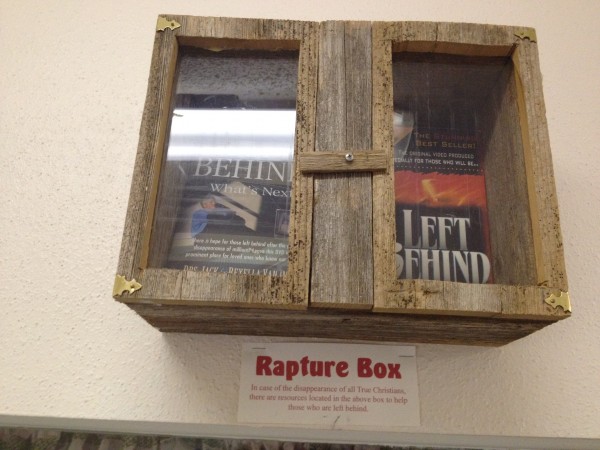
    The sign reads, “”In case of the disappearance of True Christians, there are instructions located in the above box to help those who are left behind.”

    Kristen sent me the link to this from a blog she reads. It was spotted in a small baptist church which hosted a piano recital.

    A few thoughts…

    • This could be a reason why there are fewer and fewer True Christians out there. I’m just saying if I saw this at the back of my church, I’d go home and Google a Rapture Box-free place to worship.
    • I’m actually curious to know how many people really believe in a pre-tribulational rapture, like the one of Left Behind and Harold Camping fame. Or are we, collectively as evangelical leaders, just kind of giving it a wink and a nod and I’m breaking some sort of honor code by mentioning it?
    • As a graduate of Moody Bible Institute, a place that has hung it’s hat on this but somehow turned down the publication of the Left Behind series, I can pass the test of all the Bible verses which create the concept of a pre-tribulational rapture. Let me tell you, it’s pretty thin from a hermeneutics perspective. But I passed the test.
    • The Sunday after the rapture, is the pastor going to take an offering and/or do an altar call?
    • Let’s say that all the True Christians suddenly disappeared from the planet. What are the chances people are going to read Left Behind, slap their heads, and say… “Oh, we missed it. This is why this happened!?“
    • I looked, you can’t buy this on Kirk Cameron’s website for $149.99. But he should totally sell it.

    If you’re offended– I’m not mocking you. I’m poking fun at something we, as conservative evangelicals, have hung our hats on. I’m one of us. This is part of our heritage as much as big hair and jean skirts. Every theological twist/turn has things like this. These are part of our identity. We laugh because we know.