• The Apostles Stayed in the Neighborhood

    Did you know that The Way wasn’t the only Jewish cult in Jerusalem in the first century? 

    Visit a Dead Sea Scrolls exhibit and you’ll learn all about the strict rules and discipline of the Qumran community. While they didn’t have a Messiah figure, they were disciples of a teacher. Who had his own beatitudes and life plan which sounds very similar to Jesus. Devotees left society altogether and lived in no mans land in the desert. (Remember, it took 1900 years to discover the Dead Sea scrolls– not exactly prime real estate.)

    And there were others. Collectively they are known as the Essenes. Most of them were built around a claim of the messiah or a certain apocalyptic vision or a withdrawal from societies pleasures. (Some took vows of celibacy, which seems like a tough multiplication strategy.) They each tended to remove themselves from society by first creating compounds in the city, then once you’d proven yourself truly worthy, you were allowed access to the leaders.

    My point isn’t to give an exhaustive list. Rather to point out that at the time of Jesus’ resurrection The Way joined a few other groups in the city. (I’m sure there are other books about this. But one I’m familiar with is Communities of the Last Days. Also see Josephus.) Jesus’ followers copied some of what they saw from these other groups since this is what all the cults did,  these will seem familiar in light of the Acts record:

    • Asked followers to forego their families for the sake of their group.
    • The entry point was communal living.
    • Baptism was a symbol of identification.
    • Followers sold everything they had and gave it to the group for the sake of the common good/needs.
    • The ones in Jerusalem all had a base near where the Last Supper and early church hung out. It was kind of a neighborhood of cult groups.
    • Once you’d proven you were all the way in, memorized everything, worked your tail off, proven your devotion… then you got to spend time with the leaders. (For most that meant complete withdrawal to the desert. For others that meant living in protest in the city.

    The Difference

    Of course, those groups collectively known as the Essenes, are all gone today while The Way became one of the largest religions in the world.

    Why? 

    As Christians, we believe Christianity spread because it was true. But another practical answer is strategy.

    Followers of Jesus didn’t withdrawal from society. They indwelled it.

    Once followers of Jesus had proven they were all in, memorized everything, been baptized, gave everything they had to the group– they were sent out to love their neighbors in ways that were defined by the needs of the neighborhood. Instead of withdrawing they deposited and invested in their community. (This was radical thinking! No one else did this!)

    All of these other groups, their contemporaries and fellow Judaic cults, believed that their strict obedience to rules would lead to the messiah coming, or the apocalypse, or revival of the people.

    But Jesus’ followers became an unstoppable force because of their profoundly simple strategy. They loved their neighbors as themselves. They didn’t just know them. They didn’t just witness to them about Jesus’ resurrection.

    They loved them.

    As people used to harshness and exploitation, when they experienced love in the name of Jesus, they wanted that– experiencing the practical realities of Good News made for fertile ground for Jesus’ message to be received.

    The Good News wasn’t just a theological reality, it was an unstoppable force of love for their neighbors. To date, no army has been able to stop the spread of love. The Way was an insurrection of the heart and it changed everything. It spread like wild fire. Think about it, within 200 years this simple strategy spread throughout the known world.

    Love literally conquered all. 

    And my belief? My belief is that the simple strategy of The Way is what we need today.

    Let’s indwell our neighborhoods and truly be the Good News in the name of Jesus.


  • The cup is 95% empty

    “Adam, why are you always assuming that the cup is half empty?” 

    Youth workers say this to me over coffee. Their lives are run wild with activities, planning, teaching, and meetings. Their ministries are full and something I’ve said has called that busyness into question.

    My response, not trying to be trite, is “Oh no, I’m not saying the cup is half empty, I’m saying the cup is 95% empty.

    Again and again I’ve challenged folks to do the math for themselves. Most people can do it in their head. You don’t need a scientist to measure impact if you know basic facts about your community.

    • How many students are in middle & high school in your community? How many students attend a youth ministry in your community? Divide. Probably less than 10% of the eligible population. (If you factor in students who attend youth group by choice… this number dramatically falls, doesn’t it?) 
    • How many years has the current model of youth ministry been impacting your community? 20, 30, 40 years? How much have churches grown as a result? At best, church attendance has flatlined over the past 20 years, likely declined compared to 30 or 40 years ago. 
    • You might be able to point to a couple of exceptional examples. (Communities of great impact or individuals greatly impacted) But for the amount of effort, amount of investment, in most communities the impact is pretty small.

    My point is not to tear youth ministry down down. It’s to rebuild. We can’t think about the future until we can make a sober assessment of what our tribe has accomplished.

    It’s not that the wrong people are in youth ministry, it’s not that they are uneducated, don’t care, are lazy, or even under-resourced. I actually think the frustration, the quitting, angst, and the burnout we see in youth ministry is because we have the RIGHT people working 24/7 [largely] on WRONG strategies. [More fairly, their current strategy is OK, just limited in impact.]

    That’s not tearing down at all, is it?

    My point is that the strategies we’ve used to date have a finite impact. We can look at 40 years of history and say “youth group” will impact less than 10% of any given student population. (How much more evidence do you need to see that this is true? 50 years? 100 years?)

    The challenge to anyone who will listen is to think about the 95% of un-impacted adolescents in their community and ask themselves, “What are other strategies that might impact these students lives for the sake of the Gospel prevailing?

    That’s not being negative. It’s missiology 101.

    Photo credit: Mykl Roventine via Flickr (Creative Commons)
  • Powerless

    Breathing heavy and full of adrenaline I stood up from the knee deep waves among the kids and did a 180. With a massive smile I began the long push through the surf back to my fellow bobbing boogie boarders.

    It was a Sunday afternoon at Torrey Pines. One of my favorite beaches doing one of my favorite things.

    Smiles were ear-to-ear among this pod of boogie boarders, basking in the late Sunday afternoon glow the with warm summer breezes, the water temperature had finally risen to the point where you could stay in indefinitely without shivering.

    The swell was building. We all felt it. In our group were a wide variety of skill levels. Experts with nice boards and fins running circles around all of us. Beginners on their $20 boards that weren’t quite the right size. And me, a midwesterner who loved it but resides firmly in the novice category.

    Typically, I don’t like to go off shore beyond where I can touch the bottom. My technique is typically to wade out and position myself near where the waves break so that I can move “hop on” a wave rather than paddle and drop in. But the waves have drawn me out here, floating and chatting alongside all the other giddy riders.

    We’d all caught enough waves. We were just lined up at the dessert table waiting for something fantastic to happen. In truth, the waves had already been too big for me and I’d been lucky to duck the ones that broke weird and hop on some fantastic rides.

    I was way beyond my skill level. I felt it. But the allure of nice, pretty waves, warm water, and my success pulled me out where I didn’t belong. I was trying not to think about

    A few minutes later one of the more advanced guys said, “Here they come!” About the same time one of the guys girlfriends said, “Hey, I can touch the bottom.” We all knew that this meant that the next set was going to be big. Most of us got off our boards and stood up, watching where the first waves in this set broke.

    I was in the perfect spot. I ducked and let a couple of big waves break over me. And I was feeling pressure not to let this big set go by. I could tell by the excitement level of the better boarders that the next wave was the best one. Judging by the massive size of some of the other ones, which were way taller than me, the best one had to be ridiculous.

    And there it was. I ducked a wave and looked up… it was rolling in. The best guys missed it, they were too deep. But I’m there, standing in the sand with my board up against my chest. As it approached me I felt like it was too big. But I had only a split second to turn and dive under it before it broke on top of me. Instead I hesitated. It was too late, I had to go or get rolled.

    Pushing off the sand just as this massive wave started to release I could feel the waves massive power. But I was a fraction of a second late. And I was about five feet too far to the right… I was on the waves but in the wrong spot.

    It’s hard to imagine how fast I was going… Imagine a fat dude on a boogie board going 30 miles per hour propelled by the biggest wave of the day. It’s a scary thing to imagine and an even scarier thing to experience. The first half seconds were perfect, I cut into it and was flying by as all the other boogie boarders and swimmers ducked as it went by.

    In the next instant I was crushed.

    The wave collapsed on top of me. I was completely powerless against it’s power. It shoved me to the bottom then flipped me and rolled me and held me under water. It didn’t just roll me side-to-side, my head hit the bottom then my knees then my head. Water rushed into my sinus cavities causing me to gag under water.

    It’s a horrible helpless feeling.

    Finally, it released me. I felt like I’d been spit out of Jonah’s whale. And I was back in knee deep water among the kids and moms and floaties.

    The best leaders are powerless

    There’s a silent allure to power in leadership. Early success leads us over our head. But we quickly find ourselves out deeper than our skill level.

    We mislabel fear as following. We mislabel position as authority. We mislabel obedience as respect. But behind the mask of many “strong leaders” are very scared little boys. They’ve created a puffed up thing, manipulative, terrified, and tired. Others have mislabeled it as leadership.

    Lord, make us powerless leaders who lead with love. Amen.

  • Taxation by Density

    Last week the town of Buford, Wyoming was sold for $900,000. For that price they got an exit from the highway, a small business, some land, and a zip code. With the towns sole resident moving to Colorado… it’s safe to say Buford wasn’t purchased for it’s strong tax base.

    The idea that you could buy a whole zip code or even an entire island in this country for the right price got me thinking about our income tax code. There’s a lot of talk about a flat tax or even a minimum tax for the super rich. We all want something that’s fair, and truth be told, we all want to pay as little as possible while reaping massive benefits when we want them.

    In reality, we have a system that is exactly like the airline industries baggage fees. We are rewarding people for bad behavior. Airlines charge for bags which forces everyone to cram as much into their carry-on as possible. Then the airlines and passengers complain about overhead baggage space? If they wanted less overhead baggage space they’d make it free to check bags and charge $10 per item for carry-on. Duh.

    It’s the same thing with our income tax system. We reward people with deductions for doing things they wouldn’t naturally do just to lower their tax rate.

    But what if your tax rate was based solely on where you lived? What if we rewarded people who chose to live in less desirable places with paying the lowest federal income taxes while people who lived places highly desirable or overpopulated paid higher taxes? I mean, if you’re a bagillionaire and you want to pay 10% income taxes… maybe you should live in Yuma, Arizona? But if you want to live on 5th Avenue in a mega-penthouse, that’ll cost you at least 35%.

    That way the rich can keep getting richer. They just have to make the holes of America a bit more fabulous.

  • Worth the fight

    News that George Zimmerman’s killing of Trayvon Martin would not be reviewed by a grand jury rattled me yesterday. I get it. In a case with almost no physical evidence and no witnesses, it’s impossible for a district attorney to prove anything beyond a reasonable doubt. If Zimmerman sticks to his story we will never know what really happened.

    The Trayvon Martin case made me think about my own neighborhood. My home office window looks out onto my block. Each day I look out my window and see Trayvon Martin walk by on his way to the store. Sure, the Trayvon’s in my neighborhood might be on bikes sometimes, or of a different race than the real Trayvon. Some Trayvon’s are even girls. Most of them are just going from their house to a friends house. A few smoke weed in the easement behind my house. And maybe some of them are up to worse things than that? But I’m guessing the teenagers in my neighborhood are probably a lot like the teenagers in your neighborhood, who are also just like the teenagers in Trayvon Martin’s neighborhood.

    I wonder who advocates for the teenagers in my neighborhood? I wonder who looks out for them? Who do they go to when they get into a fight with their mom and storm out of the house? Who do they talk to about stuff they can’t talk to their parents about? Who do they ask the really hard, life-altering questions? I wonder who stands up to George Zimmerman, telling him to go home and find another hobby like a softball team? I wonder if I’d go outside and get between Zimmerman and Martin? I wonder if I’d be there to tell George to put his gun down and go home? Or would I just be looking through my blinds while it all went bad?

    Pushing aside the distraction of the Trayvon Martin case, which happened thousands of miles from me, I wonder if I’m prepared to fight for the teenagers in my neighborhood?

    More importantly I wonder what’s wrong with me if I’m not? Youth minister? Pfft. Who am I to bypass ministry to the teenagers on my block for the sake of ministering to the teenagers who show up at my church?

    Question for my youth ministry friends: Do you see yourself as an advocate for teenagers in your community?

    Photo credit: Justin Nether, via Baltimore Sun
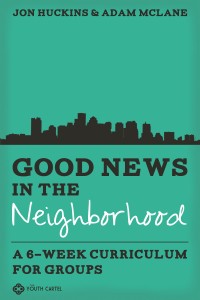
  • Good News in the Neighborhood curriculum now available!

    Early this morning I finished final edits and uploaded the final version of my latest project: Good News in the Neighborhood, a curriculum for groups. (Check out the trailer in the sidebar to the right)

    I’m very proud of how it turned out. As I think back to the original brainstorms and ideas for this product I don’t think I could have imagined it’d turn out this cool. Jon and I worked our brains off pushing through this content, finalizing edits and writing content as late as yesterday! The leaders PDF turned out to be 52 pages and about 18,000 words. This thing is beefy!

    Here’s the description:

    This 6-week series will deep dive your students into the practical realities of a radical life with Jesus. Built around six themes of community life, students will gain an understanding of their role in their community and be challenged by a series of simple experiments they can try. More than a series that teaches your students about being Good News in their community, Good News in the Neighborhood offers practical application based on the life of Jesus and the 1st century Church. Our hope is that your students begin to see how God has called them to become good news in their homes, schools, and neighborhoods.

    Who is it for? It’s for groups. It’ll most naturally fit with high school and young adult groups (college). But I would totally do this with my adult small group. In all honesty, I’d preach this as a sermon series!

    Now the really exciting part… people actually using it! 

    So that’s my excitement this Monday morning. As Marko just pointed out, my first book!

    Do me a huge favor and buy this sucker for your group, your youth pastor, your pastor, or even yourself.  


  • Pivot Points

    Four years ago, I was minding my own business when Marko called me and asked me to think about moving to San Diego to work with him at Youth Specialties.

    It was around Easter, we had a house full of guests, and a list full of projects to manage at the church. (Ironically, our house guests were the family we co-owned YMX with.) Nothing was further from my mind than leaving our ministry in Romeo when Marko called. We had a life we loved, lived in a house we wanted to retire in, loved our neighborhood, our kids school, and the people we ministered alongside.

    That phone call was a pivot point in our lives. The opportunity made no sense and perfect sense at the same time. That phone call lead to dozens of hard, honest, open conversations which ultimately lead to us walking away from the life we knew and stepping into a life of unknowns.

    I was reflecting on that last night during the Good Friday service. Four years later and its still surreal to sit in a worship service with no responsibilities. It’s surreal to not hang out and talk to people until everyone leaves so you can turn off the lights, lock the doors, and go home. It’s surreal to sit in a service and not know what’s next. (Or care) It’s surreal to sit in a worship service and not have people whisper reminders in my ear. It’s not good, it’s not bad, it’s just surreal.

    That’s the thing with life’s pivot points. You remember the life you once lead while you carry on with the new life before you.

    Are you listening? Do you have a faithful life posture? Can you discern between the voices in the desert? 

  • Jesus died for his peeps

    Pretty weird mix of metaphors if you ask me.

  • 5 things great leaders never say


    If I were preparing a talk about leadership this would be my premise and these would be my 5 points.

    5 things great leaders never say….

    1. I let others do my dirty work.
    2. I could use one more critic.
    3. I’m not hard on myself.
    4. That’s impossible for us to accomplish.
    5. I need to get better at recognizing others achievements.

    If you missed it, here’s a post on why people follow.