Category: Christian Living

  • Katie’s Story

    This week I’m sharing stories of friends whose lives were impacted by Christian camping. Join me in celebrating the Power of Camp. This story comes from a local friend, Katie Dupuis.

    After my dad left we were super poor. We were also super miserable.

    My mom was depressed and working 3 jobs, she would lock herself in her room and cry when she was home, my older brother disappeared into his high school activities and friendships. I was left alone almost all the time.

    I hated everyone; my parents, my brother, God.

    Our church family took really good care of us, bringing us food and clothes. I resented it at the time, I was too proud to want their charity. That is until anonymous donors paid my way to Christian camps more than once. I’d take any opportunity to get away from home– even for just two weeks.

    Those acts of love and sacrifice allowed God to speak to me in a place where I could hear Him, away from my pain filled home life. At camp I could feel God in the passionate worship of other teens, I could see Him in the love of the counselors and other campers, I could hear Him in the messages that were preached.

    What I heard was that my parents divorce grieved God, my pain grieved God, this was not his plan or his doing, but neither was it too much for Him to handle. I was able to start to forgive and heal.

    I am forever grateful to those in our church who gave their money so that I could go experience God in an intimate, impactful setting. I cannot underestimate the effect that their generosity has had on my life.

    Full-disclosure: I’m not getting paid a red cent for this series. I’m doing this because I believe camp is an important element of ministering to children and teenagers in our country. I invite you to join me in donating $125 to CCCA’s Corners of the Field campaign. It’s pretty simple. For every $125 given a kid can go to camp this summer.

    Photo credit: Heidelberg Castle by Zoagli via Flickr (Creative Commons)
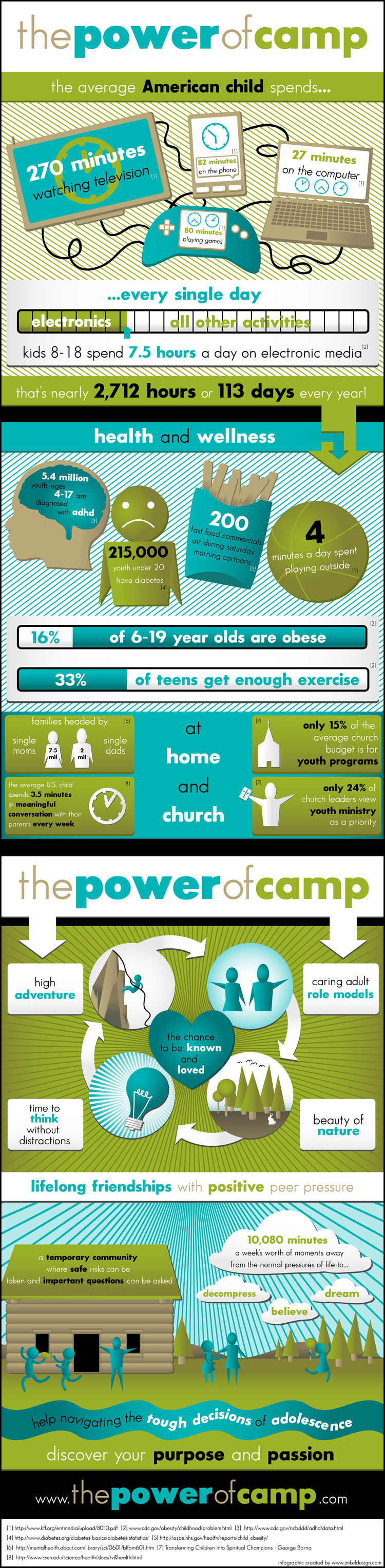
  • The Power of Camp [infographic]

    source: http://thepowerofcamp.com/?page_id=10

    Click here to download a full-sized version of this graphic. This would look hot on Pinterest.

    Full-disclosure: I’m not getting paid a red cent for this series. I’m doing this because I believe camp is an important element of ministering to children and teenagers in our country. I invite you to join me in donating $125 to CCCA’s Corners of the Field campaign. It’s pretty simple. For every $125 given a kid can go to camp this summer.

  • Camp saved me

    Welcome to Camelot

    Taking my bag out of the car and heading into the main building was like coming home. Sure, I didn’t live here. But the week I spent at camp each summer was my home base.

    Inevitably, the hour-long drive south of South Bend to a small, PCUSA camp called Geneva Center was full of anxiety. Whoever was driving was taking their sweet time. We couldn’t have left early enough nor driven fast enough for me to get there. A stop for gas was tortuous. No, please don’t stop to buy anything! Let’s go. I just had to get there. Once I was there everything was OK but nothing could be OK on the day camp started until I got there.

    This was camp week. My Camelot.

    I looked forward to camp for then unexplainable reasons. If asked I would just say it was fun and I loved the people. It’d take me a few more years to develop a vocabulary for what was going on.

    Deep stuff happened to my heart at camp. Each time I was there the grounds became more and more sacred to me. Even now, a couple decades later, when I look at the pictures on the website my mind is flooded with memories of my connection to God on those grounds.

    Like the real Camelot my imagination had built up a fantasy about this place. Camp had a disorienting effect because you had a hard time knowing if the camp world was real and home was fake or visa versa.

    Cabin Life

    Each week our little cabin group became a family. These 3 room cabins had a central room for “cabin time,” a boys room and girls room. We had a two counselors and about 15 fellow campers in each cabin. Of course, I had a favorite cabin. Cabin 4. For some reason I always ended up in that cabin group. And each week spent in Cabin 4 meant that I’d develop fun friendships with other kids from other Presbyterian churches around northern Indiana.

    I Needed Camelot

    As I’ve shared many times, my parents loved me deeply but I got dragged through the mud of all that was going on in their lives. Home often felt un-Camelot-like full of conflict, turmoil, change, and other drama. But camp was always the same. It was a predictable. It was safe. It was age-appropriate. It was “for me.

    My earliest profound encounters with God happened at camp. Going for hikes, sitting around a campfire singing silly songs, swimming in the pool, or making dinner outdoors with my cabin group. I suppose I learned some stuff about God while at camp. But what I remember the most is that Geneva Center was a place where I encountered God.

    Camelot Needs Help

    As you can imagine, the Great Recession has hit Christian camps hard. For many families sending their kids to camp is discretionary spending that they just can’t take the risk on. And for many other families (especially from lower income households) when a kid needs camp the most, when life comes unravelled at home by the stresses of a recession, mom and dad can least afford to send their child.

    My life is better because of camp. I don’t know what would have happened without my weeks in Camelot. Will you join me in donating $125 to sponsor a kid to go to camp this summer?

    Photo credit: Castle Hohenschwangau via DragonWoman (Flickr, Creative Commons)

  • There are crappy days ahead

    There are crappy days ahead.

    Reading blogs and Facebook updates and happy tweets from your friends, you might begin to think that you are the only one who has truly awful days.

    This past week I heard from a friend who told me how wonderful my life is going. “Keeping up with your blog and stuff… boy, things sure do seem to be going great.

    My response was one word: “Editing.

    My life is just like yours. There are good days, bad days, and days when the well-hidden excrement of my life hits the quite literal fan to spray proverbial crap all over my life.

    This I can promise you: There are crappy days ahead. James says it way more politely than I have.

    Consider it pure joy, my brothers and sisters, whenever you face trials of many kinds, because you know that the testing of your faith produces perseverance. (James 1:2-3)

    Notice James didn’t say, “If you face trials…” He said, “whenever.” Hard times are coming. It’s inevitable. Hard times are a guaranteed investment.

    So the question isn’t, “How can I avoid hard times?” If we’re realistic the question is, “Whatchagonnado when you have a crappy day?

    Here’s a few things that have helped me, maybe they are helpful for you?

    1. First– Am I just being sensitive? Sometimes I just get bent out of shape over things that aren’t really that bad. Am I mislabeling something as a crappy day when it’s really just a day when things didn’t go my way?
    2. Perspective helps. There will be days in life when your spouse is disappointed in you, or your kid gets in trouble at school, or you end up in the hospital, or your bank account read -$128.32. But any day you aren’t dead is another day things can get better.
    3. It’s OK to laugh. I don’t mean laughter as a way to hide from what’s going on. But sometimes the circumstances of our crappy days are just plain ridiculous and laughing about it is great medicine.
    4. Grab a friend and a drink. For millennia people who have had a bad day have met up with a friend for a beverage to unwind. Text a friend and go out for coffee, a beer, or a glass of wine. I’m not talking about getting drunk… I’m just talking about relaxing and getting some fresh air.
    5. Go for a walk, a jog, a bike ride. Anything physical seems to help me. Even if it’s late at night. This will help relax the tension so you can sleep. Oh, it’s the dark night of the soul which we all must avoid! 
    6. Just shut up. Sometimes when I’ve had a bad day I run my mouth. I say too much, I think too much, I worry too much, and I fall into anxiety about stuff I can’t control. All of that makes matters far worse!
    7. It’ll be better tomorrow. Nothing cures a crappy day like waking up the next morning.

    It’s easy & free to support this blog. Subscribe via RSS or email.

    Photo by Dennis Wong via Flickr (Creative Commons)
  • How I read the Bible

    It took me a long time to figure out a Bible reading methodology that fit me. I’ve failed at a lot of them.

    • A chapter a day keeps Adam’s Bible away
    • Read it in a year means Adam won’t read it for a year
    • Study it topical means Adam treats it like a tropical disease
    • Skip around means Adam just skips it
    • Read it in a group means Adam skips his group

    You get the idea.

    But I have found something that works for me. Something that I enjoy and gives me life.

    It doesn’t have a name and it’s not really a technique. It’s kind of a half lectio divina on slow pills. Here’s how it works.

    1. I allow myself to dwell in a passage for a while, sometimes weeks. And by passage I don’t mean a chapter… it’s usually a paragraph or a thought from the author. (1-3 paragraphs at most) I’ll fester in this passage until it sticks in my ribs and I do something about it that I actually move on. It might be a few days and it might be a month.
    2. Read it fast. Read it slow. Stare at it. Write it out. Pretty much, I keep this passage on my mind. Maybe I’ll open my Bible and read it or maybe I’ll read it in 15 different versions on Biblegateway. Sometimes I’ll print it out and stick somewhere where I’ll see it all the time. And sometimes I copy it by hand in my journal.
    3. What 1 word pops out as the most important? As I get to know the passage, typically a phrase or even a word will pop out. God illuminates this to me. When I studied Bible study methods in college I hated that they tried to make this a science. Sometimes the most important part of a passage is not the main idea of the paragraph. Sometimes it the tense of a verb. Or the personal pronouns. I find that when I do this its like putting a roast in the slow cooker. It takes time to really become important.
    4. Ask God to reveal this to me in my life. Mantra-ize it. It FREAKS evangelicals out to see that word, mantra. All I mean by that is that I make that one word/phrase important. When it pops into my head it calls me to action or helps me see the world through the lens of that passage. I’ve found it so amazing how many times God reveals that phrase to me in my day. It’s like illumination on steroids.
    God means what he says. What he says goes. His powerful Word is sharp as a surgeon’s scalpel, cutting through everything, whether doubt or defense, laying us open to listen and obey. Nothing and no one is impervious to God’s Word. We can’t get away from it—no matter what.

    This is what works for me. Have you found a way of reading the Bible that works for you? I’d love to hear about it.

    Dig this post? Let’s make it a regular thing. Subscribe via RSS or my free daily email

  • You can’t do communion alone

    When I was in middle and high school I spent a lot of time home alone. My mom worked crazy hours and my older brother joined the Air Force when I was in 8th grade. A million nights home alone will lead you past boredom. While I always kept the TV on so I didn’t feel alone I rarely watched it. (A habit I often fall back on today, to the annoyance of Kristen.) And there’s only so many nights in a row you can play video games before the loneliness of solo gameplay sets in.

    In fact, there comes a point where boredom leads to creativity. Creative with things you can do alone. 

    In those years I would take as long as I possibly could to eat meals. I’d take forever to cook it. Or I’d cook it out of order or one thing at a time. Anything to make it last longer and give me something to do.

    One little food oriented fascination I had was with communion. I don’t know why but I’d play around with communion elements. I’d tear bread, or a tortilla, or a tortilla chip… and mimic the motions of communion that we’d do in church. I’d recite the verses, dip the bread, the whole nine yards.

    I wasn’t mocking it and it wasn’t quite the real thing. Actually, I used to worry that it was sacrilegious. And I would never have told a soul about this back then. In fact, I’m a little nervous about writing about it today.

    Here’s the thing: It wasn’t really communion. Sure, it was the motions of communion. I got a certain feeling during communion at church, one worth trying to replicate.

    But you can’t do communion alone. Even if you nail the elements and the words and everything. Because you can’t do communion alone. 

    The very word communion has the same root word as community, with a different suffix. Just like you can’t be in a community alone you can’t experience communion alone.

    This is something for those of us in evangelicalism to wrestle with. We have a personal pronoun issue. Our relationship with Jesus is about communion, not ourselves. Communion with the Father, communion with the Son & Holy Spirit, and communion with one another. It isn’t about you it’s about we.

    I’ve often found the way we evangelicals do communion to be a lonely shadow of the experience found in other types of churches. We have reshaped communion into being about me and my relationship with Jesus, uncomfortably giving space to create a private moment, instead of allowing communion to be about a communal thing, our collective relationship with Jesus.

    Satan wants nothing more than us to look out for our own best interests. Never forget the table. The table drives us to communion. 

    Photo by Pierre Porte via Flickr (Creative Commons)

    Support this blog! Get regular updates from adammclane.com via RSS or email.

  • The missing simile

    Am I afraid to take Jesus at his word?

    This has been rattling through my head lately as I’ve read the Bible.

    • Love your neighbor as yourself. Yeah well, I guess that depends on how you define the word neighbor. Right Jesus? And what if my neighbor is annoying? I’m off the hook, right?
    • They sold property and possessions to give to anyone who had need. (Acts 2:45) Yeah well, this couldn’t possibly apply to me. Live in community with people? Yeah, well I mean I have the right to chose where I live blah blah blah. And I don’t live near anyone in my church. So I’m off the hook, right?
    • Then give back to Caesar what is Caesar’s, and to God what is God’s. (Luke 20:25) Yeah well, clearly in Jesus’ day they didn’t have tax attorneys or loopholes to help me not pay my fair share. Clearly, Jesus didn’t have Tax Cut. There’s other people doing it,too. I’m off the hook, right?
    • Here are my mother and my brothers! Whoever does God’s will is my brother and sister and mother. (Mark 3:34-35) Yeah well, we know that family comes first, right? It’s not like Jesus had kids. I’m off the hook, right?
    • I tell you, open your eyes and look at the fields! They are ripe for harvest. (John 4:35) Yeah well, I get to define what Jesus means by this, right? He couldn’t possibly mean the people on my block… I invited them to church and they didn’t come. So I guess I need to wait a while longer, it’s on them. I’m off the hook, right? 

    In all of those instances… and a whole lot more like it… I have a tendency to see a silent simile. I want an out clause. I need an out clause. I need some grey area to wiggle out of what Jesus is saying. And a simile would sure be useful.

    The problem is that in almost all cases there is no simile. If I’m going to take Jesus at his word than I’m going to have to reorient my life around his words and not the other way around.

  • The sweet cry of lament

    I’ve heard there was a secret chord
    That David played, and it pleased the Lord
    But you don’t really care for music, do you?
    It goes like this
    The fourth, the fifth
    The minor fall, the major lift
    The baffled king composing Hallelujah

    Your faith was strong but you needed proof
    You saw her bathing on the roof
    Her beauty in the moonlight overthrew you
    She tied you to a kitchen chair
    She broke your throne, and she cut your hair
    And from your lips she drew the Hallelujah

    Baby I have been here before
    I know this room, I’ve walked this floor
    I used to live alone before I knew you.
    I’ve seen your flag on the marble arch
    Love is not a victory march
    It’s a cold and it’s a broken Hallelujah

    —-

    Maybe there’s a God above
    But all I’ve ever learned from love
    Was how to shoot at someone who outdrew you
    It’s not a cry you can hear at night
    It’s not somebody who has seen the light
    It’s a cold and it’s a broken Hallelujah

    You say I took the name in vain
    I don’t even know the name
    But if I did, well really, what’s it to you?
    There’s a blaze of light in every word
    It doesn’t matter which you heard
    The holy or the broken Hallelujah

    I did my best, it wasn’t much
    I couldn’t feel, so I tried to touch
    I’ve told the truth, I didn’t come to fool you
    And even though it all went wrong
    I’ll stand before the Lord of Song
    With nothing on my tongue but Hallelujah

    Source, history of this song

    There’s a depth of honesty in this lament which is alluring. It’s a depth that we are uncomfortable with– almost repulsed by– but drawn to because of its connection to our story.

    The human experience unites us together. In our best and weakest moments we are all left to sing Hallelujah to something.

    We lament. We mourn. We feel the pains of loss. In doing so we don’t fail to acknowledge God. Instead, we acknowledge our humanity and need for a great big God who heals lament that shreds body from soul from spirit.

    My eyes fail from weeping, 
       I am in torment within; 
    my heart is poured out on the ground 
       because my people are destroyed, 
    because children and infants faint 
       in the streets of the city.

      They say to their mothers, 
       “Where is bread and wine?” 
    as they faint like the wounded 
       in the streets of the city, 
    as their lives ebb away 
       in their mothers’ arms.

     What can I say for you? 
       With what can I compare you, 
       Daughter Jerusalem? 
    To what can I liken you, 
       that I may comfort you, 
       Virgin Daughter Zion? 
    Your wound is as deep as the sea. 
       Who can heal you?

    Lamentations 2:11-13

  • An Ode to the Unqualified

    Here’s to you,

    The unqualified.

    The untrained.

    The unordained

    The unordainable.

    The seminary reject.

    The mom with no time for seminary.

    The dude with a job.

    The family in the pew.

    The widow in the nursery.

    The seasoned rookie.

    The mint veteran.

    The faithful.

    What you do goes unrecognized. There’s no sign in the church parking lot with your name on it but there should be. There’s no recognition from the platform because the people on the platform don’t know what you do. There’s no accolades or raises or sabbaticals or training conferences. There’s no books or magazines or hashtags describing your task.

    You just do it. You represent Christ every day in the small things. You come into contact with the people the pastors only read about. You take the words of Jesus seriously and love your neighbors as yourself. You pick up their mail. You check on them. You listen with the ears of Christ. You pay attention to the nuances in their voice. And you take action when the Spirit leads.

    There will be no pension checks for you. There will be no housing allowance. There will be no leased car. You will pay your own cell phone bill. You will mow your own grass.

    You are the unqualified. You are the heros of the faith. You are the workers reaping the harvest. You are the ones from whom Good News flows. 

    Want to support this blog? The easiest way to do that is to subscribe via RSS or sign-up to get my daily email updates

  • The Fulcrum is Jesus

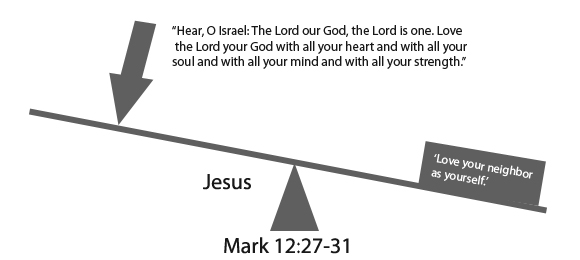
    Sometimes I sit in church with the realization that for a lot of folks they think this is the center point of their walk with Jesus. As if, somehow, the fulcrum of the Christian life is attending a worship service?

    We’ve been raised (Christian language: Discipled) to make church that “can’t miss” thing of the Christian walk. In evangelicalism, the practical disciplines of the spiritual life are:

    • Go to church
    • Regular Bible reading
    • Daily prayer

    If you want bonus points:

    • Join a small group
    • Serve in a ministry of the church

    Don’t get me wrong. I do most of those things on a regular basis. And these are very good expressions of the Christian life.

    But these are the peripherals of the Christian life, not the fulcrum.

    The church is not the centerpiece of your walk with Jesus. That’s idolatry.

    You can’t sit in church and say… “YES! This is it.” Attending church (passive action) isn’t it anymore than watching football on TV is the same as playing in the game. (active participation) Jesus didn’t come so you could go to church. He didn’t tear the veil between Levites and the people so you could watch church. That’s a foundational misunderstanding in the person and action of Christ.

    Your load... is to love the Lord your God with all your heart, soul, and mind. That’s so much more than church involvement, reading your Bible, praying, being in a small group, and serving in the church. There’s nothing wrong with those things, but they are too cheap and easy to be “it.

    What Jesus describes is all encompassing. Like two lovers in the first 90 days of their relationship! 

    Your output… is to love your neighbor as yourself. The output of your walk with Jesus can’t just be church involvement. It’s can’t be about you and your learning. It can’t be about serving at the church. That’s not what Jesus said was the output.

    According to Mark 12, the output of loving God with everything is loving your neighbors. (You know, the people next door.)

    One of the teachers of the law came and heard them debating. Noticing that Jesus had given them a good answer, he asked him, “Of all the commandments, which is the most important?”

    “The most important one,” answered Jesus, “is this: ‘Hear, O Israel: The Lord our God, the Lord is one. Love the Lord your God with all your heart and with all your soul and with all your mind and with all your strength.’ The second is this: ‘Love your neighbor as yourself.’ There is no commandment greater than these.”

    Mark 12:27-31