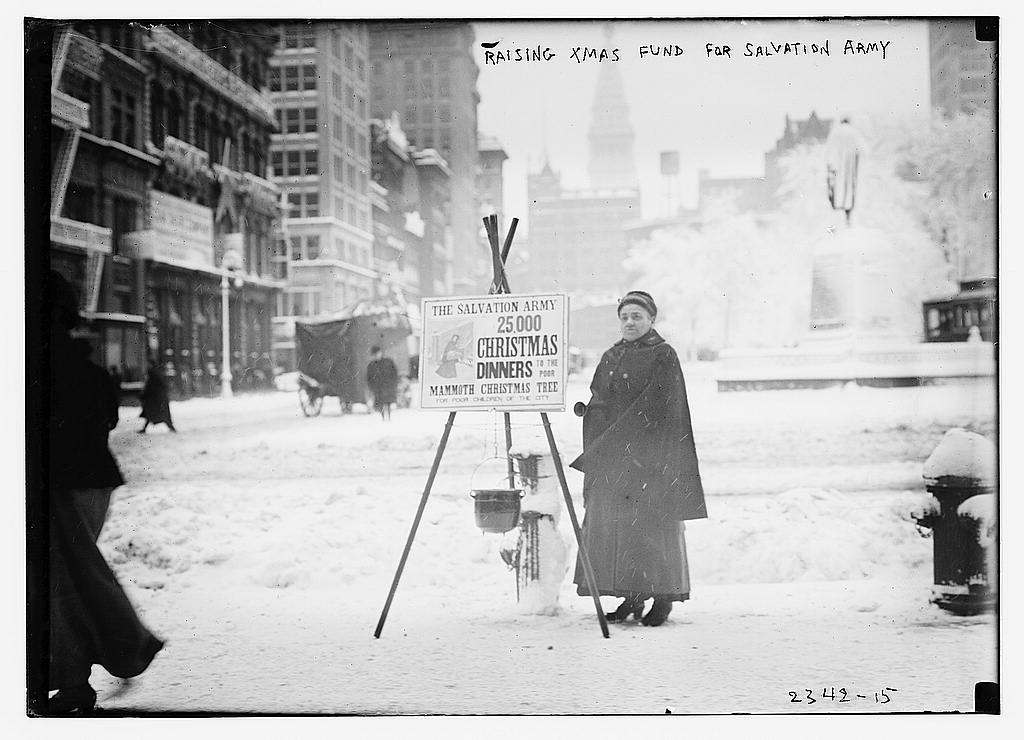
Pretty soon you’ll start hearing a familiar Christmas jingle. No, I don’t mean the annoying Christmas muzak you’ll hear at the grocery store. I mean the jingle of the bell ringer outside.
If you’ve rushed by the red kettle as quickly as possible your whole life, maybe you don’t know that it’s a fundraiser for the Salvation Army. Simply put the Salvation Army is a denomination (of sorts) built upon the idea that the Gospel of Jesus isn’t just for people who are accustomed/comfortable going to church. For more than 149 years the Salvation Army has ministered to the destitute, hungry, and homeless.
In other words, the Salvation Army does the work of bringing Good News to those who most need it 365 days per year. They are there every day for the homeless among us. They are there when disaster strikes. They are there when the hurts are bad. And they are there to help heal painful addictions.
Here’s a challenge. From Thanksgiving to Christmas you will see these Salvation Army bell ringers outside of malls, grocery stores, and department stores all over.
Don’t pass a single one. Every time you go in a store with a bell ringer outside drop in a quarter or a dollar. If you have your kids with you, give them the money to put in the kettle so they can start to see the connection between your money and what you do with your money for good.
But wait? That might cost me a lot of money?
Yup, make a choice. You want to save that quarter or dollar– don’t go shopping.
Think of it as a toll. To get into that store you have to donate to the poor. Are you up for the challenge?
Don’t just wish good tiding of joy. Be good tidings of joy.
The default topic in Christian leadership circles today is balance.
We need to balance our work and family life. We need to balance ministry in our community with ministry at our church. We need to balance our budget. We need a balanced diet.
Something is wrong in your life? You are out of balance.
And that has me wondering. Is the very concept of balance a Christian concept or an Asian philosophy of Yin and yang?
When I look at the New Testament I see Jesus calling men and women to a holy imbalance. He asked his first disciples, who asked their disciples, to leave everything for the Kingdom of God.
Some Examples of Imbalance Celebrated
Luke 5:1-10 – Jesus first asks Peter, James, and John to waste their time fishing in the wrong conditions. Than he asks them to leave their home, business, and everything they knew to follow him. Those nets, that boat, and the business all rotted.
Luke 9:23 – “Then he said to them all: “Whoever wants to be my disciple must deny themselves and take up their cross daily and follow me.“
Matthew 26:6-13 – A woman pours expensive perfume on Jesus, his disciples called that a horrible imbalance and Jesus affirmed her. “Why are you bothering this woman? She has done a beautiful thing to me.”
Acts 5:1-11 – Dave Ramsey would have affirmed Ananias and Sapphira for their financial wisdom. They held a little back just in case. The Apostles weren’t interested in balanced devotion, they demanded all or nothing.
Acts 7 – Stephen had an opportunity to defuse the anger of those in power, you know, balance things out. Instead he threw gasoline on the fire and was stoned.
There are hundreds more examples of this. The New Testament church embraced imbalance! It was celebrated. A call to follow Christ was extreme, never safe, and put your life permanently and joyfully horribly out of balance.
The very concept of balance is an avoidance of extremes. It’s holding something back. In many ways, our avoidance of extremes and calls for balance is the very thing that prevents us from truly experiencing the fullness of the weight of the cross on our shoulders.
If you ask me we need to ask people to count the cost. We need to call people not to a cheap version of discipleship but to one that is extremely out of balance. Jesus didn’t call us to balance. He calls us to pick up the cross– an instrument of death– and daily follow him.
“Christianity preaches the infinite worth of that which is seemingly worthless and the infinite worthlessness of that which is seemingly so valued.”
As I sit here this morning, looking out of my window onto my street, I have a single thought:
Today is powerful.
One single day could change everything.
No, there’s nothing significant about this Thursday.
I mean that every day is powerful.
And you have one shot to get today right.
Each day I have the opportunity to do something… in this moment… or let it slip away.
It’s a simple thought. But perspective adds to the realization that today can’t be just another day.
So often we get lost in the busyness of doing what we need to do today that we forget that Jesus Christ has empowered his believers to measure each day differently.
Jesus measures your day differently than you do.
Today might not seem significant. But it is.
Today is a gift. And what you do with this day matters deeply to the one who made the hours we describe as a day.
“Teacher, which is the greatest commandment in the Law?”
Jesus replied: “‘Love the Lord your God with all your heart and with all your soul and with all your mind.’This is the first and greatest commandment. And the second is like it: ‘Love your neighbor as yourself.’
Create in me a pure heart, O God, and renew a steadfast spirit within me. Do not cast me from your presence or take your Holy Spirit from me. Restore to me the joy of your salvation and grant me a willing spirit, to sustain me.
The river of God’s activity is real. You don’t know it really exists until you are there. And when you are there… you just ride the current and smile.
How do you get there? There’s no formula. Just walk humbly and boldly and it seems to find you more than you find it. Like the wandering Israelites found Kadesh, sometimes it takes some hardship to find it.
Those raised in evangelicalism were taught to believe that the world will only get worse until the Lord returns. Culture degrades, morality disintegrates, and the world falls apart to the point that only Jesus can rescue us from certain self-destruction.
Listen to almost any traditional evangelical voice and you’ll hear this language peppered in. Things are getting worse, of course they are getting worse, things have to get worse for Jesus to come back. (This implies that they kind of WANT things to get worse so Jesus can come back.)
This isn’t a historical eschatology of premillennialism and the general belief that Jesus would return to establish his Kingdom. Currently, much of this vantage point seems to be seated in a dispensational premillennialism which took root in the early 1900s, but was originally penned by John Darby in the 1830s.
How did this become popular?
The atrocities of World War I radically shifted people’s worldview. While the industrial revolution seemingly made life better and better, the Civil War brought an end to modern slavery, and modern medicine went about ending disease had elevated people’s general perception that the world was getting better. Those same technologies were used to kill hundreds of thousands of people in Europe– which dramatically flip-flopped the worldview the other way.
People began to look at science, invention, and modernization with a new lens. We enjoyed the benefits while always giving a suspicious eye to how evil men and women may use this against us. (This is alive and well today, isn’t it? Read Christian advice on any technology and you’ll see them dance this line of benefit versus danger.)
Evangelicalism became popular in that environment. People generally had a negative view of the world’s future and dispensationalism provided an explanation for it. It was the right message at the right time and lead to the rapid growth of the evangelical movement and the continued degradation of the mainline denominations we continue to see today. (Most of the mainline denominations rejected dispensational)
Much of how we view the world today as American Christians is heavily influenced by a a relatively new eschatological view (non-historical) and one which relatively few Americans understand or hold dear. (dispensationalism)
What does this have to do with me?
As a student at Moody Bible Institute I was taught dispensationalism and pre-tribulational, pre-millennial eschatology as bona fide fact. (I always felt it was a little weird to be taught the future as fact. I guess I was alone in that!) We were all required to take classes which indoctrinated us in the tenants. We all passed tests. And to graduate we all had to sign that we believed in a pre-tribulational rapture. Yes, every graduate of Moody has signed this… forever!
In a school that was so well-rounded in almost every other area this was the one thing they held onto as a distinctive! (And some silly rules about dancing, because we know dancing leads to amillennialism.) Moody isn’t alone. This is a core belief for traditional evangelicals.
What does this have to do with you?
I’m not saying dispensationalism is bad. And I’m not saying there’s no way there is a pre-tribulational rapture. (Though I do find the hermeneutics and evidence which lead to this conclusion as thin) Technically speaking, I’ve always affirmed premillennialism while holding views of a rapture at arms length… I’m not betting the farm on that one.
This is important to you because it impacts the tone with which so many traditional evangelicals approach issues of the day. There is an implied negativity. You’ll hear phrases like, “This is really a shame. Of course we expect it to continue getting worse until the Lord returns.” It’s a tone and a stance that they don’t intend to do anything to make it better– because that’s the way it has to be for Jesus to come back!
The shift to something else…
Most evangelicals seem to be softening on this hardline view. Even as you read this you probably felt like there was a shadow of truth there but it isn’t really how things work in your life or ministry. That’s because we’re seeing things change in evangelicalism. The rise of the neo-reformers (Piper, Driscoll, Keller) has introduced a Reformed theological perspective, which flirts with the notion of things getting worse while affirms that Jesus makes things better in society when his people are at work in society.
It doesn’t feel like people have landed, yet. But it it is clear that the traditional evangelical view of eschatology is having less and less impact on the ministry churches are doing on a day-to-day basis. In my view, this is great!
Neighborhoods are safer, schools are safer, on and on.
And just like the scary things of World War I brought about the rise of one theological perspective… The end of the Cold War and drops in these big, scary things are impacting how Christian view their place in the world.
Maybe I’m just weird? But have you ever noticed that most worship music is really just one noun or pronoun away from being a love song? And if you aren’t careful… change the name from an object of worship to an object of affection… and a whole lot of worship songs get PG-13 real fast.
There is a razor thin line between worship music for church and really weird love song. I often wonder what these songs must sound like when people are new to church. They see words on the screen and go, “Whaaaaaa?”
Just for fun, I’ll give you a couple of examples and let you suggest the rest in comments.
Christians have a weird history with celebrating Halloween. Not growing up in the church I was appalled when I heard church people refer to it as “Devil’s night” and say things like, “Of course we don’t celebrate Halloween.” It’s as if we’re talking about two different holidays. There’s the one that actually happens and the one that you’re afraid is happening. Like all things– fear is irrational.
The whole anti-Halloween concept is built on a theology of fear. Be reminded that in Ephesians 5 Paul instructs Christians to be light in dark places!
Many churches offer alternatives such as harvest parties, hell houses, or trunk-or-treating. Those things aren’t bad, but they aren’t good news in your neighborhood.
Here’s my suggestion: Skip the Christian alternatives altogether and embrace Halloween for what it is. It’s a night when hundreds of families will wander around your neighborhood, smiling and enjoying one another, and giving candy to children.
Think strategically: For those who are anti-Halloween I have this challenge. One night a year one hundred families want to come to your door and say hello. Are you going to greet them? Or are you going to turn off your light and pretend they don’t exist?
Don’t be “that guy” on your block. Embrace Halloween as an opportunity to be good news in your neighborhood.
5 Ways You Can Be Good News in Your Neighborhood on Halloween
Sit on the front porch. One of my favorite things to do is to sit on the front porch all night and talk to people as they come by. Resist the temptation to go inside between visitors. Trust me on this. You’ll like what happens. You’ll make great small talk with parents AND every time I’ve done it my neighbors see me and do the same. We have great little conversations porch-to-porch conversations between visitors.
Make it a game. Set up a simple game in your front yard to give trick-or-treaters the opportunity to win the big candy bar. It could be as simple as a bean bag toss or throwing a football to knock something down. Make it simple, kids want to hit every house on your block, but this will make a great impression.
Host a warming station on your block. We’ve done this one bunches of times– it’s ALWAYS a blast. We had close to 1000 trick-or-treaters at our house in Michigan and doing this cost me, maybe, $75. Set up a little tent in your driveway or front yard and serve coffee, hot cocoa, and apple cider. It’s a great break to the routine and easy to invite your small group or someone who doesn’t have trick-or-treaters to help with. Do it 2-3 years in a row and you’ll get known as the house that does that tent thing. Really want to make some friends? Offer parents a little Kahula or Bailey’s for their hot drink!
Do something fun and not-so-scary. There are people in our neighborhood who go all out. They build tunnels over the sidewalk and scare the tar out of children. You can have fun like that and just make it fun. Rent a bounce house and play some music. Be weird and decorate your house for Christmas. Dress up like the easter bunny and have an easter egg hunt every 15 minutes. Just because you don’t want to get into the whole devil/ghosts/zombie thing doesn’t mean you can’t be creative to have some fun with the hundreds of kids who will come up your walk.
Cover every house. I live on a block that has some elderly folks. Consequently, we have kind of a bummer block because many of them aren’t mobile enough to hand out candy. It would be great to rally a few people and make sure every porch light is on and there is candy at every house. Warning: You may need to actually talk to your neighbors to pull this one off. (Which is more scary than Halloween itself, right?)
What are other ways you can embrace Halloween as a way to be Good News in your neighborhood?
One day morning will dawn, your eyes will open, and you will awaken with the literal reality that the dream you had for yourself is over and it’s time to move on.
I can think to specific days in 2000, 2003, 2008, and most recently in summer 2011 when I rolled out of bed with the knowledge that I’d just crossed a line. The dreams I knew were gone. And I had to find new dreams.
In each case, those mornings felt like I’d just fallen from a place of positional power, security, and recognition. Even in going from one role to another– even if that new role was “better” than the one I’d left, it still felt like a fall.
Perhaps it is a guy thing? But much of who you are and how you think of yourself on a day-to-day basis is wrapped up in what you do, who you work with, and the people you do stuff with. When that’s gone– whether by choice or not– you experience this unmooring free fall feeling.
While other leaders have experienced ugly falls from grace I have never experienced that. Instead, in times where the things I knew are suddenly gone because I’ve moved on to something else… I’ve experienced something I can only describe as a fall to grace.
The free fall feeling of change always lands in the loving arms of a God who has nurtured and cared for me from the beginning. And those strong palms support my back as I try to get my bearings. God’s grace supports me, lifts me up, and the warmth of that palm reminds me that I’ll be fine.
To know Hope you must know Despair
Despair is not the enemy of hope. Frustration and anxiety may not be your friends but they are repeatedly wrestled on your way to hope. Over the years, plenty of people have called me overly hopeful– almost stupid hopeful. From my eyes I only know summits of hope because I have been in great depths of despair. In the darkness of that valley I’ve cried out to God, “What am I doing here! I can’t do this anymore. I hate every last step of this! AAAAHHHH!!!!” The echoes of those moments haunt me.
But when you’ve been there– when you’ve screamed in that valley and heard those cries echoed back empty? Then you discover that any step above that is a step towards hope.
But knowing hope, truly living a hope-filled, is a reflex against despair.
To know Faith you must know Doubt
It perplexes me that some have made doubt the enemy of faith. I would argue that you can’t know what faith is until you know what doubt is. Both are invisible. Both are real. And both are internal, silent motivators of our daily actions.
In putting both feet on either side of the faith/doubt teeter totter I desire balance while one always wins over the other. I’m either standing on faith or standing on doubt.
Falling into the arms of grace isn’t an action of doubt or faith. But the resolve that comes through pushing against doubts gravity to take action is a step of faith. That is what reassures me that grace truly will catch me.
To know Grace you must know Failure
One of my mentors, at each of these moments over the past decade, has asked me… “What are the things you are running away from by doing this and what are the things you are running to?” Even in roles where everyone has labeled me a success I know there were failures. I know there were expectations unmet. I know I expressed attitudes I shouldn’t have. There were many times when I worked on what I wanted to work on to the neglect of what others thought I should be working on.
Even on the road to success there are many failures you have to deal with. Being honest about that with myself and with others helps me discover what grace really means in my life.
Because of my failures I don’t deserve anything good. But good keeps coming my way. That’s not a reflection of my character or timing or anything else. But it is a reflection of the character of God.
Friends- I have no idea what is going on in your life. But I do know that we will all encounter times where we experience free fall. My encouragement? Fall into the receiving hands of grace.
Oh wait, not this James. The other one knew a thing or two about turning daily trials into joy. This one was kind of the opposite.
Consider it pure joy, my brothers and sisters,whenever you face trials of many kinds, because you know that the testing of your faith produces perseverance.
He knew that if you’d take walking with Jesus seriously, truly lead people, got past the fluff, and entered into the Christian life, trials would come. A life with Jesus isn’t the absence of trials.
Instead, James says to look at the trials in your life with a twisted little smile. We know how this ends, right? We know that while minute-by-minute life might stink we can look at our tough times from a Kingdom timeline and know we’ll be OK.
James doesn’t tell you to avoid trials. He says to put them in perspective because a trial is nothing but a workout for your perseverance muscle.
I Choose Joy
I’m not trial-less. Like James predicted trials indeed come my way. People who don’t really know me line up to ask, “Are you OK?” And secretly I think they want to see me squirm. They want to know that my faith is wavering because it might somehow give them permission to continue in their wobbly-kneed journey to the throne.
But I choose to take James’ advice. I choose joy. Even when it’s not rational I choose joy. Odds stacked against me? Things aren’t going to go my way? Joy is a choice and not a foregone conclusion.
It comes from inside of me. Joy flies in the face of despair, slaps it, and then gives despair a hug.
I choose joy because Joy chose me.
Sticks-n-Stones Can Kiss My Butt
I spent a lot of Monday licking my wounds from unkind things said to me over the weekend.
Maybe I deserved it? Maybe I’ve offended some people? I can’t know why people make the choice to say something rude/sarcastic/passive-aggressive– then smile and walk away.
I think to myself, “It was good seeing you, too. Thanks for being the mouthpiece of Satan.”
You see, James helps me know that discouragement isn’t from the Lord. (Even if it comes from a fellow believer.) He says that things like this are going to come your way… but you need to choose joy through them because if you pass the test your faith will grow.
When people say nasty things to me (or about me, which is somehow supposed to be better) I am reminded of Genesis 50:20. Joseph said to his wolf-like brothers, “You intended to harm me, but God intended it for good to accomplish what is now being done, the saving of many lives.”
I’m no Hebrew scholar but I’m pretty sure Jospeh was saying… “You sold me as a slave and told dad I was killed. I should have you killed or just let you starve! I know everything you’ve said about me… kiss my butt. I’m going to bless you despite what you deserve.”
A faith-filled life isn’t the absence of trials. A faith-filled life comes when you are able to choose joy when trials come your way.
For more joy, BRING IT ON!
Here’s the truly twisted thing about this passage from James. Walking with Jesus isn’t about avoiding trials. It isn’t about operating your life in such a way that people don’t have nasty things to say about you or don’t want to take you out.
As I read the Gospels and pastoral epistles I see Jesus imploring us to live a life of boldness. Paul says in Ephesians 5 to be light in dark places. We can’t be that until we pick up our lamp and go into the dark, scary places and change things!
And changing things… walking in darkness to bring light… is going to bring about drama.
Walking with Jesus in joy is telling trials to come on with it– because trials produce joy and faithfulness!
I don’t know what’s going on in your life. But in my life? I’m choosing joy.
This is such a crucial topic. As I unpacked these action steps I sliced and diced a particular segment of the argument.
Forgive the introspection. But I want to dive deeper. Specifically, I think there are three different types of busyness in my life.
Seasonal busyness. When I was a youth pastor FT, that was September & December. September because we launched everything, December because it was Christmas and that’s always crazy in a church. Every type of career faces these… I think they are pretty normal.
Legitimate busyness you just have to push through. This last season was like that for me. Summer 2011 will go down as my most busy ever. But it might also go down as the biggest season of blessing our family has ever experienced. God blessed our socks off for no good reason. It’s been my task just to keep up.
Illegitimate busyness. Where I’m staying busy to hide from something else OR looking crazy busy so people think I’m important.
As I peal back the onion one more layer and look at busyness types 1 & 2– Pride isn’t the right word for describing how I feel about these. But there’s a certain level of satisfaction in pushing through something and acknowledging hard work for what it is.
Then there is #3. For me, that’s where the shame and accountability come into play because I can convince myself that I am so busy for such a good purpose. I’m thankful I have friends in my life who call my crap. I try to label 3 as 1 & 2 sometimes… but a true friend knows the difference and doesn’t let me get away with it.
One thing I know about busyness. I hate when people start a conversation with: “I know you’re busy, but…” I always want to reply by saying, “I’m not hat busy, really.” But then I always wonder… “Why do I look so busy? What is it about my demeanor that makes people think I’m busy even if I’m not?”
What do you think? Are there legitimate and illegitimate types of busyness? Or am I just trying to slice/dice this to justify my behavior?