
Tag: Church

  • The Youth Ministry Gap

    mind_the_gapAfter 18 months of working at Youth Specialties and interacting with youth workers around the United States (and everywhere else) it’s finally sunken in: There are two different things called “youth ministry” with a major gap in the middle.

    Professional vocational youth ministry: When I talk about youth ministry this is often my default. These are youth ministries and youth ministry leaders who have formal education, continued training, experience, and live their whole lives thinking about youth ministry. When you talk to them about youth ministry they think of models, books, authors, speakers, ministry ideas, successful programs, historical viewpoints, on and on.

    This youth ministry is pretty sophisticated. Like any profession people fall into schools of thought. They have models for doing youth ministry. They have personally written and can defend philosophies of youth ministry. They run programs which implement their well thought out and defended philosophy of ministry. They train volunteers to be proteges for their school of thought. They have opinions about whether a certain models is getting stronger or dying.

    For the 20% or so of youth workers in America in this category those nuances matter to them. They are on the leading edge of thinking about Youth Ministry 3.0.

    My Church Youth Ministry: They just want to know how to minister to the kids in their church. When they e-mail me or call our customer service line they don’t want to talk philosophy or are even aware that there are different ways of doing youth ministry. They are calling because they have 15 seventh graders in their Sunday School class and they need a curriculum that will work for them. When you ask them about what they are trying to do with the group… you’ll hear the dead air or the exhale and then they’ll say, “We’re Methodist, what works for Methodists seventh graders?

    They don’t know or care about philosophies of ministry. They don’t know or care about ministry models. They haven’t heard of Saddleback or Willow Creek. They go to First United Methodist Church of Middletown– that’s it. They may know that some churches have full-time youth workers but they don’t really care. They have a full-time job outside the church. They have a kid in high school. And the pastor thought they were pretty loving towards teens and asked them to minister to their kids friends. They give of themselves to invest in the kids in their church and that’s amazingly awesome.

    ChasmFor the 80% or so of youth workers in America who fit this category, youth ministry is pretty matter-of-fact. There are kids who show up on Sunday morning or Wednesday night and they do what they can to minister to them.

    Minding the gap: There are not big steps in between the two groups of youth workers. It’s a gap with a chasm, not a ladder to the next or even a bridge.

    It is literally two different things we call youth ministry in America. They all care about the kids in their church. One group is purely interested in the kids in their church. While the other also cares a lot about the greater profession of youth ministry.

  • Confronting Segregation on Sunday Morning

    church-segregation

    Sunday morning’s sermon at Harbor stirred in me the desire for the church to be a place of reconciliation.

    Stephen reflected on Revelation 7:9-12 in which people of every tribe, tongue, and nation will worship Jesus on His throne in Heaven and asked us to consider if we would attempt to do the same on earth? We live in a melting pot commununity. Literally, within 5 miles of our church are people of many tribes, tongues, and nations. The question brought forth was, will we intentionally worship together as a community or will we allow a church culture to prevail which prefers to seperate on Sunday mornings along racial lines?

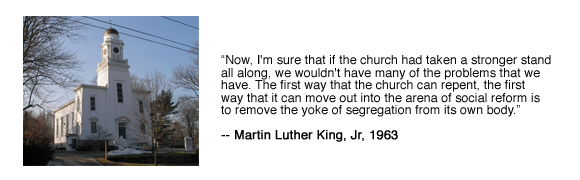
    I was reminded of this exchange, in 1963, between Martin Luther King and the one-time president of Western Michigan University, Mr. Miller:

    Miller: Don’t you feel that integration can only be started and realized in the Christian church, not in schools or by other means? This would be a means of seeing just who are true Christians.

    King: As a preacher, I would certainly have to agree with this. I must admit that I have gone through those moments when I was greatly disappointed with the church and what it has done in this period of social change. We must face the fact that in America, the church is still the most segregated major institution in America. At 11:00 on Sunday morning when we stand and sing and Christ has no east or west, we stand at the most segregated hour in this nation. This is tragic. Nobody of honesty can overlook this. Now, I’m sure that if the church had taken a stronger stand all along, we wouldn’t have many of the problems that we have. The first way that the church can repent, the first way that it can move out into the arena of social reform is to remove the yoke of segregation from its own body. Now, I’m not saying that society must sit down and wait on a spiritual and moribund church as we’ve so often seen. I think it should have started in the church, but since it didn’t start in the church, our society needed to move on. The church, itself, will stand under the judgement of God. Now that the mistake of the past has been made, I think that the opportunity of the future is to really go out and to transform American society, and where else is there a better place than in the institution that should serve as the moral guardian of the community. The institution that should preach brotherhood and make it a reality within its own body.

    The truth is, 46 years later, not much has changed. Churches are still largely segregated in America. You could argue, as this CNN article points out, that we prefer our Sunday’s segregated.

    • There are major, separate, evangelical movements within the white, black, Hispanic, and Asian communities. There are relatively few places where those churches intersect. I will lovingly say that 5% of churches are truly mixed. But I am probably rounding up.
    • Within my own culture we tend to hold our personal preferences above all else. We are fine with other ethnicity coming to our churches so long as we don’t have to give up our style of worship or preaching. We hold our worship styles as canonical!
    • White males dominate the leadership landscape within American evangelicalism. Look at most conference line-ups or take a walk around a Christian bookstore or look at the top 20 Christian albums and you will see white male dominance. Are white males the only spiritual leaders? I don’t think so.
    • Open a phone book and you will likely see, in most communities, a white, black, Hispanic, and Asian version of the same church. 99% same doctrine, but we prefer to form different churches rather than deal with intentionally segregating. It’s not just a white church issue… it’s evangelicalism as a whole not dealing with this issue!

    Something about that is anti-Revelation 7, isn’t it?

    A few years ago I was at a leadership retreat in which we were asked to bring up our dreams for the congregation. The small Michigan town we lived in has a vibrant Hispanic population and a historic black community dating back to the Underground Railroad. I said that one of my dreams for the church was that there wouldn’t be three congregations in town separated by race (but not doctrine) but that we would figure our a way to have one church. I was laughed at and mocked for weeks. “We just aren’t ready for that.”

    And by “that” I suppose they meant dealing with their racist tendencies for the sake of the Gospel.

    In America, lines of segregation are alive and well. We all know it. People use their positions of power to invent new “legal” ways to segregate people all the time. But what are we willing to do about it?

    Want to see segregation alive and well in America? Head to a school board meeting when they talk about re-districting. Or head to a planning commision meeting when they talk about building an apartment complex. You will see the dominant culture take up arms so that “they” don’t allow “them” in their school or neighborhoods. Apply some nouns to those conversations and you are right back to Brown vs. Board of Education.

    It is amazing to me that no one I know would be upset– or even notice– if they worked with people of another race (or gender.) It wouldn’t even be an issue in the workplace. For the most part it wouldn’t be an issue in our own neighborhood.  Even in our own families race is not much of an issue. Six days per week our society has integrated. It’s not perfect but we’ve come a long way.

    And yet on Sunday morning… race (and gender) are major issues! This must change and we all know it. The question for leaders today is simply, “What are you going to do about it?”

    I am proud to call Stephen my pastor. He stood up on Sunday morning, not to cheerlead the efforts our church has made in the last two years, but to remind us that we have a long way to go. I hope the small successes we see at Harbor are just the beginning of a wider movement of reconciliation on Sunday mornings for the sake of the Gospel. First in our community, but also in America.

    Some questions:
    How do I need to be confronted on this issue. This is a “first me, than lead forward” deal.
    How does that reflect how I/we relate to Scripture?
    How does that limit the effectiveness of the Gospel in the community you/I live in?
    What are action items you/I will take to confront segregation in your/my church community?
  • 6 What Ifs for My Friends in Ministry

    6-simple-questions

    1. What if the model we do church is wrong?
    2. What if the way the Bible describes the church in Acts and the pastoral epistles is really the way Jesus expects the church to be run?
    3. What if it isn’t about programs?
    4. What if it isn’t about buildings?
    5. What if it isn’t about drawing a paycheck or taking an offering or trying to grow your church?
    6. What if what the Bible says… is literally true?

    Does that change you?

  • 2 Lies of Church Employment

    two-lies-of-church-employment

    Each week I encounter a new story of a church worker that angers me. These are stories from youth workers who have been wronged by the people they trusted with their lives… their church employer. Churches who fire them because they didn’t reach the right kids. Churches who fire a staff member because their spouse got pregnant. Churches who fire because a senior leader wants to hire a younger youth worker.

    If not for a deep love of God and His bride I don’t think these people could go on. Know right now that I have a deep love for the church. This is not an attack. This post acknowledges that there are churches who are good employers and bad employers. (There’s my first disclaimer)

    It sickens me that things routinely happen in the church, a place that represents Christ the king of Justice, that would be illegal in a business. It sickens me that I routinely encounter people who are wronged, been discriminated against, treated unfairly, not paid according to their contracts… and all of these people have a deep love for the church that just takes it.

    I want to share with you two lies of church employment. These are lies that are so commonly believe that it will shock you when I address them.

    1. The church is exempt from all employment laws. I’ve heard this lie so many times that I was SHOCKED to discover it is not true. A church is an employer in the United States. All employment is governed by the Department of Labor. There are very few places where the church is allowed to be exempt, your church better talk to a lawyer. But, in total, the church is not exempt from the basic provisions the government outlines. The biggest violations I see over and over involve the minimum wage laws. Unless you are a “professional” (e.g. ordained and/or certified somehow as a professional by an organization) your work is covered by the minimum wage law. So a church cannot tell you, “we’ll pay you the first 30 hours per week, but you are required to work 10 more as ministry hours.” If it is required, and you are hourly, they must pay you for that work time as well as overtime. Nor can a church have unpaid interns. Churches do this so often that you think its OK, it’s not. You can have all the volunteers you want. But if you call someone an intern and they have set work hours, you have to pay them. (Cash payment can be offset by living expenses, but its taxable income too!) This stuff goes on and on. The church, outside of “professionals” is not exempt from discrimination laws. (Age, sex, religious background, ethnicity, you know the routine) Nor can a church make your spouse and/or childrens attendance required as a term of your employment. Nor can they fire you because you are too old. Nor can they pass you over because of your gender or ethnicity. In short, the church is not exempt from federal employment laws in all areas! There is an assumption that the church can do whatever they want… they can’t.

    2. You can’t take legal action against a church when you are wronged. This is a cultural stigma, isn’t it?  In the last 5 years I’ve repeatedly encouraged those wronged [I term this “left for dead”] to hire an attorney and pursue legal action. I don’t know of a single case where a person did that. Why? The stigma of suing a church is so strong. People always toss out a Bible verse and say, “it’s wrong to sue Christians.” I would agree with you if that’s what the Bible actually said! If you think its wrong to ever sue a church or an individual, please go read 1 Corinthians 6:1-8 right now. Paul is not saying you can’t ever sue. He’s saying people within the church shouldn’t sue one another over trivial things.

    A family bankrupted and left for dead by their employer is hardly trivial! What about the pastor fired because the board wants someone younger? Not trivial. What about the salaried staff member who has wages garnished because he left 30 minutes early on a Sunday after putting in 60+ hours the rest of the week? Not trivial. What about the church worker who has a church completely violate his privacy and discloses medical information to the congregation? Not trivial! What about the church worker who has his contract changed whimsically by the board… he’s the youth pastor one day, the childrens pastor the next, and maybe not employed the third day. Trivial? These things are happening RIGHT NOW, like this week. Shouldn’t those people do something about it?

    Simply by working at a church these people have not given up their rights to be treated fairly. Our legal system provides avenues of correction for both employee and employer. We all know 99% of these cases would never make it to a trial, but church workers need to feel the freedom to protect themselves. And churches need to know that they can’t mistreat workers.

    When I hear these stories I know that most churches do what they do to their staff because they feel like they are exempt from employment laws and that no one will ever sue them. The sad reality is that nothing will change until we educate ourselves about our rights and make it known that church staff will take legal action against villanous churches who wrong workers.

    I smell a guest post from an employment lawyer coming. If you want exact information about a situation, please consult an attorney. Just so everyone realizes this… I’m not giving legal advice! (There’s my second disclaimer)

  • 3 Musketeers of Church Staff

    three-musketeersThere’s a lot of smack talk about church staffing these days. Senior pastors rightfully elevate the role of various staff members and do their best to put all staff on the same “level” as themselves in people’s eyes. There are even a few places where church leaders will acknowledge that the childrens ministry professional, youth worker, and music minister are equally valuable. Within the non-denomination world this is emerging as a style of government where the paid staff are the elders.

    All for one and one for all: Brilliant. Biblical. Awesome.

    I agree with the premise. As a person sitting in the pews my family is ministered by all staff pretty much equally. Certainly, there is headship and we acknowledge that one of the staff is “in charge.” But that is really just a role, isn’t it? It’s not that being the leader is necessarily harder or more important. It’s a different role, equally important and dependent to the others. And in many cases each person on staff has an equal level of education while each chose a slightly different career path. So the education argument seems to prove that most staff is equal. Another argument is that the preacher should  get more money than the rest of the staff. Really? As if the stuff taught to the kids and teens isn’t as important as what’s preached? This merely shows the ignorance in the process of how churches work on a week-to-week basis. As someone who has done a lot of roles on church staff I can tell you that there is nothing more or less difficult about preparing a sermon. In fact, its a lot easier than preparing curriculum for 5-6 age levels. So, again, the argument that somehow the person preaching is more valuable to the church organization falls apart. The day-to-day reality is that all of the church staffing roles are equally important.

    Don’t believe me? Watch your senior pastors face when you tell him the chidlrens worker or worship leader are AWOL on a Sunday morning.

    The real question is… when will that be reflected on pay day?

    If church staff are equally valuable to the organization why is there inequality when it comes to taking care of staff? Why does the senior pastor make 2-3 times what the childrens worker makes? Why does that person get perks not available to the rest? Why does that person get more time off? Sabbatical? Conference budget? Book budget? Car allowance? Special tax perks. It may shock you to know that most associate level staff makes less than half what the senior pastor makes… before the perks kick in.

    This gets really strange when staff have kids the same age. The staff all have equally important roles but can’t afford to live in the same neighborhood. One family sends their kids to private school, goes on lavish vacations, and never have to worry about their kids getting new clothes. The rest of the staff live paycheck to paycheck. They watch Extreme Makeover: Home Edition and wonder when someone will turn in their house?

    I’d like to ask you to consider a new way. What if every pastoral team member made the exact same amount of money? (Perks and all.) What if they weren’t just equal in importance, recognized 1-2 times per year, but were recognized in the one way that would keep those associate level people in the game for life?

    Want to attract talent? Pay them. Want to keep staff? Pay them. Want to change a community by having talented people in place for a generation? Pay them.

    All for one and one for all. Brilliant. Biblical. Awesome.

  • Towards Holistic Youth Ministry

    degrees-360I’ve been blogging the Harbor Mid-City journey as we head towards a launch of student ministry. Up until now in the life cycle of the church plant youth ministry has always been around– part of the DNA– but never emerged as a priority. That’s changing rapidly as the church has formed to the point where ministering to adolescents is bubbling to the top of needs.

    Here is where we are:

    – We are doing a “soft launch” next Tuesday. 8-10 students are coming to one of the pastors house where we will eat dinner, get to know one another, we’ll crack open the Bible, and break off into discussion groups.

    – We’ve got a core team of 4 to start “youth group” with. (That doesn’t seem like the right term, but it’s what we have.)

    – We are creating a ministry aimed at ministering to the whole needs of our students. So Tuesday night youth group is really just one part of the greater sum of what we’re doing. We already offer mentorship, we’ll be adding to that academic help, regular community service projects, leadership development, and family assistance and probably more stuff as we go. The antithesis of what we’re after is entertainment.

    – For now, we’re focusing on high school and recent graduates. The church has a pretty solid kids ministry and for now, that’s where the middle schoolers will be ministered to.

    – For the first quarter, we are meeting in a house. But an early goal is to secure a meeting site somewhere more suitable.

    – Unlike anywhere else I’ve worked with students… getting rides is a big deal.

    – The concept of plural leadership seems to be in the DNA of what we’re creating. I’ve committed to leading up to 25%. For now that means I’m in charge of content. (Either teaching or lining up the teaching, but helping develop the content for the group.)

    – There’s a lot of excitement as we get started. I’d call it naive but the truth is that there’s a lot of experience in the leadership group. We know what we’re getting into and we’re pumped at what God is doing!

    – I think it’s a good idea that we don’t have all of the details, vision, and particulars nailed. Since we already have a solid group of students to launch with… it just seems better to launch with what we have and line-up the rest as we go.

    – We are looking to learn. I’m picking the brains of the urban youth workers I know, putting feelers out to meet more, and our team is all doing the same thing. We know we aren’t inventing something even though it feels like it.

    – Yes, we have a sexy acronymn for what we’re doing. I just can’t remember it.

  • 3 Positive Effects of Recession on the Church

    3-positive-of-recession

    Nearly every day I encounter someone who tells me their churches budget was cut, people at their church are about to lose their jobs, or otherwise their church is encountering hard financial times.

    That’s not purely a bad thing. Here are three positive things that a lack of money bring to a church.

    1. A gut check for the staff. If you’ve worked in a church you know that there are people who are on staff because they are absolutely convinced God wants them there and there are people who are there because its a job. When budgets get slashed, programs get cut, and necessary and unnecessary stuff gets trimmed to cut costs… each staff member has to examine herself and ask, “Why am I here? Do I really want to be here?” Some will double down their efforts and some will check out. Both are positive for the church going forward.

    2. A gut church for the parishoners. Along the same lines the people who attend the church have to face the same choice. When their beloved program is dismantled because of a lack of funding they have to ask themselves, “Am I here for that program, or am I here because this is where God wants me?” When they see a staff member lose benefits or their job or even their house, they re-examine their financial priorites automatically. “Am I being faithful to God with my money? Am I being a good steward of what I earn?” This is a positive outcome!

    3. A gut check for the dreamers. I can’t help but think of the mid-2000’s boom in church growth. With the last coughs of the Field of Dreams model [If you build it, they will come… and give!] of church growth, congregations built massive additions, added satellite campuses, and even reached out to buy up struggling churches. For the most part this was done during good times and using credit. Now those churches see double digit decreases in giving and are stuck in a catch-22 scenario. Admit they were wrong to buy on credit and sell property or trim programs and staff to try to ride out the dip. This is a positive outcome for the church, even if it means they go bankrupt. The healthy and faithful congregations will make it. The ones who depended on their own talents will fail.

    A bonus positive: A side effect of the extended recession is that I am seeing a massive wave of volunteerism in the church. As churches trim their budgets and people in the pews realize that they need to step up, the church as a whole is seeing an increase in volunteers in key church leadership positions.

  • Weekend Review

    I’m still amazed at how much fun we can have in a weekend. It’s been since high school that I’ve had weekends off so consistently. Love it!

    Friday night, we stayed home and rested. With temperatures in the 100s most of last week, the kids had been stuck in the house a lot. I’d even say that by Friday night they had a bit of cabin fever. Saturday morning, I got up early, did a little reading and writing, then took Megan and Stoney to dog beach.  It’s amazing how much fun we can have there. Stoney loves to play with his ball, but really he loves to socialize with other beasts. You forget that dogs are a pack animal until you let them hang out with other dogs. Stoney would like to be a dominant male… which basically means that he spends his time at the beach trying to get other dogs to submit to him. On Saturday, the funniest part was when two springer spaniel puppies spent 10 minutes messing with him. These 7 month old pups knew some of the rules of being submissive/dominant, but like adolescents, were playing with the rules. Stoney would chase one down and he would roll over to submit to some sniffs. While Stoney sniffed his belly, his brother would jump on Stoney’s back. Stoney would snap at the other and chase the other puppy. It was a riot. In the meantime, Megan and I enjoyed wading in the San Diego River. The crystal blue warm water was perfect. We could have stayed there all day… if Stoney didn’t want to chase and play with every dog on the beach we could have.

    After a couple hours of beach time with Stoney, Megan and I took him home. We rested for a little while, had some lunch, then packed up the truck to go to the beach as a family. It was hot at our house when we left. Close to 100 in San Diego is twenty degrees warmer than normal. As we headed west towards the Pacific anticipation built up. To be honest, it was a tense drive! Megan and Paul were snippy with one another the whole way to the beach. Mom and dad were in that “head down, focus” mode! When we finally got to Torrey Pines State Beach we were ready to pour our energy into the waves.

    As we gathered our stuff out of the truck to take to the beach Megan and I decided to lose our sandals. This is pretty normal and isn’t usually a big deal. But about 200 yards from the truck we were really in pain. It was so hot that I could feel the bottom of my feet burning, literally. Mom was able to swoop up Megan and carry her the rest of the way to the beach while I tried to trot there. It felt like I was walking on glass the whole way. When I finally made it to the beach the pads of my feet were covered in first degree burns. It’s hot! (They are now blistered up, yuck!)

    We spent the next four hours playing hard in the surf. The water temperature was refreshing! And the waves were awesome by the shore and a bit scary at the break line. I had fun getting Megan and Paul on the boogie board by the shore. They caught little 2 footers and would ride effortlessly to the beach… like 50-75 feet in total. It was awesome! When they tired of that I’d head out towards the break line where the waves varied from 5-10 feet. With surf that big I got plenty of practice ducking the big ones. It felt so good to be in the water! I was able to watch the surfers from close up, chat with fellow boogie boarders, and catch the occassional big wave. It’s hard to describe the joy of catching a wave. It’s a lot scary as the wave is way more powerful than you… but completely exhilarating when you catch it just right and zoom along with the wave breaking behind you while you dodge tourists.

    Exhausted, we left the beach about 4:30 and went out for pizza. It’s taken us a while to settle on a favorite pizza joint. Truth be told, San Diego has a lot of good cuisine but pizza is not their thing. When we go to Pizza Port, the pizza is good enough, the surf feel is awesome, and the kids love that they have machines to dump quarters into. While enjoying our pie we watched the local Chula Vista Little League team pound the Texas team to take home the U.S. Championship, it was good fun. We drove home, full and tired. Everyone was sound asleep by 9 o’clock!

    Sunday morning, our small group decided to bring a little rejoicing to the church by hosting a surprise tailgate party. That was a great lead in to worship. I’m still lost in the idea that we celebrate sports figures but not religious leaders… it was fun to mix those two things up intentionally for a morning. I think it was a success.

    After church, we went home and chilled for a while. We watched Chula Vista win the Little League World Series (woot!) and then went to Maddie’s 3rd birthday party. All of the church staff has kids about the same age, so it was a blast to see all the little kids party and dance together. Megan and Paul… were awesome in playing along with a “little kid party.” They really did have a good time. And it warms my heart to see that they feel like they fit in. The whining about leaving Michigan… finally dissapating.

    From there, we went home and embraced the quiet. The kids convinced mom to allow them to camp out in the living room. They were in bed early and mom and dad retired to read and go to bed early.

    I think it takes someone who never really got weekends off to really appreciate the simplicity and joy of a weekend off. Then again, I think everyone loves weekends and I’m just finally getting to join in!

    Next weekend, college football. That makes me super happy.