
Tag: Church

  • Don’t Promise, Deliver

    gm-logoIf you live in the United States, you are the proud owner of the second largest pool of retirees next to the federal government. And as a bonus you also get a small and dying breed of cars formally known as General Motors. We just spent over $80 billion to bailout a company that is only worth $7.3 billion. You can walk onto a dealers lot right now and participate in the largest liquidation of assets in the history of the world.

    And we still haven’t fixed the one thing that forced them into the red in the first place: 500,000 retirees.

    General Motors is the classic case of over promising.

    Over-promise #1: I remember talking to a GM executive about the business model as he gave me a tour of their Warren Tech Center. I asked him how often a customer was supposed to buy a new car according to the company? His answer made my jaw drop. They built their business model on the assumption that you would buy a brand new car every 3 years. No wonder their cars sucked! They only expected you to own it 36 months. No wonder they failed! No one in their right mind could afford to buy a brand new car every 3 years. They were absolutely lying to themselves. Their competitors built cars that lasted 10 years or more. Honda and Toyota owners hit 100,000 miles and knew that their cars will easily make 200,000 miles. Meanwhile, GM was building cars that were meant to be traded in at 36,000 miles.

    Over-promise #2: In the mid-1980s, when Toyota and Honda made it big in the United States market, GM was stupid to continue the retirement program. There was simply no way that they could afford to continue the program… but they lied to their employees and sold them the lie that if they took care of GM, GM would take care of them for life. The smart thing to do back then would have been to convert the program to 401k and make no promises of retiree health care. Instead, they oversold a promise they couldn’t keep. Worse yet, to deal with payroll issues they started early retirement programs which meant people in their mid-50s were walking away from GM with a “guaranteed” pension and health care. There are currently tens of thousands of people in the United States who have now been retired from GM longer than they worked for GM. No company can bear that burden. Companies struggle just to pay benefits for current employees… How did they think they could insure 500,000 non-wage earning retirees?

    My point isn’t really about GM, it’s about over-promising. Here are some ill-effects of over-promising.
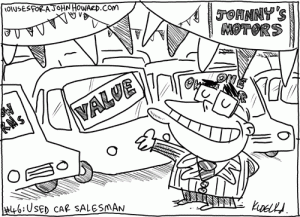
    usedcarsalesman– Advertising becomes useless. It doesn’t matter how much money you spend on ads as people won’t believe you anymore.You can’t hype up a product launch or an event that you’ve oversold forever. When you don’t deliver you are just reminding customers how much you betrayed them.

    – Your word becomes useless. When you break promise after promise, soon people won’t trust that your on their side. They will see that you only want their money and you don’t care about them.

    – Your product becomes a joke. I was in a meeting yesterday about search engines and someone used the word Yahooeveryone laughed. Yahoo has become a dinosaur of a search engine. The only thing memorable about Yahoo is that stupid song, Yaaahhoooooo. You can’t advertise and promise a web service, you can only deliver. This is the #1 reason you can’t trust Bing.com to be any good. If it was so good why are they spending $100,000,000 to advertise it?

    Shifting gears: The evangelical church has become a classic example of the over-promise. Part of the church becoming more about programs and business models is that it has fallen into the trap of needing marketing and advertising like the business models they copies. The result is a lot of over-promising. “Come to the marriage retreat, it’ll fundamentally change your marriage.” or “Sign up for our next church production, it’ll be awesome.” or “Bring your friends to the revival and they will get saved.” In a world where the awesome is so readily available churches do nothing but give away trust when they advertise promises they can’t deliver. I’ve seen church events marketed like they were going to be on par with Disney or Broadway or Oprah and deliver like a trip to the town carnival, a middle school play, or a cable access show. At the end of the day the church spent more effort marketing the event, production, or program than they did making the program awesome. It is a sick cycle that is killing thousands of churches.

    The better way: Wouldn’t it be refreshing if churches just delivered? Wouldn’t it be amazing if they didn’t sell themselves but just helped people? What if they invested in training their volunteers and staff so much that the church didn’t need to make promises, that their programs and ministries truly worked to change lives? You wouldn’t need to advertise a life-changing marriage retreat… because results would advertise themselves. You wouldn’t need to hold a revival because every church service, small group, and youth group meeting would see people come to know Jesus. You wouldn’t need to hire a killer band and create a worship experience because people were authentically worship Jesus. The best advertising a church could ever invest in is a changed life.

    If you are a church leader I want to challenge you to think about your programs. Think about how you talk about them. Think about how you market them. And remember:

    Don’t promise, deliver.

    Don’t hype, deliver.

    Don’t sell, deliver.

    Don’t measure, deliver.

    Don’t sub-contract, deliver.

    Don’t advertise, deliver.

    In a low trust, high expectation world the best way to succeed is to undersell and deliver.

  • Getting Started in Investing, part one

    money_stuff

    I’d like to let my youth ministry friends in on a dirty little secret. While pay has dramatically improved for youth workers in the past two decades the most consistent reason people leave youth ministry once they reach their mid 30s and above is mounting financial pressure. In other words, there are some glass ceilings on the personal income side of things that will eventually cause you to look for higher paying work in the church or not in the church if you don’t plan ahead. Plan ahead and you relieve the pressure bit by bit. Don’t plan ahead and that pressure builds and leads to a catastrophic failure.

    Here is a short list of those pressures:

    – Housing expenses skyrocket: That rental gets old, doesn’t it? Buying a house can be great when you land in the same place for 10 years or more. But buy and sell a house a couple of times when you change jobs and you’ll quickly see that’s a bad strategy for financial security.

    – Retirement savings becomes important: Most churches either don’t offer a retirement plan for their associate staff or it is extremely inadequate. Even if you are in a denomination that pays into a pension fund… getting ordained in order to get vested in that fund can be more costly than the pension you’d earn in the long run! (And with many mainline denominations tanking financially, you really need to wonder if that money will be there in 30 years.)

    – Kids get more expensive as time goes on: When you first have babies you think diapers and formula is a blow to your budget. Just wait! Eventually those kids will need braces, outgrow clothes every two weeks, want to go to camp, need a car of their own, and gulp… want to go to college.

    – Medical insurance won’t cover it all: Again, when you are young and/or first married this doesn’t seem important. But with premiums soaring churches are cutting back on benefits. So as you age into needing good insurance chances are your church is increasing co-pays and other out-of-pocket expenses.

    – Pressure to keep up with your peers: There’s only so long you want to live like college kids. Eventually, you are going to want grown up furniture, go on nice vacations, and have a little extra something here and there. I don’t mean that you’ll get more materialistic as time goes on… but you just get sick of scrounging.

    If you do nothing, eventually these pressures will leave you with no other option but to leave the ministry. You can do everything right in the 9-5 activity of working at your church. But if you don’t have a plan to address these mounting pressures, it will sneak up on you and the pressure will grow so intense that you may have no other option but to leave the job you love for a job that pays better. If the choice is lose your family or lose your ministry you will chose lose your ministry 100% of the time, right?

    My goal for this series is to encourage those in youth ministry– you don’t have to bail out!

    If you want to join along I will help you with a few basic strategies that will lessen these pressures. My hope is to help you stay in youth ministry longer. While things like soul care and youth ministry strategy are super important for staying in it for the long haul… I’m going to help you deal with the dirty little money secret that could eventually knock you out of ministry.

    Part two: Dealing with debt and savings

    Part three: COLA-  and I don’t mean Pepsi or Coke.

    Part four: 401ks, IRAs, 529 and other numbers that are important

    Part five: Outside income opportunities

  • Pushing Back to Find Sanity in Christ

    this-way-to-sanityClosing in on a year as “just a family in the pews” I have learned a ton about myself, my walk with Jesus, and what it’s like to be on the other end of church life. Having spent my entire adult life on the church leadership end of things I would often say, “I don’t remember what its like to just go to church.” This last year has been an amazing vantage point.



    When we first came to Harbor we knew right away that we wanted to be a part of it. We went to a service on Sunday and shared coffee with the pastor and his wife later that week. They told us their story and their vision for Harbor… Kristen and I were sold and let them know right away we were committed to staying on board.

    As the months went by we felt like we were getting sucked in and were powerless against it. What I mean by that is that churches have a tendency to get their tentacles on you and slowly wrap their eight arms around you so that you find yourself fully enveloped by its grasp until you wake up drowning in holy activity. One moment you are helping in the nursery and then you wake up to realize that you are serving at the church 7 days per week and 3 times on Sunday.

    Since I was new in my job and had just come out of serving at a church, I was determined that Kristen and I would stay out of the vortex. It may sound weird but people in our lives were firmly encouraging us… in order to reconnect with Jesus you need to do less church work and work more on your relationships outside of church. While I felt like it was a counter-intuitive approach to spiritual growth, I trust the people God has put in my life to tell me the truth… to tell me the truth!

    And yet we started getting sucked in. A weakness I am working on is that I have no ability to say no to something I have the ability/skills/talent to do. Someone from the church would pitch me an idea and my “no thank you” must have come out like a “yes, no problem.” Next thing I knew I was sucked in. It turned out the people in my life were right… and the breath of fresh air I was enjoying so much was quickly snuffed out and replaced with bitterness, anger, and temporary depression. We were right back where we started. In fact, we were probably worse off then ever.

    lead-weightFlash-forward to January and early February. I was fully freaking out about our involvement with the church on Sunday mornings. In fact, for some reason I was literally freaking out at church. I would be fine right up until we left. Then we’d pile in the car and I could feel my blood pressure getting higher. I’d get to church and be ready to explode. A little dizzy, on edge, and feeling the strong desire to flee. All my mind would be saying is, “Leave me alone. I just want to be left alone.” And the more people were nice to me the more intense the feeling. It was really one of the most bizarre experiences of my life. Mr. “I’ve got it all under control” was completely not in control. I’d tell Kristen, “I think I’m losing my mind.” I was being completely honest. I was really scared that I was actually losing my mind.

    Each time someone at church asked Kristen or I to do something it got worse. I kept saying to myself, “The kids hate coming to church, I hate coming to church, and I can tell Kristen is upset that we’re all upset.” While the calm rational side of me knew that we needed to worship on Sunday mornings the irrational, emotionally-charged side of me started to think that the best way to make these symptoms go away was simply to stop going to church altogether.

    [Enter wise council from stage left] Perhaps the solution wasn’t either of those choices? “Stay and be miserable or leave and do nothing are both crappy solutions.” That is when it hit me. What I really needed to do was meet with the leadership and push back.

    Gracious. That’s all I can say about my meeting with the staff. My experience with church leadership and AS church leadership has always been to tie someone’s involvement with church stuff to their spiritual growth. When people met with me to bail on things I always took it personally. I would always be polite and thank them for their service… but they’d leave and I would be annoyed. To look across a table and say… “I can’t explain the why, but I know that I need to say no-to-all for a while to find freedom and connect with Jesus” was so freeing. And to have those words embraced was incredible. While I’m certain the two men I met with were discouraged by the outcome of that meeting as they drove away… I was amazed at their maturity. They gained 10,000 points with our family simply by agreeing that our family needed to do nothing. (Not less, nothing.)

    fresh-airSo here we are three months later. Other than our uber-active community group my family is a regular family who fills the pew on Sunday morning, hosts a few friends on Monday nights… and that is it. I don’t know how long we will practice this new displine of “no-to-all” but I have to tell you that it is working. The more we push back from being super-involved the better things get for our family. More family time, more family growth, less busyness, less tension… these are all good things.

    I don’t know how long this needs to last. My feeling is that I need to guard our family like this until the desire to serve comes back. It hasn’t happened yet. And for once in our lives we aren’t in a rush to make something happen. But for now, we are embracing this new period of our lives. We are embracing a lifestyle of a new normality. It’s a renessaince of the soul that I am enjoying. Maybe a little too much?

  • The World Doesn’t Change Itself

    change-depends-on-you

    This weekend the family hosted my friend Andrew Marin. I suppose most people know Andy as a controversial speaker and author who is trying to help the church build bridges with the gay community. I know Andy more as a friend. We met last summer in preparing for National Youth Workers Convention where he was a general session speaker. In exchanging some Facebook messages  for a guest post I knew Andy was the real deal. There was something about him I instantly liked. Humble, yet bold. Courageous, with a healthy measure of fear. I could tell he had been biten by a few sheep as well. Then when we met in Sacramento he joined Cathy and I for a trio of fun that carried us all through the convention season.

    The point of this post isn’t my friendship with Andy.

    The point of this post isn’t that sheep bite.

    This post is about you and I bringing change to the world.

    The reason for change goes back to two core things which shape the world. First is the fall of man, which leads man towards a life in pursuit of sin, expressing enmity towards God and entropy in all systems of people. (Governments, local organizations, Christian organizations, etc.) Second is the redemption of mankind through the person and work of Jesus Christ. Jesus didn’t come to the world merely to provide a way to salvation and for us to patiently wait for the world to go to pot until His return. [Honestly, this is the view of the Evangelical church in the last 30 years.]

    No! The Gospel cannot be limited to a singular, man-focused individualistic message! He came, first and foremost to be the Savior of mankind… but He also charged the church to be His witnesses in Jerusalem, Judea, and the rest of the earth. He set us up to be agents of His. As Ephesians 2 points out… we (both individually as believers and as the church) were called by Him to do good works. We are meant to effect change. Our role as believers to to make life better. Our job in a life with Jesus is to change the world and make it a better place for others. Our desire must always be to fight systemic entropy. Our focus as belivers must be to continually force Jesus’ redemption into systems of church, government, charity, and friendship.

    The world will not right itself. The world will never wake up by itself and say… “You know what, we should stop this injustice. We should stop oppressing people. We should stop trapping them into slavery. We should stop corruption. We should stop stealing.”

    The world needs us to be agents of change. The world needs people who are absolutely driven, like Andy Marin. He is brave enough to look eye-to-eye with the most powerful men and women in Evangelicalism and say, “How you treat gay people is wrong. Let me help your church apply some principles that build bridges instead of walls.

    One of my favorite songs right now is John Mayer’s “Waiting on the World to Change.” I listen to it every Monday morning on my walk to work. It fires me up, it reminds me that I am not meant to wait for the world to change. I am meant to change the world. If you know Jesus as your Savior, you are meant to lean into the insane call of changing the world.

    Me and all my friends
    We’re all misunderstood
    They say we stand for nothing and
    There’s no way we ever could

    Now we see everything that’s going wrong
    With the world and those who lead it
    We just feel like we don’t have the means
    To rise above and beat it

    So we keep waiting
    Waiting on the world to change
    We keep on waiting
    Waiting on the world to change

    What are you waiting for?

  • Rethink Church

    HT to Sara who left this as a comment for the post, Church of the world and not of the church. I think Mr. Wesley would be proud.

  • Church of the world and not of the church

    I’ve begun to wonder what church would look like if Sunday morning worship stopped being the central focus of the church’s ministry.

    – What if Sunday morning were a celebration of community and a rallying together of community groups?

    – What if we came together purely for communion, prayers, and a simple message pushing us back to community groups for discussion and implentation?

    – What if instead of investing the time it takes to put on a worship service the church staff served the community and offered leftovers on Sunday morning?

    – What if the program of the church were just serving the community?

    – What if discipleship were of “while going” activity as Matthew 28 suggests?

    – What is going to the church were seen as a negative in light of being the church?

    – What if churches intentionally sold their properties and chose to meet in the public arena?

    – What if each community gathering became a place to serve the poor a meal?

    – What if community groups pooled their resources and invested in their own projects?

    Why not these things? Probably because in America we don’t do this things. In America we do much the opposite. A successful church in the eyes of the American evangelical church has a big building with a big worship service attended by thousands of people. It flashes wealth on its stage. People come to be seen. People come to be awed. People take pictures. The Sunday morning worship service takes the most talented people in the community and locks their time into serving the worship service… a one hour event!

    The common church lives to serve itself with nominal efforts to reach the community where the building happens to be. In essense, a “successful congregation” lives as a barnacle on its community. It pays no taxes but receives millions of dollars in income. It says it exists for the community where it resides while importing most of its staff and spending most of its resources on things that don’t actually benefit the community. Traditionally, the successful evangelical church demands access to the communities resources when they desire, but the opposite courtesy is not offered back. It often houses the best facilities in town… but acts like a country club by limiting their access to members only. The chamber of commerce can’t meet there. Local charities cannot have their events there. The school cannot use their gym or have a tutoring program there. How about housing a community development organization? Yeah, right… not in our church… we have worship team practice. Simply put, the public is not welcome at most churches.

    I don’t really think Jesus intended for the church to become a barnacle on its community. I believe he desired for his church to be the bedrock of the community. I long to see my own church give more and more to the community it serves. More importantly, I long to see churches everywhere lean into practically meeting the needs of their community.

    Success for each congregation should be defined in context. Enough with the copycat compromise.

  • Do I Fit in Here?

    welcome-to-churchThat’s what many visitors are wondering today in churches across the country.

    It’s my hope that churches around the country spent more time answering that question today than anything else.

    Jesus tore the veil between us and God. His death eliminated the need for a High Priest to represent us to God. Jesus looked at a hodgepodge group of sinners, tax collectors, political nut cases, prostitutes, and fishermen and said to them… “on you I will build my church.” That’s hope for you and I. A church is a community of messy people.

    We aren’t very priestly. We aren’t entirely seperate from sin. But what we are is atoned for and stumbling towards faith. Two steps forward, one step back.

    Do I fit in here? That is the question visitors want answered.

    If your church communicates that on Easter. Those visitors will come back. Roughly 79% of adults in America believe in the literal resurrection of Jesus. Don’t convince them in what they already believe.

    Convince  them in what they don’t believe…

  • Easter Strategery

    peeps

    If church is all about reaching numbers than this is Super Bowl Week for church.

    If you work in a church, holy week is kind of hell week. Church staff can’t wait for Monday. (Speaking as a former church staffer!) Weeks of planning and putting together a marketing plan, an event plan, a parking plan, and a planning session to make sure all of the plans are lined up.

    Here’s the dirty secret: Easter strategery doesn’t lead to long term benefits to 99% of churches.

    – While attendance is high on Easter morning, engagement is at an all-time low.

    – While production is high on Easter morning, these are largely the same people who saw the Easter show last year and weren’t effectively changed.

    – While tensions are high on Easter morning, people who are coming aren’t coming to find a church… they are there to celebrate the Resurrection of Jesus.

    I’m not sure how Easter became the Christian Super Bowl, but I do know a better plan.

    – Make the Easter service and the events leading up to it about Jesus.

    – Instead of the whole thing leading up to a Gospel presentation (Built on the false assumption that visitors aren’t believers in the resurrection… I mean, why would they be there?) why not make the service a kick-off in how you can get involved in living out the message of Jesus in your community? (Romeo nailed this last year IMO) I’m not saying we should share the Gospel, but I’m thinking we should all remember that the Gospel is all these Christmas and Easter folks hear at church. Maybe that’s why they think your church is irrelevant?

    – Instead of hosting an experience people won’t see for the next 12 months, why not invest that energy in meeting the practical needs of the people who come? A gift card for groceries says “I love you” way more than hiring a band.A warm handshake and an open heart is way more valuable then an Easter play.

    – Instead of marketing hype, why not invest in relationship hype?

    – Instead of stressing out the staff, why not send a message to the community that the church is healthy by “forcing” the staff to work less and experience Holy Week?

    – Perhaps it is time most churches took an old school approach to Easter morning, let the visitors come. Invite them back. But don’t bend over backwards for people who are only committed to coming Easter and Christmas. While it is an “opportunity” I think it’s more a distraction from the people who really want to grow in Jesus than an opportunity to reach those who have already decided to be nominal.

    Side note to those who don’t get what I’m talking about: Imagine the pageantry that you’ll experience at your church this weekend. Now, multiply that by every church and your community. Then envision that across the country… what you’ll see is an “Easter industry” that is as weird as the the Easter aisle at Target. It just doesn’t fit, but we accept it!

  • Changing the metaphor for small church

    farmer

    A couple months back I raised some eyebrows by saying that medium-sized churches were in crisis. Since that post I’ve had dozens more conversations which confirm that it isn’t just me seeing this, it really is happening. Church leaders all nod their head when they read Seth Godin,Big is the new small. But you’ll always have big.” In the business world, Wal*Mart is still getting bigger while medium-sized outlets struggle to exist. But the real growth in retail happens in the mom-and-pop shop online. The same is coming true in chuch-world.

    In churches, the big will keep getting bigger. Just like people are driven to the big box retailers, people are continuing to be drawn the big box churches. I say… let them have their big buildings, ginormous programs, and endless pursuit of perfection. While it doesn’t appeal to everyone… certainly, that appeals to masses and its obvious that those megachurches will/should continue to get mega-er.

    For them, the business model really is the best model for church. 10% effort and 90% profit.

    But for small churches, the best model is a farm. 90% effort and 10% profit.

    Both are noble. Both are valuable. But both operate in strikingly different manners.

    I see that we are at the forefront of seeing an explosion of small, niche based small churches. Just like it’s easy to dream of an online shop selling homemade Mario Brothers crafts and finding an audience on Etsy.com, it’s getting increasingly easy to build a church around a niche. People are more-than-happy to drive 50 miles to worship with people in their tribes who share their passions. That’s why we’re seeing a major wave of church planters who successfully grow from 1 to 200 and then plateau… happily. They are churches full of artists or surfers or engineers or soccer players.

    Differences between business models and farming models of church leadership.

    At the core it’s this: Business models are driven by growth. Farming models are driven by sustainability.

    home-depot1. Success is different. In business models growth is expected every year. You are expected to have a larger audience in 2010, 2011, 2012 or you’ve failed. When you reach saturation you have to franchise by planting a new megachurch or going to satellite services somehow. Plateau is the enemy, growth is measurable. In a farming model, growth is important but sustainability is more important. A farming-based model recognizes that you’ll have bumper crop seasons where there will be temptation to grow the farm… but you don’t, intentionally, because you know there will be tough times when a bigger farm would lead to failure. Successful farmers expect good years and bad years.

    2. Discipleship is different. Examine any discipleship method in the business model of church and it all goes back to the Sonlife model taught in youth ministry of the 80s. Win-Build-Equip-Multiply. Navigators, Sonlife, Willow Creek, Saddleback, North Point… all of those models are designed to grow a church through multiplication. In a farming model, it’s all about yield per person. How can I maximize growth with the people that I have? How can the people within my congregation grow the most? How can I love them more? Since farming is about sustainability and not multiplication discipleship is always about maintaining a healthy ecclesia. One isn’t better or more biblical than the other… they are just different methods. (Of course, proponents of each think their model is superior!)

    3. Leadership is different. A large church pastor is driven [and held accountable] by growth. There are many good ramifications of this. Tens of thousands of people are introduced to the Gospel… please don’t misread that I’m saying big churches are bad. But a nasty byproduct of that drive for growth is that the successful church in this model really becomes about the pastor. New Spring is Perry Noble’s church. Lifechurch.tv is Craig Groeschell’s church. Willow Creek is Bill Hybels church. North Point is Andy Stanley’s church. Mars Hills is Mark Driscoll’s church (Or Rob Bell’s church, depending which coast you live in.) On and on. While those leaders never desire to create a cult of personality… the leadership-style that creates that movement of God draws that type of person in the same way Ebay is Meg Whitman’s company, Microsoft is Bill Gates company, and Apple is Steve Jobs company. Contrary to what you might think… I don’t think the drive to grow a large church is evil. It’s perfectly fine and healthy to live within that paradigm. My fear with those churches is that there simple isn’t a succession plan if/when that leader steps away! Look back to last generations megachurches and you see the problem and how it plays out.

    soy-fieldA small church pastor is driven by sustainability. It always has to be about the people, the families, and the community. Since everyone will actually know everyone in a small, niche-based church can’t afford a cult of personality. In a small church the people are always aware that the pastor won’t be there forever… and so they hold the pastor accountable by making him make sustainable decisions. The small church pastor is motivated by “the farm” and he isn’t frustrated when there are bad times… it’s just part of what he does. He fertilizes and tills the ground, he maximizes the yield, and he understands that good and bad times are part of the ebb and flow of small church ministry.

    4. Expectations are different. Values in a large church are that things will be professional, smooth, highly organized, and striving for perfection. In a small, farm-modeled church, excellence is nice when you have an excellent person… but the expectation is “the best we can do.” That’s why there was so much pride in Mainstreet when I was in Romeo. It was the best thing we could do and we were proud of it. Sure, it wasn’t Broadway quality. Reggie Joiner wasn’t going to come to Romeo and write a book about how we adopted his model with cardboard and a fat youth pastor dressed like a cow. But no one in Romeo really expected it to be and we set it up in a way that could sustain. That’s why Mainstreet is still happening even after I moved away. In a small, niche/affinity based church, perfection isn’t the goal… the niche is the goal. Quaint is good! Rock that quirky church, baby! Mrs. Nelson’s son playing on the piano poorly is just fine. A kids program lead by an ex-stripper now Christian grandma is a blessing. Ministries lead by teenagers is about sustainability of the niche-based church… not about having the best leaders teaching.

    What do you think? Do you think it’s time to introduce a model for small church ministry that is based on sustainability? Do you agree with this premise… or am I way off?