Category: youth ministry

  • Infantilization and deinfantilization of adolescence, part 1

    In the last year I read and was deeply disturbed by the book, Teen 2.0. If you are going to read a book in 2011, make it that one. It shook me.

    One of the primary things that Epstein brought up in the book and has dramatically impacted my view of youth ministry is the concept of infantilization. For years, youth workers (myself included) have lamented about how students are less and less mature and less and less willing to make adult steps. Epstein points out and asks us, “Why are students less and less mature?” To that question I offer something to chew on, Maybe because we’ve made them that way? And maybe we like it that way?

    I’d like to encourage you in the next 10 days to start recognizing infantilization in action.

    • Where are points where we don’t expect adolescents to take responsibilities for their lives?
    • Where are points in your ministry where you take away students ability to own their faith?
    • What are ways parents are holding their adolescent children back from healthy adult behavior?
    • What are words that you use which infantilize 12-18 year olds in your life?

    Don’t do anything but observe. Write them down in Evernote or on a piece of paper so you can keep track.

    And then, if you are so inclined, come back and share what you’ve observed.

  • YS Palooza Orlando

    This weekend I’m in not-so-sunny Orlando, Florida. We are here hosting our first ever YS Palooza. It’s super fun doing something for the first time! (Er, was that an innuendo?)

    The joy of launching a new event is that the whole thing is kind of an experiment. [insert evil laugh] So far, four hours into it, it’s feeling great!

    I ask that you pray with me for this weekend as we train and encourage hundreds of youth workers from all over Florida. Also, pray that we learn quickly from this thing! We love the idea of a two-day youth ministry training event that is kind of a mash-up between YS One Day and the National Youth Workers Convention. At the same time, we need to figure out what parts of what we’ve created works, what doesn’t work, and what needs to be tweaked.

  • Tunisia, Facebook, Privacy, and Freedom

    Most youth workers have developed a Facebook apologetic. That is to say, they know how to respond and argue for Facebook usage to engage with and interact with their students.

    One component of Facebook, which causes heart palpitations for adults, is that it is a place of dissidence and venting. And the motivating reason that adults see their blood pressure elevated about these activities is that they are either the object of said dissidence/venting or they are asked to clean up the mess created online.

    As a result, some parents and other caring adults use that as a case for Facebook being banned. (Which, as human nature dictates, just means adolescents find another place to carry out dissidence and venting. It is just taken off of the adult radar and disappears into adolescent-world. But you can safely imagine a William Wallace-like response, “You can take our Facebook, but you can never have our phones!“)

    Allow me to introduce to you a story from The Atlantic, which puts this into context:

    Expert analysts of the country couldn’t tell if Ben Ali would remain in power for a few more weeks or a decade. It did not feel inevitable that Ben Ali would be deposed. People had protested in the streets before. Revolution had been in the air. It wasn’t clear that this time would be different.

    There has been a lot of debate about whether Twitter helped unleash the massive changes that led Ben Ali to leave office on January 14, but Facebook appears to have played a more important role in spreading dissent.

    Imagine you are Ben Ali. You are the unpopular leader of Tunisia. You are an oppressor of freedoms. And you hear rumors that you may be deposed of your power.

    In youth ministry language– the youth pastor hears that his students are bad mouthing him on Facebook. And they’ve engaged with enough adults in the church that you might get fired.

    So what does Ben Ali do? He had long ago banned YouTube and other video sharing sites… but all of a sudden he discovers that hundreds of thousands of Tunisians are flocking to Facebook, networking, and sharing videos which document the terrors of his rule.

    While clashes with security forces took place in the streets, Rim, who asked we not use her last name, was in her bed in her apartment in Tunis. Like the blogger cliché, Rim sat in her pajamas sharing videos. In her hands, small protests that reached 50 people could suddenly reach another 50, who would share it with another 50. The idea that it might be time for the regime to change spread from city to city faster than street protests and even middle class places got involved.

    “There were rumors that Facebook or electricity was going to be shut down,” Rim IM’d me from Tunis. “Or both.”

    Did you get that? It was either shut down the electricity or shut down Facebook. But Ben Ali’s plan was more devious.

    After more than ten days of intensive investigation and study, Facebook’s security team realized something very, very bad was going on. The country’s Internet service providers were running a malicious piece of code that was recording users’ login information when they went to sites like Facebook.

    By January 5, it was clear that an entire country’s worth of passwords were in the process of being stolen right in the midst of the greatest political upheaval in two decades. Sullivan and his team decided they needed a country-level solution — and fast.

    Instead of just shutting down Facebook, Ben Ali had ordered that the very tool being used to create dissidence be used as a tool of the government to capture personal information.

    Facebook, the company with access to 800 million users personal information, had to make a moral decision. Was it going to get involved in support of a dictators withholding the reigns of power from the people of Tunisia by doing nothing? Or was it going to spur on political revolution by protecting their core values?

    They chose the latter. And, as we know now, their was a change in leadership in Tunisia.

    At Facebook, Sullivan’s team decided to take an apolitical approach to the problem. This was simply a hack that required a technical response. “At its core, from our standpoint, it’s a security issue around passwords and making sure that we protect the integrity of passwords and accounts,” he said. “It was very much a black and white security issue and less of a political issue.”

    The software was basically a country-level keystroke logger, with the passwords presumably being fed from the ISPs to the Ben Ali regime. As a user, you just logged into some part of the cloud, Facebook or your email, say, and it snatched up that information. If you stayed persistently logged in, you were safe. It was those who logged out and came back that were open to the attack.

    Read the rest at The Atlantic

    What does this have to do with youth ministry?

    I don’t know. Nothing and everything at the same time.

    I think a lot of adults feel teenage angst more than teenagers do. Deep down we believe that it is our role to save teenagers from themselves by putting up boundaries and barriers. At the same time we acknowledge that they carry the hope of the world forward in living out the Gospel in ways and to levels that our generation has failed.

    Instead of focusing our attention on somehow asking our students to be saved from the world, perhaps we need to focus on teaching them how to take over the world and lead it in a way which acts on their Jesus-influenced convictions?


  • Unleashing a Feeding Frenzy

    Photo by Iggy via Flickr (Creative Commons)

    Last night, we dropped a bucket of chum in the tank and ran away.

    Back in December we introduced Inductive Bible Study at our winter retreat. It wasn’t anything fancy– in fact I thought it was a little cerebral for a retreat. (This coming from a guy who did a high school retreat based on the spiritual disciplines of Richard Foster!) We broke up into groups, each team given a part of a parable, we tore into it, and came back together a little later to share what we’d learned.

    Sparks flew.

    In my group a key moment happened when we were studying the parable of the sower. One of the guys in my group had been a little frustrated… “Why did Jesus teach in riddles like this? Why didn’t he just tell them what he wanted them to know. This is so confusing” Another person in the group looked at another part of the parable and said, “I think it’s like rap music. Jesus was speaking to people who understood the words like he did, but people who didn’t get, he wasn’t talking to them.” (Maybe Kanye and Jesus really do have something in common?)

    Kanye ain't Jesus, but Jesus taught like KanyeWhen our leadership group met a couple weeks later, the students told the adults… “We don’t want you to lecture us. Instead, teach us how to study the Bible on our own.

    Collectively, our  heads tilted 10 degrees to the right. We didn’t see that coming.

    Last night my task was pretty simple. Get the students thinking like investigative reports. Questions, questions, questions. Ask the text lots of questions. And get them to grasp that in Luke 1, Luke was setting out to do the same thing we were asking them to do. “Put the story in order so it makes sense.

    I created an object lesson where each student received a sealed envelope, each envelope containing a fragment of a vaguely familiar story, and they had to piece it together, chronologically, in three minutes. They were frustrated, some gave up, and in the end they didn’t quite get it in the right order.

    They saw that putting a vaguely familiar story together in chronological order was a nightmare unless  you took the time to carefully examine every fragment.

    After we read the worst rendering of ‘Twas the Night Before Christmas in history I gave them the background information they’d need to understand why the Gospel of Luke was written. Theopholis, either a new believer or an investigator of Christ, had likely hired Luke, a believer and doctor, to go back and document what actually had happened. He’d find witnesses and put together the story to document an orderly account of Jesus’ life. (Luke 1:3) There were all sorts of fragments, little letters, floating around. But someone had to put all the pieces together so that the story would stand up to histories glare.

    From there it got noisy as students went into their groups.

    Group time was disorderly. It was messy. Loud. All over the place. Markers coloring. Pens circling. And the group leaders had to poke and prod to move things along.

    But students were asking questions of the passage. Good questions.

    • Why did Gabriel pick Mary?
    • Who was this Zechariah guy? And why was it important that Gabriel made him not speak?
    • Even though Mary was scared, why did she consider it an honor to become pregnant with Jesus?
    • Why did Luke mention that Joseph was a descendent of King David?

    At the end, when we shared what we learned, I think students were left with more questions about Luke 1 than answers. And that’s a very good thing.

    I closed our time by asking them what this passage had to do with them. Those dots had not quite gotten connected… and that’s OK.

    A process

    As we cleaned up… the leaders were exhausted. I could see it on their faces. What have we gotten ourselves into? We really had to work hard to keep it together. But I was left with a few thoughts of encouragement.

    • We aren’t after quiet compliance. To change this community we need students who investigate God’s Word for themselves, ask hard questions, and put it to work.
    • It’s OK if it is messy and loud. Being quiet doesn’t mean they are engaged any more than being loud means they are disengaged. And finding the right answer isn’t as important as learning how to look for the right answer.
    • It’s OK to ask more questions than provide answers. Leaders have a desire to wrap everything up in a neat little bow. But that’s not how Jesus taught. He got the crowd thinking and then sent them home.
    • Teaching critical thinking skills takes time. In truth, today’s educational system isn’t designed to teach critical thinking skills. It teaches to regurgitate facts more than to comprehend them. Retraining the brain takes time.
    • We’re teaching a life skill that can transform our church. Imagine what would happen if our pews were filled with people who self-fed God’s Word in community? Imagine how that would change our Sunday morning worship services? The focus would step away from teaching and move towards celebration.

    Messy. Exhausting. Intriguing. Fascinating. Thrilling. Scary.

    These are words I’d use to describe unleashing a feeding frenzy of God’s Word on our students last night.

    And I like it.

  • Two positive trends in youth ministry

    I’m on the tail end of a one week tour of the East Coast. (Catching up with youth workers; talking about PlanetWisdomYS Palooza, and all things youth ministry.)

    One of the things I like to do when I meet with youth workers around the country, whether individually or in a group setting, is ask the same two questions. I frame the question differently depending on the group. But these are the two questions I’m asking and comparing answers to others to see if I can sniff a trend.

    1. What is a new problem you are facing in your own youth group in the past 12 months?
    2. What are you doing that is making a difference?

    For question #2 I am continuing to hear the same things all over. While I heard these in 2009 and 2010– it wasn’t emerging quite as strongly as a trend until this trip.

    For me, it’s very exciting because the two trends that I’m seeing are actually quite healthy and sustainable.

    First trend: Bigger churches (Congregations of 1000+) are continuing to see their youth ministries grow numerically. They are reaching more and more students. (Largely unchurched) And their ministry is asking hard questions which shape how they minister to students, parents, and train their teams. The lead youth worker at these churches are typically highly experienced, highly trained, and exceptional at both leading staff teams and replicating themselves to maximize impact & set-up long-term impact.

    Second trend: Smaller churches (Congregations of  >500) are ditching models altogether and approaching their ministry from a more missiological perspective. They are saying things like, “We still meet on Wednesday night, of course, but I have a small group of guys who get together every week to visit a homeless shelter. My students won’t bring a friend to Wednesday night– but they are bringing 2-3 to that.” Even if they aren’t articulating it in words quite yet, they are saying that the traditional ministry model they grew up on is fading in effectiveness. As such, they are adapting by maintaing status quo while finding new ways to reach students while meeting a real need in the community. I’d label this a shift from meeting felt needs to meeting obvious needs. Meeting actual needs is leading to growth and they are forming their ministry around those areas of growth… which look very different in every community.

    The hallmark of both big & small of these are the same— their spending, dollar per student, is quite low. Bigger churches have staff spread over large numbers; smaller churches lost their paid staff due to the economy and are adapting their ministry to a much cheaper model.

    The uncomfortable middle

    The pain seems to be in the middle. What I label “medium-sized churches” of 500ish-1000ish are all over the place. Some are fine while some are in crisis mode. I can imagine that their dollar per student ratio is high enough where they are feeling a big pinch. They seem to be feeling a lot of pressure as their midweek program isn’t doing as well, (a hallmark of a smaller church) they are too large to invest their time finding a pocket of mission that would likely lead to new students coming into the fold, and they don’t have the money to go to a staff-size that might take them into that big church team model which would likely put them into growth, as well. This is the size church where I’m seeing lots of people lose their paid staff jobs. This is also the size church I’m hearing that the leaders (church wide) are shifting to a model like their favorite megachurch.

    Quick disclaimer: I’m not a sociologist. (But I did stay at a Comfort Inn last night.) And I don’t have hard data for things I’m writing here. [This is my blog…] These are notable things I’m learning by talking to youth workers around the United States. Feel free to engage with them, but don’t assume that I’ve got data to back this up or that this is some sort of scientific process. I’m labeling a trend as something that just keeps coming up without my prompting.

  • Interview with Youth Worker Journal

    That's me in the photo. That's what my back yard looks like. I only wear the wig on weekends.

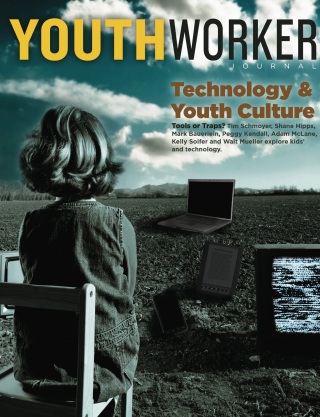
    A few months back I was contacted by Jennifer Bradbury at Youth Worker Journal about doing an interview on teens & technology. I’ve done a number of articles for Immerse, but this was the first thing I’ve done for YWJ, and it was fun for me. When the arrived at the YS offices I made sure everyone saw that my name was on the cover… and no one cared. My own children just kind of shrugged their shoulders. I’m big time in my own mind and I suppose that’s all that matters. Megan, my 9 year old, told me that I wasn’t a big deal unless I did a book signing at Barnes & Nobles. At least I have that to shoot for now.

    Also in this panel discussion were 3 smarter people than I. Shane Hipps, (Mars Hill, Grand Rapids) Mark Bauerlein, (Emory University) and Peggy Kendall. (Bethel University)

    Here’s my portion of the interview. Read the others responses here. I’d love your thoughts in the comments.

    YouthWorker Journal: How is technology shaping young people’s spiritual lives?

    Adam McLane: Technology always has shaped spiritual lives. What we’ve seen has been a change in devices that’s affected how people grow spiritually. People are involved in conversations via texts and Facebook that have devalued the interpersonal relationship.

    YWJ: Which aspects of technology are most important to teens?

    Adam: As they look for their own identities, teenagers tend to be attracted to things they can personalize—Twitter, My Space, Facebook. Those become extensions of their personalities.

    YWJ: How do Facebook and social networking influence teens’ understanding of their identity?

    Adam: It feeds our nature to self-gratify. Adolescents hunger to find out who they are from a third person perspective. Social networking gives them a false perspective. People are flippant on Facebook. It’s hard to distinguish between a compliment and what’s sarcastic.

    YWJ: How does the information that teens have access to through technology impact their understanding of authority?

    Adam: We should train students constantly to question authority in respectful ways. Technology allows truth to be validated because students can look it up.

    YWJ: If much of technology results in instant gratification, how can we teach kids the value of waiting?

    Adam: We have no concept of perseverance or what it means to wait. We get upset when we can’t access the information we want right now. This definitely affects how we process things spiritually—in a bad way. Youth workers and parents need to teach kids to be patient by teaching self-discipline.

    YWJ: How can youth workers use technology to minister to teens?

    Adam: I’m an old school youth minister, trained to do contact ministry. Go where kids are. Engage kids on Facebook and by text because that’s where they are.

    YWJ: What else should we know?

    Adam: The church always labels new things as the enemy. Today, it’s Facebook. Tomorrow, it’ll be something new. However, technology is never the enemy. The fact that people are talking about the church online—in positive and negative ways—is good.


  • Right Coast Bias

    I’m sitting in the airport, headed to the east end of our fine country. My goal for the next 6 days is pretty simple:

    • Meet up with as many youth workers as I can over the next 6 days.
    • Talk until I’m blue in the face about two ministries I’m 1000% behind- PlanetWisdom [students] and YS Palooza [adult volunteers, parents of teenagers]

    Here’s my rough schedule. If you’re in one of these areas or somewhere reasonably in between. Let me know… I’d love to grab coffee. (Or crash on your couch)

  • Overstanding God’s Word

    The book of James will punch you in the face. Repeatedly. This passage from James 1 came up at our retreat last week and was freshly illuminated to me.

    Do not merely listen to the word, and so deceive yourselves. Do what it says. Anyone who listens to the word but does not do what it says is like someone who looks at his face in a mirror and, after looking at himself, goes away and immediately forgets what he looks like. But whoever looks intently into the perfect law that gives freedom, and continues in it—not forgetting what they have heard, but doing it—they will be blessed in what they do. James 1:22-25

    Our students were doing an inductive study of Mark 4. And one of the groups was asked to act out and explain verses 21-25. When presenting, a student said something like this,”You shouldn’t just hear the Word and put it on the shelf, or even under something. You should put it over everything else you are doing.”

    That hit me like a ton of bricks. How many times am I tempted to just understand God’s word? God’s not just asking me to understand the Bible, He’s asking me to “overstand it” by putting it above everything else.

    So simple a 16 year old can teach it to me. But incredibly difficult to live out on a daily basis.

    Oh, that I might be a man (and we a people) who doesn’t just understand your word, but is bold enough to overstand it by putting it into action.

  • Climbing Trees

    One of my favorite things to do as a kid was to climb trees.

    Photo by Sugar Frizz via Flickr (Creative Commons)

    From first grade to sixth grade the most consistent place you’d find me (When I disappeared, which was all the time!) would likely be up in a tree. Until fourth grade it was all about hanging out with friends (literally) and seeing how high we could climb or if we could be quiet enough that adults would walk by and not notice us. When we got a bit older we got more brave and would try to jump from tree to tree. It was a place where I learned how far I could push myself as well as if I could trust myself as I explored various trees.

    But in my later elementary years I discovered the trees could be a wonderful place to be alone. They became a place to perch and listen to birds, watch squirrels, and one of my favorites… read books. I remember reading Tom Sawyer and Huck Finn and Shel Siverstein poems and everything by Jules Verne in trees. It was high in a pine tree in my back yard that I discovered that a book could take me somewhere far from home in the space between my ears.

    My childhood wasn’t filled with horror but it wasn’t a parade of awesome either. Like a lot of families today– we had our messes. And for whatever reasons hanging out in trees and loosing myself in a book (or later, in a video game, or at the golf course) was a form of respite or escapism from the hard realities of my situation. While escapism is probably not the best way to deal with everything, disappearing from a place of disorder to one of order was healthy.

    As I work with emerging adults who have lives strikingly similar to my own experience I wonder what their places of respite are. I’d like to think its our youth group or times when we’re together doing something fun. But more likely, they are off to their own set of trees, wherever that may be, to find sanity in chaos.

    What was your place of respite as a kid?

    How would you discover the place of respite for the students in your ministry?